

|
시장보고서
상품코드
2099752
중국의 HBM : 시장 점유율 분석, 업계 동향 및 통계, 성장 예측(2026-2031년)China HBM - Market Share Analysis, Industry Trends & Statistics, Growth Forecasts (2026 - 2031) |
||||||
 Mordor Intelligence
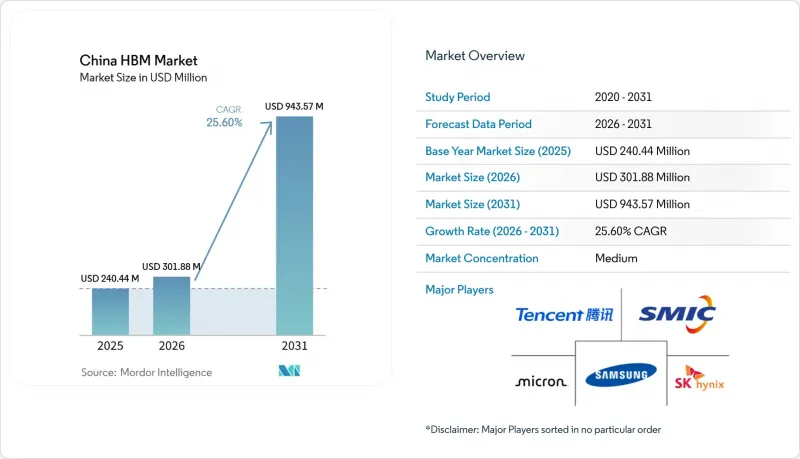
Mordor Intelligence에 의하면, 중국의 HBM 시장 규모는 2025년에 2억 4,044만 달러로 평가되었습니다. 2026년 3억 188만 달러, 2031년 9억 4,357만 달러에 이를 것으로 예측되며, 2026년부터 2031년에 걸쳐 CAGR 25.60%로 성장할 전망입니다.
본 보고서는 HBM의 유형(HBM2E 및 그 이전 세대, HBM3, HBM3E, HBM4 등), 기술 분야(1X 및 그 이상의 레거시 노드 등), 최종 이용 산업(클라우드 서비스 제공업체 및 하이퍼스케일러 등), 용도(AI 모델 훈련 등), 패키징 유형(2.5D 인터포저 기반 패키징, 팬아웃 어드밴스드 패키징 등)별로 분류되어 있습니다. 시장 전망은 금액(달러) 기준으로 제시되어 있습니다.
중국의 HBM 시장 동향 및 인사이트
수출 규제로 인한 수입 대체가 조달 논리를 재구성
미국의 수출 규제는 조달처 선택과 투자 시기 모두를 변화시켰기 때문에 여전히 중국의 HBM 시장에서 가장 큰 혼란 요인으로 작용하고 있습니다. 2024년 12월, 미국 산업안보국(BIS)은 규제 대상을 HBM, DRAM 및 첨단 패키징용 반도체 제조 장비까지 확대했으며, 이로 인해 중국 구매자들이 HBM3 및 그 이상의 제품을 확보할 수 있는 기회가 크게 줄어들었습니다. 이러한 변화로 인해 중국의 AI 칩 기업들은 이전에 확보해 둔 재고에 의존할 수밖에 없게 되었으며, 일반적인 제품 주기에서는 불가능할 정도로 신속하게 국내 인증 프로그램을 추진하게 되었습니다. 이 문제는 단순한 산업 정책의 문제에 그치지 않습니다. HBM 공급 지연은 국내 AI 가속기의 출하 속도를 직접적으로 제한하고, 새로운 컴퓨팅 클러스터의 도입을 지연시키기 때문입니다. 그 결과, 중국의 HBM 시장은 비용과 성능에 대한 논의에서 벗어나, 본격적인 경제성을 실현하기 전임에도 불구하고 국내 생산 능력이 전략적 가치를 지닌 ‘공급 확보 모델’로 전환되었습니다. CXMT의 2026년 6월 IPO 승인 또한 이러한 무역 정책 변화에 자본 조성이 얼마나 신속하게 부응했는지를 보여주고 있으며, 새로운 자금은 생산 능력 확대와 HBM 상용화에 투입되고 있습니다.
AI 서버 및 GPU의 메모리 밀도 요구 사항 가속화가 수요의 기준선을 결정
중국의 HBM 시장 수요 하한선은 상승하고 있습니다. 이는 AI 가속기의 각 신세대마다 디바이스당 용량 및 대역폭 요구 사항이 높아지고 있기 때문입니다. 2026년 3월에 출시된 화웨이의 'Ascend 950PR'은 112 GB의 HBM을 통합하여 1.6 TB/s의 메모리 대역폭을 실현했으며, 이는 이전 플랫폼에 비해 대폭 향상된 수치입니다. 다음 단계는 이미 ‘Ascend 950DT’ 로드맵에 명시되어 있으며, 더 높은 부하를 요구하는 훈련 및 추론 작업에 대응하기 위해 HBM 용량을 144GB, 대역폭을 4 TB/s로 끌어올리는 방향이 제시되었습니다. 이는 메모리 요구 사항이 선형적으로 증가하는 것이 아니기 때문에 중요한데, 칩 세대가 올라갈 때마다 로컬 HBM공급 상황, 패키징 준비 상황, 그리고 검증 주기에 대한 부담이 커지기 때문입니다. 따라서 중국의 HBM 시장은 특히 국내 가속기 프로그램이 세계 성능 벤치마크에 필적하는 것을 목표로 하고 있다는 점에서 미룰 수 없는 기술적 요건에 의해 추진되고 있습니다. 또한 메모리 밀도의 향상에 따라 패키징 및 열 설계의 중요성도 높아지고 있어, 수요 증가는 더 이상 메모리 다이 생산에만 국한되지 않는 양상을 보이고 있습니다.
고적층 HBM 제조 시 수율 저하가 양산 확대를 제약
고적층 HBM의 생산은 층이 추가될 때마다, 또한 본딩 공차가 엄격해질 때마다 어려워지기 때문에 수율은 여전히 심각한 제약 요인으로 남아 있습니다. 초기 초안에서는 층별 성능이 우수하더라도 패키징이 완료되기 전에 적층 전체의 수율이 크게 저하되어 양산 확대 속도를 늦추고 비용을 증가시킬 가능성이 있다고 지적되었습니다. 이 문제는 단일 공정 단계에 그치지 않고, 실리콘 관통 비아(TSV) 형성, 본딩 일관성, 열 제어, 테스트 커버리지, 그리고 최종 패키지의 신뢰성 등 다방면에 걸친 요소에 영향을 미치고 있습니다. 따라서 중국의 HBM 시장은 국내 공급업체들이 엔지니어링 단계 및 초기 양산 단계에서 상업적으로 타당한 수율을 안정화할 수 있게 될 때까지 생산 성숙도에 민감한 상태가 지속될 것입니다. 또한, 수출 규제도 중요한 요인이 됩니다. 이는 일반적으로 양산 개시 기간 단축에 도움이 되어야 할 해외 제조 장비, 보정 지원 및 수율 개선 노하우에 대한 접근을 제한하기 때문입니다.
부문 분석
2025년 시점에서 HBM2E 및 그 이전 세대가 중국의 HBM 시장의 44.17%를 차지했으며, 이는 새로운 수입 제품에 대한 접근이 제한되었던 기간 동안 기존 수요 기반이 여전히 레거시 공급에 의존하고 있었음을 보여줍니다. 그러나 이 압도적인 점유율은 고객의 확고한 선호도를 반영한 것은 아닙니다. 국내 AI 프로그램에서는 구형 HBM으로는 장기적으로 지원할 수 없는 더 높은 대역폭 등급이 점점 더 요구되고 있기 때문입니다. 이 부문이 여전히 중요했던 이유는 규제 이전의 조달로 인해 일시적인 재고 여유가 생겨, 국내 대체 제품이 인증 절차를 거치는 동안 구매자가 도입을 유지할 수 있는 짧은 유예 기간이 확보되었기 때문입니다. 따라서 중국의 HBM 업계에서 이 레거시 계층은 안정적인 최종 상태라기보다는 오히려 가교 역할을 수행했습니다. HBM3 및 HBM3E는 현재의 도입 수요와 국내 생산 준비가 완료될 다음 단계를 연결하기 위해, 그 과도기의 중간에 위치하고 있습니다.
HBM4는 2031년까지 연평균 성장률(CAGR) 26.57%로 확대될 것으로 예측되며, 장기적인 제품 수요의 향방을 보여주는 가장 명확한 지표가 되고 있습니다. 이러한 성장은 현재공급 제약을 넘어, 미래의 가속기 세대에 필요한 성능 수준을 염두에 둔 조달 계획을 반영한 것입니다. 이 부문은 상업적으로는 아직 초기 단계이지만, 그 성장 조짐은 중국 구매자들이 과거의 사양 세트를 기반으로 계획을 세우고 있지 않음을 보여줍니다. HBM4E 및 그 이후 세대는 현재로서는 규모가 작지만, 수요 동향을 고려할 때 금형, 수율, 패키징과 같은 장벽이 완화된다면 이 계층들은 급속히 성장할 가능성이 있습니다. 따라서 현재 출하량은 여전히 구형 메모리 제품군에 의존하고 있지만, 중국의 HBM 시장은 미래의 성능 요구 사항에 의해 주도되고 있습니다.
2025년 중국의 HBM 시장 규모 중 1Z 이하의 첨단 노드가 49.63%를 차지해, 주요 수요층이 이미 이용 가능한 최고 밀도의 다이 구성에 집중되어 있음을 확인할 수 있습니다. 이 노드 카테고리는 기술 구성 중에서 가장 빠르게 확대되고 있는 부분이기도 합니다. 이는 국내 가속기가 훈련 및 추론 배포에서 경쟁력을 유지하기 위해 더 높은 밀도와 더 엄격한 성능 요건을 필요로 하기 때문입니다. 그 결과, 1Z 및 1Y 노드는 중요하지만 다소 제한적인 역할을 맡게 되며, 주로 절대적인 대역폭보다 비용, 가용성, 호환성이 여전히 중시되는 워크로드에서 활용됩니다. 구형 1X 이상의 노드는 레거시 이용 사례나 요구 수준이 낮은 이용 사례를 계속해서 지원하지만, AI 중심의 도입이 주류가 됨에 따라 그 상대적 비중은 감소하고 있습니다. 따라서 중국의 HBM 시장은 마케팅이나 로드맵상의 이유뿐만 아니라 칩 아키텍처에 기인한 구조적인 이유로 인해 첨단 노드를 중심으로 통합이 진행되고 있습니다.
이러한 변화는 기술 노드에 관한 논의가 수출 규제나 툴 접근성과 분리되어 생각할 수 없는 이유도 설명해 줍니다. 초안에서는 첨단 노드의 진전을 리소그래피나 EDA의 제약에 지속적으로 노출되어 있는 공정 능력과 연결 짓고 있으며, 이는 공급 개선이 모든 노드 계층에서 균등하게 진행되지는 않을 것임을 의미합니다. 실제로 국내 제조 체제가 갖춰지지 않았더라도 고객의 요구 사항은 끊임없이 높아지기 때문에 현지 공급이 부진한 상황에서도 최첨단 노드에 대한 수요는 견조하게 유지될 가능성이 있습니다. 따라서 중국의 HBM 업계에서는 가장 매력적인 노드 부문와 공급이 가장 용이한 노드 부문 사이에 지속적인 격차가 발생할 가능성이 높습니다. 바로 이러한 불균형이 2025년에 첨단 노드 계층이 주도권을 잡게 되고, 동시에 향후 투자에 대한 최대의 견인력이 된 이유 중 하나입니다.
기타 혜택 :
- 엑셀 형식 시장 예측(ME) 시트
- 3개월간의 애널리스트 지원
자주 묻는 질문
목차
제1장 서론
제2장 조사 방법
제3장 주요 요약
제4장 시장 구도
제5장 시장 규모 및 성장 예측
제6장 경쟁 구도
제7장 시장 기회 및 향후 전망
KTH 26.08.10According to Mordor Intelligence, the China HBM market size is projected to be USD 240.44 million in 2025, USD 301.88 million in 2026, and reach USD 943.57 million by 2031, growing at a CAGR of 25.60% from 2026 to 2031.
This report is Segmented by HBM Type (HBM2E and Earlier Generations, HBM3, HBM3E, HBM4, and More), Technology Node (1X and Above Legacy Nodes, and More), End Use Industry (Cloud Service Providers and Hyperscalers, and More), Application (AI Model Training, and More) and Packaging Type (2. 5D Interposer-Based Packaging, Fan-Out Advanced Packaging, and More). The Market Forecasts are Provided in Terms of Value (USD).
China HBM Market Trends and Insights
Export-Control-Induced Import Substitution Reshapes Procurement Logic
US export controls remain the most disruptive force in the China HBM market because they changed both sourcing options and investment timing. In December 2024, the Bureau of Industry and Security expanded controls to cover HBM, DRAM, and advanced packaging semiconductor manufacturing equipment, which sharply narrowed access to HBM3 and higher products for Chinese buyers. That shift pushed Chinese AI chip companies to rely on previously secured inventory while advancing domestic qualification programs much faster than a typical product cycle would allow. The issue is not only industrial policy, because delayed HBM supply directly limits the shipment pace of domestic AI accelerators and slows the deployment of new computing clusters. The China HBM market, therefore, moved from a cost-and-performance discussion toward a supply-assurance model in which local capacity carries strategic value even before it reaches full-scale economics. CXMT's June 2026 IPO approval also showed how quickly capital formation followed this change in trade policy, with the new funding directed toward capacity and HBM commercialization.
Accelerating AI Server and GPU Memory Density Requirements Set the Demand Baseline
The demand floor for the China HBM market is rising because each new AI accelerator generation requires more capacity and more bandwidth per device. Huawei's Ascend 950PR, launched in March 2026, integrated 112 GB of HBM and delivered 1.6 TB/s of memory bandwidth, which marked a major increase over the earlier platform. The next step was already visible in the Ascend 950DT roadmap, which moved toward 144 GB of HBM and 4 TB/s of bandwidth for more demanding training and inference tasks. This matters because memory requirements do not increase linearly, and each chip generation increases the strain on local HBM availability, packaging readiness, and validation cycles. The China HBM market is therefore being boosted by a technical requirement that is difficult to defer, especially as domestic accelerator programs aim to match global performance benchmarks. Higher memory density has also widened the importance of packaging and thermal integration, so demand growth now reaches well beyond memory die production alone.
Yield Losses in High-Stack HBM Manufacturing Constrain Volume Scale-Up
Yield remains a serious restraint because high-stack HBM production becomes harder with every additional layer and every tighter bonding tolerance. The original draft noted that even when per-layer performance is strong, cumulative stack yield can fall meaningfully before packaging is complete, slowing and increasing the cost of scale-up. This issue is broader than a single process step because it touches through-silicon via formation, bonding consistency, thermal control, test coverage, and final package reliability. The China HBM market will therefore remain sensitive to production maturity until domestic suppliers can stabilize commercially viable yields across engineering and early mass production runs. Export restrictions also matter here because they reduce access to foreign tools, calibration support, and yield-improvement know-how that would normally help shorten the ramp period.
Other drivers and restraints analyzed in the detailed report include:
- China-Specific AI Compute Localization Programs Create Captive Demand
- Rapid Expansion of Domestic Advanced Packaging Capacity Removes a Critical Bottleneck
- Limited Access to Leading-Edge EDA and Process Tools Imposes a Structural Ceiling
For complete list of drivers and restraints, kindly check the Table Of Contents.
Segment Analysis
HBM2E and earlier generations accounted for 44.17% of the China HBM market in 2025, indicating that the installed demand base still relied on legacy supply during a period of restricted access to newer imported products. That leading share did not reflect a settled customer preference, because domestic AI programs increasingly require higher bandwidth classes that older HBM cannot support for long. The segment remained important because pre-control procurement had created a temporary inventory cushion, which gave buyers a short window to sustain deployments while local alternatives moved through qualification. In the China HBM industry, this legacy tier therefore acted as a bridge rather than a stable end state. HBM3 and HBM3E sit in the middle of that transition, because they connect current deployment needs with the next stage of domestic production readiness.
HBM4 is projected to expand at a 26.57% CAGR through 2031, which makes it the clearest marker of where long-term product demand is heading. That growth reflects procurement plans that are already looking beyond present supply constraints and toward performance levels needed by later accelerator generations. The segment is still early in commercial terms, but its growth signal shows that Chinese buyers are not planning around yesterday's specification set. HBM4E and later generations remain smaller today, yet the direction of demand suggests that once tooling, yield, and packaging barriers ease, these tiers could gain momentum quickly. The China HBM market is therefore being pulled forward by future performance requirements even while present shipments still lean on older memory families.
Advanced nodes below 1Z accounted for 49.63% of the China HBM market size in 2025, which confirms that the leading demand pool is already concentrated around the densest die configurations available. This node category also represented the fastest-moving part of the technology mix, because domestic accelerators need higher density and tighter performance envelopes to remain viable in training and inference deployments. That leaves 1Z and 1Y nodes with an important but narrower role, mainly in workloads where cost, availability, and compatibility still matter more than absolute bandwidth. Older 1X and above nodes continue to serve legacy and less demanding use cases, but they are losing relative weight as AI-centered deployments become more dominant. The China HBM market is therefore consolidating around advanced nodes for structural reasons tied to chip architecture, not only for marketing or roadmap reasons.
This shift also explains why the discussion of technology nodes cannot be separated from export controls and tool access. The draft linked advanced node progression to the same process capabilities that remain exposed to lithography and EDA constraints, meaning supply improvements will not advance evenly across all node tiers. In practical terms, leading node demand can stay strong even when local supply remains tight, because customer requirements keep moving upward regardless of domestic manufacturing readiness. The China HBM industry is therefore likely to show a persistent gap between the most attractive node segment and the easiest node segment to supply. That imbalance is one reason the advanced-node tier held the lead in 2025 while also shaping the strongest pull on future investment.
Complete Report Scope:
- By HBM Type
- HBM2E and Earlier Generations
- HBM3
- HBM3E
- HBM4
- HBM4E
- By Technology Node
- 1X and above Legacy Nodes
- 1Y Node
- 1Z Node
- Advanced Nodes below 1Z
- By End Use Industry
- Cloud Service Providers and Hyperscalers
- Internet Platforms and AI Model Developers
- Government, Defense, Research, and Academic Institutions
- Enterprise Data Centers
- Telecommunications Operators and Network Equipment Providers
- Other End Use Industries
- By Application
- AI Model Training
- AI Model Inference
- HPC and Scientific Computing
- Professional Graphics, Rendering, and Visualization
- Network and Telecom Processing
- Other Applications
- By Packaging Type
- 2.5D Interposer-Based Packaging
- 3D Stacking
- Fan-Out Advanced Packaging
List of Companies Covered in this Report:
- ChangXin Memory Technologies, Inc.
- Samsung Electronics Co., Ltd.
- SK hynix Inc.
- Micron Technology, Inc.
- Tongfu Microelectronics Co., Ltd.
- Jiangsu Changjiang Electronics Technology Co., Ltd.
- NAURA Technology Group Co., Ltd.
- Advanced Micro-Fabrication Equipment Inc.
- Piotech Inc.
- ACM Research, Inc.
- Shenzhen Kingsemi Co., Ltd.
- U-Precision Technology Co., Ltd.
- Huawei Technologies Co., Ltd.
- Semiconductor Manufacturing International Corporation
- Inspur Electronic Information Industry Co., Ltd.
- Alibaba Cloud Computing Ltd.
- Tencent Holdings Limited
- Sugon Information Industry Co., Ltd.
Additional Benefits:
- The market estimate (ME) sheet in Excel format
- 3 months of analyst support
TABLE OF CONTENTS
1 INTRODUCTION
- 1.1 Study Assumptions and Market Definition
- 1.2 Scope of the Study
2 RESEARCH METHODOLOGY
3 EXECUTIVE SUMMARY
4 MARKET LANDSCAPE
- 4.1 Market Overview
- 4.2 Market Drivers
- 4.2.1 Accelerating AI Server and GPU Memory Density Requirements
- 4.2.2 China-Specific AI Compute Localization Programs
- 4.2.3 Rapid Expansion of Domestic Advanced Packaging Capacity
- 4.2.4 Export-Control-Induced Import Substitution
- 4.2.5 Hybrid Bonding and TSV Ecosystem Catch-Up
- 4.2.6 Hyperscale Cloud Procurement of Domestic Memory
- 4.3 Market Restraints
- 4.3.1 Limited Access to Leading-Edge EDA and Process Tools
- 4.3.2 Yield Losses in High-Stack HBM Manufacturing
- 4.3.3 Tight Qualification Cycles for AI Accelerator Customers
- 4.3.4 Dependence on Imported Advanced Materials and Substrates
- 4.4 Supply Chain Analysis
- 4.5 Regulatory Landscape
- 4.6 Technological Outlook
- 4.7 Porter's Five Forces Analysis
- 4.7.1 Threat Of New Entrants
- 4.7.2 Bargaining Power Of Suppliers
- 4.7.3 Bargaining Power Of Buyers
- 4.7.4 Threat Of Substitutes
- 4.7.5 Intensity of Competitive Rivalry
5 MARKET SIZE AND GROWTH FORECASTS (VALUE)
- 5.1 By HBM Type
- 5.1.1 HBM2E and Earlier Generations
- 5.1.2 HBM3
- 5.1.3 HBM3E
- 5.1.4 HBM4
- 5.1.5 HBM4E
- 5.2 By Technology Node
- 5.2.1 1X and above Legacy Nodes
- 5.2.2 1Y Node
- 5.2.3 1Z Node
- 5.2.4 Advanced Nodes below 1Z
- 5.3 By End Use Industry
- 5.3.1 Cloud Service Providers and Hyperscalers
- 5.3.2 Internet Platforms and AI Model Developers
- 5.3.3 Government, Defense, Research, and Academic Institutions
- 5.3.4 Enterprise Data Centers
- 5.3.5 Telecommunications Operators and Network Equipment Providers
- 5.3.6 Other End Use Industries
- 5.4 By Application
- 5.4.1 AI Model Training
- 5.4.2 AI Model Inference
- 5.4.3 HPC and Scientific Computing
- 5.4.4 Professional Graphics, Rendering, and Visualization
- 5.4.5 Network and Telecom Processing
- 5.4.6 Other Applications
- 5.5 By Packaging Type
- 5.5.1 2.5D Interposer-Based Packaging
- 5.5.2 3D Stacking
- 5.5.3 Fan-Out Advanced Packaging
6 COMPETITIVE LANDSCAPE
- 6.1 Market Concentration
- 6.2 Strategic Moves
- 6.3 Market Share Analysis
- 6.4 Company Profiles (includes Global Level Overview, Market Level Overview, Core Segments, Financials as available, Strategic Information, Market Rank/Share, Products and Services, Recent Developments)
- 6.4.1 ChangXin Memory Technologies, Inc.
- 6.4.2 Samsung Electronics Co., Ltd.
- 6.4.3 SK hynix Inc.
- 6.4.4 Micron Technology, Inc.
- 6.4.5 Tongfu Microelectronics Co., Ltd.
- 6.4.6 Jiangsu Changjiang Electronics Technology Co., Ltd.
- 6.4.7 NAURA Technology Group Co., Ltd.
- 6.4.8 Advanced Micro-Fabrication Equipment Inc.
- 6.4.9 Piotech Inc.
- 6.4.10 ACM Research, Inc.
- 6.4.11 Shenzhen Kingsemi Co., Ltd.
- 6.4.12 U-Precision Technology Co., Ltd.
- 6.4.13 Huawei Technologies Co., Ltd.
- 6.4.14 Semiconductor Manufacturing International Corporation
- 6.4.15 Inspur Electronic Information Industry Co., Ltd.
- 6.4.16 Alibaba Cloud Computing Ltd.
- 6.4.17 Tencent Holdings Limited
- 6.4.18 Sugon Information Industry Co., Ltd.
7 MARKET OPPORTUNITIES AND FUTURE OUTLOOK
- 7.1 White-Space And Unmet-Need Assessment


