

|
시장보고서
상품코드
2120299
하이브리드 메모리 큐브 : 시장 점유율 분석, 업계 동향과 통계, 성장 예측(2026-2031년)Hybrid Memory Cube - Market Share Analysis, Industry Trends & Statistics, Growth Forecasts (2026 - 2031) |
||||||
 Mordor Intelligence
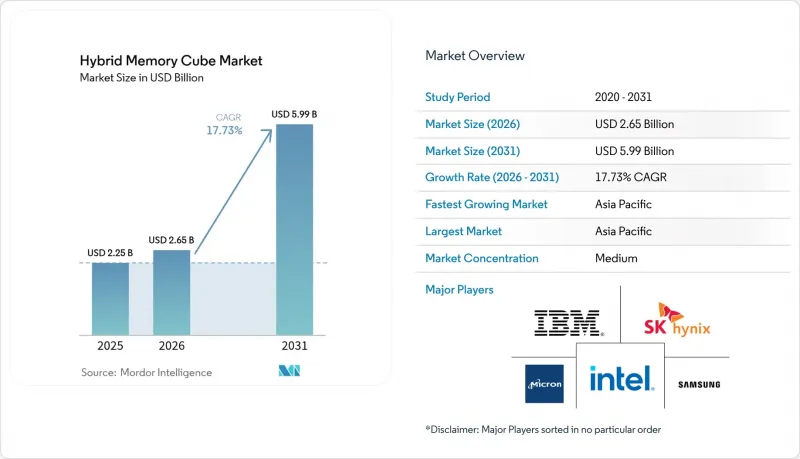
Mordor Intelligence에 따르면 하이브리드 메모리 큐브 시장 규모는 2025년 22억 5,000만 달러에서 2026년에는 26억 5,000만 달러로 확대하며, 2026-2031년에 CAGR 17.73%로 추이하며, 2031년에는 59억 9,000만 달러에 달할 것으로 예측됩니다.
이 보고서는 최종사용자 산업별(기업 스토리지, 자동차용 ADAS 등), 메모리 용량별(2GB-8GB, 8GB-16GB, 16GB-32GB, 32GB 초과),용도(프로세서 캐시, 데이터 버퍼, 그래픽스 메모리, 산업용 및 IoT 엣지), 기술 노드(광 인터커넥트 HMC, 치플릿 기반 HMC 등) 및 지역별로 분류되어 있습니다. 시장 예측은 금액(달러) 기준으로 제시되어 있습니다.
글로벌 하이브리드 메모리 큐브 시장의 동향 및 인사이트
고대역폭 메모리가 필요한 AI 및 HPC 워크로드의 급속한 확산
대규모 언어 모델의 훈련으로 인해 ‘메모리 벽’이 부각되었습니다. 이는 연산 유닛이 포화 상태에 이르기 전에 계산이 정체되는 현상인데, 하이브리드 메모리 큐브(HMC) 패키지는 최대 320 GB/s의 대역폭을 제공하여 GPU 및 텐서 코어에 대한 데이터 공급을 유지합니다. 실시간 언어 번역이나 자율 지각을 위한 엣지 추론에서는 현재 저지연 DRAM 대체품이 필수적이며, 수직 적층형 메모리에 대한 수요가 확고해지고 있습니다. 마이크론(Micron)의 보고서에 따르면 2024 회계연도에 AI 서버의 메모리 탑재량은 기존 기업 노드에 비해 2배로 증가했으며, 고대역폭 제품의 비중이 상승하고 있습니다. IEEE의 조사에 따르면 3차원 상호 연결은 DDR5에 비해 비트당 에너지 소비를 40% 감소시켜, 이를 통해 메가와트 규모의 클러스터에서 운영 비용을 절감할 수 있는 것으로 밝혀졌습니다. 지속적인 미세 조정 및 검색 강화 생성에 따라 메모리 사용량은 테라바이트 수준을 넘어 확대되고 있으며, 모듈식 확장성 덕분에 하이브리드 메모리 큐브는 이러한 환경에서 매력적인 선택지가 되고 있습니다. 조기 도입 기업은 지연 시간의 결정성이라는 이점도 지적하고 있으며, 이를 통해 대화형 AI 워크로드의 서비스 품질(QoS) 지표가 향상되고 있습니다.
확대되는 기업 스토리지와 하이퍼스케일 데이터센터의 갱신 주기
각 하이퍼스케일러 기업은 HDD 어레이를 컴퓨테이셔널 스토리지 프로세서가 통합된 올플래시 노드로 교체하고 있으며, 이러한 칩은 큐 깊이를 최소화하면서 병렬 NAND 채널을 관리하기 위한 대역폭을 필요로 합니다. 인텔은 차세대 스토리지 컨트롤러가 인라인 중복 제거, 삭제 부호화 및 암호화 속도를 높이기 위해 고대역폭 메모리에 의존하고 있음을 강조했습니다. 조직들이 컴포저블 인프라를 채택함에 따라 기업 분야의 업데이트 주기가 단축되고 있으며, 하이브리드 메모리 큐브가 지원하는 패킷 기반 메모리 인터페이스의 필요성이 더욱 부각되고 있습니다. 삼성전자는 이러한 전환을 반영하여, 2024년 기업용 SSD에서 스택형 메모리의 채택률이 전년 대비 2배 증가했다고 밝혔습니다. ISO 27001과 같은 규제 프레임워크에서는 상시 암호화 및 감사 로그 기록이 의무화되어 있으며, 대역폭 수요가 더욱 증가하고 있습니다. 또한 하이퍼스케일 사업자들은 랙 총 수를 줄이는 방안도 모색하고 있으며, 고대역폭 메모리는 노드당 지연 시간을 줄여 더 고밀도 도입을 가능하게 합니다.
높은 제조 비용과 TSV 수율에 대한 제약
SK하이닉스의 2024년 실적 설명회에 따르면 TSV용 심층 반응성 이온 에칭(DRIE)에서는 평면형 DRAM에는 존재하지 않는 결함 메커니즘이 발생하여, DDR5에 비해 1기가바이트당 비용이 최대 60% 증가한다고 합니다. 수율이 85% 미만으로 떨어지면 중복성에 따른 오버헤드가 발생하고 다이 면적이 확대되어 매출 총이익률이 하락합니다. 또한 열 사이클 중 구리 펌프의 고장은 본딩의 무결성을 더욱 훼손하여 첨단 패키징 라인의 불량률을 악화시킵니다. TSV 대응 클린룸 개조에는 건당 최소 5억 달러의 비용이 소요되고, 인증 획득에 2년 가까이 걸리기 때문에 생산 능력의 급속한 확장이 제한되고 있습니다. EU의 RoHS 등 환경 규제로 인해 재료 대체 요건이 추가되고, 공정 화학이 복잡해지면서 규모 확대가 더욱 지연되고 있습니다. 수율이 90%를 넘을 때까지는 각 공급업체들이 양산 시장보다는 프리미엄 틈새 시장에 집중할 가능성이 높습니다.
부문 분석
기업 스토리지는 2025년 매출의 40.75%를 차지하며, 이는 하이퍼스케일 사업자들이 메모리 시맨틱 스토리지 컨트롤러를 탑재한 올플래시 어레이를 업데이트하고 있기 때문입니다. 이러한 업그레이드를 통해 랜덤 액세스 처리량이 향상되었으며, 하이브리드 메모리 큐브(HMC) 패키지를 채택함으로써 병렬 NAND 채널 전체에서 낮은 테일 지연 시간을 유지하고 있습니다. 레벨 3 및 레벨 4 자율주행을 중심으로 한 자동차용 ADAS 워크로드는 센서 퓨전 및 차량용 AI가 주류가 됨에 따라 2031년까지 연평균 성장률(CAGR) 20.42%로 증가할 것으로 예측됩니다. 통신, 고성능 컴퓨팅, 산업용 자동화 분야에서는 기존 DRAM을 능가하는 결정론적 지연 시간 요구 사항을 충족하기 위해 하이브리드 메모리 큐브가 채택되고 있습니다. 기능 안전 인증 및 사이버 보안 관련 규제 요건으로 인해 안전성이 극히 중요한 분야에서의 조달이 가속화되고 있습니다.
자동차 분야의 성장은 열 효율과 지속적인 대역폭을 우선시하는 엣지 디바이스로의 하이브리드 메모리 큐브 시장 이동을 부각시키고 있습니다. 장치당 센서 수는 증가하고 있으며, 실시간 인식 알고리즘은 저지연 메모리의 혜택을 직접 누리고 있습니다. 북미 및 유럽에서 보급률이 성숙 단계에 도달함에 따라 기업 스토리지의 성장은 현재 둔화되는 추세이지만, 지속적인 용량 최적화를 통해 제품 주기는 유지되고 있습니다. 통신 사업자들은 5G 코어 네트워크 구축에 있으며, 풀형 메모리 구조를 활용하고 있습니다. FCC의 Open RAN 추진 및 EU의 기계 지침과 같은 정부 정책 또한 하이브리드 메모리 큐브가 지원하는 모듈형 메모리 아키텍처를 지원하고 있습니다.
16GB-32GB 범위의 모듈은 2025년 도입 건수의 37.15%를 차지하며, 듀얼 소켓 서버에 대한 기대에 부응하는 동시에 비용 대비 성능의 균형 측면에서 최적의 수준을 제공하고 있습니다. 32GB를 초과하는 용량의 하이브리드 메모리 큐브 시장 규모는 대규모 언어 모델의 추론 노드나 NUMA 시스템이 멀티테라바이트급 메모리 풀을 도입함에 따라 연평균 성장률(CAGR) 19.62%로 확대될 것으로 예측됩니다. 8GB-16GB 용량 대역은 전력 제약이 있는 엣지 서버에 대응하는 반면, 8GB 미만의 용량을 가진 장치는 순수한 용량보다 내방사선성 및 광범위한 온도 대응이 우선시되는 임베디드 산업 제어 시스템에서 여전히 일반적입니다.
소켓당 평균 메모리 용량은 2020년 128GB에서 2024년 256GB로 두 배로 증가했으며, 모델 가중치를 시스템 메모리에 저장하는 AI 추론 서버로의 전환에 따라 대상 대용량 부문이 확대되고 있습니다. 5G 코어의 네트워크 슬라이스 오케스트레이션 기능은 노드당 용량 요구 사항을 더욱 높이고 있습니다. 기능 안전 및 사이버 보안 표준에 따라 중복성 및 패리티를 지원하기 위해 사용 가능한 메모리가 사실상 2배로 늘어남에 따라 제어 플레인 장비에서 더 대용량의 HMC 패키지로의 전환이 더욱 정당화되고 있습니다.
지역별 분석
아시아태평양은 2025년 하이브리드 메모리 큐브 시장 매출의 41.05%를 차지하며, 삼성과 SK하이닉스에 집중된 제조 능력에 더해 중국, 일본,한국, 인도에서의 반도체 지원 정책에 힘입어 2031년까지 연평균 성장률(CAGR) 19.93%로 성장할 것으로 예측됩니다. 중국 정부는 2024년에 총 150억 위안 규모의 자금을 투입하여 국내 적층 메모리 기술 혁신을 지원하고 있습니다. 한편, 일본에서는 공동 투자를 통해 2nm 노드까지의 치플릿 패키징이 지원되고 있습니다. 인도의 각 하이퍼스케일러 기업은 고대역폭 메모리가 필요한 지역 언어 지원 AI 모델을 개발하고 있으며, 국내 수요를 끌어올리고 있습니다. 대만의 웨이퍼 레벨 패키징(WLP) 확대는 이 지역을 이종 통합 서비스의 허브로서 더욱 공고히 하고 있습니다.
북미는 하이퍼스케일 클라우드의 업데이트 주기와 미국 에너지부의 엑사스케일 프로그램에 힘입어 2025년 매출의 28.35%를 차지했습니다. 인텔의 200억 달러 규모의 오하이오주 확장 계획에는 하이브리드 메모리 큐브(Hybrid Memory Cube) 다이를 제온(Xeon) 및 GPU 어셈블리에 직접 통합하기 위한 첨단 패키징 라인이 설치될 예정입니다. Amazon Web Services, Microsoft Azure, Google Cloud는 모두 랙 간에 고대역폭 계층을 통합하는 디스어그리게이트형 메모리 패브릭의 시범 운영을 진행 중이며, 이 모델은 서버당 비용을 절감하면서 가동률을 극대화합니다. 캐나다의 Vector 및 Mila 연구소는 국가 AI 연구 목표를 지원하기 위해 HMC 기반 클러스터를 도입하고 있습니다. 고급 메모리의 출하를 제한하는 수출 규제는 공급 배분 패턴을 재구성하고, 국내 생산 능력에 대한 투자를 촉진하고 있습니다.
유럽은 자동차용 ADAS 채택과 EuroHPC 슈퍼컴퓨터 도입에 힘입어 2025년 매출의 약 17.65%를 차지했습니다. 독일의 Tier 1 공급업체인 보쉬와 콘티넨탈은 엄격한 지연 시간 요구 사항을 충족하기 위해 레벨 3 지각 플랫폼에 하이브리드 메모리 큐브(HMC)를 통합했습니다. 이 지역에서 소버린 클라우드를 추진하기 위해서는 GDPR을 준수하는 구성이 요구되며, 이를 위해서는 암호화에 적합한 메모리 아키텍처가 필요합니다. Arm은 2024년, 유럽의 자동차 및 엣지 분야 고객을 지원하기 위해 코히어런트 상호 연결 IP 포트폴리오를 확충하고, 현지 연구개발의 추진력을 강조했습니다. EU 칩 법안은 해당 지역의 반도체 점유율을 두 배로 늘리기 위해 430억 유로를 투입하고 있으며, 그 일부는 적층 메모리 제품 라인을 위한 첨단 패키징 기술에 자금을 지원하는 데 사용되고 있습니다.
기타 혜택:
- 엑셀 형식의 시장 예측(ME) 시트
- 3개월간의 애널리스트 지원
자주 묻는 질문
목차
제1장 서론
제2장 조사 방법
제3장 개요
제4장 시장 구도
제5장 시장 규모와 성장 예측
제6장 경쟁 구도
제7장 시장 기회와 향후 전망
KSA 26.09.02According to Mordor Intelligence, the hybrid memory cube market size is expected to grow from USD 2.25 billion in 2025 to USD 2.65 billion in 2026 and is forecast to reach USD 5.99 billion by 2031 at 17.73% CAGR over 2026-2031.
This report is Segmented by End-User Industry (Enterprise Storage, Automotive ADAS, and More), Memory Capacity (2 GB To 8 GB, 8 GB To 16 GB, 16 GB To 32 GB, Greater Than 32 GB), Application (Processor Cache, Data Buffer, Graphics Memory, Industrial and IoT Edge), Technology Node (Optical-Interconnect HMC, Chiplet-Based HMC, and More), and Geography. The Market Forecasts are Provided in Terms of Value (USD).
Global Hybrid Memory Cube Market Trends and Insights
Rapid Uptake of AI and HPC Workloads Demanding High-Bandwidth Memory
Large-language-model training has underscored the memory wall, where compute stalls before arithmetic units saturate, and Hybrid Memory Cube packages deliver up to 320 GB/s to keep GPUs and tensor cores fed. Edge inference for real-time language translation and autonomous perception now mandates low-latency DRAM alternatives, cementing demand for vertically stacked memory. Micron reported that AI server memory content doubled relative to traditional enterprise nodes in fiscal 2024, with high-bandwidth products capturing a rising percentage mix. IEEE research has found that 3-D interconnects lower energy per bit by 40% compared to DDR5, thereby reducing operating costs in megawatt-scale clusters. Continuous fine-tuning and retrieval-augmented generation extend memory footprints beyond terabyte levels, and modular scalability makes Hybrid Memory Cube attractive for such regimes. Early adopters also note latency determinism advantages, which improve quality-of-service metrics for conversational AI workloads.
Growing Enterprise Storage and Hyperscale Datacenter Refresh Cycles
Hyperscalers are replacing HDD arrays with all-flash nodes that integrate computational storage processors, and these chips demand bandwidth to manage parallel NAND channels with minimal queue depth. Intel highlighted that next-generation storage controllers rely on high-bandwidth memory to accelerate inline deduplication, erasure coding, and encryption. Enterprise refresh cycles are compressing as organizations adopt composable infrastructure, further emphasizing the need for packet-based memory interfaces that Hybrid Memory Cube supports. Samsung disclosed that enterprise SSD attach rates for stacked memory doubled year-over-year in 2024, reflecting this migration. Regulatory frameworks such as ISO 27001 intensify bandwidth needs by requiring always-on encryption and audit logging. Hyperscale operators also seek ways to reduce total rack count, and high-bandwidth memory reduces per-node latency, enabling denser deployments.
High Manufacturing Cost and TSV Yield Constraints
Deep reactive-ion etching for TSVs introduces defect mechanisms not present in planar DRAM, increasing the per-gigabyte cost by up to 60% relative to DDR5, according to SK hynix's 2024 earnings call. Yields under 85% create redundancy overhead and inflate die area, reducing gross margins. Copper-pumping failures during thermal cycling further damage bond integrity, worsening scrap rates in advanced packaging lines. Each TSV-capable cleanroom retrofit costs at least USD 500 million and needs nearly two years to qualify, limiting rapid capacity expansion. Environmental directives such as the EU's RoHS add material-substitution requirements, complicating process chemistry and further delaying scale-up. Until yield climbs above 90%, vendors are likely to focus on premium niches rather than mass-market volumes.
Other drivers and restraints analyzed in the detailed report include:
- Government-Backed Exascale Computing Initiatives in the United States, China, and Europe
- Chiplet-Based Heterogeneous Integration Architectures Gaining Traction
- Strong Incumbency of Conventional DDRx and LPDDR Technology
For complete list of drivers and restraints, kindly check the Table Of Contents.
Segment Analysis
Enterprise storage contributed 40.75% of 2025 revenue, underpinned by hyperscale operators refreshing all-flash arrays with memory-semantic storage controllers. These upgrades increase random-access throughput and use Hybrid Memory Cube packages to maintain low tail latency across parallel NAND channels. Automotive ADAS workloads, centered on Level 3 and Level 4 autonomy, are projected to rise at a 20.42% CAGR through 2031 as sensor fusion and in-vehicle AI become mainstream. Telecommunications, high-performance computing, and industrial automation each adopt the Hybrid Memory Cube to address deterministic latency needs that outstrip those of conventional DRAM. Regulatory requirements surrounding functional-safety certification and cybersecurity accelerate procurement in safety-critical domains.
Automotive growth highlights the shift of the hybrid memory cube market toward edge devices, which prioritize thermal efficiency and sustained bandwidth. The sensor count per vehicle is climbing, and real-time perception algorithms benefit directly from low-latency memory. Enterprise storage growth is now moderating as penetration reaches mature levels in North America and Europe, though ongoing capacity optimization ensures continued product cycles. Telecommunications operators are leveraging pooled-memory constructs in 5G core deployments. Government policies, such as the FCC's Open RAN push and the EU Machinery Regulation, also champion modular memory architectures that Hybrid Memory Cube supports.
Modules in the 16 GB to 32 GB range captured 37.15% of 2025 deployments, aligning with expectations for dual-socket servers and providing the optimal sweet spot for cost-performance balance. The hybrid memory cube market size for capacities greater than 32 GB is forecast to expand at a 19.62% CAGR as large-language-model inference nodes and NUMA systems deploy multi-terabyte pools. The 8 GB-to-16 GB tier supports power-constrained edge servers, while devices with capacities below 8 GB remain common in embedded industrial controls, where radiation tolerance and extended temperature ratings take precedence over raw capacity.
The average memory per socket has doubled from 128 GB in 2020 to 256 GB in 2024, and the shift toward AI inference servers that store model weights in system memory has widened the addressable high-capacity segment. Network-slice orchestration functions in 5G cores further raise per-node capacity needs. Functional-safety and cybersecurity standards effectively double usable memory to accommodate redundancy and parity, reinforcing the case for moving up to larger HMC packages in control-plane equipment.
Complete Report Scope:
- By End-User Industry
- Enterprise Storage
- Telecommunications and Networking
- High-Performance Computing
- Automotive ADAS
- Other End-User Industry
- By Memory Capacity
- 2 GB-8 GB
- 8 GB-16 GB
- 16 GB-32 GB
- Above 32 GB
- By Application
- Processor Cache
- Data Buffer
- Graphics Memory
- Industrial / IoT Edge
- By Technology Node
- TSV-based Hybrid Memory Cube (Gen 2)
- Optical-interconnect HMC
- Chiplet-based HMC
- By Geography
- North America
- United States
- Canada
- Mexico
- South America
- Brazil
- Argentina
- Rest of South America
- Europe
- Germany
- United Kingdom
- France
- Italy
- Spain
- Russia
- Rest of Europe
- Asia Pacific
- China
- Japan
- India
- South Korea
- Australia
- Rest of Asia Pacific
- Middle East and Africa
- Middle East
- Saudi Arabia
- United Arab Emirates
- Turkey
- Rest of Middle East
- Africa
- South Africa
- Nigeria
- Egypt
- Rest of Africa
- Middle East
- North America
Geography Analysis
The Asia Pacific delivered 41.05% of the hybrid memory cube market revenue in 2025 and is projected to grow at a 19.93% CAGR to 2031, driven by concentrated fabrication capacity at Samsung and SK hynix, as well as pro-semiconductor policies in China, Japan, South Korea, and India. The Chinese government's funds, totaling CNY 15 billion in 2024, target domestic stacked-memory innovation, while Japanese co-investment supports chiplet packaging through 2-nm nodes. Indian hyperscalers are drafting regional language AI models that require high-bandwidth memory, advancing in-country demand. Taiwan's wafer-level packaging expansions further anchor the region as a hub for heterogeneous integration services.
North America represented 28.35% of 2025 revenue, driven by hyperscale cloud refresh cycles and the Department of Energy's exascale programs. Intel's USD 20 billion Ohio expansion will house advanced packaging lines to embed Hybrid Memory Cube dies directly into Xeon and GPU assemblies. Amazon Web Services, Microsoft Azure, and Google Cloud all pilot disaggregated memory fabrics that pool high-bandwidth tiers across racks, a model that maximizes utilization while controlling per-server costs. Canada's Vector and Mila institutes deploy HMC-based clusters to underpin national AI research goals. Export controls restricting advanced memory shipments reshape supply allocation patterns and drive onshore capacity investments.
Europe captured approximately 17.65% of the 2025 revenue, driven by the adoption of automotive ADAS and the installation of EuroHPC supercomputers. German tier-ones Bosch and Continental incorporated Hybrid Memory Cube into Level 3 perception platforms to meet stringent latency budgets. The region's sovereign cloud push requires GDPR-compliant configurations, which in turn need encryption-friendly memory architectures. Arm expanded a coherent interconnect IP portfolio in 2024 to support European automotive and edge customers, underscoring local R&D momentum. The EU Chips Act funnels EUR 43 billion to double the regional semiconductor share, part of which finances advanced packaging for stacked memory lines.
- Micron Technology Inc.
- Intel Corporation
- Samsung Electronics Co., Ltd.
- SK hynix Inc.
- International Business Machines Corporation
- Advanced Micro Devices Inc.
- Xilinx, Inc.
- Fujitsu Ltd.
- Marvell Technology, Inc.
- Rambus Inc.
- Broadcom Inc.
- Cadence Design Systems Inc.
- ASE Technology Holding Co., Ltd.
- Semtech Corporation
- Open-Silicon, Inc.
- Arm Ltd.
- Altera Corporation (Intel PSG)
- Taiwan Semiconductor Manufacturing Company Ltd.
- Hitachi Ltd.
- Renesas Electronics Corporation
Additional Benefits:
- The market estimate (ME) sheet in Excel format
- 3 months of analyst support
TABLE OF CONTENTS
1 INTRODUCTION
- 1.1 Study Assumptions and Market Definition
- 1.2 Scope of the Study
2 RESEARCH METHODOLOGY
3 EXECUTIVE SUMMARY
4 MARKET LANDSCAPE
- 4.1 Market Overview
- 4.2 Market Drivers
- 4.2.1 Growing Enterprise Storage and Hyperscale Datacenter Refresh Cycles
- 4.2.2 Rapid Uptake Of AI / HPC Workloads Demanding High-Bandwidth Memory
- 4.2.3 Expanding 5G Core and Edge Networking Equipment Deployments
- 4.2.4 Government-Backed Exascale Computing Initiatives in the United States, China And Europe
- 4.2.5 Chiplet-Based Heterogeneous Integration Architectures Gaining Traction
- 4.2.6 Shift Toward Composable and Disaggregated Server Architecture in Cloud Platforms
- 4.3 Market Restraints
- 4.3.1 Strong Incumbency of Conventional Ddrx / LPDDR DRAM Technology
- 4.3.2 High Manufacturing Cost and TSV Yield Constraints
- 4.3.3 Thermal Management Complexity In 3-D Stacked Memory Cubes
- 4.3.4 Limited Supplier Ecosystem and IP Licensing Frictions
- 4.4 Industry Value Chain Analysis
- 4.5 Impact of Macroeconomic Factors
- 4.6 Regulatory Landscape
- 4.7 Technological Outlook
- 4.8 Porter's Five Forces Analysis
- 4.8.1 Bargaining Power of Buyers
- 4.8.2 Bargaining Power of Suppliers
- 4.8.3 Threat of New Entrants
- 4.8.4 Threat of Substitute Products
- 4.8.5 Intensity of Competitive Rivalry
5 MARKET SIZE AND GROWTH FORECASTS (VALUE)
- 5.1 By End-User Industry
- 5.1.1 Enterprise Storage
- 5.1.2 Telecommunications and Networking
- 5.1.3 High-Performance Computing
- 5.1.4 Automotive ADAS
- 5.1.5 Other End-User Industry
- 5.2 By Memory Capacity
- 5.2.1 2 GB-8 GB
- 5.2.2 8 GB-16 GB
- 5.2.3 16 GB-32 GB
- 5.2.4 Above 32 GB
- 5.3 By Application
- 5.3.1 Processor Cache
- 5.3.2 Data Buffer
- 5.3.3 Graphics Memory
- 5.3.4 Industrial / IoT Edge
- 5.4 By Technology Node
- 5.4.1 TSV-based Hybrid Memory Cube (Gen 2)
- 5.4.2 Optical-interconnect HMC
- 5.4.3 Chiplet-based HMC
- 5.5 By Geography
- 5.5.1 North America
- 5.5.1.1 United States
- 5.5.1.2 Canada
- 5.5.1.3 Mexico
- 5.5.2 South America
- 5.5.2.1 Brazil
- 5.5.2.2 Argentina
- 5.5.2.3 Rest of South America
- 5.5.3 Europe
- 5.5.3.1 Germany
- 5.5.3.2 United Kingdom
- 5.5.3.3 France
- 5.5.3.4 Italy
- 5.5.3.5 Spain
- 5.5.3.6 Russia
- 5.5.3.7 Rest of Europe
- 5.5.4 Asia Pacific
- 5.5.4.1 China
- 5.5.4.2 Japan
- 5.5.4.3 India
- 5.5.4.4 South Korea
- 5.5.4.5 Australia
- 5.5.4.6 Rest of Asia Pacific
- 5.5.5 Middle East and Africa
- 5.5.5.1 Middle East
- 5.5.5.1.1 Saudi Arabia
- 5.5.5.1.2 United Arab Emirates
- 5.5.5.1.3 Turkey
- 5.5.5.1.4 Rest of Middle East
- 5.5.5.2 Africa
- 5.5.5.2.1 South Africa
- 5.5.5.2.2 Nigeria
- 5.5.5.2.3 Egypt
- 5.5.5.2.4 Rest of Africa
- 5.5.5.1 Middle East
- 5.5.1 North America
6 COMPETITIVE LANDSCAPE
- 6.1 Market Concentration
- 6.2 Strategic Moves
- 6.3 Market Share Analysis
- 6.4 Company Profiles (includes Global level Overview, Market level overview, Core Segments, Financials as available, Strategic Information, Market Rank / Share for key companies, Products and Services, and Recent Developments)
- 6.4.1 Micron Technology Inc.
- 6.4.2 Intel Corporation
- 6.4.3 Samsung Electronics Co., Ltd.
- 6.4.4 SK hynix Inc.
- 6.4.5 International Business Machines Corporation
- 6.4.6 Advanced Micro Devices Inc.
- 6.4.7 Xilinx, Inc.
- 6.4.8 Fujitsu Ltd.
- 6.4.9 Marvell Technology, Inc.
- 6.4.10 Rambus Inc.
- 6.4.11 Broadcom Inc.
- 6.4.12 Cadence Design Systems Inc.
- 6.4.13 ASE Technology Holding Co., Ltd.
- 6.4.14 Semtech Corporation
- 6.4.15 Open-Silicon, Inc.
- 6.4.16 Arm Ltd.
- 6.4.17 Altera Corporation (Intel PSG)
- 6.4.18 Taiwan Semiconductor Manufacturing Company Ltd.
- 6.4.19 Hitachi Ltd.
- 6.4.20 Renesas Electronics Corporation
7 MARKET OPPORTUNITIES AND FUTURE OUTLOOK
- 7.1 White-space and Unmet-need Assessment


