

|
시장보고서
상품코드
2099757
메모리 패브릭 : 시장 점유율 분석, 업계 동향 및 통계, 성장 예측(2026-2031년)Memory Fabric - Market Share Analysis, Industry Trends & Statistics, Growth Forecasts (2026 - 2031) |
||||||
 Mordor Intelligence
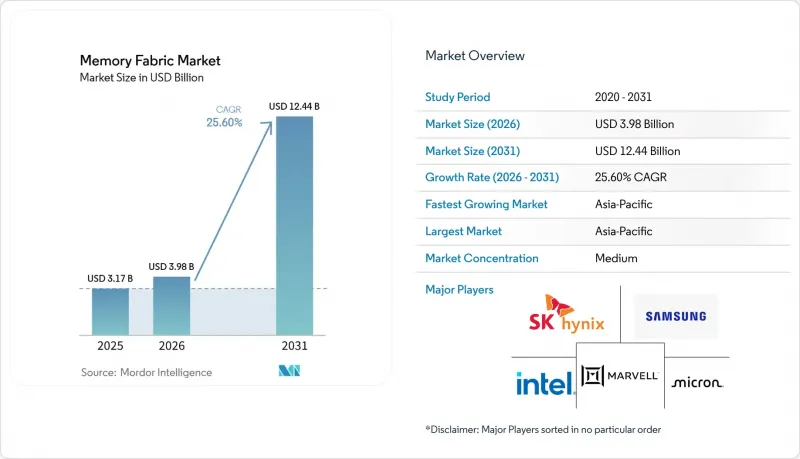
Mordor Intelligence에 의하면, 메모리 패브릭 시장 규모는 2025년 31억 7,000만 달러로 평가되었습니다. 2026년 39억 8,000만 달러에서 2031년까지 124억 4,000만 달러로 확대되어 2026년부터 2031년에 걸쳐 CAGR 25.60%를 나타낼 것으로 예측됩니다.
본 보고서는 HBM 세대별(HBM3, HBM4, 기타), 스택 높이별(8-High, 12-High, 기타), 스택당 메모리 용량별(최대 16GB, 16GB-24GB, 기타), 첨단 패키징 통합 아키텍처별(3D 로직·메모리 통합, 기타), 용도별(AI 훈련 등), 최종 사용자별(하이퍼스케일러 및 CSP 등), 지역별로 분류되어 있습니다. 시장 예측은 금액(달러) 기준으로 제시되어 있습니다.
세계의 메모리 패브릭 시장 동향 및 인사이트
인공지능(AI) 추론에서 발생하는 메모리 병목 현상이 HBM 대역폭 수요를 견인
모델 훈련에서 대규모 추론으로의 전환에 따라, 메모리 패브릭 시장은 가속기 수와 마찬가지로 대역폭 및 지연 시간이 중요시되는 단계로 접어들고 있습니다. 마이크론(Micron)의 보고서에 따르면, 에이전트형 AI 워크로드는 키-값(KV) 캐시의 이동에 현저히 높은 부하를 가하고 있으며, 동시 요청 수가 1만 건인 경우 KV 캐시 수요는 기준치의 6.07배에 달할 전망입니다. 이는 동시 실행 수가 증가함에 따라 메모리에 가해지는 부하가 급격히 높아지는 이유를 보여줍니다. 해당 논문에서는 HBM4가 HBM3E에 비해 2.82배 높은 피크 이론 대역폭을 실현하며, 고정된 연산 리소스 예산 내에서 에이전트형 AI 워크로드의 처리량을 최대 2.63배 향상시킬 수 있음이 밝혀졌습니다. 또한, 삼성은 자사의 상용 HBM4가 스택당 3.3 TB/s에 도달했다고 밝혔으며, 이는 공급업체들이 이미 이러한 새로운 수요 프로파일에 맞추어 제품을 조정하고 있음을 뒷받침합니다. 컨텍스트 길이와 요청량이 모두 지속적으로 증가하는 가운데, 메모리 패브릭 시장은 일회성 업데이트가 아닌 지속적인 조달 수요에 의해 주도되고 있습니다. 이러한 추세로 인해 메모리 패브릭 시장에는 연산 능력 업그레이드만으로는 실제 도입 시 발생하는 병목 현상을 해결할 수 없게 되더라도 수요가 지속될 수 있는 기반이 형성되고 있습니다.
CXL 기반 메모리 풀링이 하이퍼스케일 환경의 유휴 용량을 줄입니다.
CXL 풀링은 활용률이 낮은 서버 내에 갇혀 있는 미사용 메모리 용량을 해결하기 위해 메모리 패브릭 시장에 또 다른 성장 경로를 제공합니다. 2025년 『IEEE Transactions on Parallel and Distributed Systems』에 게재된 논문에서는 일반적인 컴퓨팅 서버에서 메모리가 총 소유 비용(TCO)의 최대 44%를 차지할 가능성이 있다고 지적되었으며, CXL 메모리 계층화를 통해 동일한 위치에 있는 컨테이너 간의 동적 재할당을 통해 프로덕션 워크로드의 처리량을 최대 1.7배까지 향상시킬 수 있음이 입증되었습니다. 이 결과는 메모리를 고정된 로컬 자산에서 공유 인프라 리소스로 전환한다는 점에서 중요합니다. 이를 통해 모든 워크로드를 비용이 가장 높은 로컬 DRAM에 배치할 필요가 없어져 활용도가 향상됩니다. Marvell은 Structera S 30260을 통해 이러한 방향성을 지원하는 스위치 레이어를 추가했습니다. 이 제품은 랙 스케일 풀링 설계를 위해 4 TB/s의 총 대역폭과 서브 마이크로초 수준의 메모리 액세스 지연 시간을 실현합니다. 이는 핫 티어(hot tier)의 HBM 수요와 더 광범위한 용량 티어의 CXL 풀링이 서로 대체되는 것이 아니라, 함께 확대될 수 있음을 의미합니다. 그 결과, 메모리 패브릭 시장은 더 빠른 스택뿐만 아니라 메모리를 더 효율적으로 재사용 및 재할당할 수 있는 광범위한 시스템 아키텍처에 의해서도 확대되고 있습니다.
첨단 CXL 세대의 상용 공급이 제한적이라는 점이 단기적인 도입을 제약하고 있습니다.
최첨단 CXL 세대가 아직 상용 서버에 본격적으로 도입되지 않았기 때문에 메모리 패브릭 시장은 여전히 시기적 제약에 직면해 있습니다. 조사 결과에 따르면, CXL 3.0은 2026년 중반까지 샘플 제공 및 초기 인증 단계에 머물러 있으며, 2026년의 실제 매출은 주로 CXL 2.0을 활용한 단일 호스트 메모리 확장에 국한될 전망입니다. Marvell은 자사의 Structera S 30260 CXL 3.0 스위치에 대한 고객 샘플 제공을 2026년 3분기에 시작할 것이라고 발표했으며, 이는 풀 랙 스케일의 메모리 패브릭이 여전히 CPU 및 메모리 익스팬더의 보다 광범위한 준비 상황에 의존하고 있음을 의미합니다. 또한 CXL 컨소시엄은 계속해서 플러그페스트 및 적합성 검증 프로그램을 실시하고 있으며, 이로 인해 본격적인 배포에 앞서 플랫폼 수준의 인증 주기가 추가되게 됩니다. 이러한 시기의 차이로 인해, 본래라면 단기적으로 메모리 패브릭 시장을 더 신속하게 확대했을 고부가가치의 풀링 및 공유 이용 사례가 지연되고 있습니다. 또한, 대규모 통신 사업자는 진행 중인 인프라 계획 속에서 인증 지연을 더 쉽게 흡수할 수 있기 때문에 엔터프라이즈 분야의 도입은 하이퍼스케일러에 의한 도입보다 뒤처지게 될 것입니다.
부문 분석
HBM4E 및 차세대 HBM은 2031년까지 26.46%라는 가장 높은 연평균 성장률(CAGR)을 나타낼 전망입니다. 한편, HBM3E는 2025년에 메모리 패브릭 시장 점유율의 50.67%를 차지했습니다. 이 비중은 현재 매출이 여전히 기존 도입 기반에 의해 지탱되고 있는 반면, 미래 수요는 이미 고속 및 고밀도 스택으로 전환되고 있는 과도기적 시장 상황을 반영합니다. 메모리 패브릭 시장에서 HBM3E가 주도적인 위치를 유지하고 있는 이유는 2024년 및 2025년에 도입된 많은 트레이닝 클러스터가 여전히 일반적인 3-5년의 리프레시 주기로 계속 가동되고 있기 때문입니다. 이러한 시스템은 특히 HBM3E 기반 가속기 플랫폼으로의 전환이 이미 확정된 경우, 많은 가동 중인 도입 환경의 요구를 여전히 충족시키고 있습니다. 동시에 차세대 AI 가속기의 로드맵에 따라 메모리 패브릭 시장은 분명히 HBM4급 제품으로 이끌리고 있습니다.
SK하이닉스는 2026년 6월, Advanced MR-MUF 패키징 기술을 채택한 12층 HBM4E 샘플을 출하했다고 발표했습니다. 이 제품은 핀당 16Gbps, 용량 48 GB를 실현했으며, HBM4에 비해 전력 효율이 20% 이상 향상되고 내열성이 17% 향상되었습니다. Samsung Electronics는 2026년 2월 상용 HBM4 출하를 시작했다고 발표했으며, 마이크론은 GTC 2026에서 36GB의 12-High 스택과 2.8 TB/s를 초과하는 대역폭을 갖춘 NVIDIA Vera Rubin용 HBM4의 양산에 들어갔다고 밝혔습니다. ISSCC 2026의 논문에서는 HBM4가 다이 자체에 더욱 정교한 보정 및 테스트 기능을 제공한다는 점도 밝혀졌으며, 이는 단순한 대역폭 향상에 그치지 않는 더 깊은 기술적 도약을 시사합니다. 이전 세대의 HBM3, HBM2E 및 그 이전 세대는 레거시 HPC나 전문가용 시각화, 기타 저대역폭 환경에서는 계속 사용되고 있지만, 플랫폼 로드맵이 상위 단계로 이동함에 따라 메모리 패브릭 업계에서 이들의 역할은 점차 축소되고 있습니다. 또한 제조 측면의 의존 관계도 변화하고 있습니다. HBM4는 4nm 로직 기반 다이를 채택하고 있기 때문에 생산 준비 상황이 이전 세대보다 더 선진적인 파운드리 생산 능력과 밀접하게 연결되어 있기 때문입니다.
16-High 이상의 부문은 2031년까지 연평균 성장률(CAGR) 26.79%를 나타낼 것으로 예측되지만, 2025년에는 8-High 구성이 42.37%의 점유율을 차지했습니다. 8-High 포맷이 지배적인 위치를 유지할 수 있었던 것은 2025년까지 도입된 AI 가속기의 대부분을 뒷받침했던 HBM3E 24GB 규격과 호환되었기 때문입니다. 이로 인해 메모리 패브릭 시장에는 확립된 수율, 패키징 기술에 대한 숙련도, 그리고 폭넓은 도입 실적을 갖춘 안정적인 상용 지오메트리가 도입되었습니다. 현재 12-High 계층은 HBM4 생산에서 주요 최적 지점으로 자리 잡고 있으며, 특히 2026년 및 2027년에 양산 단계에 접어드는 36GB 스택에서 두드러집니다. 하지만 고객이 스택당 48GB 이상의 용량을 요구하게 되면, 플랫폼 요구 사항은 12-High가 제공할 수 있는 범위를 넘어설 것입니다.
삼성은 2026년에 48GB 16-High HBM4 샘플을 출하했다고 발표했으며, 마이크론 역시 48GB 16-High HBM4 샘플을 출하했습니다. 이는 이 포맷이 로드맵 단계에서 고객 검증 단계로 넘어갔음을 뒷받침합니다. Applied Materials는 자사의 'Producer Avila 2' PECVD 시스템이 12-High, 16-High 및 향후 고층수 구조에서 신뢰성 높은 적층을 지원하도록 설계되었다고 덧붙였습니다. 이는 수율 지원이 스택 높이 목표와 발맞추어 진화하고 있음을 보여줍니다. 4-High 이하의 계층은 엣지 AI 추론이나 비용 중심의 도입에서 여전히 일정한 역할을 하고 있지만, 주류 가속기 설계가 더 큰 용량을 요구함에 따라 그 점유율은 줄어들고 있습니다. 따라서 메모리 패브릭 시장은 상업적 편의성을 중시하던 지오메트리 주도형에서 플랫폼 요구 사항 주도형으로 전환되고 있습니다. 이러한 변화는 중요한 의미를 지닙니다. 스택 수가 증가함에 따라 공급망 전반에 걸쳐 수익 기회와 공정 난이도가 모두 높아지기 때문입니다.
지역별 분석
아시아태평양은 2025년에 메모리 패브릭 시장 점유율의 42.33%를 차지하며 선두를 기록했으며, 2031년까지 연평균 성장률(CAGR) 27.44%로 성장할 것으로 전망됩니다. 이러한 이중 선두는 생산 능력과 수요 증가가 동일한 지역에 집중되어 있다는 사실을 반영합니다. 한국은 여전히 중심적인 위치를 차지하고 있으며, 삼성과 SK하이닉스가 전 세계 HBM 공급의 대부분을 차지하고 있을 뿐만 아니라, 두 회사 모두 2026년에 HBM4 및 HBM4E 로드맵을 앞당겼습니다. 또한, HBM과 AI 가속기의 상용화 연계에는 첨단 패키징 능력이 필수적이기 때문에 대만도 아시아태평양 내 입지를 강화하고 있습니다. 중국은 하이퍼스케일러 및 클라우드 도입 활동을 통해 강력한 수요를 창출하고 있지만, 본 보고서의 대상 기간 내에는 첨단 설비에 대한 규제가 계속해서 국내 HBM 공급 확대를 제한하고 있습니다.
북미는 하이퍼스케일러의 투자, 프로세서 플랫폼의 주도권, 그리고 CXL 생태계 개발이 맞물려 메모리 패브릭 시장에서 여전히 2위 지역 블록으로서의 지위를 유지하고 있습니다. 또한 미국은 인텔, 마이크론, 마벨 및 기타 인프라 벤더 등 CPU, 컨트롤러, 스위치, 메모리 제품 분야에서 활약하는 기업들을 통해 플랫폼 표준 및 시스템 설계의 주도권을 장악하고 있습니다. 인텔 제온 6의 네이티브 CXL 지원과 스위치 계층 제품의 활발한 상용화는 분산형 메모리 시스템의 주요 설계 및 도입 거점으로서 북미의 위상을 뒷받침하고 있습니다. 따라서 제조의 대부분이 아시아태평양에 집중되어 있더라도, 이 지역은 계속해서 기술적 방향성을 결정짓고 있습니다.
유럽은 슈퍼컴퓨팅, 기업 도입, 그리고 표준 기반 서버 업그레이드를 통해 메모리 패브릭 시장에서 전략적인 역할을 담당하고 있습니다. EuroHPC가 지원하는 도입 및 기타 기관 주도의 HPC 프로그램은 특히 성능 목표가 엑사스케일급 요구 사항에 근접한 경우, HBM 탑재 가속기에 대한 수요를 유지하는 데 기여하고 있습니다. 남미, 중동 및 아프리카는 이 시장에서 여전히 초기 단계에 있는 지역이며, 성장 동력은 현지 HBM 공급 체계의 확충보다는 클라우드 구축 및 데이터센터 확장에 기인합니다. 이 지역들의 절대적인 시장 규모는 2031년까지 확대될 것으로 예상되지만, 최첨단 AI 인프라에 대한 투자의 대부분은 계속해서 아시아태평양과 북미에 집중될 전망입니다.
기타 혜택 :
- 엑셀 형식 시장 예측(ME) 시트
- 3개월간의 애널리스트 지원
자주 묻는 질문
목차
제1장 서론
제2장 조사 방법
제3장 주요 요약
제4장 시장 구도
제5장 시장 규모 및 성장 예측
제6장 경쟁 구도
제7장 시장 기회 및 향후 전망
KTH 26.08.10According to Mordor Intelligence, the memory fabric market size is projected to expand from USD 3.17 billion in 2025 and USD 3.98 billion in 2026 to USD 12.44 billion by 2031, registering a CAGR of 25.60% between 2026 to 2031.
This report is Segmented by HBM Generation (HBM3, HBM4, and More), Stack Height (8-High, 12-High, and More), Memory Capacity Per Stack (Up To 16 GB, 16 GB To 24 GB, and More), Advanced Packaging Integration Architecture (3D Logic-Memory Integration, and More), Application (AI Training, and More), End User (Hyperscalers and CSPs, and More), and Geography. The Market Forecasts are Provided in Terms of Value (USD).
Global Memory Fabric Market Trends and Insights
Artificial Intelligence Inference Memory Bottlenecks Drive HBM Bandwidth Demand
The shift from model training toward large-scale inference is pushing the memory fabric market into a phase where bandwidth and latency matter as much as accelerator count. Micron reported that agentic AI workloads place sharply higher pressure on key-value cache movement, with KV-cache demand reaching 6.07x baseline at 10,000 concurrent requests, which shows why memory pressure rises faster as concurrency increases. The same paper showed that HBM4 delivers 2.82x higher peak theoretical bandwidth than HBM3E and supports throughput gains of up to 2.63x for agentic AI workloads at fixed compute budgets. Samsung also stated that its commercial HBM4 reached 3.3 TB/s per stack, which confirms that suppliers are already aligning products to this new demand profile. As context lengths and request volumes keep rising together, the memory fabric market is being pulled by a recurring procurement need instead of a one-time refresh. That pattern gives the memory fabric market a demand base that stays active even when compute upgrades alone no longer solve real deployment bottlenecks.
CXL-Based Memory Pooling Reduces Stranded Capacity In Hyperscale Environments
CXL pooling is giving the memory fabric market a separate expansion path because it addresses unused memory capacity that remains locked inside underutilized servers. A 2025 IEEE Transactions on Parallel and Distributed Systems paper noted that memory can represent up to 44% of the total cost of ownership in typical compute servers, and it showed that CXL memory tiering can improve throughput by up to 1.7x for production workloads through dynamic reallocation across co-located containers. That result matters because it changes memory from a fixed local asset into a shared infrastructure resource, which improves utilization without requiring all workloads to sit on the highest-cost local DRAM footprint. Marvell added switch-layer support to this direction with its Structera S 30260, which delivers 4 TB/s aggregate bandwidth and sub-microsecond memory access latency for rack-scale pooling designs. This means HBM demand at the hot tier and CXL pooling at the broader capacity tier can expand together rather than replace one another. As a result, the memory fabric market is increasing not only by faster stacks, but also by wider system architectures that can reuse and redistribute memory more efficiently.
Limited Commercial Availability Of Advanced CXL Generations Constrains Near-Term Adoption
The memory fabric market still faces a timing constraint because the most advanced CXL generations are not yet in full commercial server deployment. The input shows that CXL 3.0 remained in sampling and early qualification through mid-2026, which limited real 2026 revenue mostly to CXL 2.0 single-host memory expansion. Marvell stated that customer sampling for its Structera S 30260 CXL 3.0 switch begins in Q3 2026, which means full rack-scale memory fabrics still depend on broader CPU and memory-expander readiness. The CXL Consortium also continues to run plugfests and conformance programs, and that adds platform-level qualification cycles before broad deployment can move ahead. This timing gap delays the higher-value pooling and sharing cases that would otherwise widen the memory fabric market faster in the short term. It also keeps enterprise adoption behind hyperscaler adoption, because larger operators can absorb qualification delays more easily within ongoing infrastructure programs.
Other drivers and restraints analyzed in the detailed report include:
- Total Cost Of Ownership Pressure In Hyperscale Data Centers Accelerates Adoption
- Open Standards Adoption Across CPU, Memory, And Switch Vendors Enables Interoperability
- Integration Complexity Across Hardware, Firmware, And Software Stacks Slows Deployment
For complete list of drivers and restraints, kindly check the Table Of Contents.
Segment Analysis
HBM4E and next-generation HBM are projected to grow at the fastest CAGR of 26.46% through 2031, while HBM3E held 50.67% of the memory fabric market share in 2025. That mix reflects a market in transition, where current revenue is still anchored in the installed base, but future demand is already shifting toward faster and denser stacks. The memory fabric market kept HBM3E in a leading position because many training clusters deployed in 2024 and 2025 continue to run on normal 3-5 year refresh cycles. Those systems still meet the needs of many active deployments, especially where procurement has already been locked to HBM3E-based accelerator platforms. At the same time, the memory fabric market is clearly being pulled toward HBM4-class products by next-generation AI accelerator roadmaps.
SK hynix said in June 2026 that it shipped 12-layer HBM4E samples with 16 Gbps per pin, 48 GB capacity, more than 20% better power efficiency, and 17% lower heat resistance than HBM4 through Advanced MR-MUF packaging. Samsung stated that commercial HBM4 shipments began in February 2026, and Micron stated at GTC 2026 that it entered high-volume HBM4 production for NVIDIA Vera Rubin with 36 GB 12-High stacks and bandwidth above 2.8 TB/s. The ISSCC 2026 paper also showed how HBM4 is bringing more calibration and test sophistication into the die itself, which points to a deeper technical jump than a routine bandwidth lift. Older HBM3, HBM2E, and earlier generations remain in legacy HPC, professional visualization, and other lower-bandwidth environments, but their role inside the memory fabric industry is narrowing as platform roadmaps move upward. The manufacturing dependency is also changing, because HBM4 uses a 4 nm logic base die, which ties production readiness more closely to advanced foundry capacity than earlier generations did.
The 16-High and Above segment is projected to grow at a 26.79% CAGR through 2031, while the 8-High configuration held 42.37% share in 2025. The 8-High format stayed dominant because it aligned with the HBM3E 24 GB standard that powered a large part of the installed AI accelerator base through 2025. That gave the memory fabric market a stable commercial geometry with established yields, packaging familiarity, and broad deployment history. The 12-High tier now represents the main HBM4 production sweet spot, especially for 36 GB stacks entering commercial volumes in 2026 and 2027. Even so, platform requirements are moving beyond what 12-High can deliver when customers want 48 GB and larger capacities per stack.
Samsung stated that it shipped 48 GB 16-High HBM4 samples in 2026, and Micron also shipped 48 GB 16-High HBM4 samples, which confirms that the format has moved from the roadmap stage into customer validation. Applied Materials added that its Producer Avila 2 PECVD system was designed to support reliable stacking at 12-High, 16-High, and future high-layer-count structures, which shows how yield support is moving in step with stack height ambition. The 4-High and Below tier still has a place in edge AI inference and cost-sensitive deployments, but its share is shrinking as mainstream accelerator designs demand more capacity. The memory fabric market is therefore shifting from a geometry led by commercial comfort toward one led by platform need. That change matters because higher stacks increase both revenue opportunity and process difficulty across the supply chain.
Complete Report Scope:
- By HBM Generation
- HBM2E and Earlier Generations
- HBM3
- HBM3E
- HBM4
- HBM4E and Next-Generation HBM
- By Stack Height
- 4-High and Below
- 8-High
- 12-High
- 16-High and Above
- By Memory Capacity per Stack
- Up to 16 GB
- 16 GB to 24 GB
- 24 GB to 36 GB
- Above 36 GB
- By Advanced Packaging Integration Architecture
- 2.5D Silicon-Interposer-Based Integration
- 2.5D Bridge or RDL-Based Advanced Packaging
- 3D Logic-Memory Integration
- Other Advanced Heterogeneous Integration Architectures
- By Application
- AI Training
- AI Inference
- High-Performance Computing and Supercomputing
- Data Center Analytics and In-Memory Computing
- Networking and Telecommunications Infrastructure
- Professional Graphics and Visualization
- By End User
- Hyperscalers and Cloud Service Providers
- AI Cloud and GPU-as-a-Service Providers
- Data Center and Enterprise Infrastructure Operators
- Research Institutions and Supercomputing Centers
- Semiconductor and Accelerator Manufacturers
- Telecommunications and Networking Equipment Providers
- Government, Defense, and Aerospace Organizations
- By Geography
- North America
- United States
- Canada
- Mexico
- Europe
- Germany
- United Kingdom
- France
- Italy
- Rest of Europe
- Asia-Pacific
- China
- Japan
- South Korea
- India
- Southeast Asia
- Rest of Asia-Pacific
- South America
- Middle East and Africa
- North America
Geography Analysis
Asia-Pacific led with 42.33% of the memory fabric market share in 2025 and is also projected to grow at a 27.44% CAGR through 2031. This dual lead reflects the fact that production capability and demand growth are concentrated in the same regional system. South Korea remains central because Samsung and SK Hynix anchor a large share of global HBM supply, and both companies advanced their HBM4 and HBM4E roadmaps in 2026. Taiwan also strengthens Asia-Pacific's position because advanced packaging capacity remains essential to the commercial coupling of HBM and AI accelerators. China adds strong demand through hyperscaler and cloud deployment activity, even though advanced equipment controls continue to limit domestic HBM supply expansion within the period covered by the draft.
North America remained the second-largest regional block in the memory fabric market because it combines hyperscaler spending, processor platform control, and CXL ecosystem development. The United States also anchors platform standards and system design through companies active in CPUs, controllers, switches, and memory products, including Intel, Micron, Marvell, and other infrastructure vendors. Native CXL support in Intel Xeon 6 and active commercialization of switch-layer products support North America's position as the main design and deployment center for disaggregated memory systems. The region, therefore, continues to shape technical direction even when a large share of manufacturing sits in Asia-Pacific.
Europe holds a strategic role in the memory fabric market through supercomputing, enterprise adoption, and standards-based server upgrades. EuroHPC-backed deployments and other institutional HPC programs help sustain demand for HBM-equipped accelerators, especially where performance targets stay close to exascale-class requirements. South America, the Middle East, and Africa remain early-stage regions in this market, with growth coming from cloud buildouts and data center expansion rather than from local HBM supply depth. Their absolute value is expected to rise through 2031, but the larger share of frontier AI infrastructure investment will remain concentrated in Asia-Pacific and North America.
- Intel Corporation
- Advanced Micro Devices, Inc.
- Samsung Electronics Co., Ltd.
- SK hynix Inc.
- Micron Technology, Inc.
- Marvell Technology, Inc.
- Astera Labs, Inc.
- Montage Technology Co., Ltd.
- Credo Technology Group Holding Ltd.
- Rambus Inc.
- Microchip Technology Incorporated
- Teledyne Technologies Incorporated
- Dell Technologies Inc.
- Lenovo Group Limited
- Super Micro Computer, Inc.
- SMART Modular Technologies, Inc.
- Innodisk Corporation
- ScaleFlux, Inc.
- Enfabrica, Inc.
- MemVerge, Inc.
- H3 Platform, Inc.
- XConn Technologies, Inc.
- Penguin Solutions, Inc.
Additional Benefits:
- The market estimate (ME) sheet in Excel format
- 3 months of analyst support
TABLE OF CONTENTS
1 INTRODUCTION
- 1.1 Study Assumptions and Market Definition
- 1.2 Scope of the Study
2 RESEARCH METHODOLOGY
3 EXECUTIVE SUMMARY
4 MARKET LANDSCAPE
- 4.1 Market Overview
- 4.2 Market Drivers
- 4.2.1 Artificial Intelligence Inference Memory Bottlenecks
- 4.2.2 CXL-Based Memory Pooling Reduces Stranded Capacity
- 4.2.3 Total Cost of Ownership Pressure in Hyperscale Data Centers
- 4.2.4 Open Standards Adoption Across CPU, Memory, and Switch Vendors
- 4.2.5 Brownfield Server Refresh Needs for Memory Expansion
- 4.2.6 Emergence of Memory-As-A-Service Architectures
- 4.3 Market Restraints
- 4.3.1 Limited Commercial Availability of Advanced CXL Generations
- 4.3.2 Integration Complexity Across Hardware, Firmware, and Software Stacks
- 4.3.3 Validation and Interoperability Risk Across Multi-Vendor Ecosystems
- 4.3.4 High Dependency on Data Center Refresh Cycles and Capex Approval
- 4.4 Supply Chain Analysis
- 4.5 Regulatory Landscape
- 4.6 Technological Outlook
- 4.7 Porter's Five Forces Analysis
- 4.7.1 Bargaining Power of Suppliers
- 4.7.2 Bargaining Power of Buyers
- 4.7.3 Threat of New Entrants
- 4.7.4 Threat of Substitutes
- 4.7.5 Industry Rivalry
5 MARKET SIZE AND GROWTH FORECASTS (VALUE)
- 5.1 By HBM Generation
- 5.1.1 HBM2E and Earlier Generations
- 5.1.2 HBM3
- 5.1.3 HBM3E
- 5.1.4 HBM4
- 5.1.5 HBM4E and Next-Generation HBM
- 5.2 By Stack Height
- 5.2.1 4-High and Below
- 5.2.2 8-High
- 5.2.3 12-High
- 5.2.4 16-High and Above
- 5.3 By Memory Capacity per Stack
- 5.3.1 Up to 16 GB
- 5.3.2 16 GB to 24 GB
- 5.3.3 24 GB to 36 GB
- 5.3.4 Above 36 GB
- 5.4 By Advanced Packaging Integration Architecture
- 5.4.1 2.5D Silicon-Interposer-Based Integration
- 5.4.2 2.5D Bridge or RDL-Based Advanced Packaging
- 5.4.3 3D Logic-Memory Integration
- 5.4.4 Other Advanced Heterogeneous Integration Architectures
- 5.5 By Application
- 5.5.1 AI Training
- 5.5.2 AI Inference
- 5.5.3 High-Performance Computing and Supercomputing
- 5.5.4 Data Center Analytics and In-Memory Computing
- 5.5.5 Networking and Telecommunications Infrastructure
- 5.5.6 Professional Graphics and Visualization
- 5.6 By End User
- 5.6.1 Hyperscalers and Cloud Service Providers
- 5.6.2 AI Cloud and GPU-as-a-Service Providers
- 5.6.3 Data Center and Enterprise Infrastructure Operators
- 5.6.4 Research Institutions and Supercomputing Centers
- 5.6.5 Semiconductor and Accelerator Manufacturers
- 5.6.6 Telecommunications and Networking Equipment Providers
- 5.6.7 Government, Defense, and Aerospace Organizations
- 5.7 By Geography
- 5.7.1 North America
- 5.7.1.1 United States
- 5.7.1.2 Canada
- 5.7.1.3 Mexico
- 5.7.2 Europe
- 5.7.2.1 Germany
- 5.7.2.2 United Kingdom
- 5.7.2.3 France
- 5.7.2.4 Italy
- 5.7.2.5 Rest of Europe
- 5.7.3 Asia-Pacific
- 5.7.3.1 China
- 5.7.3.2 Japan
- 5.7.3.3 South Korea
- 5.7.3.4 India
- 5.7.3.5 Southeast Asia
- 5.7.3.6 Rest of Asia-Pacific
- 5.7.4 South America
- 5.7.5 Middle East and Africa
- 5.7.1 North America
6 COMPETITIVE LANDSCAPE
- 6.1 Market Concentration
- 6.2 Strategic Moves
- 6.3 Market Share Analysis
- 6.4 Company Profiles (includes Global Level Overview, Market Level Overview, Core Segments, Financials as available, Strategic Information, Market Rank/Share, Products and Services, Recent Developments)
- 6.4.1 Intel Corporation
- 6.4.2 Advanced Micro Devices, Inc.
- 6.4.3 Samsung Electronics Co., Ltd.
- 6.4.4 SK hynix Inc.
- 6.4.5 Micron Technology, Inc.
- 6.4.6 Marvell Technology, Inc.
- 6.4.7 Astera Labs, Inc.
- 6.4.8 Montage Technology Co., Ltd.
- 6.4.9 Credo Technology Group Holding Ltd.
- 6.4.10 Rambus Inc.
- 6.4.11 Microchip Technology Incorporated
- 6.4.12 Teledyne Technologies Incorporated
- 6.4.13 Dell Technologies Inc.
- 6.4.14 Lenovo Group Limited
- 6.4.15 Super Micro Computer, Inc.
- 6.4.16 SMART Modular Technologies, Inc.
- 6.4.17 Innodisk Corporation
- 6.4.18 ScaleFlux, Inc.
- 6.4.19 Enfabrica, Inc.
- 6.4.20 MemVerge, Inc.
- 6.4.21 H3 Platform, Inc.
- 6.4.22 XConn Technologies, Inc.
- 6.4.23 Penguin Solutions, Inc.
7 MARKET OPPORTUNITIES AND FUTURE OUTLOOK
- 7.1 White-Space and Unmet-Need Assessment


