
|
시장보고서
상품코드
2113218
독일의 창상 관리 디바이스 : 시장 점유율 분석, 업계 동향과 통계, 성장 예측(2026-2031년)Germany Wound Care Management Devices - Market Share Analysis, Industry Trends & Statistics, Growth Forecasts (2026 - 2031) |
||||||
 Mordor Intelligence
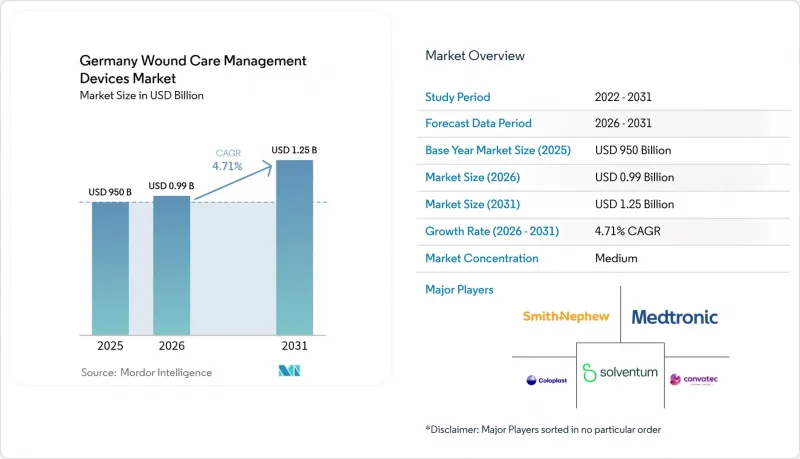
Mordor Intelligence에 따르면 2026년 독일의 창상 관리 디바이스 시장의 규모는 9억 9,475만 달러로 추정되고 있으며, 2025년 9억 5,000만 달러에서 확대하며, 2031년에는 12억 5,000만 달러에 달할 것으로 예측됩니다.
2026-2031년까지 연평균 성장률(CAGR) 4.71%로 성장할 것으로 전망됩니다.
이 보고서는 제품별(상처 관리[드레싱, 상처 관리 기기 등], 상처 봉합[봉합사, 외과용 스테이플러 등]), 상처 유형별(만성 상처, 급성 상처),최종사용자별(병원·전문 상처 클리닉 등), 구매 형태별(기관 조달, 소매/OTC 채널)로 분류되어 있습니다. 시장 규모 및 전망은 금액(달러) 기준으로 제시되어 있습니다.
독일 상처 관리 기기 시장의 동향 및 인사이트
증가하는 만성 상처와 고령 인구
독일에서는 이미 65세 이상 인구가 1,730만 명에 달하며, 중증 장애를 안고 생활하는 사람들의 비율은 계속 증가하고 있습니다. 유병률 조사에 따르면 요양 시설 입소자의 만성 상처 유병률은 7.8%이며, 그 절반은 욕창이 차지하고 있습니다. 병원 통합으로 인해 입원 병상 수가 감소함에 따라 간병은 지역사회로 이전되고 있으며, 임상적 성과를 저해하지 않으면서 환자 스스로 처치를 간소화할 수 있는 드레싱에 대한 수요가 높아지고 있습니다. 당뇨병 환자는 비당뇨병 환자에 비해 만성 상처 유병률이 높으며, 이로 인해 간호 방문 빈도가 줄어들더라도 치료를 지속할 수 있는 고품질의 다층 드레싱이나 센서가 장착된 음압 요법 시스템에 대한 수요가 증가하고 있습니다.
당뇨병 유병률이 당뇨병성 족부 궤양을 증가시키고 있다
독일 성인의 약 7.2%가 공식적으로 당뇨병 진단을 받았으며, 감시 연구에 따르면 추가로 2%가 미진단인 것으로 추정됩니다. 임상 등록부에 따르면 다학제적 협력을 통한 치료 경로가 마련되어 있음에도 불구하고 매년 25만 건의 신규 당뇨병성 족부 궤양과 1만 3,000건의 대규모 절단 수술이 기록되고 있습니다. 전문 센터에서는 절단 위험을 80%까지 낮출 수 있다는 증거가 제시됨에 따라 무증상 감염 마커를 감지할 수 있는 첨단 모니터링 기술과 항균 드레싱의 도입이 가속화되고 있습니다.
전문 상처 관리 간호사의 부족
연방 정부의 예측에 따르면 2049년까지 69만 명의 간호사가 부족할 가능성이 있습니다. 전문가 수가 감소하면 상처 드레싱 교체 빈도가 줄어들고, 전문가의 개입 없이 1주일 이상 효능을 유지할 수 있는 제품에 대한 의존도가 높아질 것입니다.
부문 분석
2025년, 독일의 상처 관리 기기 시장에서 매출의 64.88%를 상처 관리 제품이 차지했습니다. 이는 삼출액 조절과 피부 건강 유지를 동시에 실현하는 다기능 폼, 하이드로파이버, 실리콘 소재의 고흡수성 재료가 선호되고 있음을 반영합니다. 현재, 자동 압력 모니터가 장착된 음압 요법 시스템은 복잡한 외과적 상처에 대한 비용 절감 효과가 보험사 측에서 인정받으면서 의료 기관에서의 도입이 확대되고 있습니다. 항바이오필름 펩티드를 함유한 스마트 하이드로겔은 연구실 단계에서 상용화 단계로 넘어가고 있으며, 치유 속도의 추가적인 향상을 약속하고 있습니다. 기존의 거즈는 여전히 1차 진료 현장에서 사용되고 있지만, 저비용 복합 드레싱에 의한 시장 잠식 위협에 직면해 있습니다. 일회용 음압 요법(NPWT) 키트는 과거 펌프 대여와 관련된 물류 문제가 도입 장벽이 되었던 외래 진료 현장을 타겟으로 하고 있습니다. 이러한 혁신들이 결합되면서 독일의 상처 관리 기기 시장은 기술 주도형 성장 곡선을 유지할 것으로 보입니다.
병원들이 연기되었던 수술을 재개하고 생체흡수성 스테이플 및 조직 접착제를 채택함에 따라 상처 봉합용 기기는 2031년까지 5.12%라는 가장 높은 연평균 성장률(CAGR)을 보일 것으로 전망됩니다. 생체공학에 기반한 피부 대체재는 광범위한 조직 결손을 메우는 역할을 점점 더 많이 수행하고 있으며, 입원 기간을 단축하고 재택 치료 프로그램으로의 조기 퇴원을 가능하게 하고 있습니다. iCares의 프로토타입과 같이 바이오마커를 실시간으로 감지할 수 있는 스마트 붕대는 상처 봉합 제품이 진단 플랫폼으로서의 역할도 겸하게 될 시대가 도래할 것임을 예고합니다. 이러한 동향은 합병증 예방이라는 공적 보험의 목표와 밀접하게 부합하며, 독일의 상처 관리 기기 업계에서 전반적인 예산 제약이 있음에도 불구하고 조달 모멘텀이 지속되고 있음을 보여줍니다.
2025년, 독일 상처 관리 기기 시장 규모의 59.95%를 만성 병변이 차지했습니다. 당뇨병성 족부 궤양만 해도 매년 25만 건의 신규 사례가 발생하고 있으며, 이는 병원의 다학제적 사지 보존 팀에 대한 투자를 촉진하고 있습니다. 욕창 유병률은 여전히 장기 요양 시설에서 가장 높으며, 다량의 삼출액을 흡수하면서도 전단력을 분산시킬 수 있는 드레싱에 대한 수요를 높이고 있습니다. 또한 정맥성 하퇴 궤양 역시 항균 작용이 있는 은이나 폴리헥사나이드가 포함된, 압박 요법과 병용 가능한 소재의 활용을 촉진하고 있습니다. 현재 임상 지침에서는 세균 부하를 검출하기 위해 현장 진단(Point-of-Care) 방식의 형광 이미징을 권장하고 있으며, 이에 대응하는 드레싱의 수요 확대로 이어지고 있습니다.
급성 상처 시장은 팬데믹으로 인한 수술 지체가 해소됨에 따라 정형외과 및 종양외과수술 건수가 증가하고 있는 것을 배경으로 연평균 성장률(CAGR) 5.37%로 확대되고 있습니다. 장기 착용형 NPWT 드레싱은 현재 7일간 제자리에 유지될 수 있게 되어, 수술실에서 병동으로의 인계 횟수를 줄이고 간호 인력의 부담을 경감시키고 있습니다. 성장인자 매트릭스를 포함한 피부 이식 보조재는 화상이나 외상 후 회복 기간을 단축하며, 항균제로 코팅된 흡수성 봉합사는 수술 부위 감염 위험을 줄여줍니다. 이러한 발전은 독일의 상처 관리 기기 시장에서 판매되는 모든 급성기 치료용 의료기기에 대한 성능 기대치를 종합적으로 높이고 있습니다.
기타 혜택:
- 엑셀 형식의 시장 예측(ME) 시트
- 3개월간의 애널리스트 지원
자주 묻는 질문
목차
제1장 서론
제2장 조사 방법
제3장 개요
제4장 시장 구도
제5장 시장 규모와 성장 예측
제6장 경쟁 구도
제7장 시장 기회와 향후 전망
KSA 26.08.25According to Mordor Intelligence, Germany wound care management devices market size in 2026 is estimated at USD 994.75 million, growing from 2025 value of USD 950 million with 2031 projections showing USD 1.25 billion, growing at 4.71% CAGR over 2026-2031.
This report is Segmented by Product (Wound Care [Dressings, Wound-Care Devices, and More] and Wound Closure [Sutures, Surgical Staplers, and More]), Wound Type (Chronic Wounds and Acute Wounds), End User (Hospitals & Specialty Wound Clinics and More), and Mode of Purchase (Institutional Procurement and Retail / OTC Channel). The Market and Forecasts are Provided in Terms of Value (USD).
Germany Wound Care Management Devices Market Trends and Insights
Rising chronic wounds & geriatric population
Germany already counts 17.3 million citizens aged 65 years or older, and the proportion living with severe disability continues to climb. Prevalence surveys place chronic wounds among nursing-home residents at 7.8%, with pressure ulcers representing half of these lesions. As hospital consolidation reduces inpatient beds, more care shifts toward the community, elevating the need for dressings that simplify self-application without compromising clinical outcomes. Patients with diabetes show a higher chronic-wound prevalence than non-diabetics, which pushes demand for premium multilayer dressings and sensor-equipped negative-pressure systems able to sustain therapy between less frequent nursing visits.
Diabetes prevalence fuelling diabetic-foot ulcers
Roughly 7.2% of German adults carry a formal diabetes diagnosis, and surveillance studies estimate that another 2% remain undiagnosed. Clinical registries record 250,000 new diabetic-foot ulcers each year and 13,000 major amputations despite multidisciplinary care pathways . Evidence that specialised centres can cut amputation risk by 80% has accelerated procurement of advanced monitoring technologies and antimicrobial dressings capable of detecting sub-clinical infection markers.
Shortage of specialised wound-care nurses
Federal projections show a possible deficit of 690,000 nurses by 2049 Fewer professionals mean less frequent dressing changes and greater reliance on products that maintain efficacy for a week or more without specialist intervention.
Other drivers and restraints analyzed in the detailed report include:
- Continuous product innovation including silicone super-absorbers and NPWTi-d
- Hospital-digitalisation grants accelerating advanced wound-tech uptake
- Stringent EU-MDR post-market compliance burden
For complete list of drivers and restraints, kindly check the Table Of Contents.
Segment Analysis
Wound-care products generated 64.88% of Germany wound care management devices market revenue in 2025, reflecting a preference for multifunctional foams, hydrofibers, and silicone super-absorbers that address exudate control and skin integrity simultaneously. Negative-pressure systems, now equipped with automated pressure monitors, are gaining institutional traction as payers accept their cost-saving profile for complex surgical wounds. Smart hydrogels infused with antibiofilm peptides are moving from research labs toward commercial pipelines, promising additional gains in healing speed. Traditional gauze still serves primary-care settings but faces encroachment from low-cost composite dressings. Disposable NPWT kits target outpatient settings where pump rental logistics once constrained adoption. Together, these innovations ensure that the Germany wound care management devices market maintains a technology-led growth curve.
Wound-closure devices exhibit the fastest CAGR at 5.12% through 2031 as hospitals resume deferred surgeries and adopt bioresorbable staples and tissue adhesives. Bioengineered skin substitutes increasingly bridge extensive tissue defects, shortening hospital stays and enabling earlier discharge to home-care programmes. Smart bandages capable of real-time biomarker sensing, such as the iCares prototype, foreshadow an era in which closure products double as diagnostic platforms. These trends align closely with statutory insurance goals of complication prevention, indicating sustained procurement momentum despite overall budgetary constraints in the Germany wound care management devices industry.
Chronic lesions commanded 59.95% of Germany wound care management devices market size in 2025. Diabetic-foot ulcers alone account for 250,000 new cases every year, spurring hospital investment in multidisciplinary limb-saving teams. Pressure-ulcer prevalence remains highest in long-term-care institutions, reinforcing demand for dressings that can distribute shear forces while absorbing high exudate volumes. Venous leg ulcers also drive utilisation of compression-compatible materials with antimicrobial silver or polyhexanide. Clinical guidelines now recommend point-of-care fluorescence imaging to detect bacterial load, creating a pull-through effect for compatible dressings.
Acute wounds are expanding at a 5.37% CAGR, buoyed by rising orthopaedic and oncologic surgery volumes as pandemic backlogs clear. Extended-wear NPWT dressings now remain in situ for seven days, limiting theatre-to-ward hand-offs and freeing nursing resources. Skin-grafting adjuncts containing growth-factor matrices shorten recovery after burns and trauma, and absorbable sutures coated with antimicrobials lessen the risk of surgical-site infections. These developments collectively raise the performance expectations for all acute-care devices sold into the Germany wound care management devices market.
Complete Report Scope:
- By Product
- Wound Care
- Dressings
- Traditional Gauze & Tape Dressings
- Advanced Dressings
- Wound-Care Devices
- Negative Pressure Wound Therapy (NPWT)
- Oxygen & Hyperbaric Systems
- Electrical Stimulation Devices
- Other Wound Care Devices
- Other Wound Care Products
- Dressings
- Wound Closure
- Sutures
- Surgical Staplers
- Tissue Adhesives, Strips, Sealants & Glues
- Wound Care
- By Wound Type
- Chronic Wounds
- Diabetic Foot Ulcer
- Pressure Ulcer
- Venous Leg Ulcer
- Other Chronic Wounds
- Acute Wounds
- Surgical/Traumatic Wounds
- Burns
- Other Acute Wounds
- Chronic Wounds
- By End User
- Hospitals & Specialty Wound Clinics
- Long-term Care Facilities
- Home-Healthcare Settings
- By Mode of Purchase
- Institutional Procurement
- Retail / OTC Channel
List of Companies Covered in this Report:
- Hartmann Group
- Solventum
- B. Braun
- Smiths Group
- Molnlycke Health Care
- Cardinal Health
- ConvaTec Group plc
- Coloplast
- Medtronic
- Integra LifeSciences Holdings Corp.
- curea medical GmbH
- Lohmann & Rauscher GmbH
- Advanced Medical Solutions Group
- Hartmann Group
- Johnson & Johnson
- Stryker
- Medela
- QRSKIN GmbH
- Essity Medical
- Urgo Medical SAS
Additional Benefits:
- The market estimate (ME) sheet in Excel format
- 3 months of analyst support
TABLE OF CONTENTS
1 Introduction
- 1.1 Study Assumptions & Market Definition
- 1.2 Scope of the Study
2 Research Methodology
3 Executive Summary
4 Market Landscape
- 4.1 Market Overview
- 4.2 Market Drivers
- 4.2.1 Rising chronic wounds & geriatric population
- 4.2.2 Diabetes prevalence fuelling diabetic-foot ulcers
- 4.2.3 Continuous product innovation including silicone super-absorbers and NPWTi-d, among others
- 4.2.4 Hospital-digitalisation grants accelerating advanced wound tech uptake
- 4.2.5 Reimbursement for wound-care apps & tele-monitoring
- 4.2.6 Strong German cost-effectiveness evidence for NPWT boosting payer adoption
- 4.3 Market Restraints
- 4.3.1 High device costs & reimbursement gaps
- 4.3.2 Stringent EU-MDR post-market compliance burden
- 4.3.3 Fragmented outpatient-care financing limits home-care device penetration
- 4.3.4 Shortage of specialised wound-care nurses
- 4.4 Regulatory Landscape
- 4.5 Technological Outlook
- 4.6 Porters Five Forces Analysis
- 4.6.1 Threat of New Entrants
- 4.6.2 Bargaining Power of Buyers
- 4.6.3 Bargaining Power of Suppliers
- 4.6.4 Threat of Substitutes
- 4.6.5 Competitive Rivalry
5 Market Size & Growth Forecasts (Value, USD)
- 5.1 By Product
- 5.1.1 Wound Care
- 5.1.1.1 Dressings
- 5.1.1.1.1 Traditional Gauze & Tape Dressings
- 5.1.1.1.2 Advanced Dressings
- 5.1.1.2 Wound-Care Devices
- 5.1.1.2.1 Negative Pressure Wound Therapy (NPWT)
- 5.1.1.2.2 Oxygen & Hyperbaric Systems
- 5.1.1.2.3 Electrical Stimulation Devices
- 5.1.1.2.4 Other Wound Care Devices
- 5.1.1.3 Other Wound Care Products
- 5.1.1.1 Dressings
- 5.1.2 Wound Closure
- 5.1.2.1 Sutures
- 5.1.2.2 Surgical Staplers
- 5.1.2.3 Tissue Adhesives, Strips, Sealants & Glues
- 5.1.1 Wound Care
- 5.2 By Wound Type
- 5.2.1 Chronic Wounds
- 5.2.1.1 Diabetic Foot Ulcer
- 5.2.1.2 Pressure Ulcer
- 5.2.1.3 Venous Leg Ulcer
- 5.2.1.4 Other Chronic Wounds
- 5.2.2 Acute Wounds
- 5.2.2.1 Surgical/Traumatic Wounds
- 5.2.2.2 Burns
- 5.2.2.3 Other Acute Wounds
- 5.2.1 Chronic Wounds
- 5.3 By End User
- 5.3.1 Hospitals & Specialty Wound Clinics
- 5.3.2 Long-term Care Facilities
- 5.3.3 Home-Healthcare Settings
- 5.4 By Mode of Purchase
- 5.4.1 Institutional Procurement
- 5.4.2 Retail / OTC Channel
6 Competitive Landscape
- 6.1 Market Concentration
- 6.2 Market Share Analysis
- 6.3 Company Profiles (includes Global level Overview, Market level overview, Core Segments, Financials as available, Strategic Information, Market Rank/Share, Products & Services, Recent Developments)
- 6.3.1 PAUL HARTMANN AG
- 6.3.2 Solventum
- 6.3.3 B. Braun SE
- 6.3.4 Smith & Nephew plc
- 6.3.5 Molnlycke Health Care AB
- 6.3.6 Cardinal Health Inc.
- 6.3.7 ConvaTec Group plc
- 6.3.8 Coloplast A/S
- 6.3.9 Medtronic plc
- 6.3.10 Integra LifeSciences Holdings Corp.
- 6.3.11 curea medical GmbH
- 6.3.12 Lohmann & Rauscher GmbH
- 6.3.13 Advanced Medical Solutions Group plc
- 6.3.14 Hartmann Group
- 6.3.15 Johnson & Johnson (Ethicon)
- 6.3.16 Stryker Corp.
- 6.3.17 Medela AG
- 6.3.18 QRSKIN GmbH
- 6.3.19 Essity Medical
- 6.3.20 Urgo Medical SAS
7 Market Opportunities & Future Outlook
- 7.1 White-space & Unmet-Need Assessment