
|
시장보고서
상품코드
2113248
영국의 창상 관리 디바이스 : 시장 점유율 분석, 업계 동향과 통계, 성장 예측(2026-2031년)UK Wound Care Management Devices - Market Share Analysis, Industry Trends & Statistics, Growth Forecasts (2026 - 2031) |
||||||
 Mordor Intelligence
Mordor Intelligence에 따르면 2026년 영국의 창상 관리 디바이스 시장의 규모는 9억 3,000만 달러로 추정되고 있으며, 2025년 8억 9,000만 달러에서 확대하며, 2031년에는 11억 8,000만 달러에 달할 것으로 예측됩니다.
2026-2031년까지의 연평균 성장률(CAGR)은 4.85%에 달할 것으로 전망됩니다.
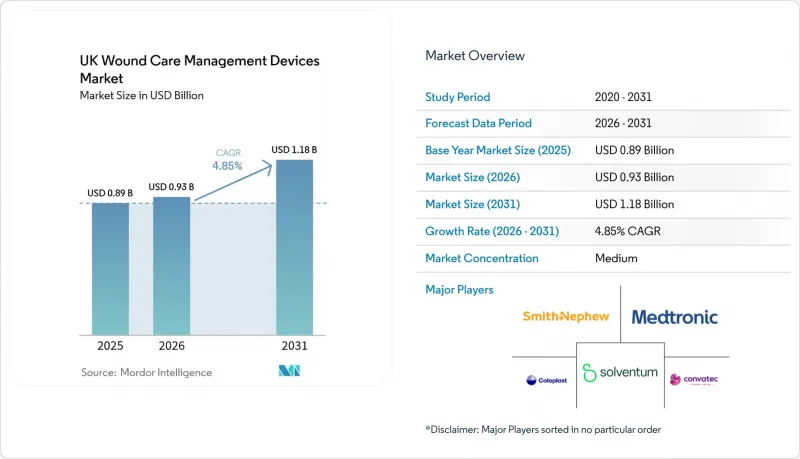
이 보고서는 제품별(상처 관리[드레싱, 상처 관리 기기 등], 상처 봉합[봉합사, 외과용 스테이플러 등]), 상처 유형별(만성 상처, 급성 상처),최종사용자별(병원·전문 상처 클리닉 등), 구매 형태별(기관 조달, 소매/OTC 채널)로 분류되어 있습니다. 시장 규모 및 전망은 금액(달러) 기준으로 제시되어 있습니다.
영국 상처 관리 기기 시장의 동향 및 인사이트
고령 인구 증가
영국 65세 이상 주민의 비율은 계속 증가하고 있으며, 2065년까지 26%에 달할 것으로 예측됩니다. 이로 인해 정맥성 하퇴 궤양, 당뇨병성 족부 궤양 및 욕창의 발생률이 상승하고 있습니다. 고령 환자들은 치유를 지연시키는 여러 가지 동반 질환을 앓고 있는 경우가 많아, 흡수성, 항균성 및 음압 드레싱에 대한 지속적인 수요를 창출하고 있습니다. 지방이나 해안 지역에서는 급성기 병원으로 이동하는 데 시간이 오래 걸리기 때문에 재택 간호에서 원격의료 대응이 가능한 창상 평가 툴이 필수적인 요소로 자리 잡고 있습니다. 따라서 AI 분류 소프트웨어와 착용하기 쉬운 드레싱을 세트로 판매하는 공급업체는 유리한 입장에 있습니다. 장기적으로는 고령 인구의 지속적인 증가가 영국의 상처 관리 기기 시장의 기초 판매량을 지원하게 될 것이며, 제조업체는 고정 비용을 더 많은 판매량에 분산시켜 가격 경쟁력을 유지하도록 유도될 것입니다.
만성 상처 및 관련 질환의 부담 증가
헬스 파운데이션(Health Foundation)의 예측에 따르면 2040년까지 930만 명의 영국 주민이 중증 질환을 앓으며 생활하게 될 것이며, 노동 연령층에서 증가하는 인구의 80%는 가장 빈곤한 지역에 집중될 것으로 보입니다. 당뇨병 유병률의 상승으로 만성 상처 환자 수가 증가하고 있으며, 그 결과 NHS(국민건강서비스)는 전체 예산의 3%를 상처 관리에 할당하고 있는 것으로 보고되고 있습니다. 부담이 큰 지역의 조달 팀은 치유 기간을 단축하는 것으로 입증된 제품을 우선적으로 채택하고 있으며, ConvaTec의 InnovaMatrix 및 Aquacel Ag+ 시리즈 등이 그 예입니다. 이러한 제품들의 기여로 인해 이 회사는 2024년 상처 관리 분야에서 6.7%의 유기적 성장을 달성했습니다. 지역 간 격차로 인해 만성질환 발생률이 가장 높은 북부 도시 지역에 추가 자금이 배정되고 있습니다. 이 지역에서 전문 클리닉의 수용 능력이 확대됨에 따라 영국의 상처 관리 기기 시장에서는 첨단 드레싱 재료, 피부 대체재, 원격 모니터링 기기를 통한 판매량이 서서히 증가하고 있습니다.
첨단 상처 관리 기기의 높은 비용
차세대 피부 대체재는 1제곱인치당 수천 달러에 달할 수 있으며, 중앙 조달을 통한 비용 절감 효과를 얻지 못하는 소규모 NHS 트러스트의 예산을 압박하고 있습니다. 임상적 유효성이 양호하더라도 재무 담당자들은 비용 대비 효과가 상회하는지 확인하기 위해 순현재가치 산정을 면밀히 검토하고 있습니다. 이에 대해 제조사 측은 가치 기반 계약, 성과 연동형 보상 조항, 그리고 재입원률 및 절단률 감소를 정량화한 의료 경제성 자료를 제시하며 대응하고 있습니다. Hartmann이 2024년에 기록한 4.4%의 유기적 매출 성장은 확고한 증거에 지원된 가격 경쟁력이 있는 실리콘계 고흡수성 드레싱이 비용 제약이 있는 의약품 리스트에 여전히 침투할 수 있음을 보여줍니다. 가격 수준이 하락하거나 보험 적용 범위가 확대될 때까지는 고급 의료기기의 도입이 교육 병원에 집중된 상태를 유지할 것이며, 영국 상처 관리 기기 시장의 전반적인 성장은 제한될 것입니다.
부문 분석
2025년, 상처 관리 제품은 영국 상처 관리 기기 시장 점유율의 63.05%를 차지했습니다. 이는 수십년에 걸친 임상적 정착도와 거즈에서 생체활성 매트릭스에 이르는 폭넓은 제품 라인업을 반영한 것입니다. 음압 상처 치료(NPWT) 시스템, 일회용 캐니스터 및 은 함유 폼은 이 시장에서 점유율을 확대하고 있습니다. 그 원인 중 하나로, RENASYS EDGE가 환자의 이동성 측면에서 제공하는 이점을 강조하여 세계적인 디자인 상을 수상한 점을 들 수 있습니다. 규모가 작은 상처 봉합 부문은 로봇 수술 및 복강경 수술의 보급에 따라 흡수성 스테이플러와 국소 조직 접착제의 적용 범위가 확대되고 있으며, 연평균 성장률(CAGR) 5.52%의 성장 궤도에 올라 있습니다. 각 제조사는 드레싱에 RFID 태그와 습도 센서를 내장하여, 과거에는 비활성 소재였던 것을 전자 차트와 연동되는 데이터가 풍부한 플랫폼으로 변모시키고 있습니다. 기존의 거즈는 삼출액이 적은 상처에서 여전히 중요한 역할을 하고 있지만, Hartmann의 첨단 실리콘계 초흡수재는 다기관 공동 감사에서 비용 대비 효과가 높은 것으로 입증됨에 따라 약품 리스트에서의 우선순위가 높아지고 있습니다.
2세대 피부 대체재, 재조합 성장인자, 생체흡수성 메쉬는 고가 제품군으로 판매될 것으로 예상되지만, 그 보급은 비용 대비 효과에 관한 데이터에 좌우될 것입니다. 예를 들어 ConvaTec의 InnovaMatrix는 조직 재생을 촉진하기 위해 돼지 진피를 채택하고 있으며, 이는 동사의 2024년 상반기 유기 매출 6.7% 증가를 지원하고 있습니다. 병원들이 조달 정책을 탄소 중립에 맞춰 나가면서, 바이오 기반 및 재활용 가능한 포장재의 영향력이 커지고 있습니다. 드레싱 사진을 통해 감염의 초기 징후를 감지하는 AI 알고리즘이 스타터 키트에 포함되기 시작했으며, 이러한 움직임은 타사 제품으로의 전환 장벽을 높여 고객 충성도를 공고히 하고 있습니다. 이 모든 요소를 종합해 볼 때, 제품 차별화, 규정 준수 및 지속가능성 노력은 영국 상처 관리 기기 시장의 구매 결정을 좌우하고 있습니다.
2025년에는 만성 상처가 매출의 59.10%를 차지하며, 영국 상처 관리 기기 시장에서 가장 큰 수요 요인으로의 입지를 공고히 했습니다. 발병률 측면에서는 하지 정맥성 궤양과 욕창이 주를 이루지만, 절단 위험이 높기 때문에 당뇨병성 족부 궤양이 환자 1인당 비용이 가장 높습니다. NICE의 UrgoStart Plus 승인은 항산화 및 프로테아제 조절형 드레싱에 대한 보험 적용 경로를 열어주었고, 근거 기반 치료법에 대한 관심을 높였습니다. AI를 활용한 예측 툴은 만성 창상 평가의 편차를 줄여주고 있으며, 임상의들이 항균 폼이나 피부 대체재를 활용한 조기 개입 프로토콜을 채택하도록 유도하고 있습니다.
급성 상처 시장은 외상 환자 수의 회복과 예정된 수술의 증가에 힘입어 2031년까지 연평균 성장률(CAGR) 5.65%로 확대될 전망입니다. Johnson & Johnson의 항균성 Ethicon Plus 봉합사는 감염 위험이 낮은 것으로 보고되어, 이에 따라 수술실 부문에서는 코팅된 봉합사 팩의 표준화가 진행되고 있습니다. 화상 치료 부문에서는 서방형 진통제가 내장된 하이드로겔 막의 시범 도입이 진행되고 있으며, 이를 통해 드레싱 교체시 통증을 경감시켜 환자의 순응도와 치료 성과 향상에 기여하고 있습니다. 군사 및 응급 대응 시장에서는 가혹한 환경에서도 작동하는 경량 지혈 패치에 대한 수요가 증가하고 있으며, 새로운 최종사용자층이 형성되고 있습니다. 만성적인 복잡성과 급성 사례 발생 건수의 상호 작용이 영국 상처 관리 기기 시장의 역동적인 제품 개발 주기의 기반이 되고 있습니다.
기타 혜택:
- 엑셀 형식의 시장 예측(ME) 시트
- 3개월간의 애널리스트 지원
자주 묻는 질문
목차
제1장 서론
제2장 조사 방법
제3장 개요
제4장 시장 구도
제5장 시장 규모와 성장 예측
제6장 경쟁 구도
제7장 시장 기회와 향후 전망
KSA 26.08.25According to Mordor Intelligence, UK wound care management devices market size in 2026 is estimated at USD 0.93 billion, growing from 2025 value of USD 0.89 billion with 2031 projections showing USD 1.18 billion, growing at 4.85% CAGR over 2026-2031.
This report is Segmented by Product (Wound Care [Dressings, Wound-Care Devices, and More] and Wound Closure [Sutures, Surgical Staplers, and More]), Wound Type (Chronic Wounds and Acute Wounds), End User (Hospitals & Specialty Wound Clinics and More), and Mode of Purchase (Institutional Procurement and Retail / OTC Channel). The Market and Forecasts are Provided in Terms of Value (USD).
UK Wound Care Management Devices Market Trends and Insights
Increase in Geriatric Population
The proportion of UK residents aged 65 and older continues to climb and is projected to reach 26% by 2065, pushing up the incidence of venous leg ulcers, diabetic foot ulcers, and pressure injuries . Older patients often present with multiple comorbidities that slow healing, creating repeat demand for absorbent, antimicrobial, and negative-pressure dressings. Rural and coastal communities face extended travel times to acute hospitals, so tele-enabled wound assessment tools are becoming critical for home-based care. Suppliers that bundle AI triage software with easy-to-apply dressings are therefore well positioned. Over the long term, sustained geriatric growth will underpin baseline volumes in the UK wound care management devices market, encouraging manufacturers to spread fixed costs across larger unit throughput and keep prices competitive.
Growing Burden of Chronic Wounds & Related Diseases
A Health Foundation projection indicates 9.3 million UK residents will be living with major illness by 2040, with 80% of working-age increases located in the most deprived districts . Rising diabetes prevalence inflates the pool of chronic wounds, leading the NHS to allocate a reported 3% of its entire budget to wound care. Procurement teams in high-burden regions are prioritizing products proven to shorten time-to-heal, such as ConvaTec's InnovaMatrix and Aquacel Ag+ lines, which helped the company deliver 6.7% organic wound-care growth in 2024. Regional inequalities are steering additional funding to northern urban centers where chronic disease rates are highest. As these geographies widen specialist clinic capacity, the UK wound care management devices market gains incremental volume from advanced dressings, skin substitutes, and remote-monitoring hardware.
High Cost of Advanced Wound Devices
Next-generation skin substitutes can cost thousands of dollars per square inch, stretching the budgets of smaller NHS trusts that lack central purchasing leverage. Even when clinical efficacy is favorable, financial directors scrutinize net-present-value calculations to ensure benefits outweigh expense. Manufacturers are responding with value-based contracting, pay-for-performance clauses, and health-economic dossiers that quantify reductions in readmission or amputation rates. Hartmann's 4.4% organic sales rise in 2024 illustrates how competitively priced silicone-based super-absorbent dressings, supported by solid evidence, can still penetrate cost-constrained formularies. Until price points fall or reimbursement widens, uptake of premium devices will remain concentrated in teaching hospitals, tempering aggregate growth for the UK wound care management devices market.
Other drivers and restraints analyzed in the detailed report include:
- Technological Advances in Surgical Procedures & Devices
- NHS-Backed Shift Toward Community-Based Wound Clinics
- Limited Reimbursement for Home-Care Consumables
For complete list of drivers and restraints, kindly check the Table Of Contents.
Segment Analysis
Wound Care products represented 63.05% of UK wound care management devices market share in 2025, reflecting decades-long clinical familiarity and a broad catalog ranging from gauze to bioactive matrices. Negative-pressure wound therapy (NPWT) systems, disposable canisters, and silver-impregnated foams account for a rising slice of this pool, in part because RENASYS EDGE won a global design award that underscored its patient-mobility advantage. The smaller Wound Closure category is on a 5.52% CAGR path as robotic and laparoscopic procedures broaden indications for absorbable staplers and topical tissue adhesives. Manufacturers are embedding RFID tags and moisture sensors into dressings, converting what was once inert material into data-rich platforms that integrate with electronic health records. Traditional gauze retains a role for low-exudate wounds, yet advanced silicone-based super-absorbents from Hartmann are gaining formulary priority after proving cost-effective in multicenter audits.
Second-generation skin substitutes, recombinant growth factors, and bioresorbable meshes are poised to command premium price bands, though their diffusion will depend on cost-effectiveness dossiers. ConvaTec's InnovaMatrix, for instance, employs porcine dermis to accelerate tissue regeneration, supporting the firm's 6.7% organic revenue rise in H1 2024. As hospitals align procurement with Net-Zero, bio-based and recyclable packaging gains influence. AI algorithms that flag early infection signs from dressing photos are being bundled with starter kits, a move that elevates switching barriers and anchors account loyalty. Taken together, product differentiation, regulatory compliance, and sustainability credentials direct purchasing decisions in the UK wound care management devices market.
Chronic Wounds accounted for 59.10% of revenue in 2025, cementing their role as the largest demand driver for the UK wound care management devices market. Venous leg ulcers and pressure injuries dominate incidence tables, although diabetic foot ulcers incur the steepest per-patient cost because of high amputation risk. NICE endorsement of UrgoStart Plus opened reimbursement pathways for oxidative and protease-modulating dressings, sharpening the focus on evidence-backed therapies. AI-enabled prediction tools are reducing variability in chronic-wound assessment, steering clinicians toward early intervention protocols that rely on antimicrobial foams and skin substitutes.
Acute Wounds are set to expand at a 5.65% CAGR through 2031, driven by the rebound in trauma presentations and elective surgeries. Johnson & Johnson's antibacterial Ethicon Plus sutures report lower infection odds, which is encouraging theatre departments to standardize on coated suture packs. Burns units are trialing hydrogel membranes embedded with slow-release analgesics that cut dressing-change pain, enhancing patient compliance and outcomes. Military and emergency-response markets are demanding lightweight haemostatic patches that function under austere conditions, introducing new end-user segments. The interplay between chronic complexity and acute episode volume underpins a dynamic product-development cycle inside the UK wound care management devices market.
Complete Report Scope:
- By Product
- Wound Care
- Dressings
- Traditional Gauze & Tape Dressings
- Advanced Dressings
- Wound-Care Devices
- Negative Pressure Wound Therapy (NPWT)
- Oxygen & Hyperbaric Systems
- Electrical Stimulation Devices
- Other Wound Care Devices
- Other Wound Care Products
- Dressings
- Wound Closure
- Sutures
- Surgical Staplers
- Tissue Adhesives, Strips, Sealants & Glues
- Wound Care
- By Wound Type
- Chronic Wounds
- Diabetic Foot Ulcer
- Pressure Ulcer
- Venous Leg Ulcer
- Other Chronic Wounds
- Acute Wounds
- Surgical/Traumatic Wounds
- Burns
- Other Acute Wounds
- Chronic Wounds
- By End User
- Hospitals & Specialty Wound Clinics
- Long-term Care Facilities
- Home-Healthcare Settings
- By Mode of Purchase
- Institutional Procurement
- Retail / OTC Channel
List of Companies Covered in this Report:
- Solventum
- Smiths Group
- Convatec
- Johnson & Johnson
- Molnlycke Health Care
- KCI Inc. (Acelity)
- Coloplast
- Medtronic
- B. Braun
- Baxter
- Hartmann Group
- BSN Medical
- Lohmann & Rauscher
- Advanced Medical Solutions Group
- Integra LifeSciences
- Medela
- Stryker
- Derma Sciences (Integra)
- DermaRite Industries
- Mimedx Group
Additional Benefits:
- The market estimate (ME) sheet in Excel format
- 3 months of analyst support
TABLE OF CONTENTS
1 Introduction
- 1.1 Study Assumptions & Market Definition
- 1.2 Scope of the Study
2 Research Methodology
3 Executive Summary
4 Market Landscape
- 4.1 Market Overview
- 4.2 Market Drivers
- 4.2.1 Increase in geriatric population
- 4.2.2 Growing burden of chronic wounds & related diseases
- 4.2.3 Technological advances in surgical procedures & devices
- 4.2.4 NHS-backed shift toward community-based wound clinics
- 4.2.5 AI-enabled digital wound assessment platforms
- 4.2.6 Bio-based dressings aligned with UK Net-Zero targets
- 4.3 Market Restraints
- 4.3.1 High cost of advanced wound devices
- 4.3.2 Limited reimbursement for home-care consumables
- 4.3.3 Post-Brexit UKCA regulatory delays & supply risk
- 4.3.4 Clinical staffing shortages for tech-intensive devices
- 4.4 Regulatory Landscape
- 4.5 Technological Outlook
- 4.6 Porters Five Forces Analysis
- 4.6.1 Threat of New Entrants
- 4.6.2 Bargaining Power of Buyers/Consumers
- 4.6.3 Bargaining Power of Suppliers
- 4.6.4 Threat of Substitute Products
- 4.6.5 Intensity of Competitive Rivalry
5 Market Size & Growth Forecasts (Value, USD)
- 5.1 By Product
- 5.1.1 Wound Care
- 5.1.1.1 Dressings
- 5.1.1.1.1 Traditional Gauze & Tape Dressings
- 5.1.1.1.2 Advanced Dressings
- 5.1.1.2 Wound-Care Devices
- 5.1.1.2.1 Negative Pressure Wound Therapy (NPWT)
- 5.1.1.2.2 Oxygen & Hyperbaric Systems
- 5.1.1.2.3 Electrical Stimulation Devices
- 5.1.1.2.4 Other Wound Care Devices
- 5.1.1.3 Other Wound Care Products
- 5.1.1.1 Dressings
- 5.1.2 Wound Closure
- 5.1.2.1 Sutures
- 5.1.2.2 Surgical Staplers
- 5.1.2.3 Tissue Adhesives, Strips, Sealants & Glues
- 5.1.1 Wound Care
- 5.2 By Wound Type
- 5.2.1 Chronic Wounds
- 5.2.1.1 Diabetic Foot Ulcer
- 5.2.1.2 Pressure Ulcer
- 5.2.1.3 Venous Leg Ulcer
- 5.2.1.4 Other Chronic Wounds
- 5.2.2 Acute Wounds
- 5.2.2.1 Surgical/Traumatic Wounds
- 5.2.2.2 Burns
- 5.2.2.3 Other Acute Wounds
- 5.2.1 Chronic Wounds
- 5.3 By End User
- 5.3.1 Hospitals & Specialty Wound Clinics
- 5.3.2 Long-term Care Facilities
- 5.3.3 Home-Healthcare Settings
- 5.4 By Mode of Purchase
- 5.4.1 Institutional Procurement
- 5.4.2 Retail / OTC Channel
6 Competitive Landscape
- 6.1 Market Concentration
- 6.2 Market Share Analysis
- 6.3 Company Profiles {(includes Global level Overview, Market level overview, Core Segments, Financials as available, Strategic Information, Market Rank/Share for key companies, Products & Services, and Recent Developments)}
- 6.3.1 Solventum
- 6.3.2 Smith & Nephew
- 6.3.3 Convatec Group PLC
- 6.3.4 Johnson & Johnson (Ethicon)
- 6.3.5 Molnlycke Health Care
- 6.3.6 KCI Inc. (Acelity)
- 6.3.7 Coloplast A/S
- 6.3.8 Medtronic PLC
- 6.3.9 B. Braun SE
- 6.3.10 Baxter International
- 6.3.11 Paul Hartmann AG
- 6.3.12 BSN Medical (Essity)
- 6.3.13 Lohmann & Rauscher
- 6.3.14 Advanced Medical Solutions Group
- 6.3.15 Integra LifeSciences
- 6.3.16 Medela AG
- 6.3.17 Stryker Corporation
- 6.3.18 Derma Sciences (Integra)
- 6.3.19 DermaRite Industries
- 6.3.20 Mimedx Group
7 Market Opportunities & Future Outlook
- 7.1 White-space & Unmet-need Assessment