

|
시장보고서
상품코드
2115062
아시아태평양의 자동차용 인포테인먼트 시스템 시장 : 시장 점유율 분석, 업계 동향 및 통계, 성장 예측(2026-2031년)Asia Pacific Automotive Infotainment Systems - Market Share Analysis, Industry Trends & Statistics, Growth Forecasts (2026 - 2031) |
||||||
 Mordor Intelligence
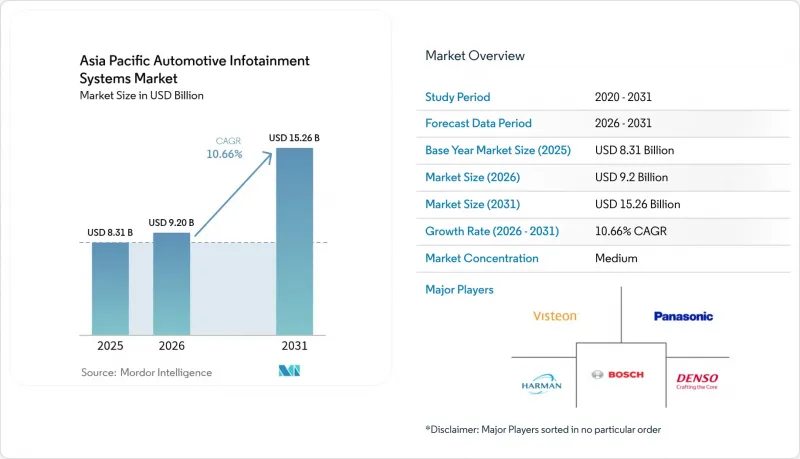
Mordor Intelligence에 의하면, 아시아태평양의 자동차용 인포테인먼트 시스템 시장 규모는 2025년에 83억 1,000만 달러로 평가되었고, 2026년 92억 달러에서 2031년까지 152억 6,000만 달러에 이를 것으로 추정되며, 예측 기간(2026-2031년) CAGR은 10.66%를 나타낼 전망입니다.
본 보고서는 설치 유형별(대시보드 내장형 인포테인먼트 등), 차량 유형별(승용차 등), 구성 요소별(디스플레이, 헤드 유닛 등), 구동 방식별(내연 기관 등), 연결성별(4G, 5G, 2G/3G), 운영 체제별(리눅스 등), 판매 채널별(OEM 및 애프터마켓), 국가별로 분류되어 있습니다. 시장 전망은 금액 기준(달러)으로 제시되어 있습니다.
아시아태평양의 자동차용 인포테인먼트 시스템 시장 동향 및 인사이트
커넥티드카 서비스에 대한 수요 증가
플릿 사업자와 라이드셰어·어그리게이터는 현재 인포테인먼트 시스템을 단순한 차량 내 사치품이 아닌, 업무 효율을 높이기 위한 중요한 도구로 인식하고 있습니다. 텔레매틱스 통합을 통해 보다 효율적인 경로 설정이 가능해지며, 운전자의 행동에 대한 인사이트력을 얻을 수 있고, 예측 유지보수가 지원됩니다. 이 모든 요소가 연료 소비량의 현저한 절감에 기여하고 있습니다. 인도나 한국 등 시장에서는 주행 거리에 따른 보험(Usage-based Insurance) 시범 사업이 개별 인센티브를 제공함으로써 커넥티비티 지원 헤드 유닛의 도입을 촉진하고 있습니다. 또한, 클라우드 기반 교통 예측 기술을 활용함으로써 내장형 지도 시스템이 더 이상 필요 없어져 운영이 합리화되었습니다. 그 결과, 부품표(BOM)의 총비용이 절감되어 비용 효율성이 향상되었습니다.
OTA를 통한 업그레이드가 가능한 소프트웨어 정의 차량으로의 전환
2024년, 폭스바겐 그룹 차이나는 다수의 차종에 무선(OTA) 업데이트를 도입했습니다. 동시에, 현대와 기아는 이듬해 출시 예정인 모델의 대부분에 OTA 업데이트를 확대할 계획입니다. 또한, BMW의 iDrive 9.0에는 하이퍼바이저가 내장되어 있어 콕핏 시스템의 독립적인 업데이트가 가능해졌습니다. 이러한 이터레이션 주기 단축을 위한 진전은 구독형 수익원의 성장을 가속하는 동시에, 차량 리콜과 관련된 비용 절감으로도 이어지고 있습니다.
가격에 민감한 시장에서 높은 부품 원가
인포테인먼트 시스템의 부품 원가(BOM) 중 디스플레이 모듈, 커넥티비티용 IC 및 SoC가 대부분을 차지합니다. 인도 양산차 시장의 비용 제약으로 인해 OEM은 합리적인 가격을 유지하기 위해 기능을 간소화한 헤드 유닛을 탑재할 수밖에 없습니다. 또한, 아세안(ASEAN) 국가들이 부과하는 수입 관세로 인해 반도체의 총비용이 크게 증가하고 있습니다. 반면, 인도 국내의 제조 능력은 여전히 제한적이며, 주로 와이어 하네스 생산이나 기본적인 조립 작업에 중점을 두고 있습니다.
부문 분석
2025년 매출의 77.65%를 대시보드 내장형 유닛이 차지한 반면, 뒷좌석용 엔터테인먼트 매출은 연평균 성장률(CAGR) 12.04%로 증가하고 있습니다. 콘티넨탈의 곡면 멀티존 디스플레이는 배선 무게를 줄이고, 승객 각자가 개별적으로 스트리밍을 이용할 수 있게 해줍니다. 중국과 한국에서는 운전기사 고용 문화가 수요를 가속화하고 있는 반면, 비용에 민감한 인도와 아세안 국가에서는 여전히 대시보드 내장형이 주류를 이루고 있습니다. NIO와 같은 프리미엄 전기차 브랜드는 현재 뒷좌석용 스크린을 기본 사양으로 장착하고 있으며, 과거에는 고급차에만 국한되었던 기능이 이제 중형차에서도 당연한 기대 사항이 되고 있습니다.
차량 내 스크린 면적의 확대는 타겟팅 광고를 가능하게 하여, OEM의 앱 스토어에 새로운 수익원을 제공합니다. 따라서 아시아태평양의 자동차용 인포테인먼트 시스템 시장에서는 뒷좌석 도입 확대가 공급업체의 로드맵에 영향을 미치며, 여러 디스플레이를 개별적으로 구동하는 모듈형 도메인 컨트롤러로의 전환이 진행되고 있습니다. 이는 2031년을 향해 중요한 차별화 분야가 될 것입니다.
소형 상용차는 연평균 성장률(CAGR) 11.55%로 성장을 지속하고, 있으며, 텔레매틱스 지원 인포테인먼트 시스템을 활용하여 경로 최적화 및 운전자 분석을 수행하고 있습니다. 마힌드라의 ‘Treo Zor’는 차량 내 터치스크린을 통해 접근 가능한 플릿 API를 탑재하고 있어, 물류 사업자들이 인포테인먼트 시스템을 어떻게 미션 크리티컬한 대시보드로 전환하고 있는지를 보여줍니다.
플릿 구매자는 가동 시간과 총소유비용(TCO)을 최우선으로 고려하기 때문에 내후성이 뛰어난 스크린, 원격 진단, FOTA가 필수적입니다. 각 OEM 업체들은 구매 시 패키지화된 단계별 SaaS 플랜을 제공하며, 다년간의 데이터 계약을 확정하고 있습니다. 아시아태평양의 자동차용 인포테인먼트 시스템 시장은 쇼룸 판매를 넘어 지속적인 수익을 창출하고 있으며, 이는 공급업체들이 LCV에 전략적으로 집중하는 기반이 되고 있습니다.
2025년에는 프리미엄급에서 OLED가 LCD를 대체함에 따라 디스플레이가 가치 점유율의 43.28%를 차지했습니다. 삼성디스플레이의 명암비 100,000:1을 자랑하는 자동차용 OLED는 증강현실(AR) 오버레이와 마이크로초 단위의 응답 속도를 실현하고 있습니다. 그러나 OS 소프트웨어와 앱이 연평균 성장률(CAGR) 13.18%로 성장을 주도하고 있어, 이익률의 변화를 시사하고 있습니다.
도메인 컨트롤러는 현재 콕핏, 계기판, 뒷좌석의 로직을 단일 SoC로 통합하여 부품 원가를 대폭 절감하고 있습니다. 구독형 비즈니스 모델로의 전환에 따라 OEM 각사는 기존 휴대전화 플랫폼에 비해 앱 스토어 수익에서 더 큰 점유율을 확보하고 있습니다. 그 결과, 아시아태평양의 자동차용 인포테인먼트 시스템 시장에서 하드웨어 제공에만 집중하던 상태에서 엔드투엔드 소프트웨어 라이프사이클 서비스 제공으로 전환한 공급업체들이 점점 더 큰 혜택을 누리고 있습니다.
기타 혜택 :
- 엑셀 형식 시장 예측(ME) 시트
- 3개월간의 애널리스트 지원
자주 묻는 질문
목차
제1장 서론
제2장 조사 방법
제3장 주요 요약
제4장 시장 구도
제5장 시장 규모 및 성장 예측
제6장 경쟁 구도
제7장 시장 기회 및 향후 전망
AJY 26.08.28According to Mordor Intelligence, the Asia-Pacific automotive infotainment system market size was valued at USD 8.31 billion in 2025 and estimated to grow from USD 9.2 billion in 2026 to reach USD 15.26 billion by 2031, at a CAGR of 10.66% during the forecast period (2026-2031).
This report is Segmented by Installation Type (In-Dash Infotainment, and More), Vehicle Type (Passenger Cars, and More), Component (Display, Head Unit, and More), Propulsion (Internal Combustion Engine, and More), Connectivity (4G, 5G, and 2G/3G), Operating System (Linux, and Others), Sales Channel (OEM and Aftermarket), and Country. The Market Forecasts in Value (USD).
Asia Pacific Automotive Infotainment Systems Market Trends and Insights
Growing Demand for Connected-Car Services
Fleet operators and ride-hailing aggregators now view infotainment as a critical tool for enhancing operational efficiency rather than a mere cabin luxury. The integration of telematics enables more efficient routing, provides insights into driver behavior, and supports predictive maintenance, all of which contribute to noticeable reductions in fuel consumption. In markets such as India and South Korea, usage-based insurance pilots are encouraging the adoption of connectivity-enabled head units by offering tailored incentives. Furthermore, the use of cloud-based traffic prediction has streamlined operations by eliminating the need for embedded maps, thereby reducing the overall Bill of Materials (BOM) and improving cost efficiency.
Shift to OTA-Upgradeable, Software-Defined Vehicles
In 2024, Volkswagen Group China introduced over-the-air (OTA) updates for a significant number of vehicles . At the same time, Hyundai and Kia plan to extend OTA updates to the majority of their upcoming models for the following year. Furthermore, BMW's iDrive 9.0 incorporates hypervisors to enable independent updates for cockpit systems. These advancements in faster iteration cycles are driving growth in subscription-based revenue streams while simultaneously reducing costs associated with vehicle recalls.
High BOM Cost in Price-Sensitive Markets
Display modules, connectivity ICs, and SoCs account for a major portion of the infotainment bill of materials. Due to cost constraints in India's mass-market cars, original equipment manufacturers are compelled to ship head units with simplified features to maintain affordability. Furthermore, import tariffs imposed by ASEAN countries significantly increase the overall cost of semiconductors. Meanwhile, local manufacturing capabilities in India remain limited, focusing primarily on the production of wiring harnesses and performing basic assembly tasks.
Other drivers and restraints analyzed in the detailed report include:
- OEM-Tech Giant Platform Partnerships
- Low-Cost SoC Penetration in Entry-Level Cars
- Patchy 5G Coverage Outside Metro Areas
For complete list of drivers and restraints, kindly check the Table Of Contents.
Segment Analysis
Rear-seat entertainment revenue is climbing at 12.04% CAGR, even as in-dash units dominated 77.65% of 2025 sales. Curved multi-zone displays from Continental reduce wiring weight and enable independent streaming for passengers. Chauffeur-driven cultures in China and South Korea accelerate demand, whereas cost-sensitive India and ASEAN remain in-dash centric. Premium EV brands, such as NIO, now bundle rear-seat screens as a baseline, moving a former luxury feature into mid-segment expectations.
Greater cabin screen real estate supports targeted advertising, unlocking fresh revenue for OEM app stores. The Asia-Pacific Automotive Infotainment System market, therefore, sees rear-seat uptake influencing supplier roadmaps toward modular domain controllers that independently power multiple displays-a critical differentiation frontier heading to 2031.
Passenger cars account for 71.78% of revenue, yet they are pivoting to subscription models for navigation and ADAS upgrades. Light commercial vehicles deliver 11.55% CAGR, leveraging telematics-enabled infotainment for route optimization and driver analytics. Mahindra's Treo Zor embeds fleet APIs accessible via cabin touchscreens, illustrating how logistics operators convert infotainment into a mission-critical dashboard.
Fleet buyers prioritize uptime and TCO, so ruggedized screens, remote diagnostics, and FOTA are vital. OEMs offer tiered SaaS plans that are packaged at the time of purchase, locking in multi-year data contracts. The Asia-Pacific Automotive Infotainment System market accrues incremental recurring revenue beyond the showroom, underpinning strategic focus on LCVs for suppliers.
Displays secured a 43.28% value share in 2025, as OLEDs replace LCDs in premium tiers. Samsung Display's 100,000:1-contrast automotive OLED enables augmented-reality overlays and microsecond response times. Yet, operating-system software and apps lead growth at a 13.18% CAGR, signaling a margin migration.
Domain controllers now integrate cockpit, cluster, and rear-seat logic into a single SoC, significantly reducing the bill of materials. With the shift to subscription-based economics, original equipment manufacturers retain a larger share of app-store revenues compared to traditional phone platforms. Consequently, the Asia-Pacific Automotive Infotainment System market increasingly benefits suppliers that adapt from focusing solely on hardware delivery to offering end-to-end software lifecycle services.
Complete Report Scope:
- By Installation Type
- In-dash Infotainment
- Rear-seat Infotainment
- By Vehicle Type
- Passenger Cars
- Light Commercial Vehicles
- Medium and Heavy Commercial Vehicles
- By Component
- Display / Touch-screen Module
- Head Unit / Domain Controller
- Operating-System Software and Apps
- Connectivity ICs and Antenna Modules
- By Propulsion Type
- Internal-Combustion Engine Vehicles
- Hybrid Electric Vehicles
- Battery Electric Vehicles
- By Connectivity Generation
- 4G LTE
- 5G
- Legacy 2G/3G
- By Operating System
- Linux-Based (AAOS, AGL, etc.)
- QNX
- Android Automotive OS
- Others (Proprietary, RTOS)
- By Sales Channel
- OEM-Installed
- Aftermarket
- By Country
- China
- Japan
- India
- South Korea
- Australia
- Rest of Asia-Pacific
List of Companies Covered in this Report:
- Panasonic Corporation
- Harman International Inc. (Samsung)
- Denso Corporation
- Robert Bosch GmbH
- Visteon Corporation
- Continental AG
- Alpine Electronics Inc.
- JVCKenwood Corporation
- Mitsubishi Electric Corporation
- Aptiv PLC
- Hyundai Mobis
- Garmin Ltd.
- Sony Group Corporation
- BlackBerry QNX
Additional Benefits:
- The market estimate (ME) sheet in Excel format
- 3 months of analyst support
TABLE OF CONTENTS
1 Introduction
- 1.1 Study Assumptions and Market Definition
- 1.2 Scope of the Study
2 Research Methodology
3 Executive Summary
4 Market Landscape
- 4.1 Market Overview
- 4.2 Market Drivers
- 4.2.1 Growing Demand for Connected-Car Services
- 4.2.2 OEM-Tech Giant Platform Partnerships
- 4.2.3 Regulatory Mandates (ecall, Telematics)
- 4.2.4 Localized OTT and Navigation Ecosystems (ASEAN)
- 4.2.5 Low-Cost Soc Penetration in Entry-Level Cars
- 4.2.6 Shift to OTA-Upgradeable, Software-Defined Vehicles
- 4.3 Market Restraints
- 4.3.1 High BOM Cost in Price-Sensitive Markets
- 4.3.2 Software Fragmentation and Cybersecurity Risks
- 4.3.3 Head-Unit Shortages from Chip Supply Shocks
- 4.3.4 Patchy 5G Coverage Outside Metro Areas
- 4.4 Value / Supply-Chain Analysis
- 4.5 Regulatory Landscape
- 4.6 Technological Outlook
- 4.7 Porter's Five Forces
- 4.7.1 Threat of New Entrants
- 4.7.2 Bargaining Power of Suppliers
- 4.7.3 Bargaining Power of Buyers
- 4.7.4 Threat of Substitutes
- 4.7.5 Competitive Rivalry
5 Market Size and Growth Forecasts
- 5.1 By Installation Type
- 5.1.1 In-dash Infotainment
- 5.1.2 Rear-seat Infotainment
- 5.2 By Vehicle Type
- 5.2.1 Passenger Cars
- 5.2.2 Light Commercial Vehicles
- 5.2.3 Medium and Heavy Commercial Vehicles
- 5.3 By Component
- 5.3.1 Display / Touch-screen Module
- 5.3.2 Head Unit / Domain Controller
- 5.3.3 Operating-System Software and Apps
- 5.3.4 Connectivity ICs and Antenna Modules
- 5.4 By Propulsion Type
- 5.4.1 Internal-Combustion Engine Vehicles
- 5.4.2 Hybrid Electric Vehicles
- 5.4.3 Battery Electric Vehicles
- 5.5 By Connectivity Generation
- 5.5.1 4G LTE
- 5.5.2 5G
- 5.5.3 Legacy 2G/3G
- 5.6 By Operating System
- 5.6.1 Linux-Based (AAOS, AGL, etc.)
- 5.6.2 QNX
- 5.6.3 Android Automotive OS
- 5.6.4 Others (Proprietary, RTOS)
- 5.7 By Sales Channel
- 5.7.1 OEM-Installed
- 5.7.2 Aftermarket
- 5.8 By Country
- 5.8.1 China
- 5.8.2 Japan
- 5.8.3 India
- 5.8.4 South Korea
- 5.8.5 Australia
- 5.8.6 Rest of Asia-Pacific
6 Competitive Landscape
- 6.1 Market Concentration
- 6.2 Strategic Moves
- 6.3 Market Share Analysis
- 6.4 Company Profiles {(Includes Global level Overview, Market level overview, Core Segments, Financials as available, Strategic Information, Market Rank/Share for key companies, Products and Services, and Recent Developments)}
- 6.4.1 Panasonic Corporation
- 6.4.2 Harman International Inc. (Samsung)
- 6.4.3 Denso Corporation
- 6.4.4 Robert Bosch GmbH
- 6.4.5 Visteon Corporation
- 6.4.6 Continental AG
- 6.4.7 Alpine Electronics Inc.
- 6.4.8 JVCKenwood Corporation
- 6.4.9 Mitsubishi Electric Corporation
- 6.4.10 Aptiv PLC
- 6.4.11 Hyundai Mobis
- 6.4.12 Garmin Ltd.
- 6.4.13 Sony Group Corporation
- 6.4.14 BlackBerry QNX


