

|
시장보고서
상품코드
2120285
자동차 인포테인먼트 시스템 시장 : 점유율 분석, 업계 동향과 통계, 성장 예측(2026-2031년)Automotive Infotainment Systems - Market Share Analysis, Industry Trends & Statistics, Growth Forecasts (2026 - 2031) |
||||||
 Mordor Intelligence
Mordor Intelligence에 의하면, 자동차 인포테인먼트 시스템 시장 규모는 2026년에 285억 1,000만 달러로 추정되고 있어 예측 기간(2026-2031년)에서 CAGR 6.11%로 확대되어 2031년까지 383억 5,000만 달러에 이를 전망입니다.
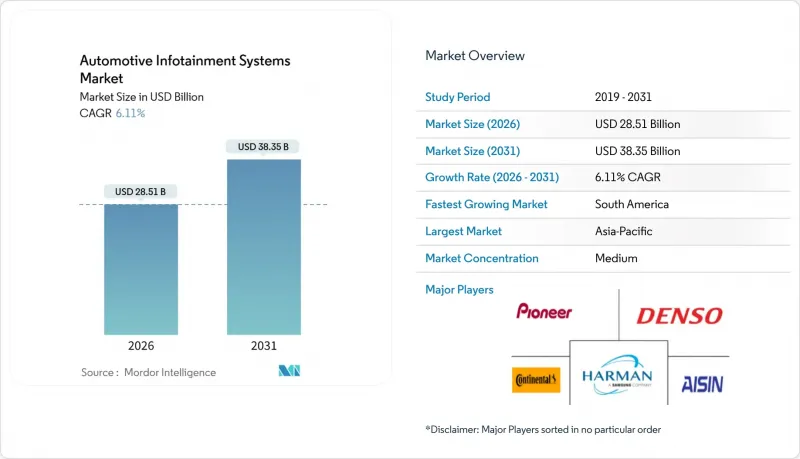
본 보고서는 설치 유형(대시보드 내장형 인포테인먼트 및 뒷좌석용 인포테인먼트), 차종(승용차 등), 구성 요소(디스플레이/터치스크린 모듈 등),구동 방식(내연기관 차량 등), 커넥티비티 세대, 운영 체제, 판매 채널 및 지역별로 분류되어 있습니다. 시장 전망은 금액(달러) 및 수량(대수)으로 제시되어 있습니다.
세계 자동차 인포테인먼트 시스템 시장 동향 및 인사이트
커넥티드 서비스에 대한 소비자 수요와 5G 확산
세계 자동차 소유자의 5분의 2가 더 나은 인포테인먼트 사용자 경험을 위해 브랜드 변경을 고려하고 있으며, 독일에서는 그 비율이 거의 절반까지 상승했습니다. AT&T는 2025년에 도요타 및 렉서스 차량에 5G 연결 서비스를 제공하기 시작하여, 실시간 경로 재설정, 클라우드 음성 어시스턴트, 저지연 V2X 메시징을 가능하게 했습니다. 네트워크 슬라이싱을 통해 안전 관련 통신을 위한 대역폭을 확보하는 동시에 뒷좌석으로 4K 동영상 스트리밍을 동시에 실행할 수 있으며, 이는 4G LTE에서는 실현하기 어려운 기능입니다. 제너럴 모터스(GM)는 2025년 및 2026년형 모델에 Apple Music을 기본으로 탑재하고, 브랜드 충성도를 높이기 위해 8년간 무료 스트리밍 서비스를 제공합니다.
소프트웨어 정의 차량 및 디지털 콕핏으로의 전환
OTA(Over-the-Air) 배포를 통해 소프트웨어 정의 아키텍처는 기능 출시 지연을 대폭 단축하고, 보다 신속한 업데이트를 가능하게 했습니다. 도요타의 차기 RAV4는 Arene 플랫폼을 활용하여 지속적인 업데이트가 예정되어 있습니다. 한편, BMW의 ‘Operating System X’는 가까운 시일 내에 ‘Neue Klasse’에서 데뷔할 예정이며, 이를 통해 BMW는 데이터와 그 수익화에 대한 통제권을 유지할 수 있게 될 것입니다. OEM 각사가 사용자 인터페이스 계층의 개발을 점점 더 주도함에 따라, Tier 1 공급업체들은 미들웨어 서비스로 집중 분야를 전환하고 있습니다. 업계 전망에 따르면, 자동차 소프트웨어 매출은 향후 몇 년간 크게 성장할 것이며, 그 중 상당 부분을 인포테인먼트, 커넥티비티, 보안이 차지할 것으로 보입니다. 소프트웨어 인력을 확대할 능력이 부족한 공급업체는 특히 하드웨어의 상품화가 진행되는 가운데 시장에서 도태될 위험에 직면해 있습니다.
엔트리 모델의 비용 의식
신흥 시장의 가격에 민감한 구매자들은 1만 5,000달러 미만의 가격대를 실현하기 위해 터치스크린이나 커넥티비티 기능을 포기하는 경우가 많습니다. 인도에서는 마루티 스즈키 ‘알토’의 기본 트림에 아날로그 계기판이 탑재되어 있어, 프리미엄 헤드 유닛 도입의 기반이 제한되고 있습니다. 중국에서 진입한 신규 기업들이 가격 경쟁을 심화시키면서, 기존 제조업체들은 인포테인먼트 비용을 흡수하거나 시장 점유율 하락을 감수할 수밖에 없는 상황에 몰리고 있습니다. 150-300달러 상당의 애프터마켓용 안드로이드 헤드 유닛은 부분적인 해결책이 될 수는 있지만, 차량과의 심층적인 통합에는 한계가 있습니다. 커넥티비티 도입이 지연되고 있는 것은 앱 스토어 생태계에 필수적인 네트워크 효과를 저해하고 있습니다.
부문 분석
자동차 인포테인먼트 시스템 시장에서는 2025년에 대시보드 내장형 유닛이 73.27%의 점유율을 차지했으나, 뒷좌석용 설치 대수는 2031년까지 연평균 성장률(CAGR) 6.13%로 증가할 것으로 예측됩니다. 고급차 제조업체들은 8K 디스플레이와 클라우드 게임을 도입하여 뒷좌석을 생활 공간으로 탈바꿈시킴으로써 높은 가격 책정을 정당화하고 있습니다. BMW의 31.3인치 ‘시어터 스크린’과 메르세데스-벤츠의 듀얼 스크린 방식 MBUX 리어 시스템은 주차 중이거나 자율 주행 모드일 때만 작동하는 몰입형 엔터테인먼트로의 전환을 여실히 보여주고 있습니다. 각 공급업체들은 고가의 반도체 중복을 억제하기 위해 전면과 후면 구역 간에 GPU와 메모리를 공유하는 모듈식 아키텍처에 주력하고 있습니다.
두 번째 동향은 규제 측면입니다. UNECE(유엔 유럽 경제 위원회)는 운전석 측 디스플레이에 안전 관련 필수 표시를 표시하도록 규정하고 있으며, 이로 인해 대시보드 내 디스플레이의 우위가 확고해진 반면, 뒷좌석 컨텐츠는 여전히 선택 사항으로 남아 있습니다. 뒷좌석용 시스템은 플래그십 모델 기준 대당 3,000-5,000달러라는 높은 단가를 기록하고 있으며, 총 판매 대수는 전면 디스플레이에 미치지 못하지만 수익성이 높은 틈새 시장을 형성하고 있습니다. 스트리밍 제공업체들도 이 틈새 시장에 진출하고 있으며, Xbox Cloud Gaming은 2025년에 LG와의 제휴를 활용하여 차량용 콘솔이 없는 차량 내로 서비스를 확장함으로써 자동차 인포테인먼트 시스템 시장의 성장 궤도를 뒷받침하고 있습니다.
2025년, 승용차는 자동차 인포테인먼트 시스템 시장 규모의 81.31%를 차지하며 대중 시장으로서의 입지를 공고히 했습니다. 물류 기업들이 텔레매틱스, 전자 로그 기록, 운전자 교육을 우선시하는 가운데, 소형 상용차(LCV) 시장은 연평균 성장률(CAGR) 6.18%를 나타낼 것으로 예측됩니다. 인도의 스타트업 기업인 Euler Motors는 자사의 전기 배송 밴에 지오펜싱 및 예측 유지보수 대시보드를 통합한 10인치 Chimera 헤드 유닛을 탑재하고 있는데, 이는 LCV용 인포테인먼트가 오락에서 업무에 필수적인 차량 관리 소프트웨어로 전환되고 있음을 보여줍니다.
상용차 부문은 내환경성 문제에 직면해 있습니다. 차량 운영사들은 진동과 먼지를 견딜 수 있는 MIL-STD-810 규격 준수 하드웨어를 요구하고 있지만, 이로 인해 부품 비용은 극히 미미하게 증가할 뿐입니다. 그럼에도 구독 가입률은 높으며, 차량 관리 사업자들은 연료 소비량과 보험료를 절감해 주는 커넥티드 서비스에 대해월30-50달러를 기꺼이 지불하고 있습니다. 승용차 사용자 인터페이스에 대한 인사이트력과 차량 함대의 내구성을 융합한 OEM은 추가 수익을 창출하는 동시에 자동차 인포테인먼트 시스템 시장을 강화할 수 있을 것입니다.
헤드 유닛과 도메인 컨트롤러는 2025년 매출의 43.43%를 차지했지만, 운영 체제 소프트웨어와 앱은 2031년까지 연평균 성장률(CAGR) 6.27%로 증가할 것으로 예측됩니다. Android Open Source Project를 기반으로 개발된 BMW의 자체 개발 OS ‘Operating System X’는 하드웨어에서 지속적인 라이선스 수익으로의 전략적 전환을 여실히 보여주고 있습니다. 더 크고 고해상도의 디스플레이는 여전히 하드웨어 업셀링을 주도하고 있습니다. 볼보의 2026년형 XC60 디스플레이는 화소 밀도를 5분의 1 향상시켰지만, 증분 이익률을 주도하는 것은 소프트웨어입니다.
하드웨어의 상품화로 인해 Tier 1 공급업체들은 미들웨어에 대한 투자를 가속화하고 있습니다. Elektrobit, BlackBerry QNX, Wind River는 Qualcomm이나 NXP의 SoC 위에 구축된 하이퍼바이저와 보안 통신 스택을 통해 수익을 창출하고 있습니다. 자동차 인포테인먼트 시스템 시장이 소프트웨어 정의형 가치로 전환됨에 따라, 탄탄한 코드 포트폴리오를 보유하지 못한 공급업체는 이익률 압박이나 시장 퇴출에 직면할 가능성이 있습니다.
지역별 분석
2025년, 아시아태평양은 자동차 인포테인먼트 시스템 시장의 38.77%를 차지했습니다. 이는 중국의 신에너지차 대량 생산과 인도의 커넥티드카 급속한 보급이 주도한 결과입니다. 2025년 초, 일본에서는 도요타의 멀티미디어 시스템 ‘Arene’을 탑재한 승용차가 다수 출시되었고, 한국에서는 현대모비스가 홀로그래픽 헤드업 디스플레이를 선보이는 등, 해당 지역의 통합된 자동차 생태계가 두드러지고 있습니다. 반도체 공급 측면에서는 TSMC와 삼성이 지배적인 위치를 차지하고 있지만, 대만을 둘러싼 긴장이 공급 차질을 초래할 가능성이 있습니다. 한편, 베트남 등 동남아시아 국가들은 현재로서는 시장 내 존재감이 미미하지만, 경쟁 관계에 있는 중국의 OEM 제조업체들이 기능이 풍부한 인포테인먼트 시스템을 제공하고 있다는 점에 점점 더 수용적인 태도를 보이고 있습니다.
남미는 2024년 브라질에서 eCall 의무화로 인해 모든 신차에 셀룰러 연결이 의무화됨에 따라, 2031년까지 연평균 성장률(CAGR) 6.17%로 가장 빠른 성장을 기록할 것으로 예측됩니다. 2025년에는 아르헨티나의 자동차 등록 대수 시장에서 첨단 인포테인먼트 기능을 활용해 기존 제조업체들에 도전하며 공세를 강화하는 중국 브랜드와의 경쟁이 격화될 것으로 전망됩니다. 지역별 결제 방식의 차이나 환율 변동과 같은 과제가 있기는 하지만, 선견지명을 갖춘 자동차 제조업체는 컨텐츠, 과금, 클라우드 서비스를 현지화함으로써 커넥티비티를 안정적인 수익원으로 전환할 수 있습니다.
유럽과 북미는 이미 시장이 확립되어 있음에도 여전히 활기를 띠고 있습니다. 독일, 영국, 프랑스를 중심으로 한 유럽 국가들은 ‘일반 안전 규정 II(General Safety Regulation II)’에 따른 ADAS(첨단 운전자 지원 시스템) 가시화 추진을 발판으로 삼아, 소프트웨어 정의 콕핏 도입의 최전선에 서 있습니다. 미국은 5G 확산과 급성장하는 전기차 시장(2024년 전기차 판매 대수 증가가 이를 여실히 보여주고 있습니다)을 활용하여, 스트리밍 및 인포테인먼트 등의 기능을 통합함으로써 고객 충성도 향상을 도모하고 있습니다. 캐나다는 미국의 동향을 주시하고 있으며, 중동 및 아프리카에서는 UAE와 사우디아라비아에 성장이 집중되고 있습니다. 특히 튀르키예와 남아프리카공화국은 eCall 규제에 대응하고 있어, 지역 전체에서 커넥티비티의 혜택이 더욱 확대될 것으로 기대됩니다.
기타 혜택:
- 엑셀 형식 시장 예측(ME) 시트
- 3개월간의 애널리스트 지원
자주 묻는 질문
목차
제1장 서론
제2장 조사 방법
제3장 개요
제4장 시장 구도
제5장 시장 규모와 성장 예측
제6장 경쟁 구도
제7장 시장 기회와 향후 전망
JHS 26.09.03According to Mordor Intelligence, the automotive infotainment systems market size is estimated at USD 28.51 billion in 2026, and is expected to reach USD 38.35 billion by 2031, at a CAGR of 6.11% during the forecast period (2026-2031).
This report is Segmented by Installation Type (In-Dash Infotainment and Rear-Seat Infotainment), Vehicle Type (Passenger Cars and More), Component (Display / Touch-Screen Module and More), Propulsion (ICE Vehicles and More), Connectivity Generation, Operating System, Sales Channel, and Geography. Market Forecasts are Provided in Terms of Value (USD) and Volume (Units).
Global Automotive Infotainment Systems Market Trends and Insights
Consumer Demand for Connected Services and 5G Roll-out
Two-fifths of global car owners would consider switching brands for a better infotainment user experience, rising to nearly half in Germany. AT&T began delivering 5G connectivity to Toyota and Lexus vehicles in 2025, enabling real-time rerouting, cloud voice assistants, and low-latency V2X messaging . Network slicing reserves bandwidth for safety traffic while simultaneously streaming 4K video to rear seats, a capability 4G LTE struggles to match. General Motors embedded Apple Music natively across 2025 and 2026 models, offering eight years of free streaming to encourage brand loyalty.
Shift Toward Software-Defined Vehicles and Digital Cockpits
Through over-the-air delivery, software-defined architectures have significantly reduced the feature lag, enabling much faster updates. Toyota's upcoming RAV4, leveraging the Arene platform, is set for continuous updates. Meanwhile, BMW's Operating System X will make its debut on the Neue Klasse in the near future, allowing the automaker to maintain control over data and its monetization. As OEMs increasingly take charge of developing the user-interface layer, Tier-1 suppliers are shifting their focus towards middleware services. Industry projections indicate that automotive software revenue will experience substantial growth in the coming years, with infotainment, connectivity, and security taking a significant share. Suppliers lacking the ability to scale their software talent face the risk of displacement, especially as hardware edges closer to commoditization.
Cost Sensitivity in Entry-Level Models
Price-conscious buyers in emerging markets often forgo touchscreens and connectivity to hit sub-USD 15,000 price points. In India, base trims of the Maruti Suzuki Alto ship with analog clusters, limiting the installed base for premium head units. Chinese entrants intensify price pressure, forcing incumbents to absorb infotainment costs or risk share erosion. Aftermarket Android head units priced at USD 150-300 offer partial remedies but lack deep vehicle integration. The delay in connected adoption restrains network effects vital for app-store ecosystems.
Other drivers and restraints analyzed in the detailed report include:
- Integration of ADAS-Centric HMI Into Infotainment Head Units
- Mandatory eCall and Data-Logging Regulations in Emerging Markets
- Cybersecurity and Liability Risks
For complete list of drivers and restraints, kindly check the Table Of Contents.
Segment Analysis
The automotive infotainment systems market registered a 73.27% dominance for in-dash units in 2025, yet rear-seat installations are projected to post a 6.13% CAGR through 2031. Luxury OEMs deploy 8K screens and cloud gaming to transform back seats into living spaces and justify up-market pricing. BMW's 31.3-inch Theatre Screen and Mercedes-Benz's dual-screen MBUX rear system illustrate the move toward immersive entertainment that operates only when parked or in autonomous mode. Suppliers focus on modular architectures that share GPUs and memory between front and rear zones to curb duplication of costly silicon.
A second trend is regulatory. UNECE dictates that driver-facing displays show mandatory safety visuals, cementing in-dash primacy, while rear-seat content remains discretionary. Rear-seat setups command higher per-unit revenue-USD 3,000-5,000 in flagship models-creating a profitable niche even though overall volumes trail front displays. Streaming providers align with this niche; Xbox Cloud Gaming leveraged LG partnerships in 2025 to reach vehicle cabins without onboard consoles, supporting the growth trajectory of the automotive infotainment systems market.
Passenger cars accounted for 81.31% of the automotive infotainment systems market size in 2025, reinforcing their mass-market status. Light commercial vehicles are forecast to clock a 6.18% CAGR as logistics firms prioritize telematics, electronic logging, and driver coaching. Indian start-up Euler Motors has equipped its electric delivery vans with a 10-inch Chimera head unit that integrates geofencing and predictive maintenance dashboards, signaling a shift in LCV infotainment from entertainment to mission-critical fleet software.
The commercial segment experiences ruggedization challenges. Fleets demand MIL-STD-810-rated hardware to withstand vibration and dust, which adds minimal cost to components. Yet subscription attach rates are higher; fleet operators willingly pay USD 30-50 per month for connected services that shave fuel use and insurance premiums. OEMs that harmonize passenger-car user-interface learnings with fleet durability stand to gain incremental revenue and strengthen the automotive infotainment systems market.
Head units and domain controllers contributed 43.43% to 2025 revenue, but operating-system software and apps are projected to increase at a 6.27% CAGR through 2031. BMW's in-house Operating System X, built on the Android Open Source Project, illustrates the strategic shift from hardware to recurring licenses. Larger, higher-resolution screens still generate hardware upsell-Volvo's 2026 XC60 display boosts pixel density by one-fifth-yet software dominates incremental margin.
Hardware commoditization spurs tier-1 suppliers to invest in middleware. Elektrobit, BlackBerry QNX, and Wind River monetize hypervisors and secure communication stacks that sit atop SoCs from Qualcomm or NXP. As the automotive infotainment systems market transitions toward software-defined value, suppliers lacking deep code portfolios could face margin compression or displacement.
Complete Report Scope:
- By Installation Type
- In-dash Infotainment
- Rear-seat Infotainment
- By Vehicle Type
- Passenger Cars
- Light Commercial Vehicles
- Medium and Heavy Commercial Vehicles
- By Component
- Display / Touch-screen Module
- Head Unit / Domain Controller
- Operating-System Software & Apps
- Connectivity ICs & Antenna Modules
- By Propulsion Type
- Internal-Combustion Engine Vehicles
- Battery Electric Vehicles
- Hybrid Electric Vehicles
- By Connectivity Generation
- 4G LTE
- 5G
- Legacy 2G/3G
- By Operating System
- Linux-Based (AAOS, AGL, etc.)
- QNX
- Android Automotive OS
- Others (Proprietary, RTOS)
- By Sales Channel
- OEM-Installed
- Aftermarket
- By Geography
- North America
- United States
- Canada
- Rest of North America
- South America
- Brazil
- Argentina
- Rest of South America
- Europe
- Germany
- United Kingdom
- France
- Italy
- Spain
- Rest of Europe
- Asia Pacific
- China
- India
- Japan
- South Korea
- Rest of Asia Pacific
- Middle East and Africa
- United Arab Emirates
- Saudi Arabia
- South Africa
- Turkey
- Rest of Middle East and Africa
- North America
Geography Analysis
Asia Pacific held 38.77% of the automotive infotainment systems market in 2025, driven by China's substantial production of new-energy vehicles and India's swift embrace of connected cars. In early 2025, Japan rolled out a considerable number of passenger vehicles featuring Toyota's Arene multimedia, while South Korea's Hyundai Mobis showcased holographic head-up displays, highlighting the region's integrated automotive ecosystem. While TSMC and Samsung dominate the semiconductor supply, tensions surrounding Taiwan present potential disruptions. Meanwhile, Southeast Asian nations like Vietnam, though currently modest players, are becoming increasingly receptive to Chinese OEMs offering competitive, feature-rich infotainment systems.
South America is projected to register the fastest growth at a 6.17% CAGR through 2031 as Brazil's 2024 eCall requirement forces cellular connectivity into every new vehicle. In 2025, Argentina's vehicle registrations grapple with aggressive Chinese brands, leveraging advanced infotainment features to challenge established players. Despite hurdles like regional payment fragmentation and currency fluctuations, savvy OEMs can turn connectivity into a steady revenue stream by localizing content, billing, and cloud services.
Europe and North America, while established, remain vibrant. European nations, led by Germany, the UK, and France, are at the forefront of deploying software-defined cockpits, spurred by the General Safety Regulation II's push for ADAS visualization. The U.S. is capitalizing on the 5G rollout and a burgeoning electric vehicle market-evident from the growing EV sales in 2024-integrating features like streaming infotainment for enhanced customer loyalty. Canada is closely following U.S. trends, while the Middle East and Africa see growth concentrated in the UAE and Saudi Arabia. Notably, Turkey and South Africa are gearing up for eCall regulations, promising to amplify connectivity benefits throughout the region.
- Harman International Industries Inc.
- Robert Bosch GmbH
- Continental AG
- Denso Corporation
- Visteon Corporation
- Panasonic Corporation
- Aptiv plc
- Mitsubishi Electric Corporation
- Alpine Electronics Inc.
- JVCKenwood Corporation
- Pioneer Corporation
- Faurecia SE (Clarion Electronics)
- Qualcomm Technologies Inc.
- Nvidia Corporation
- NXP Semiconductors N.V.
Additional Benefits:
- The market estimate (ME) sheet in Excel format
- 3 months of analyst support
TABLE OF CONTENTS
1 Introduction
- 1.1 Study Assumptions & Market Definition
- 1.2 Scope of the Study
2 Research Methodology
3 Executive Summary
4 Market Landscape
- 4.1 Market Overview
- 4.2 Market Drivers
- 4.2.1 Consumer Demand for Connected Services & 5G Roll-out
- 4.2.2 Shift toward Software-Defined Vehicles & Digital Cockpits
- 4.2.3 Integration of ADAS-Centric HMI into Infotainment Head Units
- 4.2.4 Mandatory eCall & Data-Logging Regulations in Emerging Markets
- 4.2.5 Cloud-Native Updates Enabling Feature-on-Demand
- 4.2.6 In-Car E-commerce / App-Store Monetisation
- 4.3 Market Restraints
- 4.3.1 Cost Sensitivity in Entry-Level Models
- 4.3.2 Cyber-security & Liability Risks
- 4.3.3 Automotive SoC Supply-Chain Volatility
- 4.3.4 Right-to-Repair & Data-Ownership Legislation
- 4.4 Value / Supply-Chain Analysis
- 4.5 Regulatory Landscape
- 4.6 Technological Outlook
- 4.7 Porter's Five Forces
- 4.7.1 Bargaining Power of Suppliers
- 4.7.2 Bargaining Power of Buyers
- 4.7.3 Threat of New Entrants
- 4.7.4 Threat of Substitutes
- 4.7.5 Competitive Rivalry
5 Market Size & Growth Forecasts (Value (USD) and Volume (Units))
- 5.1 By Installation Type
- 5.1.1 In-dash Infotainment
- 5.1.2 Rear-seat Infotainment
- 5.2 By Vehicle Type
- 5.2.1 Passenger Cars
- 5.2.2 Light Commercial Vehicles
- 5.2.3 Medium and Heavy Commercial Vehicles
- 5.3 By Component
- 5.3.1 Display / Touch-screen Module
- 5.3.2 Head Unit / Domain Controller
- 5.3.3 Operating-System Software & Apps
- 5.3.4 Connectivity ICs & Antenna Modules
- 5.4 By Propulsion Type
- 5.4.1 Internal-Combustion Engine Vehicles
- 5.4.2 Battery Electric Vehicles
- 5.4.3 Hybrid Electric Vehicles
- 5.5 By Connectivity Generation
- 5.5.1 4G LTE
- 5.5.2 5G
- 5.5.3 Legacy 2G/3G
- 5.6 By Operating System
- 5.6.1 Linux-Based (AAOS, AGL, etc.)
- 5.6.2 QNX
- 5.6.3 Android Automotive OS
- 5.6.4 Others (Proprietary, RTOS)
- 5.7 By Sales Channel
- 5.7.1 OEM-Installed
- 5.7.2 Aftermarket
- 5.8 By Geography
- 5.8.1 North America
- 5.8.1.1 United States
- 5.8.1.2 Canada
- 5.8.1.3 Rest of North America
- 5.8.2 South America
- 5.8.2.1 Brazil
- 5.8.2.2 Argentina
- 5.8.2.3 Rest of South America
- 5.8.3 Europe
- 5.8.3.1 Germany
- 5.8.3.2 United Kingdom
- 5.8.3.3 France
- 5.8.3.4 Italy
- 5.8.3.5 Spain
- 5.8.3.6 Rest of Europe
- 5.8.4 Asia Pacific
- 5.8.4.1 China
- 5.8.4.2 India
- 5.8.4.3 Japan
- 5.8.4.4 South Korea
- 5.8.4.5 Rest of Asia Pacific
- 5.8.5 Middle East and Africa
- 5.8.5.1 United Arab Emirates
- 5.8.5.2 Saudi Arabia
- 5.8.5.3 South Africa
- 5.8.5.4 Turkey
- 5.8.5.5 Rest of Middle East and Africa
- 5.8.1 North America
6 Competitive Landscape
- 6.1 Market Concentration
- 6.2 Strategic Moves
- 6.3 Market Share Analysis
- 6.4 Company Profiles (includes Global Level Overview, Market Level Overview, Core Segments, Financials as Available, Strategic Information, Market Rank/Share for Key Companies, Products and Services, SWOT Analysis, and Recent Developments)
- 6.4.1 Harman International Industries Inc.
- 6.4.2 Robert Bosch GmbH
- 6.4.3 Continental AG
- 6.4.4 Denso Corporation
- 6.4.5 Visteon Corporation
- 6.4.6 Panasonic Corporation
- 6.4.7 Aptiv plc
- 6.4.8 Mitsubishi Electric Corporation
- 6.4.9 Alpine Electronics Inc.
- 6.4.10 JVCKenwood Corporation
- 6.4.11 Pioneer Corporation
- 6.4.12 Faurecia SE (Clarion Electronics)
- 6.4.13 Qualcomm Technologies Inc.
- 6.4.14 Nvidia Corporation
- 6.4.15 NXP Semiconductors N.V.
7 Market Opportunities & Future Outlook
- 7.1 White-space & Unmet-need Assessment


