
|
시장보고서
상품코드
2116637
탄소 폼 시장 : 점유율 분석, 업계 동향과 통계, 성장 예측(2026-2031년)Carbon Foam - Market Share Analysis, Industry Trends & Statistics, Growth Forecasts (2026 - 2031) |
||||||
 Mordor Intelligence
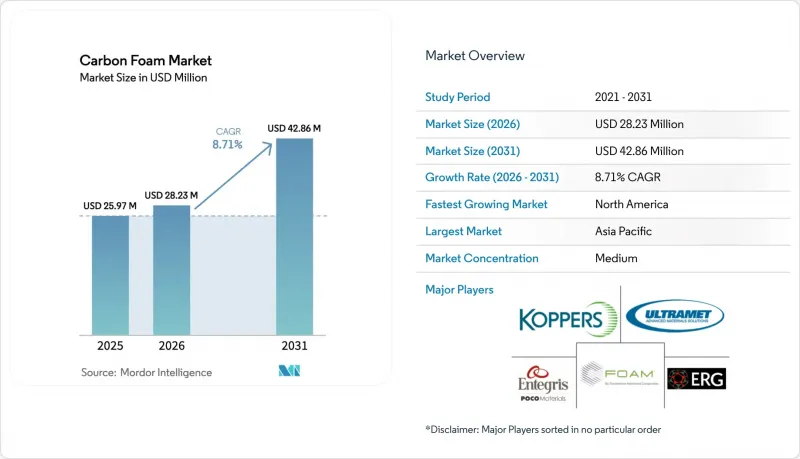
Mordor Intelligence에 의하면, 탄소 폼 시장 규모는 2025년에 2,597만 달러로 평가되었고 2026년 2,823만 달러에서 2031년까지 4,286만 달러에 이를 것으로 예측되며, 예측 기간(2026-2031년) CAGR은 8.71%를 나타낼 전망입니다.
본 보고서는 유형별(흑연계 및 비흑연계), 최종 사용자 산업별(항공우주 및 방위, 전자 및 전기, 자동차 및 운송, 건축 및 건설, 에너지 저장·연료전지, 산업기기, 기타), 지역별(아시아태평양, 북미, 유럽, 남미, 중동 및 아프리카)로 분류되어 있습니다. 시장 예측은 금액(달러) 기준으로 제시되어 있습니다.
세계 탄소 폼 시장 동향 및 인사이트
항공우주 및 방위 부문 수요 증가
초음속 항공기는 높은 열유속과 고온과 같은 가혹한 조건에 노출됩니다. 주목할 점은 흑연계 탄소 폼 코어가 조기 침식을 일으키지 않으면서 이러한 과제를 견딜 수 있다는 것입니다. 2024년부터 2025년까지 미국 공군과 해군은 모듈식 카본-카본 및 탄소 폼 구조를 대상으로 한 몇 가지 SBIR(중소기업 혁신 연구) 주제를 발표했습니다. 그 목적은 일회용 재진입 시스템의 단위 비용을 절감하는 데 있습니다. 한편, 2024년 헥셀(Hexel)사는 견실한 수주 잔고를 기록했습니다. 이러한 급증은 와이드바디 항공기 프로그램에서 지향성 열전달을 강화하기 위해 탄소 폼을 통합한 나셀 라이너와 주익 제빙 장치가 점점 더 많이 채택되고 있음을 보여줍니다. 방위 부문과 민간 항공우주 부문의 이러한 융합은 수년에 걸친 생산량 가시성을 확보할 뿐만 아니라, 공급업체를 일반적인 기체 개발 주기의 영향으로부터 보호하는 결과로 이어집니다. 2020년대 후반에 극초음속 시험이 본격화됨에 따라, 흑연화로의 가동 온도를 더욱 높일 수 있는 공급업체는 향후 체결될 계약에서 상당한 점유율을 확보할 수 있는 태세를 갖추고 있습니다.
파워 일렉트로닉스 분야의 열 관리 수요 증가
전기자동차에 탑재되는 절연 게이트형 바이폴라 트랜지스터(IGBT)의 신뢰성 한계는 약 150°C 전후입니다. 그러나 상변화 물질과 결합함으로써, 다공성 탄소 재질의 히트 스프레더는 5C의 방전율에서도 접합부 온도를 이 한계치보다 훨씬 낮은 수준으로 유지할 수 있습니다. 2025년 6월에 실시된 검사에서는 구리 피복 탄소 폼과 PCM을 채택한 배터리 팩을 통해 피크 온도를 현저히 낮출 수 있었습니다. 이 구성에서는 기존 액체 냉각 방식에 비해 시스템의 질량을 줄일 수도 있었습니다. 이러한 소재 변경은 경량화로 이어질 뿐만 아니라, 기생 전력 소비도 대폭 줄여줍니다. 한편, 데이터센터 운영 사업자들도 유사한 밀도 관련 과제에 직면해 있으며, 특히 인공지능(AI) 가속기가 칩 하나당 다량의 열을 방출하고 있는 것이 그 원인입니다. 이에 등장한 것이 그래핀 폼으로 제작된 베이퍼 챔버이며, 이는 현재 추론 클러스터의 열 관리 전략에서 필수적인 역할을 수행하고 있습니다. 운송 부문과 컴퓨팅 부문 모두에서 열 스로틀링을 완화해야 할 시급한 필요성이 커지고 있는 점을 감안할 때, 전력 전자 장치 냉각은 탄소 폼 시장에서 가장 수익성이 높은 부문으로 부상하고 있습니다.
높은 생산 비용과 에너지 집약도
폼의 흑연화에는 극히 높은 임계치를 초과하는 용광로 내부 온도와 장시간에 걸친 불활성 가스 환경이 필요하며, 이는 막대한 전력을 소비합니다. 그 소비량은 1차 알루미늄 제련에 필적하는 수준입니다. CONSOL의 연속식 파일럿 플랜트는 산화와 탄화를 단일 공정으로 통합하여 운영 효율을 높이고 있지만, 산업용 라인 구축에는 막대한 설비 투자가 필요하며, 이러한 장벽으로 인해 자본력이 있는 기업만이 시장에 진입할 수 있는 상황입니다. 유럽의 가스 및 전력 가격 급등은 SGL Carbon의 Graphite Solutions 부문의 EBITDA 마진을 압박했으며, 에너지 집약적 지역에서 지속되는 이익률 압박을 여실히 드러냈습니다. 재생에너지가 산업용 전력망의 절반 이하를 차지하는 한, 생산자들은 화석연료 가격 변동에 시달리게 되며, 건설 및 산업용 용광로 용도와 같은 가격에 민감한 부문에서의 경쟁력을 저해하게 될 것입니다.
부문별 분석
탄소 폼 시장에서 2025년 매출의 74.55%를 흑연계 폼이 차지하고 있으며, 2031년까지 연평균 성장률(CAGR) 9.85%를 나타낼 것으로 예측됩니다. 이는 초음속 항공기의 외판이나 파워 인버터에서 지향성 열 확산에 흑연계 폼이 필수적임을 반영한 것입니다. 2026년 탄소 폼 시장 규모는 2,823만 달러이지만, 대체 소재는 40-180W/(m·K)라는 면내 열전도율 요건을 충족하지 못하기 때문에 에너지 발자국이 높음에도 불구하고 시장은 흑연화 등급에 크게 치우쳐 있습니다. Toray Industries Inc.가 일본과 미국에서 흑연화 생산 능력을 두 배로 늘리기로 결정한 것은 고온용 제품 라인이 여전히 최고의 이익률을 가져다주는 전략적 병목 현상임을 증명하고 있습니다. 오크리지 국립연구소(Oak Ridge National Laboratory)의 적층 가공(AM) 실증 테스트에서 굽힘 강도가 235MPa에 육박하며, 비흑연계 폼이 산화되는 로켓 노즐 인서트에서 3,000°C 이상의 내열성을 지닌 흑연계 폼 코어가 유효하다는 것이 입증되었습니다. 반면, 5-20W/(m·K)의 열전도율로 충분하고 가격이 성능을 능가하는 건축용 단열재 및 용광로 내벽재의 경우, 비흑연계 폼이 여전히 중요한 역할을 하고 있습니다. 1,050°C의 내화성을 달성한 리그닌 유래 폼은 생산자가 파일럿 로트 이상의 규모로 생산을 확대한다면, 바이오 유래 비흑연계 소재가 건설 부문에서 대량 수요를 창출할 수 있는 가능성을 시사하고 있습니다. 따라서 비용 절감 압력으로 인해 탄소 폼 시장은 고성능의 흑연화 층과 비용 중심의 바이오 유래 층으로 나뉘게 될 것이며, 향후 10년 동안은 양자가 공존할 것으로 예측됩니다.
지역별 분석
아시아태평양은 Toray Industries Inc.의 한국 내 사업 확대와 수소 압력 용기를 목적으로 한 효성의 여러 국가에 걸친 생산 거점 확충에 힘입어 2025년 매출의 27.53%를 차지했습니다. 또한 중국과 일본의 투자자들도 풍력 터빈 및 자동차용 복합재료의 생산 능력을 확대하고 있어, 이 지역이 전 세계 고객을 위한 생산 거점으로서의 역할을 강화하고 있습니다. 일본에서는 고밀도 축열을 우선시하는 정부의 로드맵에 따라 탄소 폼으로 만든 산업용 단열재에 대한 국내 수요가 더욱 높아지고 있습니다.
북미는 2031년까지 연평균 성장률(CAGR) 9.24%를 기록하며 가장 빠르게 성장하는 지역이 될 전망입니다. 미국 국방 기관은 5,000°F 내열 쉴드에 흑연계 폼의 사용을 의무화하는 초음속 항공기 프로그램에 자금을 지원하고 있으며, 한편 민간 항공우주 부문의 수주 잔고는 2020년대 말까지 이어질 전망입니다.
유럽에서는 활발한 항공우주 산업에 더해, 무독성이며 내화성이 뛰어난 단열재를 권장하는 엄격한 건축 에너지 기준이 결합되어 있습니다. 2024년에는 에너지 가격 변동으로 인해 Graphite Solutions의 이익률이 압박을 받았지만, 순환형 경제 정책에 따라 탄소 발자국을 최대 95%까지 줄일 수 있는 폼 제조용 탄소섬유 스크랩을 회수하는 재활용 라인에 대한 투자가 촉진되었습니다. 이러한 움직임과 EPBD(유럽 건축물 에너지 성능 지침)의 제로 배출 로드맵이 맞물리면서, 고급 항공우주용 폼과 저비용 건축용 폼에 대한 이중 수요가 발생했고, 유럽은 기술의 인큐베이터이자 규제 측면의 선도자로서의 입지를 확고히 하고 있습니다.
기타 혜택
- 엑셀 형식 시장 예측(ME) 시트
- 3개월간의 애널리스트 지원
자주 묻는 질문
목차
제1장 서론
제2장 조사 방법
제3장 개요
제4장 시장 구도
제5장 시장 규모와 성장 예측
제6장 경쟁 구도
제7장 시장 기회와 향후 전망
JHS 26.09.01According to Mordor Intelligence, the carbon foam market size was valued at USD 25.97 million in 2025 and is estimated to grow from USD 28.23 million in 2026 to reach USD 42.86 million by 2031, at a CAGR of 8.71% during the forecast period (2026-2031).
This report is Segmented by Type (Graphitic and Non-Graphitic), End-User Industry (Aerospace and Defence, Electronics and Electrical, Automotive and Transportation, Building and Construction, Energy Storage and Fuel Cells, Industrial Equipment, and Other End-Users), and Geography (Asia-Pacific, North America, Europe, South America, and Middle East and Africa). Market Forecasts are Provided in Terms of Value (USD).
Global Carbon Foam Market Trends and Insights
Increasing Demand from Aerospace and Defence
Hypersonic vehicles endure extreme conditions, facing high heat fluxes and temperatures. Remarkably, graphitic carbon-foam cores withstand these challenges without premature ablation. In 2024-2025, the U.S. Air Force and Navy unveiled several SBIR topics, targeting modular carbon-carbon and carbon-foam structures. Their goal: to reduce unit costs for expendable re-entry systems. Meanwhile, in 2024, Hexcel boasted a robust backlog. This surge indicates that wide-body programs are increasingly opting for nacelle liners and wing de-icing hardware, both integrating carbon foam for enhanced directional heat transfer. This convergence of defense and commercial aerospace not only ensures multi-year volume visibility but also shields suppliers from the typical airframe cycles. As hypersonic testing gains momentum heading into the late-2020s, suppliers who can elevate their graphitization furnaces to higher temperatures stand poised to secure a significant share of emerging contracts.
Expanding Thermal-Management Needs of Power Electronics
Insulated-gate bipolar transistors in electric vehicles have reliability thresholds hovering around 150 °C. However, when combined with phase-change materials, porous carbon heat-spreaders ensure junction temperatures remain well below this limit, even at 5C discharge rates. In trials conducted in June 2025, battery packs utilizing copper-coated carbon foam and PCM achieved a notable reduction in peak temperatures. This setup also managed to reduce the system's mass compared to traditional liquid cooling methods. Such a material switch not only lightens the load but also significantly cuts parasitic power draw. Meanwhile, data-center operators grapple with similar density challenges, especially as artificial-intelligence accelerators push out substantial heat per chip. Enter graphene-foam vapor chambers, now essential players in the thermal management strategies for inference clusters. Given the pressing need to mitigate thermal throttling in both transportation and computing realms, power-electronics cooling has emerged as the most lucrative segment for the carbon foam market.
High Production Cost and Energy Intensity
Graphitizing foam demands furnace temperatures exceeding high thresholds and inert atmospheres for extended durations, consuming significant power-a draw on par with primary aluminum smelting. While CONSOL's continuous pilot streamlines operations by merging oxidation and carbonization into a single pass, establishing an industrial line comes with substantial capital expenditure, a barrier that confines entry to well-capitalized firms. Rising gas and electricity prices in Europe squeezed SGL Carbon's Graphite Solutions EBITDA margin, highlighting persistent margin pressures in energy-intensive locales. As long as renewable energy constitutes less than half of industrial grids, producers will grapple with fossil-fuel price volatility, hindering their competitiveness in price-sensitive sectors like construction and industrial furnace applications.
Other drivers and restraints analyzed in the detailed report include:
- Environmental Regulations Favouring Non-Toxic, Fire-Resistant Insulation
- Rapid Adoption of Carbon-Foam Current Collectors in Solid-State Batteries
- Limited Supply of High-Quality Mesophase Pitch
For complete list of drivers and restraints, kindly check the Table Of Contents.
Segment Analysis
Graphitic foam accounted for 74.55% of 2025 revenue in the carbon foam market and is forecast to grow at a 9.85% CAGR to 2031, reflecting its indispensability for directional heat spreading in hypersonic skins and power inverters. At USD 28.23 million, the 2026 carbon foam market size skews heavily toward graphitized grades despite their higher energy footprint because alternative materials cannot meet 40-180 W/m*K in-plane conductivity requirements. Toray's decision to double graphitization capacity in Japan and the United States proves that high-temperature lines remain the strategic bottleneck that commands the best margins. Oak Ridge National Laboratory's additive manufacturing trials reached flexural strengths near 235 MPa, validating graphitic foam cores above 3,000 °C for rocket-nozzle inserts where non-graphitic foams oxidize. At the same time, non-graphitic foams maintain relevance in building insulation and furnace linings where 5-20 W/m*K conductivity suffices and price beats performance. Lignin-derived foams reaching 1,050 °C fire resistance signal that bio-based non-graphitic options could unlock large-volume construction demand once producers scale beyond pilot lots. Cost-down pressures, therefore, split the carbon foam market into a high-performance, graphitized tier and a cost-sensitive, bio-based tier that will coexist through the decade.
Complete Report Scope:
- By Type
- Graphitic
- Non-graphitic
- By End-user Industry
- Aerospace and Defence
- Electronics and Electrical
- Automotive and Transportation
- Building and Construction
- Energy Storage and Fuel Cells
- Industrial Equipment
- Other End-users
- By Geography
- Asia-Pacific
- China
- India
- Japan
- South Korea
- ASEAN Countries
- Rest of Asia-Pacific
- North America
- United States
- Canada
- Mexico
- Europe
- Germany
- United Kingdom
- France
- Italy
- Spain
- NORDIC Countries
- Russia
- Rest of Europe
- South America
- Brazil
- Argentina
- Rest of South America
- Middle East and Africa
- Saudi Arabia
- South Africa
- Rest of Middle East and Africa
- Asia-Pacific
Geography Analysis
Asia-Pacific delivered 27.53% of 2025 revenue, underpinned by Toray's South Korean expansion and Hyosung's multi-country build-out aimed at hydrogen pressure vessels. Chinese and Japanese investors also advanced capacity for wind-turbine and automotive composites, reinforcing the region's role as the production hub for global customers. Government roadmaps in Japan that prioritize high-density heat storage further elevate domestic demand for industrial thermal barriers made from carbon foam.
North America will be the fastest-growing region at a 9.24% CAGR through 2031. U.S. defense agencies fund hypersonic vehicle programs that insist on graphitic foams for 5,000 °F heat shields, while commercial aerospace backlogs stretch to the decade's end.
Europe blends strong aerospace activity with stringent building-energy codes that favor non-toxic, fire-safe insulation. Energy-price volatility compressed graphite-solutions margins in 2024, yet circular-economy policies catalyzed investment in recycling lines that recover carbon-fiber scrap for foam production at up to 95% lower carbon footprint. These moves, coupled with the EPBD's zero-emission trajectory, create a dual pull for high-end aerospace foams and low-cost building foams, positioning Europe as both a technology incubator and a regulatory driver.
- American Elements
- Beijing Jingke Xingye Technology Development Co., Ltd.
- Carbon-Core Corporation
- CONSOL Energy Inc.
- Entegris Inc.
- ERG Aerospace
- Evonik Industries
- Goodfellow Cambridge Ltd.
- Graphite India Limited
- Hexcel Corporation
- Koppers Inc.
- SGL Carbon
- TORAY CARBON MAGIC CO., LTD
- Touchstone Advanced Composites
- Ultramet
- Xiamen Zopin New Material Limited
Additional Benefits:
- The market estimate (ME) sheet in Excel format
- 3 months of analyst support
TABLE OF CONTENTS
1 Introduction
- 1.1 Study Assumptions and Market Definition
- 1.2 Scope of the Study
2 Research Methodology
3 Executive Summary
4 Market Landscape
- 4.1 Market Overview
- 4.2 Market Drivers
- 4.2.1 Increasing demand from aerospace and defence
- 4.2.2 Expanding thermal-management needs of power electronics
- 4.2.3 Environmental regulations favouring non-toxic, fire-resistant insulation
- 4.2.4 Rapid adoption of carbon-foam current collectors in solid-state batteries
- 4.2.5 Biomass-derived carbon-foam feedstocks enabling cost reduction
- 4.3 Market Restraints
- 4.3.1 High production cost and energy intensity
- 4.3.2 Limited supply of high-quality mesophase pitch
- 4.3.3 Lack of global test standards delaying OEM qualification
- 4.4 Value Chain Analysis
- 4.5 Porter's Five Forces
- 4.5.1 Bargaining Power of Suppliers
- 4.5.2 Bargaining Power of Buyers
- 4.5.3 Threat of New Entrants
- 4.5.4 Threat of Substitutes
- 4.5.5 Degree of Competition
5 Market Size and Growth Forecasts (Value)
- 5.1 By Type
- 5.1.1 Graphitic
- 5.1.2 Non-graphitic
- 5.2 By End-user Industry
- 5.2.1 Aerospace and Defence
- 5.2.2 Electronics and Electrical
- 5.2.3 Automotive and Transportation
- 5.2.4 Building and Construction
- 5.2.5 Energy Storage and Fuel Cells
- 5.2.6 Industrial Equipment
- 5.2.7 Other End-users
- 5.3 By Geography
- 5.3.1 Asia-Pacific
- 5.3.1.1 China
- 5.3.1.2 India
- 5.3.1.3 Japan
- 5.3.1.4 South Korea
- 5.3.1.5 ASEAN Countries
- 5.3.1.6 Rest of Asia-Pacific
- 5.3.2 North America
- 5.3.2.1 United States
- 5.3.2.2 Canada
- 5.3.2.3 Mexico
- 5.3.3 Europe
- 5.3.3.1 Germany
- 5.3.3.2 United Kingdom
- 5.3.3.3 France
- 5.3.3.4 Italy
- 5.3.3.5 Spain
- 5.3.3.6 NORDIC Countries
- 5.3.3.7 Russia
- 5.3.3.8 Rest of Europe
- 5.3.4 South America
- 5.3.4.1 Brazil
- 5.3.4.2 Argentina
- 5.3.4.3 Rest of South America
- 5.3.5 Middle East and Africa
- 5.3.5.1 Saudi Arabia
- 5.3.5.2 South Africa
- 5.3.5.3 Rest of Middle East and Africa
- 5.3.1 Asia-Pacific
6 Competitive Landscape
- 6.1 Market Concentration
- 6.2 Strategic Moves
- 6.3 Market Share/Ranking Analysis
- 6.4 Company Profiles (includes Global-level Overview, Market-level Overview, Core Segments, Financials as available, Strategic Information, Market Rank/Share, Products and Services, Recent Developments)
- 6.4.1 American Elements
- 6.4.2 Beijing Jingke Xingye Technology Development Co., Ltd.
- 6.4.3 Carbon-Core Corporation
- 6.4.4 CONSOL Energy Inc.
- 6.4.5 Entegris Inc.
- 6.4.6 ERG Aerospace
- 6.4.7 Evonik Industries
- 6.4.8 Goodfellow Cambridge Ltd.
- 6.4.9 Graphite India Limited
- 6.4.10 Hexcel Corporation
- 6.4.11 Koppers Inc.
- 6.4.12 SGL Carbon
- 6.4.13 TORAY CARBON MAGIC CO., LTD
- 6.4.14 Touchstone Advanced Composites
- 6.4.15 Ultramet
- 6.4.16 Xiamen Zopin New Material Limited
7 Market Opportunities and Future Outlook
- 7.1 White-space and Unmet-need Assessment