

|
시장보고서
상품코드
2119210
헬스케어 마케팅 서비스 시장 : 시장 점유율 분석, 업계 동향 및 통계, 성장 예측(2026-2031년)Healthcare Marketing Services - Market Share Analysis, Industry Trends & Statistics, Growth Forecasts (2026 - 2031) |
||||||
 Mordor Intelligence
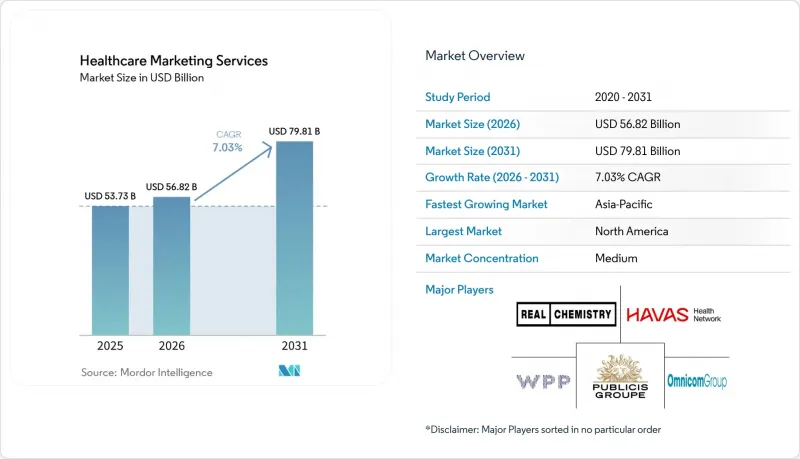
Mordor Intelligence에 의하면, 헬스케어 마케팅 서비스 시장 규모는 2025년 537억 3,000만 달러로 평가되었고, 2026년에는 568억 2,000만 달러로 추정되고, 2031년까지 798억 1,000만 달러에 이를 것으로 예측되며, 2026-2031년 연평균 복합 성장률(CAGR)은 7.03%를 나타낼 전망입니다.
본 보고서는 서비스 유형별(디지털 마케팅 서비스, 브랜드 전략 및 크리에이티브 서비스, 평판 관리·홍보·옹호 서비스, 기타), 최종 사용자별(의료 제공업체·의료 시스템, 제약·바이오기술 기업, 의료기기·진단기기 기업, 기타), 지역별로 분류되어 있습니다. 시장 전망은 금액(달러) 기준으로 제시되어 있습니다.
헬스케어 마케팅 서비스 시장 동향 및 인사이트
검색, 소셜 미디어, AI를 아우르는 환자의 자발적인 정보 수집 증가
헬스케어 마케팅 서비스 시장은 임상적 개입이 시작되기 전부터 시작되는 경우가 늘고 있는 환자의 여정에 대응하고 있습니다. KFF 보고서에 따르면, 2026년에는 미국 성인의 29%가 건강 관련 조언을 얻기 위해 매달 AI 챗봇을 이용할 것으로 예상되며, 이는 2024년 중반의 17%에서 증가한 수치입니다. 또한 KFF는 검색 엔진, 소셜 미디어, AI 도구가 사람들이 건강 정보나 조언을 구하는 방식에 영향을 미치고 있음을 밝혔습니다. 퓨 리서치 센터(Pew Research Center)의 조사에 따르면, 사용자들은 AI 챗봇이 제공하는 건강 정보를 ‘정확하다’기보다는 ‘편리하다’고 평가하는 경향이 더 강한 것으로 나타났습니다. 이러한 격차로 인해 명확한 제공업체 정보, 임상적 자격, 그리고 기존 임상 현장 이외의 환경에서도 이해할 수 있는 최신 답변이 더욱 중요시되고 있습니다. 의료 기관은 의료적 주장을 과장하지 않으면서도, 환자가 초기 조사 단계부터 적절한 치료 선택지에 이르기까지 안내할 수 있도록 디지털 상의 존재감을 강화해야 합니다.
‘디지털 프론트 도어’ 및 온라인 예약에 대한 투자 확대
의료 기관은 대외 커뮤니케이션과 예약 완료를 연결하는 환자 접근 시스템에 대한 투자를 확대되고 있습니다. Assort Health는 2026년 6월, 환자의 진료 과정 전반에 걸쳐 AI 에이전트 도입을 확대하기 위해 1억 2,000만 달러를 조달했습니다. 이 회사는 자사 플랫폼을 통해 예약 건수가 5% 증가했고, 도입 시 인력의 처리 능력이 115% 향상되었다고 밝혔습니다. 예약 절차가 간편하고 신속하게 처리될 경우, 의료 기관의 캠페인 효과는 웹 트래픽뿐만 아니라 실제로 예약된 건수를 통해 평가할 수 있게 됩니다. 이러한 변화에 따라 대행사의 업무 범위는 인지도 제고 활동에서 환자 여정 설계, 컨택 센터 조정, 예약 성사율 측정으로 확대되고 있습니다. 병원 및 의료 시스템이 환자 접근 채널을 지속적으로 개선해 나가는 가운데, 헬스케어 마케팅 서비스 시장에서는 지속적인 수요가 예상됩니다.
추적 픽셀 및 동의와 관련된 개인정보 보호 소송
개인정보 보호 관련 법 집행으로 인해, 과거에는 일상적인 캠페인 측정을 뒷받침하던 추적 도구의 사용이 제한되고 있습니다. 미국 보건복지부는 규제 대상 사업자가 온라인 추적 기술을 사용할 때 개인을 식별할 수 있는 건강 정보를 보호해야 한다고 밝혔습니다. 2026년 7월, 연방거래위원회(FTC)와 유타주, 캘리포니아주는 광고 픽셀을 통해 기밀성이 높은 건강 정보를 공유했다는 이유로 Hims & Hers를 제소했습니다. 이 소장은 데이터 수집 및 광고 관행이 어떻게 법적, 재정적, 평판상의 위험을 초래하는지를 보여줍니다. 마케팅 팀은 개인정보 보호 요건을 충족하지 못하는 측정 방식을 대체하거나 재설계해야 합니다. 헬스케어 마케팅 서비스 시장에서는 유용한 측정 지표를 유지하면서, 동의에 기반한 데이터, 개인정보 보호를 고려한 분석, 적절한 계약상 관리 조치를 활용할 수 있는 기업이 높이 평가받고 있습니다.
부문 분석
2025년, 디지털 마케팅 서비스는 헬스케어 마케팅 서비스 시장 점유율의 37.20%를 차지하며 가장 큰 서비스 카테고리가 되었습니다. 이 부문에는 검색 마케팅, 프로그래매틱 환자 타겟팅, 유료 소셜 미디어 활동, 제약 회사 및 의료 서비스 제공업체가 이용하는 기타 디지털 채널이 포함됩니다. 그 규모는 성과를 관찰하고 조정할 수 있는 채널을 통해 환자와 의료 전문가(HCP)에게 도달해야 할 필요성을 반영하고 있습니다. 디지털 전략은 여전히 신뢰할 수 있는 컨텐츠, 적절한 타겟팅, 규정 준수를 준수하는 캠페인 정보 수집에 의존하고 있습니다. 분석, 인사이트 및 규정 준수 서비스는 2026-2031년 연평균 성장률(CAGR) 7.83%로 확대될 것으로 예측되며, 이는 서비스 유형 중 가장 빠른 성장 속도입니다.
헬스케어 마케팅 서비스 시장에서 분석, 인사이트 및 규정 준수 업무 시장 규모는 픽셀 기반 어트리뷰션이 제한되는 상황에서 측정 방법을 재구축해야 할 필요성에 의해 주도되고 있습니다. 조직은 미디어 활동과 환자의 문의, 예약, 의료진과의 상호작용, 기타 허용되는 성과를 연결하는 실용적인 방법을 필요로 합니다. 여기에는 서버 측 분석, 안전한 데이터 처리, 동의 기록, 헬스케어 고객을 위해 설계된 보고서 작성이 포함됩니다. 브랜드 전략과 크리에이티브 서비스는 AI 생성 응답, 전통 미디어, 진료 현장 등 모든 상황에서 브랜드 정보가 효과를 발휘해야 하므로 여전히 중요합니다. 또한, 의료 제공업체 정보, 환자 피드백, 임상적 신뢰도가 디지털 검색 결과에 영향을 미치면서 평판 관리, 홍보, 옹호 서비스의 중요성도 높아지고 있습니다.
지역별 분석
2025년, 북미는 헬스케어 마케팅 서비스 시장 점유율의 46.80%를 차지했습니다. 이 지역에서는 제약 홍보가 활발하며, 확립된 헬스케어 광고 인프라가 잘 갖춰져 있을 뿐만 아니라, 헬스케어에 특화된 AI 도구의 도입도 조기에 진행되고 있습니다. 또한, 미국 규제 당국의 단속 활동으로 인해 개인정보를 보호하는 데이터 관리 관행이 대행사 선정의 중요한 기준이 되고 있습니다. 2026년 7월 연방거래위원회(FTC)가 Hims & Hers에 대해 취한 조치는 광고 시스템 내 민감한 건강 정보의 이용에 대한 지속적인 모니터링이 강화되고 있음을 여실히 보여주었습니다. 개인정보 보호, FDA 규제에 대한 이해, 의료 데이터 관련 요건을 충족할 수 있는 대행사는 일반적인 디지털 마케팅 기업에 비해 우위를 점하고 있습니다.
아시아태평양은 2026-2031년 연평균 성장률(CAGR) 7.91%로 확대될 것으로 예상되며, 이는 지역별 가장 높은 성장률입니다. 이러한 성장은 제약 산업의 확대, 디지털 헬스케어에 대한 투자, 모바일 우선의 의료 이용 행동, 환자 참여 도구에 대한 수요 증가를 반영하고 있습니다. 인도의 디지털 헬스 프로그램은 의료의 디지털화를 확대하기 위한 중요한 인프라를 구축했습니다. 중국의 헬스케어 플랫폼은 AI를 활용한 만성 질환 관리와 새로운 형태의 제약 기업과의 협력 방식을 지원하고 있습니다. 일본과 한국에서는 시장 고유의 데이터 보호 접근 방식이 요구되고 있어, 이는 국제 기업들에게 복잡성을 가중시키고 있습니다. 따라서 아시아태평양의 헬스케어 마케팅 서비스 시장 규모는 상업적 확장과 지역별로 상이한 데이터 규제의 두 가지 요인에 의해 형성되고 있습니다.
유럽에서는 ‘유럽 헬스 데이터 스페이스(European Health Data Space)’ 프레임워크가 도입되었습니다. 이는 2025년에 발효되었으며, 유럽연합(EU) 전역에서 헬스 데이터의 접근 및 이용에 관한 공통된 접근 방식을 규정하고 있습니다. 프랑스는 2026년, 유럽 헬스 데이터 스페이스의 요건과 헬스 데이터 활용에 관한 AI 윤리를 반영하기 위해 국내 디지털 헬스 정책을 개정했습니다. 남미에서는 디지털 헬스 생태계가 부상하고 있으며, 이 지역의 헬스 테크놀로지 활동 대부분을 브라질이 차지하고 있습니다. 중동 및 아프리카 수요는 사우디아라비아와 아랍에미리트(UAE)의 민간 병원 간 경쟁, 그리고 아프리카 주요 도시에서 제약 기업의 사업 확장에 의해 주도되고 있습니다.
기타 혜택
- 엑셀 형식 시장 예측(ME) 시트
- 3개월간의 애널리스트 지원
자주 묻는 질문
목차
제1장 서론
제2장 조사 방법
제3장 주요 요약
제4장 시장 구도
제5장 시장 규모 및 성장 예측
제6장 경쟁 구도
제7장 시장 기회 및 향후 전망
AJY 26.09.03According to Mordor Intelligence, the healthcare marketing services market size is projected to expand from USD 53.73 billion in 2025 to USD 56.82 billion in 2026, and to USD 79.81 billion by 2031, registering a CAGR of 7.03% between 2026 and 2031.
This report is Segmented by Service Type (Digital Marketing Services, Brand Strategy and Creative Services, Reputation, Public Relations, and Advocacy Services, and More), End-User (Healthcare Providers and Health Systems, Pharmaceutical and Biotechnology Companies, Medical Device and Diagnostics Companies, and More), and Geography. The Market Forecasts are Provided in Terms of Value (USD).
Insights and Trends of Healthcare Marketing Services
Rise of Patient Self-Navigation Across Search, Social, and AI
The healthcare marketing services market is responding to a patient journey that increasingly starts before a clinical interaction. KFF reported that 29% of US adults used AI chatbots monthly for health advice in 2026, compared with 17% in mid-2024. KFF also found that search engines, social media, and AI tools influence how people seek health information and advice. Pew Research Center found that users viewed health information from AI chatbots as convenient more often than accurate. This gap places greater weight on clear provider information, clinical credentials, and current answers that can be understood outside a traditional clinical setting. Healthcare organizations need their digital presence to guide patients from early research to appropriate care options without overstating medical claims.
Expansion of Digital Front Door and Online Scheduling Investment
Healthcare providers are investing in patient access systems that connect public-facing communications with appointment completion. Assort Health raised USD 120 million in June 2026 to expand AI-agent deployment across the patient journey. The company stated that its platform supported a 5% increase in appointment volume and a 115% increase in labor capacity for deployments. When scheduling is simple and responsive, provider campaigns can be evaluated by booked appointments rather than web traffic alone. This change broadens agency assignments from awareness work to journey design, contact-center coordination, and appointment conversion measurement. The healthcare marketing services market sees recurring demand as hospitals and health systems continue to improve patient access pathways.
Privacy Litigation Around Tracking Pixels and Consent
Privacy enforcement limits the use of tracking tools that once supported routine campaign measurement. The US Department of Health and Human Services has stated that regulated entities must protect individually identifiable health information when using online tracking technologies. In July 2026, the Federal Trade Commission and the states of Utah and California sued Hims and Hers over alleged sharing of sensitive health information through advertising pixels. The complaint shows how data collection and advertising practices can create legal, financial, and reputational exposure. Marketing teams must replace or redesign measurement practices that cannot meet privacy requirements. The healthcare marketing services market rewards firms that can use consented data, privacy-safe analytics, and appropriate contractual controls while retaining useful measurement.
Other drivers and restraints analyzed in the detailed report include:
- Growth of Omnichannel Commercialization and Personalization Programs
- Intensifying Reputation Management and Review-Driven Patient Choice
- Fragmented Data and Slow Medical, Legal, and Regulatory Review Cycles
For complete list of drivers and restraints, kindly check the Table Of Contents.
Segment Analysis
Digital Marketing Services held 37.20% of the healthcare marketing services market share in 2025, making it the largest service category. The segment includes search marketing, programmatic patient targeting, paid social activity, and other digital channels used by pharmaceutical companies and providers. Its scale reflects the need to reach patients and HCPs across channels where performance can be observed and adjusted. Digital work still depends on reliable content, appropriate targeting, and compliant collection of campaign information. Analytics, Insights, and Compliance Services is projected to expand at a 7.83% CAGR from 2026 to 2031, the fastest pace among service types.
The healthcare marketing services market size for analytics, insights, and compliance work is driven by the need to rebuild measurement when pixel-based attribution is limited. Organizations need practical ways to connect media activity with patient inquiries, appointments, HCP engagement, and other permitted outcomes. This includes server-side analytics, secure data handling, consent records, and reporting designed for healthcare clients. Brand Strategy and Creative Services remain important because brand information must work across AI-generated answers, traditional media, and point-of-care settings. Reputation, Public Relations, and Advocacy Services are also becoming more relevant as provider information, patient feedback, and clinical credibility influence digital discovery.
Complete Report Scope:
- By Service Type
- Digital Marketing Services
- Brand Strategy and Creative Services
- Reputation, Public Relations, and Advocacy Services
- Analytics, Insights, and Compliance Services
- By End-User
- Healthcare Providers and Health Systems
- Pharmaceutical and Biotechnology Companies
- Medical Device and Diagnostics Companies
- Health Insurance Payers and Health Plans
- By Geography
- North America
- United States
- Canada
- Mexico
- South America
- Brazil
- Argentina
- Chile
- Rest of South America
- Europe
- Germany
- United Kingdom
- France
- Italy
- Spain
- Netherlands
- Russia
- Rest of Europe
- Asia-Pacific
- China
- Japan
- India
- Australia
- South Korea
- Singapore
- Rest of Asia-Pacific
- Middle East
- Saudi Arabia
- United Arab Emirates
- Turkey
- Israel
- Rest of Middle East
- Africa
- South Africa
- Egypt
- Nigeria
- Kenya
- Rest of Africa
- North America
Geography Analysis
North America accounted for 46.80% of the healthcare marketing services market share in 2025. The region has substantial pharmaceutical promotion, an established healthcare advertising infrastructure, and early adoption of healthcare-focused AI tools. US enforcement activity has also made privacy-safe data practices central to agency selection. The Federal Trade Commission's July 2026 action against Hims and Hers highlighted ongoing scrutiny of the use of sensitive health information in advertising systems. Agencies that can meet privacy, FDA-awareness, and healthcare data requirements have an advantage over general digital marketing firms.
Asia-Pacific is projected to expand at a 7.91% CAGR from 2026 to 2031, the fastest regional rate. Growth reflects pharmaceutical expansion, digital health investment, mobile-first care behavior, and increasing demand for patient engagement tools. India's digital health programs have created important infrastructure for broader healthcare digitization. China's healthcare platforms are supporting AI-enabled chronic disease management and new forms of pharmaceutical engagement. Japan and South Korea require market-specific data protection approaches, which adds complexity for international agencies. The healthcare marketing services market size in Asia-Pacific is therefore shaped by both commercial expansion and differing local data rules.
Europe is implementing the European Health Data Space framework, which entered into force in 2025 and sets a common approach to health data access and use across the European Union. France updated its national digital health doctrine in 2026 to reflect the European Health Data Space requirements and AI ethics for the use of health data. South America has an emerging digital health ecosystem, with Brazil providing a large share of the region's health technology activity. Demand in the Middle East and Africa is driven by competition among private hospitals in Saudi Arabia and the United Arab Emirates, as well as pharmaceutical expansion in major African cities.
- Omnicom Group Inc.
- Publicis Groupe S.A.
- WPP plc
- Havas Health & You
- Indegene Limited
- Real Chemistry, Inc.
- IQVIA Inc.
- Accenture plc
- Klick Inc.
- Avalere Health Topco Limited
- OPEN Health Communications LLP
- Merkle Inc.
- Syneos Health, Inc.
- Cognizant Technology Solutions Corporation
- EVERSANA, LLC
- GCI Health, LLC
- Experian plc
- PatientPoint, LLC
- CMI Media Group
Additional Benefits:
- The market estimate (ME) sheet in Excel format
- 3 months of analyst support
TABLE OF CONTENTS
1 INTRODUCTION
- 1.1 Study Assumptions and Market Definition
- 1.2 Scope of the Study
2 RESEARCH METHODOLOGY
3 EXECUTIVE SUMMARY
4 MARKET LANDSCAPE
- 4.1 Market Overview
- 4.2 Market Drivers
- 4.2.1 Rise of Patient Self-Navigation Across Search, Social, and AI
- 4.2.2 Expansion of Digital Front Door and Online Scheduling Investment
- 4.2.3 Growth of Omnichannel Commercialization and Personalization Programs
- 4.2.4 Intensifying Reputation Management and Review-driven Patient Choice
- 4.2.5 Generative Engine Optimization and AI Directory Visibility Spend
- 4.2.6 Telemedicine Advertising Liberalization in Select Regulated Markets
- 4.3 Market Restraints
- 4.3.1 Privacy Litigation Around Tracking Pixels and Consent
- 4.3.2 Fragmented Data and Slow Medical, Legal, and Regulatory Review Cycles
- 4.3.3 Zero-click Search Erodes Traditional SEO Economics
- 4.3.4 Platform Certification and Content-policy Volatility
- 4.4 Impact of Macroeconomic Factors on the Market
- 4.5 Industry Value Chain Analysis
- 4.6 Regulatory Landscape
- 4.7 Technological Outlook
- 4.8 Porter's Five Forces Analysis
- 4.8.1 Bargaining Power of Buyers
- 4.8.2 Bargaining Power of Suppliers
- 4.8.3 Threat of New Entrants
- 4.8.4 Threat of Substitutes
- 4.8.5 Intensity of Competitive Rivalry
5 MARKET SIZE AND GROWTH FORECASTS (VALUE)
- 5.1 By Service Type
- 5.1.1 Digital Marketing Services
- 5.1.2 Brand Strategy and Creative Services
- 5.1.3 Reputation, Public Relations, and Advocacy Services
- 5.1.4 Analytics, Insights, and Compliance Services
- 5.2 By End-User
- 5.2.1 Healthcare Providers and Health Systems
- 5.2.2 Pharmaceutical and Biotechnology Companies
- 5.2.3 Medical Device and Diagnostics Companies
- 5.2.4 Health Insurance Payers and Health Plans
- 5.3 By Geography
- 5.3.1 North America
- 5.3.1.1 United States
- 5.3.1.2 Canada
- 5.3.1.3 Mexico
- 5.3.2 South America
- 5.3.2.1 Brazil
- 5.3.2.2 Argentina
- 5.3.2.3 Chile
- 5.3.2.4 Rest of South America
- 5.3.3 Europe
- 5.3.3.1 Germany
- 5.3.3.2 United Kingdom
- 5.3.3.3 France
- 5.3.3.4 Italy
- 5.3.3.5 Spain
- 5.3.3.6 Netherlands
- 5.3.3.7 Russia
- 5.3.3.8 Rest of Europe
- 5.3.4 Asia-Pacific
- 5.3.4.1 China
- 5.3.4.2 Japan
- 5.3.4.3 India
- 5.3.4.4 Australia
- 5.3.4.5 South Korea
- 5.3.4.6 Singapore
- 5.3.4.7 Rest of Asia-Pacific
- 5.3.5 Middle East
- 5.3.5.1 Saudi Arabia
- 5.3.5.2 United Arab Emirates
- 5.3.5.3 Turkey
- 5.3.5.4 Israel
- 5.3.5.5 Rest of Middle East
- 5.3.6 Africa
- 5.3.6.1 South Africa
- 5.3.6.2 Egypt
- 5.3.6.3 Nigeria
- 5.3.6.4 Kenya
- 5.3.6.5 Rest of Africa
- 5.3.1 North America
6 COMPETITIVE LANDSCAPE
- 6.1 Market Concentration
- 6.2 Strategic Moves
- 6.3 Market Share Analysis
- 6.4 Company Profiles (includes Global Level Overview, Market Level Overview, Core Segments, Financials as available, Strategic Information, Market Rank/Share, Products and Services, Recent Developments)
- 6.4.1 Omnicom Group Inc.
- 6.4.2 Publicis Groupe S.A.
- 6.4.3 WPP plc
- 6.4.4 Havas Health & You
- 6.4.5 Indegene Limited
- 6.4.6 Real Chemistry, Inc.
- 6.4.7 IQVIA Inc.
- 6.4.8 Accenture plc
- 6.4.9 Klick Inc.
- 6.4.10 Avalere Health Topco Limited
- 6.4.11 OPEN Health Communications LLP
- 6.4.12 Merkle Inc.
- 6.4.13 Syneos Health, Inc.
- 6.4.14 Cognizant Technology Solutions Corporation
- 6.4.15 EVERSANA, LLC
- 6.4.16 GCI Health, LLC
- 6.4.17 Experian plc
- 6.4.18 PatientPoint, LLC
- 6.4.19 CMI Media Group
7 MARKET OPPORTUNITIES AND FUTURE OUTLOOK
- 7.1 White-Space and Unmet-Need Assessment


