

|
시장보고서
상품코드
2119312
수요 창출 서비스 : 시장 점유율 분석, 업계 동향 및 통계, 성장 예측(2026-2031년)Demand Generation Services - Market Share Analysis, Industry Trends & Statistics, Growth Forecasts (2026 - 2031) |
||||||
 Mordor Intelligence
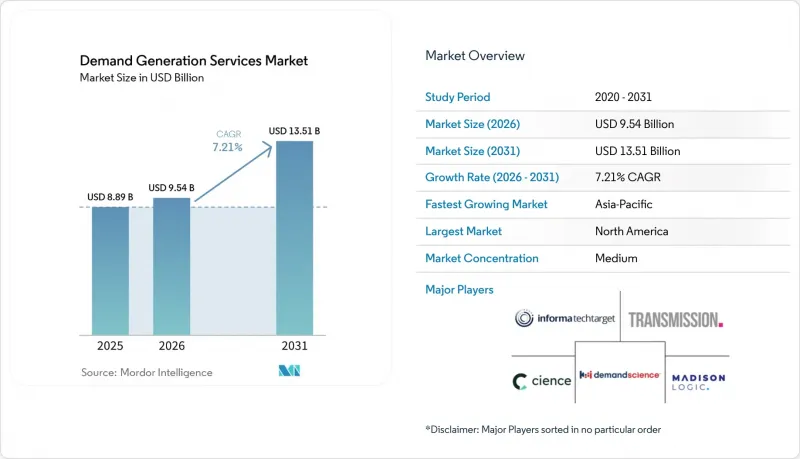
Mordor Intelligence에 의하면, 수요 창출 서비스 시장 규모는 2025년에 88억 9,000만 달러로 평가되었습니다. 2026년에 95억 4,000만 달러에 달하고, 2031년까지 135억 1,000만 달러에 이를 것으로 예측되며, 2026년부터 2031년에 걸쳐 CAGR 7.21%로 성장할 전망입니다.
본 보고서는 서비스 유형(콘텐츠 마케팅, SEO 및 SEM, 소셜 미디어 마케팅, 이메일 마케팅 및 마케팅 자동화, 유료 광고 및 퍼포먼스 마케팅 등), 조직 규모(대기업 및 중소기업), 최종 사용자 산업(소매 및 전자상거래, BFSI 등), 그리고 지역별로 분류되어 있습니다. 시장 전망은 금액(달러) 기준으로 제시되어 있습니다.
세계의 수요 창출 서비스 시장 동향 및 인사이트
AI를 활용한 개인화 및 예측형 리드 스코어링 도입
AI를 활용한 개인화는 수요 창출 서비스 제공업체에게 핵심 제공 기능이 되어 가고 있습니다. 2026년에는 리드 스코어링 도구가 행동, 팜그래픽, 테크노그래픽 및 구매 의도 신호를 결합하여 구매 가능성이 높은 계정을 식별하게 될 것입니다. 이를 통해 팀은 상업적으로 중요한 구매 기간 동안 적극적인 구매 행동을 보이는 계정에 아웃리치를 집중할 수 있게 됩니다. 수요 창출 서비스 시장은 많은 조직이 여전히 기본적인 콘텐츠 제작을 넘어선 도입 지원을 필요로 한다는 사실로부터 혜택을 받고 있습니다. 페도위츠 그룹의 보고서에 따르면, 2025년에는 B2B 기업의 28%가 기본적인 콘텐츠 제작을 넘어 AI를 자유롭게 활용하고 있었습니다. 스코어링과 CRM 조치를 연계하는 공급업체는 마케팅 활동, 영업 후속 조치, 파이프라인 진행 상황 및 상업적 성과 간의 더 긴밀한 연관성을 보여줄 수 있습니다.
MQL 추적에서 파이프라인 및 수익에 대한 책임성 확보로의 전환
마케팅 인증 리드(MQL)는 수요 창출 성과에 대한 주요 지표로서의 유용성을 점차 잃어가고 있습니다. 고객은 캠페인이 영업 기회를 창출하고, 거래 진행에 영향을 미치며, 계약 성사 수익을 뒷받침하고 있다는 증거를 점점 더 요구하고 있습니다. Pedowitz Group의 조사에 따르면, 2025년에는 B2B 기업의 74%가 파이프라인 또는 매출을 주요 지표로 삼았지만, 수익 마케팅 성숙도에 도달한 기업은 18%에 불과했습니다. 이러한 격차는 풀 퍼널 어트리뷰션 및 보고서를 작성하고 영업 팀과 실질적인 협력을 구축할 수 있는 제공업체에게 비즈니스 기회가 될 것입니다. 수요 창출 서비스 시장은 잠재 고객의 질, 파이프라인 기여도, 거래 진행 상황 및 갱신 가치를 측정하는 계약으로 전환되고 있습니다. 등록 수나 양식 작성 건수만을 보고하는 대행사는 클라이언트가 측정 가능한 상업적 성과를 위해 예산을 재분배할 때 더 어려운 입장에 처하게 될 것입니다.
데이터 개인정보 보호, 동의 및 쿠키 없는 타겟팅의 제약
개인정보 보호 규정 및 쿠키 제한으로 인해 국경을 초월한 타겟팅에 활용할 수 있는 데이터가 줄어들고 있습니다. 서비스 제공업체는 GDPR(EU 개인정보보호규정), CCPA 및 아시아태평양의 개인정보 보호 프레임워크에 기반한 동의 요건을 준수하도록 캠페인을 조정해야 합니다. 이로 인해 오디언스 구축, 캠페인 측정, 멀티 터치 어트리뷰션, 그리고 클라이언트 팀 전반에 걸친 상업적 가치 입증이 복잡해지고 있습니다. 클라이언트가 지역에 관계없이 개인정보 보호 규정을 준수하는 실행을 기대하고 있기 때문에 수요 창출 서비스 시장은 더 높은 운영 요건에 직면해 있습니다. 퍼스트파티 데이터 및 동의 기반 데이터에 대한 투자가 증가하는 반면, 컨텍스트 기반 접근 방식은 전문적인 B2B 타겟팅을 부분적으로만 지원할 수 있습니다. 이러한 상황으로 인해 규정 준수 비용이 증가함에 따라, 확립된 데이터 거버넌스 프로세스, 지역별 실행 경험, 그리고 공식적인 개인정보 보호 관리 관행을 갖춘 기업이 유리한 입지를 점하고 있습니다.
부문별 분석
2025년, 콘텐츠 마케팅은 수요 창출 서비스 시장 점유율의 23.67%를 차지했습니다. 이러한 위상은 구매자 교육 및 AI를 활용한 검색 및 견적 경험을 위한 자료 제공에서 콘텐츠 마케팅이 수행하는 역할을 반영합니다. 콘텐츠 마케팅 인스티튜트(CMI) 보고서에 따르면, 2026년에는 콘텐츠 마케팅이 B2B 마케팅 총 예산의 26%를 차지했습니다. 각 제공업체들은 기존 검색과 생성형 엔진에서의 가시성을 모두 지원할 수 있도록 콘텐츠 제작을 조정하고 있습니다. 오가닉 검색을 통한 발견은 장기적인 수익을 가져오기 때문에 SEO 및 SEM은 계속해서 안정적인 트래픽을 뒷받침하고 있습니다. 소셜 미디어 마케팅, 특히 LinkedIn에서의 활동은 타겟 계정에 대한 노출과 구매자와의 참여를 촉진합니다. CRM을 트리거로 하는 시퀀싱가 광범위한 아웃바운드 메시지를 대체하는 가운데, 이메일 마케팅과 마케팅 자동화는 여전히 중요한 역할을 수행하고 있습니다. 이러한 도구를 통해 팀은 참여 신호에 대해 보다 시기적절한 커뮤니케이션으로 대응할 수 있습니다. 수요 창출 서비스 시장에서는 교육, 발견, 육성, 영업 대화의 모든 단계를 아우를 수 있는 콘텐츠에 대한 수요가 증가하고 있습니다. 이러한 폭넓은 활용 덕분에 콘텐츠 프로그램은 많은 통합형 제공 계획의 중심에 자리 잡고 있습니다.
유료 광고 및 성과 기반 마케팅은 2031년까지 연평균 성장률(CAGR) 7.68%로 확대될 것으로 예측됩니다. 이러한 성장은 명확한 기여도 분석과 상업적 책임성을 갖춘 서비스 모델에 대한 고객 수요를 반영합니다. 성과 연동형 과금을 통해 서비스 요금을 고품질 영업 기회나 파이프라인 목표와 연계할 수 있습니다. 이를 통해 실행 위험이 서비스 제공업체 쪽으로 더 많이 이동하게 되어, 재무 심사가 엄격해지는 시기에는 매력적인 선택지가 됩니다. 구매 그룹에 이해관계자가 더 많이 참여함에 따라, 계정 기반 디스플레이 광고 및 콘텐츠 배포의 중요성도 높아지고 있습니다. 이러한 채널은 타겟 계정 내에서 활성화할 수 있는 접점의 수를 늘려줍니다. 따라서 수요 창출 서비스 업계에서는 유료 채널 전반에 걸친 측정 가능한 캠페인 실행과 통합 보고서 작성이 더욱 중요시되고 있습니다. 제공업체는 또한 캠페인의 규모와 정밀한 타겟팅, 책임감 있는 영업 후속 조치의 균형을 맞추어야 합니다. 수요 창출 서비스 시장에서는 유료 전략이 특정 계정이나 수익 기회를 어떻게 지원하고 있는지 보여줄 수 있는 사업자가 우대받습니다. 이를 위해서는 미디어 기획, 타겟 관리, 성과 보고가 하나로 통합된 서비스로서의 운영이 요구됩니다.
지역별 분석
2025년, 북미는 전 세계 매출의 34.68%를 차지했습니다. 이 지역은 엔터프라이즈 기술 기업, 계정 기반 마케팅(ABM) 플랫폼, 전문 대행사가 밀집해 있다는 강점을 가지고 있습니다. Demandbase는 2026년 4월, 워크플로우 통합 및 대화형 측정 기능을 포함한 ‘Demandbase AI’를 발표했습니다. ZoomInfo는 2026년 6월, 검증된 상업 데이터와 AI 에이전트를 연동하는 ‘GTM.AI’ 플랫폼의 일반 제공을 시작했습니다. Informa TechTarget도 브랜드, 콘텐츠, 리드, 의도 데이터를 통합한 ‘통합된 수요’를 축으로 사업 재편을 추진하고 있습니다.
아시아태평양은 2026년부터 2031년까지 연평균 성장률(CAGR) 7.89%를 나타낼 것으로 예측됩니다. 인도는 기업 구매 담당자들이 디지털 및 AI 관련 기능에 대한 투자를 확대하고 있어 이 지역의 성장을 이끄는 핵심 동력이 되고 있습니다. 인도 브랜드 에퀴티 재단(India Brand Equity Foundation)의 보고서에 따르면, 인도의 B2B 전자상거래 부문은 가까운 시일 내에 대폭적인 확장이 예상됩니다. 중국 내 기업 소프트웨어 도입 확대와 동남아시아에서의 디지털 광고 활동 활성화도 수요를 뒷받침하고 있습니다. 인도, 일본, 한국, 중국의 개인정보 보호 규제로 인해 해당 지역 내 데이터 거버넌스 전문 지식의 가치가 높아지고 있습니다.
유럽에서는 GDPR(EU 개인정보보호규정)이 ‘프라이버시 퍼스트’ 및 ‘퍼스트 파티 데이터’ 전략을 권장함에 따라 독자적인 사업 환경이 형성되고 있습니다. bvik의 동향 바로미터 조사에 따르면, 응답자의 대다수가 단기적으로는 생성형 AI의 최적화가 필수적이라고 생각하며, 많은 응답자가 AI를 활용한 개인화를 우선순위로 꼽았습니다. AI를 통한 비용 절감 효과를 보고한 비율은 비교적 낮아, 도입 현황에 여전히 편차가 있음을 시사합니다. 영국과 프랑스에서는 확립된 계정 기반 마케팅 생태계가 유지되고 있는 반면, 스페인과 이탈리아에서는 중견 기업을 위한 서비스 체계가 정비되고 있습니다. 남미, 중동 및 아프리카에서는 디지털화의 진전과 기업 소프트웨어 이용 확대에 따라 장기적인 수요가 예상됩니다.
기타 혜택 :
- 엑셀 형식 시장 예측(ME) 시트
- 3개월간의 애널리스트 지원
자주 묻는 질문
목차
제1장 서론
제2장 조사 방법
제3장 개요
제4장 시장 구도
제5장 시장 규모 및 성장 예측
제6장 경쟁 구도
제7장 시장 기회 및 향후 전망
KTH 26.09.02According to Mordor Intelligence, the demand generation services market size is projected to be USD 8.89 billion in 2025, USD 9.54 billion in 2026, and reach USD 13.51 billion by 2031, growing at a CAGR of 7.21% from 2026 to 2031.
This report is Segmented by Service Type (Content Marketing, SEO and SEM, Social Media Marketing, Email Marketing and Marketing Automation, Paid Advertising and Performance Marketing, and More), Organization Size (Large Enterprises, and Small and Medium Enterprises), End-User Industry (Retail and E-Commerce, BFSI, and More), and Geography. The Market Forecasts are Provided in Terms of Value (USD).
Global Demand Generation Services Market Trends and Insights
AI-Powered Personalization and Predictive Lead Scoring Adoption
AI-powered personalization is becoming a core delivery capability for demand generation service providers. In 2026, lead-scoring tools combine behavioral, firmographic, technographic, and intent signals to identify accounts with greater purchase potential. This allows teams to focus outreach on accounts that show active buying behavior during commercially relevant purchase windows. The demand generation services market benefits from the fact that many organizations still need implementation support beyond basic content generation. The Pedowitz Group reported that 28% of B2B organizations were AI-fluent beyond basic content generation in 2025. Providers that connect scoring to CRM actions can demonstrate a closer link between marketing activity, sales follow-up, pipeline progress, and commercial outcomes.
Shift From MQL Tracking to Pipeline and Revenue Accountability
Marketing-qualified leads are becoming less useful as the primary measure of demand-generation performance. Clients increasingly want evidence that campaigns create opportunities, influence deal movement, and support closed revenue. The Pedowitz Group found that 74% of B2B organizations used pipeline or revenue as their main metric in 2025, although only 18% had reached revenue marketing maturity. This gap creates work for providers that can build full-funnel attribution, reporting, and practical coordination with sales teams. The demand generation services market is moving toward agreements that measure qualified opportunities, pipeline contribution, deal movement, and renewal value. Agencies that report only registrations or form fills are more exposed when clients reallocate budgets toward measurable commercial results.
Data Privacy, Consent, and Cookie-Less Targeting Limits
Privacy rules and cookie restrictions are narrowing the data available for cross-border targeting. Providers must adapt campaigns to comply with consent requirements under the GDPR, the CCPA, and Asia-Pacific privacy frameworks. This complicates audience building, campaign measurement, multi-touch attribution, and proof of commercial value across client teams. The demand generation services market faces higher operating requirements as clients expect privacy-compliant execution across regions. More investment is moving toward first-party and consent-based data, while contextual approaches provide only partial support for specialized B2B targeting. These conditions increase compliance costs and favor firms with established data governance processes, regional delivery experience, and formal privacy management practices.
Other drivers and restraints analyzed in the detailed report include:
- Rising Account-Based Marketing and Buying Group Orchestration Spend
- Growing Need for Omnichannel Automation and CRM-Connected Execution
- Rising Cost Per Lead and Paid Media Saturation
For complete list of drivers and restraints, kindly check the Table Of Contents.
Segment Analysis
Content marketing held 23.67% of the demand generation services market share in 2025. Its position reflects its role in educating buyers and supplying material for AI-powered search and citation experiences. Content Marketing Institute reported that content marketing received 26% of total B2B marketing budgets in 2026. Providers are adapting content production to support both conventional search and visibility in generative engines. SEO and SEM continue to support sustained volume, as organic discovery can deliver long-term returns. Social media marketing, especially LinkedIn activity, supports account-targeted distribution and buyer engagement. Email marketing and marketing automation remain important when CRM-triggered sequences replace broad outbound messages. These tools help teams respond to engagement signals with more timely communication. The demand generation services market increasingly requires content that can serve education, discovery, nurture, and sales conversations. This broad use makes content programs central to many integrated delivery plans.
Paid advertising and performance marketing are projected to expand at a 7.68% CAGR through 2031. This growth reflects client demand for service models with clear attribution and commercial accountability. Performance-linked billing can align service fees with qualified meetings or pipeline targets. This shifts more execution risk to the service provider, which is attractive during periods of stricter financial review. Account-based display and content syndication are also gaining relevance as buying groups include more stakeholders. These channels increase the number of contacts that can be activated within a target account. The demand generation services industry is therefore placing more emphasis on measurable campaign delivery across paid channels and integrated reporting. Providers also need to balance campaign scale with precise audience selection and accountable sales follow-up. The demand generation services market favors operators that can show how paid activity supports named accounts and revenue opportunities. This requires media planning, audience management, and performance reporting to operate as one service.
Complete Report Scope:
- By Service Type
- Content Marketing
- SEO and SEM
- Social Media Marketing
- Email Marketing and Marketing Automation
- Paid Advertising and Performance Marketing
- Other Service Types
- By Organization Size
- Large Enterprises
- Small and Medium Enterprises
- By End-User Industry
- Retail and E-commerce
- Media and Entertainment
- BFSI
- IT and Telecom
- Travel and Hospitality
- Healthcare
- Other End-User Industries
- By Geography
- North America
- United States
- Canada
- Mexico
- South America
- Brazil
- Argentina
- Chile
- Rest of South America
- Europe
- Germany
- United Kingdom
- France
- Italy
- Spain
- Rest of Europe
- Asia-Pacific
- China
- Japan
- India
- South Korea
- Australia
- Rest of Asia-Pacific
- Middle East
- United Arab Emirates
- Saudi Arabia
- Qatar
- Rest of Middle East
- Africa
- South Africa
- Egypt
- Nigeria
- Rest of Africa
- North America
Geography Analysis
North America held 34.68% of global revenue in 2025. The region benefits from a dense base of enterprise technology firms, account-based marketing platforms, and specialist agencies. Demandbase introduced Demandbase AI in April 2026, including workflow integration and conversational measurement features. ZoomInfo made its GTM.AI platform generally available in June 2026 to connect verified commercial data with AI agents. Informa TechTarget is also repositioning its business around unified demand, combining brand, content, leads, and intent data.
Asia-Pacific is projected to grow at a 7.89% CAGR from 2026 to 2031. India is a central source of regional momentum as enterprise buyers increase investment in digital and AI-related capabilities. The India Brand Equity Foundation reported that India's B2B e-commerce sector is projected to expand significantly in the near term. China's expanding enterprise software deployment and growing digital advertising activity in Southeast Asia also support demand. Privacy rules across India, Japan, South Korea, and China increase the value of regional data governance expertise.
Europe has a distinct operating environment because GDPR encourages privacy-first and first-party data strategies. The bvik Trendbarometer found that most respondents considered generative engine optimization essential in the near term, while many prioritized AI-driven personalization. A smaller share reported cost savings from AI, which indicates that adoption is still uneven. The United Kingdom and France retain established account-based marketing ecosystems, while Spain and Italy are developing mid-market service capacity. South America, the Middle East, and Africa offer longer-term demand as digital adoption and enterprise software use increase.
- Informa TechTarget, Inc.
- Demand Science Group Inc.
- Madison Logic, Inc.
- CIENCE Technologies, Inc.
- Transmission Agency Ltd.
- The Marketing Practice
- Walker Sands Communications, LLC
- memoryBlue, LLC
- Ironpaper, Inc.
- Demandbase, Inc.
- 6sense Insights, Inc.
- ZoomInfo Technologies LLC
- Cognism Limited
- Belkins Inc.
- Martal Group Inc.
- Callbox Inc.
- Directive Consulting LLC
- Gripped Ltd.
Additional Benefits:
- The market estimate (ME) sheet in Excel format
- 3 months of analyst support
TABLE OF CONTENTS
1 INTRODUCTION
- 1.1 Study Assumptions and Market Definition
- 1.2 Scope of the Study
2 RESEARCH METHODOLOGY
3 EXECUTIVE SUMMARY
4 MARKET LANDSCAPE
- 4.1 Market Overview
- 4.2 Market Drivers
- 4.2.1 AI-Powered Personalization and Predictive Lead Scoring Adoption
- 4.2.2 Shift From MQL Tracking to Pipeline and Revenue Accountability
- 4.2.3 Rising Account-Based Marketing and Buying Group Orchestration Spend
- 4.2.4 Growing Need for Omnichannel Automation and CRM-Connected Execution
- 4.2.5 Generative Engine Optimization and AI Search Discovery Services
- 4.2.6 Dark-Funnel Intelligence and Micro-Event Activation Strategies
- 4.3 Market Restraints
- 4.3.1 Data Privacy, Consent, and Cookie-Less Targeting Limits
- 4.3.2 Rising Cost Per Lead and Paid Media Saturation
- 4.3.3 CRM-Native AI Compressing Standalone Service Differentiation
- 4.3.4 AI Content Glut and Buyer Trust Erosion
- 4.4 Impact of Macroeconomic Factors on the Market
- 4.5 Industry Value Chain Analysis
- 4.6 Regulatory Landscape
- 4.7 Technological Outlook
- 4.8 Porter's Five Forces Analysis
- 4.8.1 Bargaining Power of Buyers
- 4.8.2 Bargaining Power of Suppliers
- 4.8.3 Threat of New Entrants
- 4.8.4 Threat of Substitutes
- 4.8.5 Intensity of Competitive Rivalry
5 MARKET SIZE AND GROWTH FORECASTS (VALUE)
- 5.1 By Service Type
- 5.1.1 Content Marketing
- 5.1.2 SEO and SEM
- 5.1.3 Social Media Marketing
- 5.1.4 Email Marketing and Marketing Automation
- 5.1.5 Paid Advertising and Performance Marketing
- 5.1.6 Other Service Types
- 5.2 By Organization Size
- 5.2.1 Large Enterprises
- 5.2.2 Small and Medium Enterprises
- 5.3 By End-User Industry
- 5.3.1 Retail and E-commerce
- 5.3.2 Media and Entertainment
- 5.3.3 BFSI
- 5.3.4 IT and Telecom
- 5.3.5 Travel and Hospitality
- 5.3.6 Healthcare
- 5.3.7 Other End-User Industries
- 5.4 By Geography
- 5.4.1 North America
- 5.4.1.1 United States
- 5.4.1.2 Canada
- 5.4.1.3 Mexico
- 5.4.2 South America
- 5.4.2.1 Brazil
- 5.4.2.2 Argentina
- 5.4.2.3 Chile
- 5.4.2.4 Rest of South America
- 5.4.3 Europe
- 5.4.3.1 Germany
- 5.4.3.2 United Kingdom
- 5.4.3.3 France
- 5.4.3.4 Italy
- 5.4.3.5 Spain
- 5.4.3.6 Rest of Europe
- 5.4.4 Asia-Pacific
- 5.4.4.1 China
- 5.4.4.2 Japan
- 5.4.4.3 India
- 5.4.4.4 South Korea
- 5.4.4.5 Australia
- 5.4.4.6 Rest of Asia-Pacific
- 5.4.5 Middle East
- 5.4.5.1 United Arab Emirates
- 5.4.5.2 Saudi Arabia
- 5.4.5.3 Qatar
- 5.4.5.4 Rest of Middle East
- 5.4.6 Africa
- 5.4.6.1 South Africa
- 5.4.6.2 Egypt
- 5.4.6.3 Nigeria
- 5.4.6.4 Rest of Africa
- 5.4.1 North America
6 COMPETITIVE LANDSCAPE
- 6.1 Market Concentration
- 6.2 Strategic Moves
- 6.3 Market Share Analysis
- 6.4 Company Profiles (includes Global Level Overview, Market Level Overview, Core Segments, Financials as available, Strategic Information, Market Rank/Share, Products and Services, Recent Developments)
- 6.4.1 Informa TechTarget, Inc.
- 6.4.2 Demand Science Group Inc.
- 6.4.3 Madison Logic, Inc.
- 6.4.4 CIENCE Technologies, Inc.
- 6.4.5 Transmission Agency Ltd.
- 6.4.6 The Marketing Practice
- 6.4.7 Walker Sands Communications, LLC
- 6.4.8 memoryBlue, LLC
- 6.4.9 Ironpaper, Inc.
- 6.4.10 Demandbase, Inc.
- 6.4.11 6sense Insights, Inc.
- 6.4.12 ZoomInfo Technologies LLC
- 6.4.13 Cognism Limited
- 6.4.14 Belkins Inc.
- 6.4.15 Martal Group Inc.
- 6.4.16 Callbox Inc.
- 6.4.17 Directive Consulting LLC
- 6.4.18 Gripped Ltd.
7 MARKET OPPORTUNITIES AND FUTURE OUTLOOK
- 7.1 White-Space and Unmet-Need Assessment


