

|
시장보고서
상품코드
2120298
항공우주 비파괴 검사(NDT) 시장 : 점유율 분석, 업계 동향과 통계, 성장 예측(2026-2031년)Aerospace NDT - Market Share Analysis, Industry Trends & Statistics, Growth Forecasts (2026 - 2031) |
||||||
 Mordor Intelligence
Mordor Intelligence에 의하면, 2026년 항공우주 비파괴 검사(NDT) 시장 규모는 13억 달러로 추정되고 있어 2025년 12억 달러에서 확대해, 2031년에는 19억 1,000만 달러에 이를 것으로 예측됩니다. 2026년부터 2031년까지 CAGR은 8.05%를 나타낼 전망입니다.
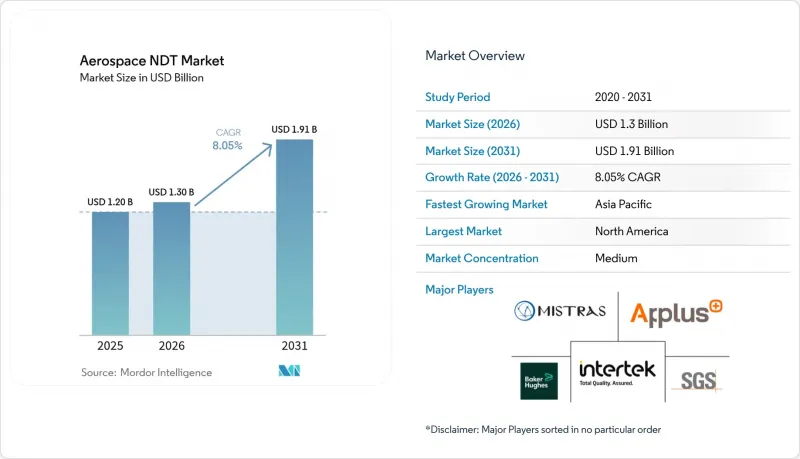
본 보고서는 구성 요소(장비, 소프트웨어 등), 검사 방법(초음파 검사, 방사선 검사, 자분 탐상 검사 등), 기술(기존/기존 방식 및 AI 지원), 지역(북미, 남미, 유럽, 아시아태평양, 중동 및 아프리카)별로 분류되어 있습니다. 시장 전망은 금액(달러) 기준으로 제시되어 있습니다.
전 세계 항공우주 비파괴 검사(NDT) 시장 동향 및 인사이트
여객기 생산 대수 증가
보잉과 에어버스는 2024년에 총 1,200대 이상의 항공기를 출하하여, 팬데믹 이후 최저 수준에서 2배로 증가했습니다. 이에 따라 생산 라인에서는 타크트 타임을 저하시키지 않으면서 엔진 파이론, 주익 스퍼, 동체 패널을 검증하는 고처리량 검사 시스템의 도입이 시급해졌습니다. 현재 최종 조립 스테이션에는 자동 위상 배열 로봇이 도입되어 재현성 있는 스캔 데이터를 확보하여 통합된 결함 라이브러리에 반영하고 있습니다. AS9100에 기반한 문서화 부담으로 인해 제조업체는 모든 초음파 측정값을 특정 부품 일련번호와 연계해야 하며, 그 결과 디지털 추적성을 위한 소프트웨어 수요가 점차 증가하고 있습니다. 인라인 로봇과 분석 대시보드를 결합한 솔루션을 제공하는 장비 공급업체는 수주가 호조를 보이고 있는 반면, 기존의 수동 워크플로는 현재의 생산 속도를 감당하지 못하고 있습니다.
증가하는 정비·수리·정비(MRO) 수요
2025년 현재, 상업용 항공기의 평균 운용 연수는 12.8년에 달하며, 이러한 수명 주기로 인해 구조적 피로 위험이 높아지고, 중정비 작업 부하가 증가하고 있습니다. 각 항공사는 협폭기(narrow-body)의 자본 집약적인 갱신 주기를 상쇄하기 위해 자산의 수명을 연장하고 있으며, 그 결과 정기적인 와전류 검사나 투과 검사가 필요한 노후화된 기체의 도입 기반이 확대되고 있습니다. 광저우에서 하이데라바드에 이르는 아시아태평양의 시설에서는 격납고 수용 능력을 3배로 확대하고 있으며, 이에 따라 장비 대여, 검사원 교육 및 소모품 공급망에 대한 지역적 수요가 발생하고 있습니다. 예측 분석 플랫폼은 현재 비행 부하 데이터와 비파괴 검사 이력을 통합하고 있어, 이를 통해 엔지니어링 팀은 실제 응력 주기에 따라 검사를 연기하거나 앞당길 수 있게 되었습니다. 센서, 분석, 현장 서비스 교육을 패키지로 제공하는 업체들은 이 MRO 시장의 호황기에 다년간의 프레임워크 계약을 확실하게 확보하고 있습니다.
첨단 비파괴 검사(NDT) 장비의 높은 자본 비용
턴키 방식의 위상 배열 및 CT(컴퓨터 단층 촬영) 시스템 도입 비용은 종종 50만 달러를 초과하여, 지역 MRO 사업자나 창업 단계에 있는 eVTOL 제조업체의 예산을 압박하고 있습니다. 대출 기관이 기술적 평가 체계를 갖추지 못한 경제권에서는 자금 조달의 장벽이 높아져 업그레이드 주기가 지연되고 있습니다. 각 벤더들은 현재 투자를 자본 지출(CapEx)에서 운영 비용(OpEx)으로 전환하는 렌탈 풀 및 사용량 기반 구독 모델을 시범적으로 도입하고 있지만, Tier 1 허브를 제외한 지역에서는 하드웨어 업데이트 속도가 여전히 더딘 실정입니다.
부문 분석
2025년, 정밀 스캐너, 위상 배열 프로브 및 고에너지 CT 장비는 항공우주 비파괴 검사(NDT) 시장 규모의 46.10%를 차지하고 있으며, 이는 검사 예산을 역사적으로 특징지어 온 하드웨어 중심의 구매 접근 방식을 뒷받침합니다. 플랫폼 1대당 평균 가격이 30만-50만 달러라는 사실은 진입 장벽이 높고, 기존 기업의 수익을 안정화시키는 장기적인 감가상각 일정을 여실히 보여줍니다. 반면, 소프트웨어는 더 빠르게 성장하고 있으며, 9.15%의 연평균 성장률(CAGR)은 과거 스캔 데이터를 분석하여 예측 시그니처를 추출하는 클라우드 대시보드로의 전환을 시사합니다. 2030년까지 SaaS 이용료가 매년 복리로 증가함에 따라, 분석 서비스 구독이 하드웨어의 매출 점유율을 압박할 가능성이 있습니다.
소프트웨어 벤더는 낮은 도입 비용을 활용하여 여러 OEM이 혼재된 항공기 전체로 도입을 확대하고, 스캔 단위 또는 항공기 단위의 라이선스를 통해 수익화를 도모하고 있습니다. 이러한 자산 부담이 적은 모델은 최고급 하드웨어 구매가 어려운 지역 MRO에게 매력적입니다. 항공사가 정기 점검을 외부에 위탁하고 있기 때문에 서비스 계약은 견조한 추세를 보이고 있는 반면, 소모품은 검사 빈도와 직접 연동된 지속적인 현금 흐름을 창출하여 하드웨어 시장의 침체기에 수익을 보전해 주고 있습니다. 초기 설비 투자액이 높고, 소프트웨어 이용료는 적정 수준이면서도 복리로 증가한다는 상호작용에 따라, 항공우주 NDT 시장 전체의 수명 주기 가치 산정 방식이 재구성되고 있습니다.
지역별 분석
북미는 2025년, 보잉사의 생산 거점과 시애틀에서 마이애미에 이르는 밀집된 MRO 회랑에 힘입어 항공우주 NDT 시장 점유율 38.45%를 유지했습니다. 연방항공청(FAA)의 지침에 따라 노후화된 기체에 대한 철저한 검사 절차가 의무화되어, 각 항공사는 설비 갱신 및 디지털 기록 시스템 확충을 서두르고 있습니다. 또한, 이 지역에서는 정비 일정 수립 엔진에 정보를 제공하는 예측 분석의 통합이 선도적으로 진행되고 있어 소프트웨어 지출의 점진적인 증가를 견인하고 있습니다.
아시아태평양은 중국의 협폭기 제조 확대와 인도 정부의 MRO 지원책에 힘입어 연평균 성장률(CAGR) 9.1%라는 가장 빠른 성장 궤도를 기록하고 있습니다. 광저우, 하이데라바드, 싱가포르는 AI를 활용한 플랫폼이 기존 인프라의 격차를 비약적으로 해소하는 검사 거점으로 부상하고 있습니다. 그러나 인력 부족은 여전히 심각하여, 이해관계자들은 암호화된 통신 회선을 통해 현장 기술자와 해외 레벨 III 전문가를 연결하는 원격 검증 서비스 도입을 추진하고 있습니다.
유럽에서는 툴루즈와 함부르크의 에어버스 조립 라인, 그리고 민간 및 방위 프로그램 모두에 서비스를 제공하는 성숙한 공급망을 기반으로 한 자릿수 중반대의 성장을 유지하고 있습니다. 유럽연합 항공안전청(EASA)은 엄격한 데이터 보관 의무를 부과하고 있어, 규정 준수 보고를 자동화하는 SaaS 도입을 가속화하고 있습니다. 중동의 항공사들은 석유 달러로 조달한 자금을 두바이와 도하의 격납고 복합 시설에 투입하여 장거리 노선의 경유지 확보를 경쟁하고 있지만, 검사관 부족과 높은 설비 비용으로 인해 당분간 확장이 제한되고 있습니다. 남미 및 아프리카에서는 정부 주도의 안전 대책에 발맞추어 간헐적인 시설 현대화가 이루어지고 있으나, 여전히 발전 단계에 머물러 있습니다.
기타 혜택:
- 엑셀 형식 시장 예측(ME) 시트
- 3개월간의 애널리스트 지원
자주 묻는 질문
목차
제1장 서론
제2장 조사 방법
제3장 개요
제4장 시장 구도
제5장 시장 규모와 성장 예측
제6장 경쟁 구도
제7장 시장 기회와 향후 전망
JHS 26.09.03According to Mordor Intelligence, aerospace NDT market size in 2026 is estimated at USD 1.3 billion, growing from 2025 value of USD 1.20 billion with 2031 projections showing USD 1.91 billion, growing at 8.05% CAGR over 2026-2031.
This report is Segmented by Component (Equipment, Software, and More), Testing Method (Ultrasonic Testing, Radiographic Testing, Magnetic Particle Testing, and More), Technique (Traditional/Conventional and AI-Enabled), and Geography (North America, South America, Europe, Asia Pacific, Middle East, and Africa). The Market Forecasts are Provided in Terms of Value (USD).
Global Aerospace NDT Market Trends and Insights
Increasing Passenger Aircraft Production
Boeing and Airbus together shipped more than 1,200 airframes in 2024, doubling post-pandemic lows and forcing production lines to embed high-throughput inspection systems that verify engine pylons, wing spars, and fuselage panels without slowing takt times. Automated phased-array robots now populate final-assembly stations, capturing repeatable scans that feed centralized defect libraries. Documentation burdens under AS9100 require manufacturers to associate every ultrasonic reading with specific part serial numbers, thereby driving incremental software demand for digital traceability. Equipment vendors offering inline robotics paired with analytics dashboards have seen order pipelines tighten, while legacy manual workflows struggle to scale at current build rates.
Growing Maintenance, Repair and Overhaul (MRO) Demand
Commercial fleets averaged 12.8 years of service in 2025, a life cycle that magnifies structural fatigue risk and inflates heavy-check workloads. Airlines prolong the lives of their assets to counterbalance the capital-intensive replacement cycles of narrow-body aircraft, thereby enlarging the installed base of aging airframes that require periodic eddy-current and radiographic evaluations. Asia-Pacific facilities, from Guangzhou to Hyderabad, are tripling their hangar capacity, creating a neighborhood demand for equipment rentals, inspector training, and supply chains for consumables. Predictive analytics platforms now fuse flight-load data with non-destructive test histories, enabling engineering teams to defer or accelerate checks based on real-world stress cycles. Providers that bundle sensors, analytics, and field-service training secure multi-year framework contracts amid this MRO up-cycle.
High Capital Cost of Advanced NDT Equipment
Turnkey phased-array and CT installations frequently exceed USD 500,000, straining the budgets of regional MROs and launch-phase eVTOL manufacturers. Financing hurdles intensify in economies where lenders lack technical valuation frameworks, postponing upgrade cycles. Vendors are now piloting rental pools and usage-based subscription models that shift investments from CapEx to OpEx; however, hardware refresh rates remain slower outside tier-one hubs.
Other drivers and restraints analyzed in the detailed report include:
- Rising Adoption of Composite Airframes
- Stricter Safety-Quality Assurance Regulations
- Shortage of Level III Certified Inspectors
For complete list of drivers and restraints, kindly check the Table Of Contents.
Segment Analysis
In 2025, precision scanners, phased-array probes, and high-energy CT machines accounted for 46.10% of the Aerospace NDT market size, underscoring the hardware-centric purchasing approach that has historically defined inspection budgets. Average ticket prices of USD 300,000-500,000 per platform underscore high barriers to entry and long depreciation schedules that stabilize incumbent revenues. Software, however, is scaling faster; its 9.15% CAGR signals a pivot toward cloud dashboards that mine historical scans for predictive signatures. By 2030, analytics subscriptions could dilute hardware's revenue share as SaaS fees compound annually.
Software vendors leverage low entry costs to seed installations across mixed OEM fleets, monetizing via per-scan or per-aircraft licenses. This asset-light model appeals to regional MROs that are locked out of top-tier hardware purchases. Service contracts hold steady as airlines outsource periodic inspections, while consumables supply recurring cash flow linked directly to test frequency, cushioning revenue during hardware down-cycles. The interplay of high upfront equipment outlays and modest but compounding software fees is reshaping lifetime-value calculations across the Aerospace NDT market.
Complete Report Scope:
- By Component
- Equipment
- Software
- Services
- Consumables
- By Testing Method
- Ultrasonic Testing
- Radiographic Testing
- Magnetic Particle Testing
- Liquid Penetrant Testing
- Visual Inspection Testing
- Eddy-Current Testing
- Acoustic Emission Testing
- Thermography / Infrared Testing
- Computed Tomography Testing
- By Technique
- Traditional / Conventional
- AI-enabled
- By Geography
- North America
- United States
- Canada
- Mexico
- South America
- Brazil
- Argentina
- Rest of South America
- Europe
- Germany
- United Kingdom
- France
- Italy
- Spain
- Rest of Europe
- Asia Pacific
- China
- Japan
- India
- South Korea
- South-East Asia
- Rest of Asia Pacific
- Middle East
- Saudi Arabia
- United Arab Emirates
- Turkey
- Rest of Middle East
- Africa
- South Africa
- Nigeria
- Rest of Africa
- North America
Geography Analysis
North America retained 38.45% of the Aerospace NDT market share in 2025, buoyed by Boeing's production hubs and dense MRO corridors stretching from Seattle to Miami. Federal Aviation Administration directives prescribe exhaustive inspection routines for aging fleets, prompting airlines to refresh equipment arsenals and expand digital record systems. The region also pioneers predictive analytics integrations that feed maintenance-scheduling engines, driving incremental software spend.
Asia-Pacific posts the fastest trajectory at 9.1% CAGR, energized by China's narrow-body manufacturing ramp and India's government-backed MRO incentives. Guangzhou, Hyderabad, and Singapore have emerged as inspection hubs where AI-enabled platforms leapfrog legacy infrastructure gaps. Talent shortages remain acute, however, nudging stakeholders to adopt remote-verification services that connect on-site technicians with off-shore Level III experts via encrypted links.
Europe sustains mid-single-digit growth, anchored by Airbus assembly lines in Toulouse and Hamburg, alongside mature supply chains that serve both civil and defense programs. The European Union Aviation Safety Agency enforces stringent data-retention mandates, accelerating SaaS adoption that automates compliance reporting. Middle Eastern carriers channel petro-dollar capital into hangar complexes in Dubai and Doha, vying to capture long-haul layover maintenance; yet, inspector shortages and high equipment costs cap immediate expansion. South America and Africa remain nascent, with sporadic upgrades tied to government-funded safety drives.
- Baker Hughes Company
- Mistras Group Inc.
- SGS SA
- Intertek Group plc
- Applus Services SA
- General Electric Company (GE Aviation NDT Solutions)
- Olympus Corporation
- Nikon Corporation
- Eddyfi Technologies Inc.
- Teledyne Technologies Incorporated
- Zetec Inc.
- Sonatest Ltd.
- TWI Ltd.
- Ashtead Technology Ltd.
- Vermont Ultrasonics Inc.
- YXLON International GmbH
- Hologic Inc. (SureScan)
- Waygate Technologies GmbH
- Magnaflux Corporation
- Fischer Technology Inc.
- Element Materials Technology Group Ltd.
- Collins Aerospace (UTAS NDT Lab)
- Lufthansa Technik AG (NDT Services)
- Airbus S.A.S (AIRTAC NDT)
- Spirit AeroSystems Holdings Inc. (NDT Centers)
- Bombardier Inc. (In-house NDT)
Additional Benefits:
- The market estimate (ME) sheet in Excel format
- 3 months of analyst support
TABLE OF CONTENTS
1 INTRODUCTION
- 1.1 Study Assumptions and Market Definition
- 1.2 Scope of the Study
2 RESEARCH METHODOLOGY
3 EXECUTIVE SUMMARY
4 MARKET LANDSCAPE
- 4.1 Market Overview
- 4.2 Market Drivers
- 4.2.1 Increasing passenger aircraft production
- 4.2.2 Growing maintenance, repair and overhaul (MRO) demand
- 4.2.3 Rising adoption of composite airframes
- 4.2.4 Stricter safety - quality assurance regulations
- 4.2.5 Integration of predictive analytics in NDT workflows
- 4.2.6 Expansion of urban air mobility prototypes
- 4.3 Market Restraints
- 4.3.1 High capital cost of advanced NDT equipment
- 4.3.2 Shortage of level-III certified inspectors
- 4.3.3 Data-security concerns in cloud-connected NDT tools
- 4.3.4 Limited test standards for novel additive-manufactured parts
- 4.4 Industry Value Chain Analysis
- 4.5 Impact of Macroeconomic Factors
- 4.6 Regulatory Landscape
- 4.7 Technological Outlook
- 4.8 Porter's Five Forces Analysis
- 4.8.1 Threat of New Entrants
- 4.8.2 Bargaining Power of Suppliers
- 4.8.3 Bargaining Power of Buyers
- 4.8.4 Threat of Substitutes
- 4.8.5 Competitive Rivalry
5 MARKET SIZE AND GROWTH FORECASTS (VALUE)
- 5.1 By Component
- 5.1.1 Equipment
- 5.1.2 Software
- 5.1.3 Services
- 5.1.4 Consumables
- 5.2 By Testing Method
- 5.2.1 Ultrasonic Testing
- 5.2.2 Radiographic Testing
- 5.2.3 Magnetic Particle Testing
- 5.2.4 Liquid Penetrant Testing
- 5.2.5 Visual Inspection Testing
- 5.2.6 Eddy-Current Testing
- 5.2.7 Acoustic Emission Testing
- 5.2.8 Thermography / Infrared Testing
- 5.2.9 Computed Tomography Testing
- 5.3 By Technique
- 5.3.1 Traditional / Conventional
- 5.3.2 AI-enabled
- 5.4 By Geography
- 5.4.1 North America
- 5.4.1.1 United States
- 5.4.1.2 Canada
- 5.4.1.3 Mexico
- 5.4.2 South America
- 5.4.2.1 Brazil
- 5.4.2.2 Argentina
- 5.4.2.3 Rest of South America
- 5.4.3 Europe
- 5.4.3.1 Germany
- 5.4.3.2 United Kingdom
- 5.4.3.3 France
- 5.4.3.4 Italy
- 5.4.3.5 Spain
- 5.4.3.6 Rest of Europe
- 5.4.4 Asia Pacific
- 5.4.4.1 China
- 5.4.4.2 Japan
- 5.4.4.3 India
- 5.4.4.4 South Korea
- 5.4.4.5 South-East Asia
- 5.4.4.6 Rest of Asia Pacific
- 5.4.5 Middle East
- 5.4.5.1 Saudi Arabia
- 5.4.5.2 United Arab Emirates
- 5.4.5.3 Turkey
- 5.4.5.4 Rest of Middle East
- 5.4.6 Africa
- 5.4.6.1 South Africa
- 5.4.6.2 Nigeria
- 5.4.6.3 Rest of Africa
- 5.4.1 North America
6 COMPETITIVE LANDSCAPE
- 6.1 Market Concentration
- 6.2 Strategic Moves
- 6.3 Market Share Analysis
- 6.4 Company Profiles (includes Global level Overview, Market level overview, Core Segments, Financials as available, Strategic Information, Market Rank/Share for key companies, Products and Services, and Recent Developments)
- 6.4.1 Baker Hughes Company
- 6.4.2 Mistras Group Inc.
- 6.4.3 SGS SA
- 6.4.4 Intertek Group plc
- 6.4.5 Applus Services SA
- 6.4.6 General Electric Company (GE Aviation NDT Solutions)
- 6.4.7 Olympus Corporation
- 6.4.8 Nikon Corporation
- 6.4.9 Eddyfi Technologies Inc.
- 6.4.10 Teledyne Technologies Incorporated
- 6.4.11 Zetec Inc.
- 6.4.12 Sonatest Ltd.
- 6.4.13 TWI Ltd.
- 6.4.14 Ashtead Technology Ltd.
- 6.4.15 Vermont Ultrasonics Inc.
- 6.4.16 YXLON International GmbH
- 6.4.17 Hologic Inc. (SureScan)
- 6.4.18 Waygate Technologies GmbH
- 6.4.19 Magnaflux Corporation
- 6.4.20 Fischer Technology Inc.
- 6.4.21 Element Materials Technology Group Ltd.
- 6.4.22 Collins Aerospace (UTAS NDT Lab)
- 6.4.23 Lufthansa Technik AG (NDT Services)
- 6.4.24 Airbus S.A.S (AIRTAC NDT)
- 6.4.25 Spirit AeroSystems Holdings Inc. (NDT Centers)
- 6.4.26 Bombardier Inc. (In-house NDT)
7 MARKET OPPORTUNITIES AND FUTURE OUTLOOK
- 7.1 White-space and Unmet-Need Assessment


