

|
시장보고서
상품코드
2155009
산업용 이미징 시스템 통합 : 시장 점유율 분석, 업계 동향과 통계, 성장 예측(2026-2031년)Industrial Imaging System Integration - Market Share Analysis, Industry Trends & Statistics, Growth Forecasts (2026 - 2031) |
||||||
 Mordor Intelligence
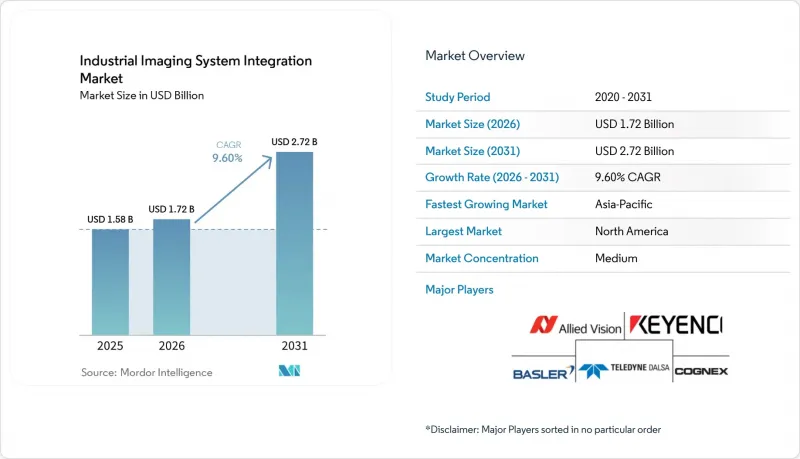
에 따르면 산업용 영상 시스템 통합 시장 규모는 2025년 15억 8,000만 달러에서 2026년에는 17억 2,000만 달러로 확대하며, 2031년까지 27억 2,000만 달러에 달할 것으로 예상되고 있으며, 2026-2031년에 CAGR 9.60%로 성장할 것으로 전망되고 있습니다.
전 세계 산업용 이미징 시스템 통합 시장의 동향 및 인사이트
무결점 제조에 대한 수요 증가
자동차 및 전자기기 제조업체들은 후공정에서의 표본 검사를 100% 인라인 시각 검사로 대체하고 있습니다. 보증 리스크, 리콜 비용 및 공급업체 평가 지표로 인해 고객에게 전달되는 결함 1건당 비용이 증가하고 있습니다. 고급 전기자동차의 트림 패널에서 놓친 결함은 검사 주기 비용을 상회하는 고객으로부터의 벌금을 초래할 가능성이 있습니다. 코그넥스(Cognex)는 2026년 1분기 실적 보고서에서 규칙 기반 시스템에서 AI 비전으로의 전환이 포장, 자동차, 전자 분야 고객들 사이에서 가장 활발하게 이루어지고 있다고 밝혔습니다. 표면 결함 모델의 정확도 향상으로 인해 과거 불량 데이터에서는 탐지되지 않았던 결함을 식별하는 것도 가능해집니다. 이러한 인사이트가 수명주기 지원 및 모델 관리의 범위를 확대함에 따라 산업용 이미지 시스템 통합 시장에 대한 수요는 더욱 높아질 것입니다.
AI를 활용한 인라인 검사 및 엣지 추론
임베디드 프로세서를 통해 외부 서버로 이미지를 전송할 때 발생하는 지연 및 대역폭 부하가 경감되고 있습니다. 코그넥스는 2026년 5월, 퀄컴 드래곤윙(Qualcomm Dragonwing) 플랫폼을 탑재한 ‘In-Sight 3900’을 출시했습니다. 이 제품은 최대 25 MP의 해상도를 갖추고 있으며, 이전 세대에 비해 최대 4배의 처리 속도를 실현하고 있습니다. 또한 코그넥스는 2026년 4월, NVIDIA Jetson 기술을 탑재하고 157 TOPS의 AI 연산 능력을 갖춘 ‘In-Sight 6900’ 컨트롤러를 출시했습니다. 이 컨트롤러는 병렬 처리를 통한 고해상도 모델 및 10-20장의 훈련 이미지를 사용하는 구성을 지원합니다. 이러한 개발을 통해 일부 애플리케이션의 도입 작업이 단축되었으며, 경쟁의 초점은 모델의 품질 및 수명주기관리로 이동하고 있습니다. 엣지 추론이 더욱 표준적인 시스템 아키텍처로 자리 잡음에 따라 산업용 영상 시스템 통합 시장은 그 혜택을 누리고 있습니다.
초기 통합 및 검증 비용의 높음
완전한 통합 프로젝트에는 카메라, 조명, 배선, 소프트웨어 라이선스, PLC 인터페이스 및 인증 작업이 포함될 수 있습니다. 이러한 비용은 중규모 제조업체의 경우, 품질 개선으로 인해 향후 수년간 예상되는 절감액을 초과할 가능성이 있습니다. 특히 설치, 운영 및 성능 인증을 문서화해야 하는 제약 및 의료기기 분야에서는 그 부담이 특히 큽니다. 소규모 제조업체의 경우 검증 엔지니어가 부족한 경우가 많아, 고정적인 규정 준수 비용을 여러 생산 라인에 분산시킬 수 없습니다. 모듈식이며 사전에 검증된 시스템을 도입함으로써 현장 특유의 작업을 줄일 수 있습니다. 자본 승인 주기가 길어져 투자가 지연될 경우, 산업용 영상 시스템 통합 시장은 여전히 제약을 받고 있습니다.
부문 분석
2025년 기준, 수명주기 지원 및 모델 관리는 산업용 영상 시스템 통합 시장 규모의 27.65%를 차지했습니다. 제품 구성, 생산 라인 상황, 규정 준수 요건의 변화에 따라 도입된 시스템에서는 모델 재훈련이 필요합니다. 이 서비스는 초기 장비 설치 후에도 지속적인 운영을 가능하게 합니다. 또한 여러 거점에서 육안 검사 프로그램을 관리하는 기업 고객을 지원합니다. 카메라, 조명, 생산 제어 시스템을 연결하기 위해서는 설치 및 시운전이 여전히 필수적입니다. 제약 및 항공우주 분야에서는 고객이 공식 기록을 요구하므로 검증 및 적합성 평가 서비스에는 고액의 요금이 책정되어 있습니다.
시스템 설계 및 타당성 시험 시장은 2031년까지 연평균 성장률(CAGR) 10.22%로 확대될 것으로 예측됩니다. AI 검사 프로그램의 경우, 제조업체가 자본을 투자하기 전에 실제 결함에 대한 타당성 시험을 수행해야 합니다. 이 작업은 규칙 기반 설계에 비해 프로젝트 초기 단계에서 시간이 더 소요됩니다. 코그넥스(Cognex)는 100개 이상의 제조업체가 참여한 베타 프로그램을 거쳐 2026년 5월 ‘OneVision’을 일반에 공개했습니다. 이 플랫폼은 검사가 생산 라인에서 로컬로 실행되는 한편, 모델 개발과 배포를 중앙 집중화합니다. 이러한 기능으로 인해 산업용 이미징 시스템 통합 업계 전반에서 지원 서비스의 중요성이 높아지고 있습니다.
2D 이미징은 2025년에 61.21%의 점유율을 차지했습니다. 이러한 위상은 저렴한 비용, 검증된 소프트웨어, 그리고 라벨, 표면, 바코드 검증 분야에서 폭넓게 활용되고 있음을 반영합니다. 영역 스캔 및 라인 스캔 시스템은 대부분의 최종사용자 범주에 걸친 용도를 지원합니다. 또한 2D 시스템은 기존 운영을 현대화하고 있는 제조업체에게도 친숙한 기술입니다. 이러한 기존 친화성이 지속적인 통합 작업을 지원하고 있습니다. 3D 이미징은 자동차 차체 구조 및 정밀 가공 부품 분야에서 여전히 중요한 역할을 수행하고 있습니다.
하이퍼스펙트럼 및 멀티스펙트럼 이미징은 2031년까지 연평균 성장률(CAGR) 12.34%로 확대될 것으로 예측됩니다. 하드웨어 비용의 감소와 툴의 성숙화로 인해 생산 라인에서의 활용이 확대되고 있습니다. 이러한 시스템은 표준 RGB 카메라로는 식별할 수 없는 재료 특성을 파악할 수 있습니다. 식품 및 의약품 제조업체는 이 기능을 활용하여 혼입물, 코팅 불균일성, 이물 유무를 평가하고 있습니다. 2025년 연구에 따르면 케모메트릭스를 이용한 하이퍼스펙트럼 이미징은 의약품의 혼합 균일성 모니터링에 효과적인 것으로 밝혀졌습니다. 또한 산업용 이미징 시스템 통합 업계에서는 열화상 및 X선 시스템도 복합재료와 항공우주 분야의 중요 부품에 대한 비파괴 검사를 지원하고 있습니다.
지역별 분석
2025년, 북미는 산업용 이미징 시스템 통합 시장의 31.72%를 차지했습니다. 이 지역에는 자동차, 제약, 방위 관련 제조업이 집중되어 있습니다. 애리조나주, 오하이오주, 텍사스주의 반도체 생산 능력에 대한 투자가 포괄적인 통합 계약을 지원하고 있습니다. 또한 리쇼어링(국내 복귀) 프로그램으로 인해 국내내 새로운 전기자동차용 배터리 및 칩 제조 시설에 대한 수요도 증가하고 있습니다. FDA(미국 식품의약국)의 식품 이력추적 및 의약품 기록에 관한 요건은 검사 시스템의 정기적인 업데이트 주기를 지원하고 있습니다.
유럽에서는 정밀 제조 및 특수 제조가 여전히 중요한 위치를 차지하는 독일, 이탈리아, 프랑스에서 수요가 견고합니다. 조달 요건에는 AI 거버넌스, 제품 추적성, 사이버 보안이 점점 더 많이 포함되고 있습니다. IEC 62443 준수는 높은 규정 준수가 요구되는 고객의 스마트 카메라 및 임베디드 AI 시스템에 있으며, 그 중요성이 더욱 커지고 있습니다. 디지털 제품 여권(Digital Product Passport)의 도입으로 배터리, 섬유, 전자기기 제조 분야에서 새로운 요건이 발생하고 있습니다. 이러한 프로그램에서는 생산 단계부터 제품 정보를 기록해야 하므로, 산업용 영상 시스템 통합 시장을 지원하고 있습니다.
아시아태평양은 2031년까지 연평균 성장률(CAGR) 11.78%로 확대될 것으로 예측됩니다. 중국, 한국, 일본, 대만에서는 반도체 검사 수요가 지원되고 있는 반면, 말레이시아와 베트남에서는 첨단 패키징 역량이 확충되고 있습니다. 한국의 수요는 삼성전자 및 SK하이닉스의 DRAM 및 3D NAND 검사에 집중되어 있습니다. 일본은 정밀 검사 장비의 주요 구매국인 동시에 주요 공급국이기도 합니다. 인도는 초기 단계의 시장 기회로, 자동차 및 제약 업계의 고객들이 지역 시스템 통합사업자를 이용하고 있습니다. 남미, 중동 및 아프리카는 여전히 소규모 시장이며, 수요는 자동차, 식품 가공, 석유화학, 항공우주 유지보수와 관련되어 있습니다.
기타 혜택:
- 엑셀 형식의 시장 예측(ME) 시트
- 3개월간의 애널리스트 지원
자주 묻는 질문
목차
제1장 서론
- 조사 전제조건과 시장 정의
- 조사 범위
제2장 조사 방법
제3장 개요
제4장 시장 구도
- 시장 개요
- 시장 성장 촉진요인
- 시장 성장 억제요인
- 거시경제 요인이 시장에 미치는 영향
- 업계 밸류체인 분석
- 규제 상황
- 기술 전망
- Porter's Five Forces 분석
제5장 시장 규모와 성장 예측
- 통합 서비스별
- 이미징 기술별
- 용도별
- 배포 유형별
- 최종사용자 산업별
- 지역별
- 북미
- 미국
- 캐나다
- 멕시코
- 남미
- 브라질
- 아르헨티나
- 기타 남미 국가
- 유럽
- 독일
- 영국
- 프랑스
- 이탈리아
- 스페인
- 기타 유럽 국가
- 아시아태평양
- 중국
- 일본
- 인도
- 한국
- ASEAN
- 기타 아시아태평양 국가
- 중동
- 사우디아라비아
- 아랍에미리트
- 기타 중동 국가
- 아프리카
- 남아프리카공화국
- 기타 아프리카 국가
- 북미
제6장 경쟁 구도
- 시장 집중도
- 전략적 동향
- 시장 점유율 분석
- 기업 개요
- Cognex Corporation
- Keyence Corporation
- Teledyne Technologies Incorporated
- SICK AG
- Basler AG
- Allied Vision Technologies GmbH
- IDS Imaging Development Systems GmbH
- JAI A/S
- LMI Technologies Inc.
- Datalogic S.p.A.
- Baumer Holding AG
- Vitronic GmbH
- Stemmer Imaging AG
- ViTrox Corporation Berhad
- Pleora Technologies Inc.
- Matrox Imaging Inc.
- Vision Components GmbH
- Emergent Vision Technologies Inc.
- HIKROBOT Co., Ltd.
- MVTec Software GmbH
- Qualitas Technologies Pvt. Ltd.
제7장 시장 기회와 향후 전망
KSA 26.10.28According to Mordor Intelligence, the industrial imaging system integration market size is expected to increase from USD 1.58 billion in 2025 to USD 1.72 billion in 2026 and reach USD 2.72 billion by 2031, growing at a CAGR of 9.60% over 2026-2031.
Global Industrial Imaging System Integration Market Trends and Insights
Rising Demand for Zero-Defect Manufacturing
Automotive and electronics producers are replacing downstream sampling with 100% inline visual monitoring. Warranty exposure, recall costs, and supplier scorecards have increased the cost of a defect that reaches the customer. A missed defect on a premium EV trim panel can create customer penalties that exceed the cost of the inspection cycle. Cognex reported in its first-quarter 2026 results that migration from rule-based systems to AI vision was most active in packaging, automotive, and electronics accounts. Better surface-defect models can also reveal defects that were not captured in past scrap data. The industrial imaging system integration market gains further demand when these findings expand the scope of lifecycle support and model management.
AI-Enabled Inline Inspection and Edge Inference
Embedded processors are reducing the latency and bandwidth burden of sending images to external servers. Cognex launched the In-Sight 3900 in May 2026 on Qualcomm Dragonwing platforms, with up to 25 MP resolution and processing that is up to 4 times faster than the preceding generation. Cognex also launched the In-Sight 6900 controller in April 2026 on NVIDIA Jetson technology with 157 TOPS of AI compute. The controller supports parallel high-resolution models and configurations that use 10-20 training images. These developments shorten implementation work for some applications and shift competition toward model quality and lifecycle management. The industrial imaging system integration market benefits as edge inference becomes a more standard system architecture.
High Upfront Integration and Validation Costs
A full integration project can include cameras, lighting, cabling, software licenses, PLC interfaces, and qualification work. These costs can exceed several years of projected quality savings for a mid-sized manufacturer. The burden is particularly high in pharmaceutical and medical device settings that need documented installation, operational, and performance qualification. Smaller manufacturers often lack validation engineers and cannot spread fixed compliance costs across many lines. Modular and pre-validated systems can reduce the site-specific work required. The industrial imaging system integration market remains constrained where capital approval cycles delay these investments.
Other drivers and restraints analyzed in the detailed report include:
- Expansion of Vision-Guided Robotics
- Traceability and Compliance Requirements
- Shortage of Vision-System Integration Talent
For complete list of drivers and restraints, kindly check the Table Of Contents.
Segment Analysis
Lifecycle Support and Model Management held 27.65% of the industrial imaging system integration market size in 2025. The installed base requires model retraining as product mixes, line conditions, and compliance expectations change. This service provides continuity after the initial equipment installation. It also supports enterprise customers that manage visual inspection programs across multiple sites. Installation and Commissioning remains necessary to connect cameras, lighting, and production controls. Validation and Qualification earns premium rates in pharmaceutical and aerospace work because customers require formal records.
System Design and Feasibility Testing is projected to expand at a 10.22% CAGR through 2031. AI inspection programs need feasibility testing against real defects before a manufacturer commits capital. This work adds time to early project stages when compared with rule-based designs. Cognex made OneVision generally available in May 2026 following a beta program that involved more than 100 manufacturers. The platform centralizes model development and deployment while inspections run locally on the line. These capabilities increase the importance of support services across the industrial imaging system integration industry.
2D Imaging accounted for 61.21% share in 2025. Its position reflects lower costs, established software, and broad use in labels, surfaces, and barcode verification. Area-scan and line-scan systems serve applications across most end-user categories. 2D systems are also familiar to manufacturers that are modernizing existing operations. This installed familiarity supports continued integration work. 3D Imaging remains important for automotive body structures and precision-machined components.
Hyperspectral and Multispectral Imaging is projected to expand at a 12.34% CAGR through 2031. Falling hardware costs and more mature tools are supporting use on production lines. These systems can identify material characteristics that standard RGB cameras cannot distinguish. Food and pharmaceutical producers use this capability to assess adulteration, coating variation, and foreign objects. A 2025 study found that hyperspectral imaging with chemometrics supported pharmaceutical blending homogeneity monitoring. Thermal and X-ray systems also support non-destructive inspection of composites and critical aerospace components in the industrial imaging system integration industry.
Complete Report Scope:
- By Integration Service
- System Design and Feasibility Testing
- Installation and Commissioning
- Validation and Qualification
- Lifecycle Support and Model Management
- Other Integration Services
- By Imaging Technology
- 2D Imaging
- 3D Imaging
- Hyperspectral and Multispectral Imaging
- Other Imaging Technologies
- By Application
- Quality Assurance and Inspection
- Measurement and Gauging
- Identification and Traceability
- Positioning and Guidance
- Predictive Maintenance and Process Monitoring
- Other Applications
- By Deployment Type
- New System Integration
- Retrofit and Modernization
- By End-User Industry
- Automotive and Automotive Components
- Electronics and Semiconductor
- Food and Beverage
- Pharmaceuticals and Life Sciences
- Industrial Manufacturing
- Packaging
- Aerospace and Defense
- Logistics and Warehousing
- Other End-User Industries
- By Geography
- North America
- United States
- Canada
- Mexico
- South America
- Brazil
- Argentina
- Rest of South America
- Europe
- Germany
- United Kingdom
- France
- Italy
- Spain
- Rest of Europe
- Asia-Pacific
- China
- Japan
- India
- South Korea
- ASEAN
- Rest of Asia-Pacific
- Middle East
- Saudi Arabia
- United Arab Emirates
- Rest of the Middle East
- Africa
- South Africa
- Rest of Africa
- North America
Geography Analysis
North America held 31.72% of the industrial imaging system integration market share in 2025. The region has a high concentration of automotive, pharmaceutical, and defense manufacturing. Semiconductor capacity investment in Arizona, Ohio, and Texas supports full-scope integration contracts. Reshoring programs also increase the need for new domestic EV battery and chip facilities. FDA food traceability and pharmaceutical record requirements support a recurring renewal cycle for inspection systems.
Europe has strong demand in Germany, Italy, and France, where precision and specialty manufacturing remain important. Procurement requirements increasingly cover AI governance, product traceability, and cybersecurity. IEC 62443 compliance has become more relevant for smart cameras and embedded AI systems in high-compliance accounts. Digital Product Passports create additional requirements in battery, textile, and electronics manufacturing. These programs require product information to be recorded from the point of production and support the industrial imaging system integration market.
Asia-Pacific is projected to expand at an 11.78% CAGR through 2031. China, South Korea, Japan, and Taiwan support semiconductor inspection demand, while Malaysia and Vietnam are adding advanced packaging capacity. South Korean demand centers on DRAM and 3D NAND inspection at Samsung Electronics and SK Hynix. Japan is both a major buyer and supplier of precision inspection equipment. India is an early-stage opportunity, where automotive and pharmaceutical customers are using regional integrators. South America, the Middle East, and Africa remain smaller markets, with demand linked to automotive, food processing, petrochemicals, and aerospace maintenance.
- Cognex Corporation
- Keyence Corporation
- Teledyne Technologies Incorporated
- SICK AG
- Basler AG
- Allied Vision Technologies GmbH
- IDS Imaging Development Systems GmbH
- JAI A/S
- LMI Technologies Inc.
- Datalogic S.p.A.
- Baumer Holding AG
- Vitronic GmbH
- Stemmer Imaging AG
- ViTrox Corporation Berhad
- Pleora Technologies Inc.
- Matrox Imaging Inc.
- Vision Components GmbH
- Emergent Vision Technologies Inc.
- HIKROBOT Co., Ltd.
- MVTec Software GmbH
- Qualitas Technologies Pvt. Ltd.
Additional Benefits:
- The market estimate (ME) sheet in Excel format
- 3 months of analyst support
TABLE OF CONTENTS
1 INTRODUCTION
- 1.1 Study Assumptions and Market Definition
- 1.2 Scope of the Study
2 RESEARCH METHODOLOGY
3 EXECUTIVE SUMMARY
4 MARKET LANDSCAPE
- 4.1 Market Overview
- 4.2 Market Drivers
- 4.2.1 Rising Demand for Zero-Defect Manufacturing
- 4.2.2 Expansion of Vision-Guided Robotics
- 4.2.3 AI-Enabled Inline Inspection and Edge Inference
- 4.2.4 Traceability and Compliance Requirements
- 4.2.5 Brownfield Vision Retrofits for Existing Lines
- 4.2.6 Vision Data Feeds for Digital Twins and Production Intelligence
- 4.3 Market Restraints
- 4.3.1 High Upfront Integration and Validation Costs
- 4.3.2 Shortage of Vision-System Integration Talent
- 4.3.3 Interoperability and Legacy-Equipment Constraints
- 4.3.4 Cybersecurity Exposure of Connected Vision Assets
- 4.4 Impact of Macroeconomic Factors on the Market
- 4.5 Industry Value Chain Analysis
- 4.6 Regulatory Landscape
- 4.7 Technological Outlook
- 4.8 Porter's Five Forces Analysis
5 MARKET SIZE AND GROWTH FORECASTS (VALUE)
- 5.1 By Integration Service
- 5.1.1 System Design and Feasibility Testing
- 5.1.2 Installation and Commissioning
- 5.1.3 Validation and Qualification
- 5.1.4 Lifecycle Support and Model Management
- 5.1.5 Other Integration Services
- 5.2 By Imaging Technology
- 5.2.1 2D Imaging
- 5.2.2 3D Imaging
- 5.2.3 Hyperspectral and Multispectral Imaging
- 5.2.4 Other Imaging Technologies
- 5.3 By Application
- 5.3.1 Quality Assurance and Inspection
- 5.3.2 Measurement and Gauging
- 5.3.3 Identification and Traceability
- 5.3.4 Positioning and Guidance
- 5.3.5 Predictive Maintenance and Process Monitoring
- 5.3.6 Other Applications
- 5.4 By Deployment Type
- 5.4.1 New System Integration
- 5.4.2 Retrofit and Modernization
- 5.5 By End-User Industry
- 5.5.1 Automotive and Automotive Components
- 5.5.2 Electronics and Semiconductor
- 5.5.3 Food and Beverage
- 5.5.4 Pharmaceuticals and Life Sciences
- 5.5.5 Industrial Manufacturing
- 5.5.6 Packaging
- 5.5.7 Aerospace and Defense
- 5.5.8 Logistics and Warehousing
- 5.5.9 Other End-User Industries
- 5.6 By Geography
- 5.6.1 North America
- 5.6.1.1 United States
- 5.6.1.2 Canada
- 5.6.1.3 Mexico
- 5.6.2 South America
- 5.6.2.1 Brazil
- 5.6.2.2 Argentina
- 5.6.2.3 Rest of South America
- 5.6.3 Europe
- 5.6.3.1 Germany
- 5.6.3.2 United Kingdom
- 5.6.3.3 France
- 5.6.3.4 Italy
- 5.6.3.5 Spain
- 5.6.3.6 Rest of Europe
- 5.6.4 Asia-Pacific
- 5.6.4.1 China
- 5.6.4.2 Japan
- 5.6.4.3 India
- 5.6.4.4 South Korea
- 5.6.4.5 ASEAN
- 5.6.4.6 Rest of Asia-Pacific
- 5.6.5 Middle East
- 5.6.5.1 Saudi Arabia
- 5.6.5.2 United Arab Emirates
- 5.6.5.3 Rest of the Middle East
- 5.6.6 Africa
- 5.6.6.1 South Africa
- 5.6.6.2 Rest of Africa
- 5.6.1 North America
6 COMPETITIVE LANDSCAPE
- 6.1 Market Concentration
- 6.2 Strategic Moves
- 6.3 Market Share Analysis
- 6.4 Company Profiles (includes Global Level Overview, Market Level Overview, Core Segments, Financials as available, Strategic Information, Market Rank/Share, Products and Services, Recent Developments)
- 6.4.1 Cognex Corporation
- 6.4.2 Keyence Corporation
- 6.4.3 Teledyne Technologies Incorporated
- 6.4.4 SICK AG
- 6.4.5 Basler AG
- 6.4.6 Allied Vision Technologies GmbH
- 6.4.7 IDS Imaging Development Systems GmbH
- 6.4.8 JAI A/S
- 6.4.9 LMI Technologies Inc.
- 6.4.10 Datalogic S.p.A.
- 6.4.11 Baumer Holding AG
- 6.4.12 Vitronic GmbH
- 6.4.13 Stemmer Imaging AG
- 6.4.14 ViTrox Corporation Berhad
- 6.4.15 Pleora Technologies Inc.
- 6.4.16 Matrox Imaging Inc.
- 6.4.17 Vision Components GmbH
- 6.4.18 Emergent Vision Technologies Inc.
- 6.4.19 HIKROBOT Co., Ltd.
- 6.4.20 MVTec Software GmbH
- 6.4.21 Qualitas Technologies Pvt. Ltd.
7 MARKET OPPORTUNITIES AND FUTURE OUTLOOK
- 7.1 White-Space and Unmet-Need Assessment


