

|
시장보고서
상품코드
2155279
산업용 영상 처리 소프트웨어 : 시장 점유율 분석, 업계 동향과 통계, 성장 예측(2026-2031년)Industrial Image Processing Software - Market Share Analysis, Industry Trends & Statistics, Growth Forecasts (2026 - 2031) |
||||||
 Mordor Intelligence
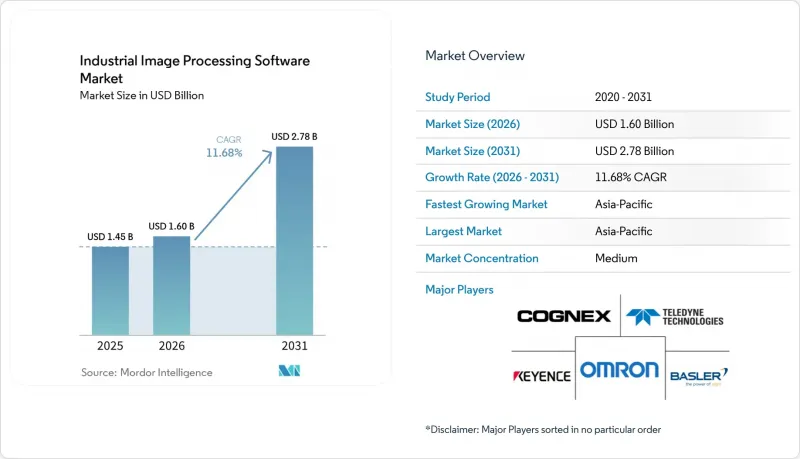
에 따르면 산업용 영상 처리 소프트웨어 시장 규모는 2025년에 14억 5,000만 달러로, 2026년 16억 달러에서 2031년까지 27억 8,000만 달러에 달할 것으로 예측되고 있으며, 예측 기간(2026-2031년)에 CAGR은 11.68%에 달할 전망입니다.
전 세계 산업용 이미지 처리 소프트웨어 시장의 동향 및 인사이트
자동화된 품질 검사 및 무결점 제조에 대한 수요 증가
여러 생산 공정을 거치면서 발견되지 못한 결함은 각 공정에서 완제품에 부가가치가 더해지기 때문에 자재 손실로 이어질 가능성이 있습니다. 따라서 조기 발견은 제조업체에게 중요한 운영 요건이 되고 있습니다. 제공된 조사에 따르면 산업용 AI 비전 시스템은 100밀리초 미만의 추론 속도를 유지하면서 시간당 1만개 이상의 부품을 검사할 수 있습니다. 이러한 운영 요건이 산업용 이미지 처리 소프트웨어 시장 전체의 수요를 지원하고 있습니다. 폭스바겐 그룹은 2025년, 품질관리용 컴퓨터 비전 애플리케이션을 포함해 제조 네트워크 전체에 1,200개 이상의 AI 애플리케이션을 도입했습니다. 한 시설에서는 이러한 애플리케이션 도입을 통해 에너지 비용을 12% 절감했으며, 이는 검사 자동화가 더 광범위한 공정 개선에 기여할 수 있음을 입증했습니다. 또한 ISO 9001 및 IATF 16949의 요구 사항 역시 생산 라인에서 타임스탬프가 찍히고 감사 가능한 검사 기록에 대한 수요를 지원하고 있습니다. 이러한 요구 사항은 산업용 이미지 처리 소프트웨어 시장에 있으며, 중요한 요소입니다.
AI를 활용한 검사 및 적응형 이미지 분석의 확대
산업용 이미지 처리 소프트웨어 시장은 고정된 규칙 기반 프로그래밍에서 사례 기반 딥러닝 모델로 전환되고 있습니다. 이러한 접근 방식은 변화하는 조명 조건, 표면 불균일성, 복잡한 형상 등 기존 비전 기법의 한계가 될 수 있는 요소들에 대응하는 데 도움이 됩니다. 2026년 5월, 코그넥스(Cognex)는 한 고객이 OneVision을 사용하여 1일도 채 되지 않는 시간 내에 실 검사 애플리케이션을 구축하고 검증했다고 발표했습니다. 반면, 동등한 수준의 기존 비전 프로젝트에서는 1년 이상이 소요되었습니다. MVTec은 2026년 5월, 딥러닝을 활용한 물체 탐지 추론 속도가 최대 5배 빨라지고 비주얼 프롬프팅을 지원하는 ‘HALCON 26.05’를 출시했습니다. 개발 속도가 빨라짐에 따라 기존에는 대대적인 맞춤 설정이 필요했던 검사 용도에 대한 접근성이 확대됩니다. 또한 현재의 생산 이미지를 활용하여 업데이트 가능한 모델은 제품이나 공정 변경에 따른 유지보수 부담을 경감시킬 수도 있습니다. 이로 인해 산업용 이미지 처리 소프트웨어 시장에서 AI 기능의 중요성은 점점 더 높아지고 있습니다.
첨단 통합, 보정 및 총 소유 비용
가동중인 검사 시스템의 비용은 초기 소프트웨어 라이선스 비용과 하드웨어 견적액의 합계를 초과할 수 있습니다. 제조업체는 통합용 미들웨어, 이미지 스트림을 위한 네트워크 업그레이드, 엣지 컴퓨팅 장비, 그리고 가혹한 가동 조건에 대응하기 위한 보정이 필요할 수 있습니다. 이러한 요구 사항은 자본 예산이 제한된 중소규모 제조업체에게 더 큰 장벽이 될 수 있습니다. 그 결과, 대기업은 고도화된 시스템을 도입하는 반면, 소규모 시설에서는 보다 단순한 툴을 사용하는 양극화된 도입 패턴이 나타날 수 있습니다. OPC UA나 IEC 62443과 같은 표준은 프로토콜 및 사이버 보안과 관련된 장벽의 일부를 완화할 수 있습니다. 그러나 공장 내에서 여러 공급업체나 세대가 다른 장비를 운영하고 있는 경우, 완전한 상호 운용성을 실현하는 것은 여전히 어렵습니다.
부문 분석
2025년, 이미지 처리·분석 소프트웨어는 산업용 이미지 처리 소프트웨어 시장 점유율의 29.78%를 차지했습니다. 이 소프트웨어는 많은 산업용 비전 시스템에서 활용되는 핵심 연산 기능을 제공합니다. 이러한 기능에는 특징 추출, 에지 검출, 블롭 분석, 형태학적 연산 등이 포함됩니다. 제조업체들은 치수 검증, 표면 등급 판정, 존재 확인 등에 달할 활용하고 있습니다. 자동차, 전자기기, 제약 분야의 각 생산 라인은 모두 이러한 확립된 기능에 의존하고 있습니다. 범용 이미지 처리 소프트웨어는 안정적이며, 문서화가 잘 갖춰진 검사 로직을 제공하므로 여전히 중요한 역할을 수행하고 있습니다. 이미지 보정 및 전처리 툴은 분석 전에 이미지 품질을 향상시킵니다. 측정 및 계측 소프트웨어는 재현성 있는 치수 검사가 필요한 용도에 유용합니다. 또한 공장이 정기적인 샘플링에서 지속적인 모니터링으로 전환됨에 따라 실시간 모니터링 및 이상 감지 라이브러리의 활용도 확대되고 있습니다.
AI 및 딥러닝을 활용한 비전 소프트웨어는 2031년까지 연평균 성장률(CAGR) 12.24%로 성장할 것으로 예측됩니다. 복잡한 표면이나 가변적인 형상의 경우, 수동으로 정의된 규칙보다 예시를 기반으로 한 학습이 더 적합할 수 있습니다. 딥러닝 모델은 기존 접근 방식을 방해할 수 있는 조명 변동이나 제품 간 차이에도 대응할 수 있습니다. MVTec사는 2026년 5월 HALCON 26.05를 출시하여 딥러닝을 활용한 물체 탐지 추론 속도를 최대 5배까지 향상시켰습니다. 또한 이번 릴리스에서는 시각적 프롬프트 기능을 갖춘 다중 모달 대규모 언어 모델에 대한 지원도 추가되었습니다. 하이브리드 구현에서는 알려진 결함에 대한 규칙 기반 툴와 비정상적인 결함에 대한 AI 툴을 결합할 것으로 기대됩니다. 모델 압축 및 엣지 네이티브 추론을 통해 이 접근 방식은 공장 현장에서 더욱 실용적으로 활용될 것입니다. 이러한 기능들은 산업용 이미지 처리 소프트웨어 업계에서 사용되는 소프트웨어 스택을 혁신할 가능성이 있습니다.
2025년 산업용 이미지 처리 소프트웨어 시장 규모 중 온프레미스 및 엣지 소프트웨어가 73.23%를 차지했습니다. 생산 라인에서는 특히 고속 가동시 결정론적인 응답 시간이 요구됩니다. 클라우드와의 왕복 통신에는 지연이 발생할 수 있으며, 이는 즉각적인 검사 판단에 있으며, 용납될 수 없는 요소입니다. 또한 데이터 주권 및 사이버 보안 요건 역시 생산 이미지를 사내에 보관하도록 시설에 촉구하고 있습니다. IEC 62443 요건은 관리된 산업용 시스템 아키텍처의 필요성을 더욱 강화하고 있습니다. 코그넥스는 2026년 4월, 엣지에서 최대 157 TOPS의 AI 처리 능력을 갖춘 ‘In-Sight 6900 비전 컨트롤러’를 출시했습니다. 이 컨트롤러는 외부 PC 없이도 여러 개의 고해상도 AI 모델을 병렬로 실행할 수 있습니다. 이러한 제품 설계는 실시간 작업에서 로컬 처리의 중요성이 여전히 높다는 점을 보여줍니다.
클라우드 기반 소프트웨어는 2031년까지 연평균 성장률(CAGR) 12.37%로 성장할 것으로 예측됩니다. 이 소프트웨어의 역할은 통합된 모델 개발, 버전 관리, 플릿 관리, 그리고 거점 간 협업적 배포에 중점을 두고 있습니다. 실시간 추론이 필요하지 않기 때문에 공장 현장에서 떨어져 운영할 수 있습니다. 코그넥스는 2026년 5월 ‘OneVision’의 일반 제공을 시작했으며, 전 세계 제조업 고객사에서 여러 거점에 걸친 확장 비용을 최대 50% 절감했다고 보고했습니다. 또한 이 회사는 사용자가 단일 라인 프로젝트에서 글로벌 배포로 몇 달이 아닌 며칠 만에 전환할 수 있었다고 보고했습니다. 슈나이더 일렉트릭은 자사의 전체 검사 네트워크에 이 플랫폼을 도입했으며, 제공된 조사 보고서를 통해 오탐지 감소에 따라 수율이 2배로 증가했다고 밝혔습니다. 하이브리드 배포를 통해 기업은 라인 수준의 신뢰성을 유지하면서 모델을 중앙 집중식으로 관리할 수 있게 됩니다. 이러한 조합은 산업용 이미지 처리 소프트웨어 시장에서 기업 규모의 배포를 촉진하고 있습니다.
지역별 분석
아시아태평양은 2025년에 산업용 이미지 처리 소프트웨어 시장 점유율의 36.56%를 차지할 것으로 예상되며, 2031년까지 연평균 성장률(CAGR) 12.83%로 성장할 것으로 전망됩니다. 중국은 대규모 제조 기반을 바탕으로 이 지역에서 가장 큰 수요 원천이 되고 있습니다. 국제로봇연맹(IFR)에 따르면 2024년 전 세계에서 도입된 54만 2,000대의 산업용 로봇 중 74%가 아시아에 도입되었습니다. 제시된 조사 결과에 따르면 이러한 도입 대수의 대부분을 중국이 차지하고 있습니다. 이 도입 대수는 비전 소프트웨어, 제어 시스템 및 관련 서비스에 대한 수요를 지원하고 있습니다. 한국은 2025년 9월 ‘M.AX 얼라이언스’를 출범시켰으며, 2026년에는 4억 9,100만 달러의 정부 자금을 투입해 2030년까지 AI를 도입한 공장을 500곳으로 늘리겠다는 목표를 세웠습니다. 일본에서는 숙련된 노동력 부족에 대응하기 위해 AI를 활용한 스케줄링 및 검사 툴이 활용되고 있습니다. 인도에서는 자동차 및 제약 생산 확대에 따라 수요가 증가하고 있습니다. 중국의 스마트 제조 기준과 일본의 생산성 향상 보조금을 통해 보다 체계적이고 추적 가능한 검사 시스템의 도입이 촉진되고 있습니다.
북미와 유럽은 산업용 영상 처리 소프트웨어 시장에서 기술적으로 성숙한 중심지입니다. 이 지역들은 시설당 평균 계약액이 높고, 기업의 AI 네이티브 플랫폼 활용이 활발하다는 특징이 있습니다. 북미의 리쇼어링 투자와 숙련된 노동력 부족이 자동화 시스템 도입을 지원하고 있습니다. 유럽에서는 독일, 이탈리아, 프랑스에 정밀 제조업 거점이 밀집해 있습니다. DIN, ISO 및 CE 마킹 요건이 검사 소프트웨어 조달을 위한 체계적인 조건을 제공하고 있습니다. 폭스바겐 그룹은 2025년, 품질관리를 위한 컴퓨터 비전을 포함해 생산 네트워크 전체에 1,200개 이상의 AI 애플리케이션을 도입했습니다. EU AI법에서는 2026년부터 관련 고위험 용도에 대해 추가적인 문서화 및 감사 요건이 도입됩니다. 이로 인해 공식적인 모델 거버넌스와 감사 추적 기능을 갖춘 공급업체가 유리한 입지를 차지할 가능성이 있습니다.
남미, 중동 및 아프리카는 규모는 작지만 수요가 확대되고 있는 지역입니다. 남미에서는 브라질과 아르헨티나에서 자동차 공급망 및 식품 가공 산업이 AI의 단계적 도입을 지원하고 있습니다. 다국적 OEM 제조사가 현지 공급업체에 품질 인증 기준 준수를 요구할 경우, 수요가 창출될 가능성이 있습니다. 사우디아라비아와 UAE는 산업 다각화 프로그램을 통해 그린필드형 스마트 팩토리 프로젝트를 추진하고 있습니다. 중동 지역의 대규모 도입은 여전히 석유화학 및 항공우주 분야에 집중되어 있습니다. 아프리카의 도입은 초기 단계에 있으며, 남아프리카공화국, 이집트, 나이지리아에서는 식품, 음료, 포장 분야에서 움직임이 보입니다. 라벨 검증 및 이물질 혼입 검사는 이러한 사용자들에게 일반적인 도입 계기가 되고 있습니다. 다국적 공급망과의 통합이 진행됨에 따라 2031년까지 표준화된 비전 플랫폼의 보다 광범위한 활용이 촉진될 가능성이 있습니다.
기타 혜택:
- 엑셀 형식의 시장 예측(ME) 시트
- 3개월간의 애널리스트 지원
자주 묻는 질문
목차
제1장 서론
- 조사 전제조건과 시장 정의
- 조사 범위
제2장 조사 방법
제3장 개요
제4장 시장 구도
- 시장 개요
- 시장 성장 촉진요인
- 시장 성장 억제요인
- 거시경제 요인이 시장에 미치는 영향
- 업계 밸류체인 분석
- 규제 상황
- 기술 전망
- Porter's Five Forces 분석
제5장 시장 규모와 성장 예측
- 소프트웨어 유형별
- 배포 모델별
- 용도별
- 최종사용자별
- 지역별
- 북미
- 미국
- 캐나다
- 멕시코
- 남미
- 브라질
- 아르헨티나
- 칠레
- 기타 남미 국가
- 유럽
- 독일
- 영국
- 프랑스
- 이탈리아
- 스페인
- 기타 유럽 국가
- 아시아태평양
- 중국
- 일본
- 인도
- 한국
- 호주
- 기타 아시아태평양 국가
- 중동
- 아랍에미리트
- 사우디아라비아
- 카타르
- 기타 중동 국가
- 아프리카
- 남아프리카공화국
- 이집트
- 나이지리아
- 기타 아프리카 국가
- 북미
제6장 경쟁 구도
- 시장 집중도
- 전략적 동향
- 시장 점유율 분석
- 기업 개요
- Cognex Corporation
- Basler AG
- Keyence Corporation
- Teledyne Technologies Incorporated
- OMRON Corporation
- SICK AG
- National Instruments Corporation
- Allied Vision Technologies GmbH
- LMI Technologies Inc.
- Siemens Aktiengesellschaft
- Rockwell Automation, Inc.
- ABB Ltd.
- Emerson Electric Co.
- Mitsubishi Electric Corporation
- FANUC CORPORATION
- Datalogic S.p.A.
- Baumer Holding AG
- Balluff GmbH
- MVTec Software GmbH
- Stemmer Imaging AG
제7장 시장 기회와 향후 전망
KSA 26.10.28According to Mordor Intelligence, the industrial image processing software market size was USD 1.45 billion in 2025 and is estimated to grow from USD 1.60 billion in 2026 to reach USD 2.78 billion by 2031, at a CAGR of 11.68% during the forecast period (2026-2031).
Global Industrial Image Processing Software Market Trends and Insights
Rising Demand for Automated Quality Inspection and Zero-Defect Manufacturing
Defects that pass through several production stages can create material losses because each stage adds value to the finished part. This makes early detection an important operating requirement for manufacturers. Industrial AI vision systems can inspect more than 10,000 parts per hour while maintaining sub-100-millisecond inference speeds, according to the supplied research. This operating requirement supports demand across the industrial image processing software market. Volkswagen Group used more than 1,200 AI applications across its manufacturing network in 2025, including quality-control computer vision applications. One facility reduced energy costs by 12% through these applications, demonstrating that inspection automation can support broader process improvements. Requirements under ISO 9001 and IATF 16949 also support demand for time-stamped and auditable inspection records on production lines. These requirements are material to the industrial image processing software market.
Expansion of AI-Enabled Inspection and Adaptive Image Analysis
The industrial image processing software market is shifting from fixed, rule-based programming toward example-based deep learning models. This approach helps address changing lighting conditions, surface variation, and complex geometry that can limit classical vision methods. In May 2026, Cognex stated that a customer built and demonstrated a sealing inspection application with OneVision in less than 1 day, compared with more than 1 year for a comparable classical vision project. MVTec released HALCON 26.05 in May 2026 with up to 5x faster deep-learning object-detection inference and support for visual prompting. Faster development can widen access to inspection uses that previously required extensive customization. Models that can be updated with current production images can also reduce the maintenance burden as products and processes change. This makes AI functionality increasingly important in the industrial image processing software market.
High Integration, Calibration, and Total Cost of Ownership
The cost of an operational inspection system can exceed the combined cost of the original software license and hardware quotation. Manufacturers may need integration middleware, network upgrades for image streams, edge computing equipment, and calibration for difficult operating conditions. These requirements can create a greater obstacle for small and mid-sized manufacturers with limited capital budgets. The result can be a divided adoption pattern, with larger enterprises implementing advanced systems while smaller facilities use simpler tools. Standards such as OPC UA and IEC 62443 can reduce some protocol and cybersecurity barriers. Full interoperability remains difficult where a factory operates equipment from several suppliers and generations.
Other drivers and restraints analyzed in the detailed report include:
- Growth of Vision-Guided Robotics and Smart Factory Deployments
- Electronics, Semiconductor, and Battery Manufacturing Complexity
- Shortage of Machine Vision and Industrial AI Skills
For complete list of drivers and restraints, kindly check the Table Of Contents.
Segment Analysis
Image processing and analysis software held 29.78% of the industrial image processing software market share in 2025. It provides the core computational functions used across many industrial vision installations. These functions include feature extraction, edge detection, blob analysis, and morphological operations. Manufacturers use them for dimensional verification, surface grading, and presence confirmation. Automotive, electronics, and pharmaceutical production lines all rely on these established capabilities. General-purpose image processing software remains important because it provides stable, well-documented inspection logic. Image enhancement and preprocessing tools improve image quality before analysis. Measurement and metrology software serves applications that require repeatable dimensional checks. Real-time monitoring and anomaly detection libraries are also gaining use as plants shift from periodic sampling to continuous oversight.
AI and deep-learning vision software is projected to grow at a 12.24% CAGR through 2031. Example-based training can be more suitable than manually written rules for complex surfaces and variable geometry. Deep learning models can handle lighting variations and product differences that can disrupt classical approaches. MVTec released HALCON 26.05 in May 2026 with up to 5x faster deep-learning object-detection inference. The release also added multimodal large language model support with visual prompting. Hybrid implementations are expected to combine rule-based tools for familiar defects with AI tools for unusual failures. Model compression and edge-native inference can make this approach more practical on factory floors. These capabilities could reshape the software stack used in the industrial image processing software industry.
On-premises and edge software accounted for 73.23% of the industrial image processing software market size in 2025. Production lines require deterministic response times, particularly when running at high speeds. Cloud round-trip can introduce delays that are not acceptable for immediate inspection decisions. Data sovereignty and cybersecurity requirements also encourage facilities to keep production images within their own boundaries. IEC 62443 requirements reinforce the need for controlled industrial system architectures. Cognex launched the In-Sight 6900 Vision Controller in April 2026 with up to 157 TOPS of AI processing at the edge. The controller can run several high-resolution AI models in parallel without an external PC. These product designs show the continuing importance of local processing for real-time work.
Cloud-based software is projected to grow at a 12.37% CAGR through 2031. Its role is centered on centralized model development, version control, fleet management, and coordinated deployment across sites. It does not require real-time inference to move away from the factory floor. Cognex made OneVision generally available in May 2026 and reported multi-site scaling cost reductions of up to 50% for global manufacturing customers. The company also reported that users moved from single-line projects to global deployments in days rather than months. Schneider Electric used the platform across its inspection network and reported doubled yield with fewer false rejects in the supplied research. Hybrid deployments can allow companies to manage models centrally while retaining line-level reliability. This combination supports enterprise rollouts in the industrial image processing software market.
Complete Report Scope:
- By Software Type
- General-Purpose Image Processing Software
- Image Enhancement and Preprocessing Software
- Image Analysis and Feature Extraction Software
- Measurement and Metrology Software
- Other Software Types
- By Deployment Model
- On-Premises / Edge Software
- Cloud-Based Software
- Hybrid Software
- By Application
- Quality Inspection and Defect Detection
- Measurement and Metrology
- Identification and Traceability
- Robotic Guidance
- Assembly Verification
- Process Monitoring
- By End User
- Automotive and Mobility
- Electronics and Semiconductors
- Industrial Machinery and Equipment
- EV and Battery Manufacturing
- Pharmaceuticals and Medical Devices
- Food, Beverage and Packaging
- Aerospace and Defense
- Other End Users
- By Geography
- North America
- United States
- Canada
- Mexico
- South America
- Brazil
- Argentina
- Chile
- Rest of South America
- Europe
- Germany
- United Kingdom
- France
- Italy
- Spain
- Rest of Europe
- Asia-Pacific
- China
- Japan
- India
- South Korea
- Australia
- Rest of Asia-Pacific
- Middle East
- United Arab Emirates
- Saudi Arabia
- Qatar
- Rest of Middle East
- Africa
- South Africa
- Egypt
- Nigeria
- Rest of Africa
- North America
Geography Analysis
Asia-Pacific held 36.56% of the industrial image processing software market share in 2025 and is projected to grow at a 12.83% CAGR through 2031. China is the largest source of demand in the region because of its large manufacturing base. Asia received 74% of the 542,000 industrial robots installed globally in 2024, according to the International Federation of Robotics. China accounted for the majority of these installations in the supplied research. This installed base supports demand for vision software, controls, and related services. South Korea launched the M.AX alliance in September 2025 and provided USD 491 million in government funding for 2026, with an objective of 500 AI-equipped factories by 2030. Japan uses AI scheduling and inspection tools to respond to skilled-labor shortages. India adds demand through expanding automotive and pharmaceutical production. China's smart manufacturing standards and Japan's productivity subsidies encourage more formal and traceable inspection deployments.
North America and Europe are technology-mature centers for the industrial image processing software market. They are characterized by high average contract values per facility and strong enterprise use of AI-native platforms. North American reshoring investment and skilled-labor constraints support automation procurement. Europe has a dense base of precision manufacturers in Germany, Italy, and France. DIN, ISO, and CE marking requirements provide structured conditions for inspection software procurement. Volkswagen Group used more than 1,200 AI applications across its production network in 2025, including computer vision for quality control. The EU AI Act introduces additional documentation and audit expectations for relevant high-risk uses beginning in 2026. This can favor vendors with formal model governance and audit-trail capabilities.
South America, the Middle East, and Africa represent smaller but expanding areas of demand. In South America, automotive supplier chains and food processing support gradual adoption in Brazil and Argentina. Multinational original equipment manufacturers can create demand when they require local suppliers to meet quality certification standards. Saudi Arabia and the UAE are developing greenfield smart-factory projects through industrial diversification programs. Larger deployments in the Middle East remain concentrated in petrochemicals and aerospace. African adoption is at an earlier stage, with South Africa, Egypt, and Nigeria showing activity in food, beverage, and packaging. Labeling verification and contamination inspection are common entry points for these users. Greater integration with multinational supply chains can encourage wider use of standardized vision platforms through 2031.
- Cognex Corporation
- Basler AG
- Keyence Corporation
- Teledyne Technologies Incorporated
- OMRON Corporation
- SICK AG
- National Instruments Corporation
- Allied Vision Technologies GmbH
- LMI Technologies Inc.
- Siemens Aktiengesellschaft
- Rockwell Automation, Inc.
- ABB Ltd.
- Emerson Electric Co.
- Mitsubishi Electric Corporation
- FANUC CORPORATION
- Datalogic S.p.A.
- Baumer Holding AG
- Balluff GmbH
- MVTec Software GmbH
- Stemmer Imaging AG
Additional Benefits:
- The market estimate (ME) sheet in Excel format
- 3 months of analyst support
TABLE OF CONTENTS
1 INTRODUCTION
- 1.1 Study Assumptions and Market Definition
- 1.2 Scope of the Study
2 RESEARCH METHODOLOGY
3 EXECUTIVE SUMMARY
4 MARKET LANDSCAPE
- 4.1 Market Overview
- 4.2 Market Drivers
- 4.2.1 Rising Demand for Automated Quality Inspection and Zero-Defect Manufacturing
- 4.2.2 Expansion of AI-Enabled Inspection and Adaptive Image Analysis
- 4.2.3 Growth of Vision-Guided Robotics and Smart Factory Deployments
- 4.2.4 Electronics, Semiconductor, and Battery Manufacturing Complexity
- 4.2.5 Persistent Industrial Labor Shortages and Pressure to Reduce Scrap
- 4.2.6 Reusable Edge AI Models for Brownfield Production Lines
- 4.3 Market Restraints
- 4.3.1 High Integration, Calibration, and Total Cost of Ownership
- 4.3.2 Shortage of Machine Vision and Industrial AI Skills
- 4.3.3 Legacy-System Interoperability and Data-Quality Constraints
- 4.3.4 Dataset Drift from Product Mix and Process Changes
- 4.4 Impact of Macroeconomic Factors on the Market
- 4.5 Industry Value Chain Analysis
- 4.6 Regulatory Landscape
- 4.7 Technological Outlook
- 4.8 Porter's Five Forces Analysis
- 4.8.1 Threat of New Entrants
- 4.8.2 Bargaining Power of Suppliers
- 4.8.3 Bargaining Power of Buyers
- 4.8.4 Threat of Substitutes
- 4.8.5 Competitive Rivalry
5 MARKET SIZE AND GROWTH FORECASTS (VALUE)
- 5.1 By Software Type
- 5.1.1 General-Purpose Image Processing Software
- 5.1.2 Image Enhancement and Preprocessing Software
- 5.1.3 Image Analysis and Feature Extraction Software
- 5.1.4 Measurement and Metrology Software
- 5.1.5 Other Software Types
- 5.2 By Deployment Model
- 5.2.1 On-Premises / Edge Software
- 5.2.2 Cloud-Based Software
- 5.2.3 Hybrid Software
- 5.3 By Application
- 5.3.1 Quality Inspection and Defect Detection
- 5.3.2 Measurement and Metrology
- 5.3.3 Identification and Traceability
- 5.3.4 Robotic Guidance
- 5.3.5 Assembly Verification
- 5.3.6 Process Monitoring
- 5.4 By End User
- 5.4.1 Automotive and Mobility
- 5.4.2 Electronics and Semiconductors
- 5.4.3 Industrial Machinery and Equipment
- 5.4.4 EV and Battery Manufacturing
- 5.4.5 Pharmaceuticals and Medical Devices
- 5.4.6 Food, Beverage and Packaging
- 5.4.7 Aerospace and Defense
- 5.4.8 Other End Users
- 5.5 By Geography
- 5.5.1 North America
- 5.5.1.1 United States
- 5.5.1.2 Canada
- 5.5.1.3 Mexico
- 5.5.2 South America
- 5.5.2.1 Brazil
- 5.5.2.2 Argentina
- 5.5.2.3 Chile
- 5.5.2.4 Rest of South America
- 5.5.3 Europe
- 5.5.3.1 Germany
- 5.5.3.2 United Kingdom
- 5.5.3.3 France
- 5.5.3.4 Italy
- 5.5.3.5 Spain
- 5.5.3.6 Rest of Europe
- 5.5.4 Asia-Pacific
- 5.5.4.1 China
- 5.5.4.2 Japan
- 5.5.4.3 India
- 5.5.4.4 South Korea
- 5.5.4.5 Australia
- 5.5.4.6 Rest of Asia-Pacific
- 5.5.5 Middle East
- 5.5.5.1 United Arab Emirates
- 5.5.5.2 Saudi Arabia
- 5.5.5.3 Qatar
- 5.5.5.4 Rest of Middle East
- 5.5.6 Africa
- 5.5.6.1 South Africa
- 5.5.6.2 Egypt
- 5.5.6.3 Nigeria
- 5.5.6.4 Rest of Africa
- 5.5.1 North America
6 COMPETITIVE LANDSCAPE
- 6.1 Market Concentration
- 6.2 Strategic Moves
- 6.3 Market Share Analysis
- 6.4 Company Profiles (includes Global Level Overview, Market Level Overview, Core Segments, Financials as available, Strategic Information, Market Rank/Share, Products and Services, Recent Developments)
- 6.4.1 Cognex Corporation
- 6.4.2 Basler AG
- 6.4.3 Keyence Corporation
- 6.4.4 Teledyne Technologies Incorporated
- 6.4.5 OMRON Corporation
- 6.4.6 SICK AG
- 6.4.7 National Instruments Corporation
- 6.4.8 Allied Vision Technologies GmbH
- 6.4.9 LMI Technologies Inc.
- 6.4.10 Siemens Aktiengesellschaft
- 6.4.11 Rockwell Automation, Inc.
- 6.4.12 ABB Ltd.
- 6.4.13 Emerson Electric Co.
- 6.4.14 Mitsubishi Electric Corporation
- 6.4.15 FANUC CORPORATION
- 6.4.16 Datalogic S.p.A.
- 6.4.17 Baumer Holding AG
- 6.4.18 Balluff GmbH
- 6.4.19 MVTec Software GmbH
- 6.4.20 Stemmer Imaging AG
7 MARKET OPPORTUNITIES AND FUTURE OUTLOOK
- 7.1 White-Space and Unmet-Need Assessment


