

|
시장보고서
상품코드
2155587
내환경형 산업용 이미징 시스템 : 시장 점유율 분석, 업계 동향과 통계, 성장 예측(2026-2031년)Ruggedized Industrial Imaging Systems - Market Share Analysis, Industry Trends & Statistics, Growth Forecasts (2026 - 2031) |
||||||
 Mordor Intelligence
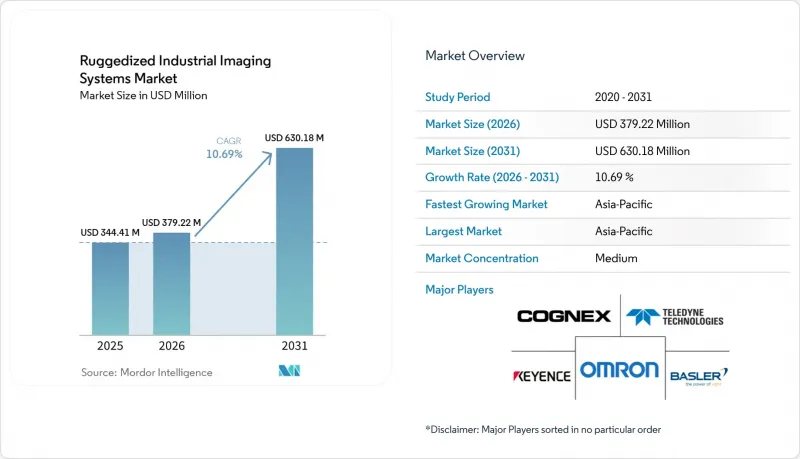
에 의하면, 내환경형 산업용 이미징 시스템 시장 규모는 2025년에 3억 4,441만 달러로 평가되었고, 2026년 3억 7,922만 달러에서 2031년까지 6억 3,018만 달러에 이를 것으로 예측되며, 예측 기간(2026년-2031년) CAGR은 10.69%를 기록할 전망입니다.
세계 내환경형 산업용 이미징 시스템 시장 동향 및 인사이트
공장 자동화 및 인라인 품질 관리 도입 확대
선진 공장에서는 표본 추출에 기반한 검사에서 최대 생산 속도에서의 100% 인라인 검증으로 전환하고 있습니다. 이러한 접근 방식에는 일반적인 공장 내의 분진, 진동, 온도 변동 속에서도 지속적으로 작동할 수 있는 비전 하드웨어가 필요합니다. 국제로봇연맹(IFR)의 기록에 따르면, 2024년 전 세계 산업용 로봇 도입 대수는 54만 2,000대이며, 동 연맹의 예측에 따르면 2025년에는 57만 5,000대, 2028년까지는 70만 대를 넘어설 것으로 보입니다. 로봇을 통합한 생산 라인에서는 대개 여러 대의 고정 카메라가 필요하기 때문에 새로운 자동화 라인이 도입될 때마다 도입 대수가 증가할 가능성이 있습니다. 일본로봇공업회는 2025년에 2026년 로봇 수주액이 1조 2,200억 엔(82억 달러)에 달할 것으로 예측하고 있으며, AI 관련 반도체 투자가 수요를 뒷받침하고 있습니다. 반도체 투자는 클린룸 인접 작업 및 웨이퍼 핸들링 작업에 대한 수요를 뒷받침하고 있으며, 이러한 현장에서는 내환경형 산업용 이미징 시스템 시장에서 보호 케이스가 기본적인 요건으로 자리 잡고 있습니다.
엣지 AI와 3D 비전의 견고한 케이스로의 급속한 통합
엣지 컴퓨팅 성능의 향상으로 인해 산업용 이미지 데이터를 별도의 서버로 전송할 필요성이 줄어들고 있습니다. 이에 따라 카메라, 연산 기능, 분석 소프트웨어를 통합한 밀폐형 장치가 까다로운 검사 작업에서 더욱 실용적인 선택지가 되고 있습니다. 코그넥스(Cognex)는 2026년 4월, NVIDIA Jetson 기술을 채택하고 동기화된 멀티모델 추론을 통해 최대 157 TOPS의 AI 성능을 실현하는 ‘In-Sight 6900 비전 컨트롤러’를 발표했습니다. 2026년 동료 심사를 거친 연구에 따르면, 이벤트 기반 머신 비전은 작업 성능을 유지하면서 움직임에 민감한 엣지 용도에서 추론 지연을 줄일 수 있는 것으로 밝혀졌습니다. 디바이스에서 실행되는 분석이 증가함에 따라, 하드웨어 공급업체들은 그동안 산업용 견고한 이미징 시스템 시장에서 별도로 판매되던 소프트웨어 기능을 번들로 제공할 수 있게 되었습니다.
높은 초기 투자 비용과 시스템 통합 비용
통합 시스템에는 밀폐형 카메라 본체, 산업용 광학 시스템, 조명, 엣지 컨트롤러 및 플랜트 시스템과의 소프트웨어 연결이 포함될 수 있습니다. 이러한 구성은 보급형 산업용 카메라보다 비용이 높아, 예산이 제한된 제조업체의 도입을 저해할 수 있습니다. 레거시 PLC, SCADA 및 ERP 플랫폼과의 통합에는 맞춤형 미들웨어나 현장별 보정이 필요할 수 있습니다. 이러한 작업으로 인해 도입 일정이 장기화되고 프로젝트 총비용이 증가합니다. 그 결과, 남아시아, 동남아시아, 남미의 구매자들은 수작업 검사 방식을 유지하거나 사양이 더 낮은 대체품을 선택하는 경우가 있습니다. IP67 규격을 준수하는 제품을 제공하는 중국 공급업체들의 경쟁력 있는 가격 책정은 내환경형 산업용 이미징 시스템 시장에서 북미 및 유럽의 기존 공급업체들에 대한 압박을 가중시키고 있습니다.
부문 분석
2025년 기준, 내환경형 카메라는 제품 카테고리의 64.31%를 차지하고 있으며, 이는 자동차 용접, 의약품 포장, 전자기기 검사 분야에서 오랫동안 사용되어 온 실적을 반영한 것입니다. 이러한 도입 실적은 표준 구성이 된 ‘카메라 + 외부 PC’라는 설계에 기반을 두고 있습니다. 내환경형 비전 시스템은 2031년까지 연평균 성장률(CAGR) 11.67%를 나타낼 것으로 예측됩니다. 이러한 높은 성장률은 광학 시스템, 연산 기능, 소프트웨어를 통합한 단일 밀폐형 유닛에 대한 구매자의 관심을 반영합니다. 고객이 외부 의존도를 최소화하려는 경향은 통합형 시스템 내 내환경형 산업용 이미징 시스템 시장 규모 확대에 기여하고 있습니다. 코그넥스는 2026년 5월에 ‘In-Sight 3900’을 출시했습니다. 이 제품은 이전 세대에 비해 최대 4배 빠른 처리 속도와 최대 25메가픽셀의 해상도를 실현하고 있습니다.
렌즈, 센서, 맞춤형 조명 어셈블리 등 견고하게 설계된 이미징 구성 요소는 카메라와 통합 시스템 모두를 지원합니다. 이 카테고리는 교체 수요와 하이퍼스펙트럼 검사, 자외선 검사 등의 특수 용도로부터 혜택을 받고 있습니다. 통합 유닛은 연산 기능과 소프트웨어가 이미 카메라와 연동되어 있으므로 설치 작업의 일부를 줄일 수 있습니다. 이는 고객이 외부 PC의 유지보수를 최소화하고 시스템 통합의 위험을 낮추고자 할 때 중요합니다. 또한 이러한 변화에 따라 밀폐형 하우징 내에서 신뢰성 높은 성능을 유지할 수 있는 공급업체의 중요성이 커지고 있습니다. 이러한 상황으로 인해 내환경형 산업용 이미징 시스템 시장 전반에서 제품 구성의 점진적인 변화가 진행되고 있습니다.
2025년 현재, 2D 이미징은 이미징 카테고리의 69.19%를 차지하고 있으며, 자동차, 인쇄 회로 기판, 식품 제조 분야의 확립된 워크플로우에 의해 뒷받침되고 있습니다. 안정적인 생산 업무에서 색상, 대비, 2차원 형상을 감지하는 데 여전히 유효합니다. 3D 이미징은 2031년까지 연평균 성장률(CAGR) 12.32%를 나타낼 것으로 예측됩니다. 구조화된 광, 스테레오 비전 및 비행 시간(ToF) 기술은 빈 피킹, 부피 측정, 로봇 유도 등에 활용됩니다. 이러한 작업에는 2D 센서로는 일관되게 제공할 수 없는 깊이 정보가 필요합니다. 2D 이미징이 69.19%의 점유율을 차지하고 있는 것은 광범위한 도입 실적과 작업자의 확립된 지식을 반영한 결과입니다.
SICK사는 2026년 8월, 자사의 Nova 플랫폼을 위한 AI 기반 3D 검사 기능을 발표했습니다. 이 시스템은 딥러닝 모델과 높이 데이터 분석을 결합하여 표면의 색상이나 명암에 의존하지 않고 결함을 감지할 수 있습니다. Teledyne e2v사는 2026년 3월, Perciva 5D를 발표했습니다. 이 제품은 GigE Vision 규격의 하우징에 내장된 단일 CMOS 센서에서 2D 및 3D 데이터를 생성하며, 무게는 230그램, 소비 전력은 5W 미만입니다. 열화상 및 적외선 시스템은 가혹한 환경에서의 상태 모니터링과 예측 유지보수를 지속적으로 지원하고 있습니다. 가시광선 카메라에 방폭 하우징이 필요한 장소에서는 장파장 적외선과 가시광선 스펙트럼을 결합한 제품을 사용할 수 있습니다.
지역별 분석
아시아태평양은 2025년에 세계 시장의 36.78%를 차지할 것으로 예상되며, 2031년까지 연평균 성장률(CAGR) 11.56%로 성장할 것으로 전망됩니다. 이에 따라 이 지역은 내환경형 산업용 이미징 시스템 시장에서 가장 큰 점유율을 차지하며, 지역별로는 가장 빠른 성장세를 보이고 있습니다. 2024년, 전 세계 산업용 로봇 도입 대수 54만 2,000대 중 중국은 29만 5,000대(도입 대수의 54%)를 차지했으며, 가동 중인 재고는 200만 대 이상에 달했습니다. 중국의 머신 비전 시장에서 국내 제조업체의 점유율은 57%에 달하며, 이는 10년 전 28%에서 대폭 증가한 수치입니다. 중국 내 반도체 자동화의 진전에 따라 클린룸 및 웨이퍼 핸들링 작업에서 고정밀 비전 시스템에 대한 수요가 높아지고 있습니다.
일본도 이 지역 수요 증가를 예고하고 있습니다. JARA는 AI 관련 반도체 투자에 힘입어 2026년 로봇 수주 총액이 1조 2,200억 엔(82억 달러)에 달할 것으로 예측했습니다. 인도에서는 2024년에 사상 최대인 9,100대의 산업용 로봇이 도입되어 전년 대비 7% 증가했습니다. 그중 45%를 자동차 산업이 차지하고 있습니다. 인도는 도입 대수 기준으로 세계 6위를 기록하며, 인라인 비전 기술의 추가적인 보급을 위한 여지가 생겨나고 있습니다. Hikrobot사는 2026년 7월, 인도에서 적외선 LWIR 카메라 ‘CI 시리즈’ 및 에어리어 스캔 카메라 ‘CT 시리즈’를 출시하며, 아시아의 신흥 자동화 시장에 대한 공급업체의 관심을 보여주었습니다.
북미와 유럽에서는 2025년 의약품 일련번호 부여, 항공우주 분야의 계측, 그리고 첨단 자동차 관련 업무를 통해 두 지역을 합친 수요가 대폭 증가했습니다. 미국에서는 2024년에 3만 4,200대의 산업용 로봇이 도입되어, 중국을 제외한 국가별 시장 중 최대 규모를 기록했습니다. 2024년 유럽의 로봇 도입 대수는 8% 감소했으며, 독일에서는 5% 감소한 2만 6,982대를 기록했습니다. 이에 따라 단기적으로는 신규 도입보다 기존 설비의 업그레이드나 소프트웨어 통합이 더 중요해질 가능성이 있습니다. 중동 및 아프리카, 남미에서는 에너지, 광업, 식품 가공, 농업 가공 분야의 열화상 시스템 및 방폭 시스템 도입이 여전히 초기 단계에 머물러 있습니다.
기타 혜택:
- 엑셀 형식 시장 예측(ME) 시트
- 3개월간의 애널리스트 지원
자주 묻는 질문
목차
제1장 서론
- 조사의 전제조건과 시장의 정의
- 조사 범위
제2장 조사 방법
제3장 주요 요약
제4장 시장 구도
- 시장 개요
- 시장 성장 촉진요인
- 시장 성장 억제요인
- 거시경제 요인이 시장에 미치는 영향
- 업계 밸류체인 분석
- 규제 상황
- 기술 전망
- Porter의 Five Forces 분석
제5장 시장 규모와 성장 예측
- 제품 유형별
- 이미징 유형별
- 용도별
- 최종사용자 산업별
- 지역별
- 북미
- 미국
- 캐나다
- 멕시코
- 남미
- 브라질
- 아르헨티나
- 칠레
- 기타 남미 국가
- 유럽
- 독일
- 영국
- 프랑스
- 이탈리아
- 스페인
- 기타 유럽 국가
- 아시아태평양
- 중국
- 일본
- 인도
- 한국
- 호주
- 기타 아시아태평양 국가
- 중동
- 아랍에미리트(UAE)
- 사우디아라비아
- 카타르
- 기타 중동 국가
- 아프리카
- 남아프리카공화국
- 이집트
- 기타 아프리카 국가
- 북미
제6장 경쟁 구도
- 시장 집중도
- 전략적 동향
- 시장 점유율 분석
- 기업 개요
- Cognex Corporation
- Keyence Corporation
- Teledyne Technologies Incorporated
- Basler AG
- Omron Corporation
- Sick AG
- TKH Group N.V.
- Baumer Holding AG
- Sony Group Corporation
- IDS Imaging Development Systems GmbH
- Zebra Technologies
- Hikrobot Co., Ltd.
- Opto Engineering S.p.A.
- The Imaging Source Europe GmbH
- LUCID Vision Labs, Inc.
- Banner Engineering Corp.
제7장 시장 기회와 향후 전망
LSH 26.10.29According to Mordor Intelligence, the ruggedized industrial imaging systems market size was valued at USD 344.41 million in 2025 and estimated to grow from USD 379.22 million in 2026 to reach USD 630.18 million by 2031, at a CAGR of 10.69% during the forecast period (2026-2031).
Global Ruggedized Industrial Imaging Systems Market Trends and Insights
Increasing Adoption of Factory Automation and Inline Quality Control
Advanced plants are moving from sampling-based checks toward 100% inline verification at full production speed. This approach requires vision hardware that can operate continuously in the presence of ordinary factory dust, vibration, and temperature fluctuations. The International Federation of Robotics recorded 542,000 industrial robot installations worldwide in 2024, and its forecast indicated 575,000 installations in 2025 and more than 700,000 by 2028. A robot-integrated production line often needs several fixed cameras so that deployment volumes can rise with each new automated line. The Japan Robot Industry Association projected JPY 1.22 trillion in robot orders for 2026 (USD 8.2 billion) in 2025, with AI-related semiconductor investment supporting demand. Semiconductor investment supports demand in cleanroom-adjacent and wafer-handling operations, where protected enclosures are a basic requirement for the Ruggedized industrial imaging systems market.
Rapid Integration of Edge AI and 3D Vision Into Rugged Enclosures
Improved edge computing performance is reducing the need to send industrial image data to a separate server. This makes sealed devices that combine camera, computing, and analysis software more practical for demanding inspection work. Cognex introduced the In-Sight 6900 Vision Controller in April 2026 with up to 157 TOPS of AI performance using NVIDIA Jetson technology for synchronized multi-model inference. A 2026 peer-reviewed study found that event-based machine vision can reduce inference latency for motion-sensitive edge applications while preserving task performance. As more analysis runs on-device, hardware suppliers can bundle software functions that were previously sold separately in the Ruggedized industrial imaging systems market.
High Upfront Capital Costs and System Integration Expenses
An integrated system can include a sealed camera body, industrial optics, lighting, an edge controller, and software links to plant systems. That configuration costs more than an entry-level industrial camera and can limit adoption by manufacturers with constrained budgets. Integration with legacy PLC, SCADA, and ERP platforms can require custom middleware and site-specific calibration. These activities extend deployment schedules and raise total project costs. Buyers in South and Southeast Asia and South America may therefore retain manual inspection practices or choose lower-specification alternatives. Competitive pricing from Chinese suppliers with IP67-rated products increases pressure on established North American and European suppliers in the Ruggedized industrial imaging systems market.
Other drivers and restraints analyzed in the detailed report include:
- Proliferation of Vision-Guided Robotics and Autonomous Mobile Robots
- Growing Demand for Harsh-Environment Asset Monitoring in Heavy Industries
- Thermal Dissipation Bottlenecks in Sealed and Fanless Enclosures
For complete list of drivers and restraints, kindly check the Table Of Contents.
Segment Analysis
Ruggedized cameras accounted for 64.31% of the product category in 2025, reflecting long-standing use in automotive welding, pharmaceutical packaging, and electronics inspection. Their installed base rests on a camera-plus-external-PC design that became a standard configuration. Ruggedized vision systems are projected to grow at an 11.67% CAGR through 2031. Their higher growth reflects buyer interest in a single sealed unit that combines optics, computing, and software. The Ruggedized industrial imaging systems market size for integrated systems benefits when customers seek fewer external dependencies. Cognex launched the In-Sight 3900 in May 2026, with processing up to 4 times faster than the prior generation and up to 25-megapixel resolution.
Ruggedized imaging components, including lenses, sensors, and custom lighting assemblies, support both cameras and integrated systems. This category benefits from replacement demand and specialty work such as hyperspectral and ultraviolet inspection. Integrated units can reduce some installation work because their compute and software are already aligned with the camera. This matters where customers want to limit external PC maintenance and reduce system integration risk. The shift also raises the importance of suppliers that can maintain reliable performance inside sealed housings. These conditions support a gradual change in product mix across the Ruggedized industrial imaging systems market.
2D imaging held 69.19% of the imaging category in 2025, supported by established workflows in automotive, printed circuit board, and food operations. It remains effective for detecting color, contrast, and two-dimensional geometry in stable production tasks. 3D imaging is projected to grow at a 12.32% CAGR through 2031. Structured light, stereovision, and time-of-flight technologies address bin picking, volumetric metrology, and robotic guidance. These tasks require depth information that 2D sensors cannot consistently provide. The 69.19% position held by 2D imaging reflects its broad installed base and established operator knowledge.
SICK launched AI-powered 3D inspection capabilities for its Nova platform in August 2026. The system combines deep learning models with height data analysis and can detect defects without relying on surface color or contrast. Teledyne e2v introduced the Perciva 5D in March 2026, producing 2D and 3D data from a single CMOS sensor in a GigE Vision-compliant housing that weighs 230 grams and draws less than 5 W. Thermal and infrared systems continue to support condition monitoring and predictive maintenance in harsh environments. Combined long-wave infrared and visible-spectrum products can be used where visible-light cameras need explosion-protected housings.
Complete Report Scope:
- By Product Type
- Ruggedized Cameras
- Ruggedized Vision Systems
- Ruggedized Imaging Components
- By Imaging Type
- 2D Imaging
- 3D Imaging
- Thermal and Infrared Imaging
- Other Imaging Types
- By Application
- Quality Inspection and Defect Detection
- Process Monitoring and Control
- Metrology and Measurement
- Positioning, Guidance, and Robotics
- Predictive and Condition Monitoring
- Other Applications
- By End-User Industry
- Automotive and Transportation
- Food and Beverage
- Pharmaceuticals and Chemicals
- Oil and Gas
- Metals and Mining
- Electronics and Semiconductor
- Aerospace and Defense
- Logistics and Warehousing
- Other End-User Industries
- By Geography
- North America
- United States
- Canada
- Mexico
- South America
- Brazil
- Argentina
- Chile
- Rest of South America
- Europe
- Germany
- United Kingdom
- France
- Italy
- Spain
- Rest of Europe
- Asia-Pacific
- China
- Japan
- India
- South Korea
- Australia
- Rest of Asia-Pacific
- Middle East
- United Arab Emirates
- Saudi Arabia
- Qatar
- Rest of Middle East
- Africa
- South Africa
- Egypt
- Rest of Africa
- North America
Geography Analysis
Asia-Pacific held 36.78% of the global market in 2025 and is projected to grow at an 11.56% CAGR through 2031. This gives the region the leading share of the Ruggedized industrial imaging systems market and the fastest regional expansion. China accounted for 295,000 of 542,000 global industrial robot installations in 2024, or 54% of deployments, and had an operational stock of more than 2 million units. Domestic manufacturers reached 57% of China's machine vision market, compared with 28% a decade earlier. Semiconductor automation in China is increasing demand for high-precision vision in cleanroom and wafer-handling operations.
Japan provides a separate signal of demand in the region. JARA projected 2026 robot orders totaling JPY 1.22 trillion (USD 8.2 billion), supported by AI-related semiconductor investment. India installed a record 9,100 industrial robots in 2024, up 7%, and automotive accounted for 45% of these installations. India ranked sixth globally in installations, creating room for wider adoption of in-line vision. Hikrobot introduced its CI Series infrared LWIR cameras and CT Series area-scan cameras in India in July 2026, signaling supplier interest in emerging Asian automation markets.
North America and Europe had substantial combined demand in 2025 through pharmaceutical serialization, aerospace metrology, and advanced automotive work. The United States installed 34,200 industrial robots in 2024, making it the largest national market outside China. European robot installations fell 8% in 2024, while Germany fell 5% to 26,982 units, so upgrades and software integration may matter more than new lines in the near term. Middle East, Africa, and South America remain earlier-stage areas for thermal and explosion-protected systems in energy, mining, food processing, and agriprocessing.
- Cognex Corporation
- Keyence Corporation
- Teledyne Technologies Incorporated
- Basler AG
- Omron Corporation
- Sick AG
- TKH Group N.V.
- Baumer Holding AG
- Sony Group Corporation
- IDS Imaging Development Systems GmbH
- Zebra Technologies
- Hikrobot Co., Ltd.
- Opto Engineering S.p.A.
- The Imaging Source Europe GmbH
- LUCID Vision Labs, Inc.
- Banner Engineering Corp.
Additional Benefits:
- The market estimate (ME) sheet in Excel format
- 3 months of analyst support
TABLE OF CONTENTS
1 INTRODUCTION
- 1.1 Study Assumptions and Market Definition
- 1.2 Scope of the Study
2 RESEARCH METHODOLOGY
3 EXECUTIVE SUMMARY
4 MARKET LANDSCAPE
- 4.1 Market Overview
- 4.2 Market Drivers
- 4.2.1 Increasing Adoption of Factory Automation and In-Line Quality Control
- 4.2.2 Growing Demand for Harsh-Environment Asset Monitoring in Heavy Industries
- 4.2.3 Rapid Integration of Edge AI and 3D Vision into Robust Enclosures
- 4.2.4 Stringent Global Compliance and Traceability Mandates in Food and Pharma
- 4.2.5 Proliferation of Vision-Guided Robotics and Autonomous Mobile Robots (AMRs)
- 4.2.6 Escalating Need for Continuous Non-Contact Thermal and Condition Monitoring
- 4.3 Market Restraints
- 4.3.1 High Upfront Capital Costs and System Integration Expenses
- 4.3.2 Thermal Dissipation Bottlenecks in Sealed and Fanless Enclosures
- 4.3.3 Interoperability and Compatibility Challenges with Legacy Industrial Infrastructure
- 4.3.4 Scarcity of Skilled Technical Specialists for System Calibration and Maintenance
- 4.4 Impact of Macroeconomic Factors on the Market
- 4.5 Industry Value Chain Analysis
- 4.6 Regulatory Landscape
- 4.7 Technological Outlook
- 4.8 Porter's Five Forces Analysis
- 4.8.1 Threat of New Entrants
- 4.8.2 Bargaining Power of Suppliers
- 4.8.3 Bargaining Power of Buyers
- 4.8.4 Threat of Substitutes
- 4.8.5 Competitive Rivalry
5 MARKET SIZE AND GROWTH FORECASTS (VALUE)
- 5.1 By Product Type
- 5.1.1 Ruggedized Cameras
- 5.1.2 Ruggedized Vision Systems
- 5.1.3 Ruggedized Imaging Components
- 5.2 By Imaging Type
- 5.2.1 2D Imaging
- 5.2.2 3D Imaging
- 5.2.3 Thermal and Infrared Imaging
- 5.2.4 Other Imaging Types
- 5.3 By Application
- 5.3.1 Quality Inspection and Defect Detection
- 5.3.2 Process Monitoring and Control
- 5.3.3 Metrology and Measurement
- 5.3.4 Positioning, Guidance, and Robotics
- 5.3.5 Predictive and Condition Monitoring
- 5.3.6 Other Applications
- 5.4 By End-User Industry
- 5.4.1 Automotive and Transportation
- 5.4.2 Food and Beverage
- 5.4.3 Pharmaceuticals and Chemicals
- 5.4.4 Oil and Gas
- 5.4.5 Metals and Mining
- 5.4.6 Electronics and Semiconductor
- 5.4.7 Aerospace and Defense
- 5.4.8 Logistics and Warehousing
- 5.4.9 Other End-User Industries
- 5.5 By Geography
- 5.5.1 North America
- 5.5.1.1 United States
- 5.5.1.2 Canada
- 5.5.1.3 Mexico
- 5.5.2 South America
- 5.5.2.1 Brazil
- 5.5.2.2 Argentina
- 5.5.2.3 Chile
- 5.5.2.4 Rest of South America
- 5.5.3 Europe
- 5.5.3.1 Germany
- 5.5.3.2 United Kingdom
- 5.5.3.3 France
- 5.5.3.4 Italy
- 5.5.3.5 Spain
- 5.5.3.6 Rest of Europe
- 5.5.4 Asia-Pacific
- 5.5.4.1 China
- 5.5.4.2 Japan
- 5.5.4.3 India
- 5.5.4.4 South Korea
- 5.5.4.5 Australia
- 5.5.4.6 Rest of Asia-Pacific
- 5.5.5 Middle East
- 5.5.5.1 United Arab Emirates
- 5.5.5.2 Saudi Arabia
- 5.5.5.3 Qatar
- 5.5.5.4 Rest of Middle East
- 5.5.6 Africa
- 5.5.6.1 South Africa
- 5.5.6.2 Egypt
- 5.5.6.3 Rest of Africa
- 5.5.1 North America
6 COMPETITIVE LANDSCAPE
- 6.1 Market Concentration
- 6.2 Strategic Moves
- 6.3 Market Share Analysis
- 6.4 Company Profiles (includes Global Level Overview, Market Level Overview, Core Segments, Financials as available, Strategic Information, Market Rank/Share, Products and Services, Recent Developments)
- 6.4.1 Cognex Corporation
- 6.4.2 Keyence Corporation
- 6.4.3 Teledyne Technologies Incorporated
- 6.4.4 Basler AG
- 6.4.5 Omron Corporation
- 6.4.6 Sick AG
- 6.4.7 TKH Group N.V.
- 6.4.8 Baumer Holding AG
- 6.4.9 Sony Group Corporation
- 6.4.10 IDS Imaging Development Systems GmbH
- 6.4.11 Zebra Technologies
- 6.4.12 Hikrobot Co., Ltd.
- 6.4.13 Opto Engineering S.p.A.
- 6.4.14 The Imaging Source Europe GmbH
- 6.4.15 LUCID Vision Labs, Inc.
- 6.4.16 Banner Engineering Corp.
7 MARKET OPPORTUNITIES AND FUTURE OUTLOOK
- 7.1 White-Space and Unmet-Need Assessment


