

|
시장보고서
상품코드
2155586
고속 산업용 이미징 시스템 : 시장 점유율 분석, 업계 동향과 통계, 성장 예측(2026-2031년)High-Speed Industrial Imaging Systems - Market Share Analysis, Industry Trends & Statistics, Growth Forecasts (2026 - 2031) |
||||||
 Mordor Intelligence
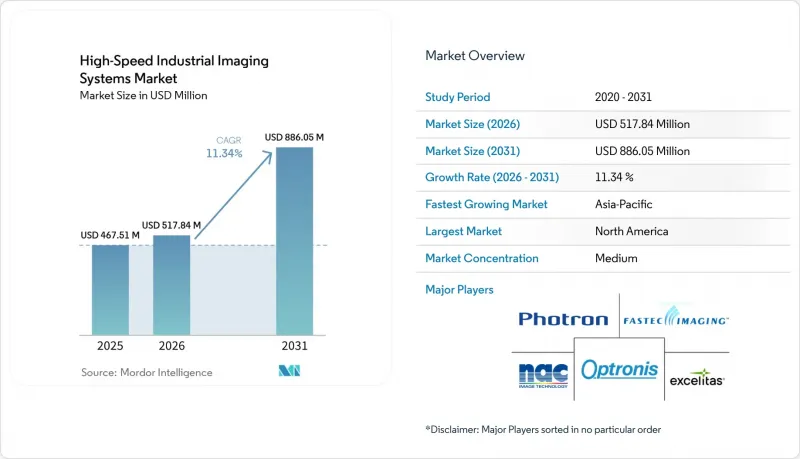
에 의하면, 고속 산업용 이미징 시스템 시장 규모는 2025년 4억 6,751만 달러에서 2026년에는 5억 1,784만 달러, 2031년까지 8억 8,605만 달러에 이를 것으로 예상되고 있어 2026-2031년 CAGR 11.34%를 기록할 전망입니다.
세계 고속 산업용 이미징 시스템 시장 동향 및 인사이트
공장 자동화 및 무결점 검사
무결점 프로그램에 따라 고속 검사 시스템은 자동차, 전자, 식품 가공 산업의 생산 라인 인증에서 핵심적인 역할을 수행하게 되었습니다. 제조업체들이 제품이 생산의 후속 공정으로 넘어가기 전에 결함을 식별하기 위해 이러한 시스템을 활용함에 따라, 고속 산업용 이미징 시스템 시장은 그 혜택을 누리고 있습니다. ISO 26262 및 FDA 21 CFR Part 820에서는 공정 내 검사 기록을 기능 안전 및 의료기기 품질 요건 준수의 증거로 간주하고 있습니다. 2026년 『Scientific Reports』지에 게재된 연구에 따르면, 자석 롤러 방식을 이용한 영상 획득 기법을 통해 배터리 캔의 검사 처리량이 분당 140개에서 240개로 향상되었으며, 99.6%의 정확도를 달성한 것으로 밝혀졌습니다. 이 결과는 장비 공급업체들이 처리량과 추적성 모두를 향상시키는 시스템에 주력하고 있는 이유를 보여줍니다. 일단 특정 이미지 처리 구성으로 생산 라인 인증이 완료되면, 운영자는 사양이 낮은 장비로 교체하기보다는 이미 도입된 시스템 내에서 업그레이드를 선호하는 경향이 있습니다.
엣지 AI가 고속 이미지 데이터의 병목 현상을 해소
고속 산업용 이미지 시스템 시장은 센서의 출력이 기존 스토리지 및 네트워크 인프라의 처리 능력을 압도할 가능성이 있기 때문에 엣지 처리로 전환되고 있습니다. 1 MHz로 작동하는 8킬로픽셀 TDI 라인 스캔 카메라는 시간당 8 TB가 넘는 데이터 스트림을 생성할 수 있습니다. 엣지 AI는 카메라 또는 인접한 FPGA에서 검사 모델을 실행하여 전송 전에 불필요한 프레임을 필터링합니다. 코그넥스는 2026년 5월, 퀄컴 드래곤윙(Qualcomm DragonWing) 프로세서를 탑재한 ‘In-Sight 3900’을 발표했습니다. 이를 통해 별도의 PC 호스트 없이도 실시간 AI 검사가 가능해집니다. 이러한 설계로 지연 시간을 줄이고, 기밀성이 높은 이미지를 공장 네트워크 내에 유지할 수 있습니다. 소프트웨어 배포 도구와 학습된 검사 모델은 카메라 사양만큼이나 중요해지고 있습니다.
머신 비전 통합 전문가 부족
고속 이미징 시스템을 도입하려면 광학, 임베디드 프로그래밍, 머신 비전 소프트웨어 및 제조 공정에 대한 지식이 필요합니다. 이러한 복합적인 기술 역량을 습득하는 데는 시간이 걸리며, 시장에서 널리 찾아볼 수 있는 인재도 아닙니다. VDMA는 2025년 유럽의 자동화 투자에 있어 주요 제약 요인 중 하나로 숙련된 인력 부족을 꼽고 있습니다. 고속 이미징 시스템을 도입하려면 트리거, 동기화, 관심 영역(ROI), 엣지 AI 모델에 대한 정밀한 설정이 필요합니다. 이용 가능한 전문가 풀은 북미, 일본, 독일에 집중되어 있습니다. 이러한 인력 부족으로 인해 제조업체는 본래의 처리량을 달성할 수 있도록 설정되지 않은 고성능 하드웨어를 보유하게 되어, 고속 산업용 이미징 시스템의 구매가 지연될 가능성이 있습니다.
부문 분석
2025년, 고속 산업용 이미징 시스템 시장에서 에어리어 스캔 카메라는 73.45%의 점유율을 차지했습니다. 웨이퍼 검증, PCB 자동 광학 검사, 블리스터 팩 검사 등에서의 폭넓은 활용이 도입 대수를 뒷받침하고 있습니다. 에어리어 스캔 시스템은 확립된 CoaXPress 2.0 및 GigE Vision 프레임 그래버 구성으로 작동합니다. 기존의 보정 절차, 훈련 데이터 및 운영자의 경험으로 인해 카메라 아키텍처를 변경할 때 비용이 높아질 가능성이 있습니다. 이러한 요인들로 인해 에어리어 스캔 시스템은 개별 물체 검사 분야에서 여전히 중요한 위치를 차지하고 있습니다.
라인 스캔 카메라는 2031년까지 연평균 성장률(CAGR) 12.35%를 나타낼 것으로 예측됩니다. 이 카메라들은 리튬 이온 전극 코팅, 플렉서블 디스플레이 필름, 탄소섬유 복합재 검사 등 연속 웹 생산에 적합합니다. 이러한 용도에서는 푸시-블룸 방식의 이미징이 필요하지만, 에어리어 스캔 방식으로는 동등한 처리량을 달성할 수 없습니다. Allied Vision사는 2026년 5월, 50×50 mm 포맷에 4개의 CoaXPress-12 채널, Power-over-CXP, 팬리스 냉각 기능을 갖춘 FXO CXP-12 시리즈를 출시했습니다. 연속 기판 생산이 확대됨에 따라, 고속 산업용 이미징 시스템 시장에서는 라인 스캔 시스템이 기존의 인쇄 및 제지 분야 이외의 용도에서도 활용될 것으로 보입니다.
2025년에는 2-5 MP 범위가 매출의 42.78%를 차지했습니다. 이 범위는 확립된 CoaXPress 및 Camera Link 구성에서 이미지 크기와 프레임 속도의 균형이 잘 잡혀 있습니다. 대규모 데이터 인프라 없이도 신뢰성 높은 검사가 필요한 많은 시스템에 여전히 적합합니다. 2 MP 미만 수요는 기존의 라인 모니터링 및 바코드 검증에 집중되어 있습니다. 12 MP를 초과하는 고해상도 시스템은 풀 웨이퍼 검사 및 까다로운 반도체 계측에 계속해서 중점을 두고 있습니다.
5-12 MP 부문은 2031년까지 연평균 성장률(CAGR) 13.21%로 확대될 것으로 예측됩니다. 소니의 ‘Pregius S’ 백사이드 일루미네이션(BSI) 방식 세계 셔터 플랫폼은 각 벤더에서 100기가비트 이더넷을 통해 192 FPS 이상, 12 MP 이상의 촬영을 지원합니다. 이러한 성능을 통해 라인 속도를 유지하면서 더욱 상세한 이미지를 얻을 수 있습니다. 이러한 해상도라면 온보드 AI를 통해 훨씬 더 큰 이미지 파일에 따른 대역폭 부하 없이 표면의 특징을 식별할 수 있습니다. 중해상도 시스템용 고속 산업용 이미징 시스템 시장 규모는 데이터 부하, 비용, 감지 능력 간의 이러한 균형 덕분에 혜택을 보고 있습니다.
지역별 분석
2025년, 북미는 지역별 매출의 31.23%를 차지했습니다. 이 지역의 반도체 제조, 확립된 머신 비전 통합 서비스, 그리고 방위 및 항공우주 분야의 연구 활동이 고속 산업용 이미징 시스템 시장을 견인하고 있습니다. 미국은 반도체 제조 장비 제조업체, 자동차 부품 공급업체, 항공우주 계약업체 등을 포함한 최대 규모의 최종 사용자 기반을 보유하고 있습니다. 코그넥스(Cognex)는 물류, 반도체, 전자, 포장 부문 수요에 힘입어 2026년 1분기 매출이 전년 동기 대비 24% 증가한 2억 6,800만 달러를 기록했다고 보고했습니다. 캐나다와 멕시코는 자동차 공급망을 통해 기여하고 있으며, 캐나다는 또한 포토닉스 분야의 활동을 통해 특수 이미징 기술도 지원하고 있습니다.
유럽의 고속 산업용 이미징 시스템 시장은 독일의 자동차 및 특수 기계 산업 기반에 힘입어 성장하고 있습니다. VDMA 보고서에 따르면, 산업 환경의 침체에도 불구하고 2025년 비전 컴포넌트 매출은 안정적인 수준을 유지했습니다. Basler사는 2025년 매출이 2억 2,450만 유로(2억 4,470만 달러)로 전년 대비 22% 증가했으며, 그중 EMEA 지역이 매출의 32%를 차지했다고 보고했습니다. 영국에서는 의약품 포장 및 항공우주용 복합재료 시험을 통해 수요가 뒷받침되고 있으며, 프랑스와 이탈리아에서는 식품 가공, 명품 진위 판별, 특수 차량 조립 분야에서 수요가 더해지고 있습니다. 유럽공급업체들은 CoaXPress 표준 제정에 참여하고 있으며, 이를 통해 해당 지역 내 제품 인증 절차를 신속하게 진행할 수 있습니다.
아시아태평양의 고속 산업용 이미징 시스템 시장은 2031년까지 연평균 성장률(CAGR) 12.95%를 나타낼 것으로 예측됩니다. 중국의 반도체 자급자족 정책이 국내 수요를 뒷받침하고 있으며, SinceVision사는 2026년 6월에 SH8 시리즈를 발표했습니다. 이 시리즈는 최대 1,100,000 FPS를 실현하며, EMVA 1288 인증에 따른 양자 효율이 85% 이상임을 명시하고 있습니다. 한국의 DRAM 및 NAND 투자, 포토론(Photron)사의 ‘FASTCAM NOVA R-4K’를 포함한 일본의 정밀 광학 기술 기반, 그리고 인도의 ‘생산 연계형 인센티브(PLI)’ 제도가 몇 가지 수요 거점을 뒷받침하고 있습니다. 남미, 중동 및 아프리카는 여전히 수요 규모가 작은 지역이지만, 브라질의 자동차 조립, 걸프 국가들의 산업 자동화 프로그램, 아프리카의 광업 및 식품 가공 분야가 초기 비즈니스 기회를 창출하고 있습니다.
기타 혜택:
- 엑셀 형식 시장 예측(ME) 시트
- 3개월간의 애널리스트 지원
자주 묻는 질문
목차
제1장 서론
- 조사의 전제조건과 시장의 정의
- 조사 범위
제2장 조사 방법
제3장 주요 요약
제4장 시장 구도
- 시장 개요
- 시장 성장 촉진요인
- 시장 성장 억제요인
- 거시경제 요인이 시장에 미치는 영향
- 업계 밸류체인 분석
- 규제 상황
- 기술 전망
- Porter의 Five Forces 분석
제5장 시장 규모와 성장 예측
- 카메라 아키텍처별
- 해상도별
- frame rate 별
- Imaging Spectrum 별
- 용도별
- 최종사용자 산업별
- 지역별
- 북미
- 미국
- 캐나다
- 멕시코
- 남미
- 브라질
- 아르헨티나
- 칠레
- 기타 남미 국가
- 유럽
- 독일
- 영국
- 프랑스
- 이탈리아
- 스페인
- 기타 유럽 국가
- 아시아태평양
- 중국
- 일본
- 인도
- 한국
- 호주
- 기타 아시아태평양 국가
- 중동
- 아랍에미리트(UAE)
- 사우디아라비아
- 카타르
- 기타 중동 국가
- 아프리카
- 남아프리카공화국
- 이집트
- 나이지리아
- 기타 아프리카 국가
- 북미
제6장 경쟁 구도
- 시장 집중도
- 전략적 동향
- 시장 점유율 분석
- 기업 개요
- Photron Ltd.
- nac Image Technology Inc.
- Excelitas Technologies
- Optronis GmbH
- Fastec Imaging Corporation
- AOS Technologies AG
- DEL Imaging Systems LLC
- iX Cameras Inc.
- High Speed Vision GmbH
- Specialised Imaging Limited
- IDT(UK) Ltd
- XIMEA GmbH
- Emergent Vision Technologies Inc.
- SinceVision Technology Co., Ltd.
- Basler AG
- Allied Vision Technologies GmbH
- JAI A/S
- NED Nippon Electro-Sensory Devices Corporation
- Teledyne DALSA, Inc.
제7장 시장 기회와 향후 전망
LSH 26.10.29According to Mordor Intelligence, the high-speed industrial imaging systems market size is expected to increase from USD 467.51 million in 2025 to USD 517.84 million in 2026 and reach USD 886.05 million by 2031, growing at a CAGR of 11.34% over 2026-2031.
Global High-Speed Industrial Imaging Systems Market Trends and Insights
Factory Automation and Zero-Defect Inspection
Zero-defect programs have made high-speed inspection systems a core part of production-line qualification in the automotive, electronics, and food processing industries. The high-speed industrial imaging systems market benefits because manufacturers use these systems to identify faults before products move to later stages of production. ISO 26262 and FDA 21 CFR Part 820 treat in-process inspection records as evidence of compliance with functional safety and device quality requirements. A 2026 Scientific Reports study found that a magnet-roller image acquisition method raised battery-can inspection throughput from 140 to 240 units per minute while achieving 99.6% accuracy. The result shows why equipment suppliers are focusing on systems that improve both throughput and traceability. Once a line is qualified with a particular imaging configuration, operators often favor upgrades within that installed system rather than a lower-specification replacement.
Edge AI Reduces High-Speed Image Data Bottlenecks
The high-speed industrial imaging systems market is moving toward edge processing because sensor output can overwhelm conventional storage and network infrastructure. An 8-kilopixel TDI line-scan camera operating at 1 MHz can generate data streams exceeding 8 TB per hour. Edge AI runs inspection models in the camera or an adjacent FPGA and filters irrelevant frames before transmission. Cognex introduced the In-Sight 3900 in May 2026, featuring Qualcomm DragonWing processing for real-time AI inspection without a separate PC host. This design can reduce latency and keep sensitive images inside the plant network. Software deployment tools and trained inspection models are becoming as important as camera specifications.
Shortage of Machine Vision Integration Specialists
Installing high-speed imaging requires knowledge of optics, embedded programming, machine vision software, and manufacturing processes. The combined skill set takes time to develop and is not widely available. VDMA identified skilled labor shortages as one of the leading constraints on European automation investment in 2025. High-speed deployments require precise settings for triggers, synchronization, regions of interest, and edge AI models. The available specialist base is concentrated in North America, Japan, and Germany. The shortage can leave manufacturers with capable hardware that is not configured to achieve its intended throughput, delaying purchases of high-speed industrial imaging systems.
Other drivers and restraints analyzed in the detailed report include:
- Semiconductor and EV Battery Inspection Intensity
- High-Bandwidth Interfaces Enable Higher Resolution at Line Speed
- High Data Handling, Storage, and Cooling Costs
For complete list of drivers and restraints, kindly check the Table Of Contents.
Segment Analysis
Area scan cameras accounted for 73.45% of the high-speed industrial imaging systems market share in 2025. Their broad use in wafer verification, automated optical inspection of PCBs, and blister-pack inspection supports their installed base. Area scan systems work with established CoaXPress 2.0 and GigE Vision frame-grabber configurations. Existing calibration routines, training data, and operator experience can raise the cost of changing camera architecture. These factors keep area scan systems important in discrete-object inspection.
Line scan cameras are projected to grow at a 12.35% CAGR through 2031. They are suited to continuous-web production such as lithium-ion electrode coating, flexible display films, and carbon-fiber composite inspection. These applications require push-broom imaging that area-scan designs cannot deliver at equivalent throughput. Allied Vision launched the FXO CXP-12 series in May 2026 in a 50X50 mm format with 4 CoaXPress-12 channels, Power-over-CXP, and fanless cooling. As continuous substrate production expands, the high-speed industrial imaging systems market is likely to see line-scan systems used beyond their traditional roles in printing and paper.
The 2-5 MP range held 42.78% of revenue in 2025. The range has balanced image size and frame rate across established CoaXPress and Camera Link configurations. It remains appropriate for many systems that need reliable inspection without an extensive data infrastructure. Demand below 2 MP remains focused on legacy line monitoring and barcode verification. High-resolution systems above 12 MP remain focused on full-wafer inspection and demanding semiconductor metrology.
The 5-12 MP segment is projected to advance at a 13.21% CAGR through 2031. Sony's Pregius S backside-illuminated global-shutter platform supported 12-plus MP imaging at 192 FPS or more over 100 Gigabit Ethernet across camera vendors. This performance supports greater image detail while maintaining line speed. At this resolution, onboard AI can identify surface features without the bandwidth load associated with much larger image files. The high-speed industrial imaging systems market size for mid-range-resolution systems benefits from this balance among data load, cost, and detection capability.
Complete Report Scope:
- By Camera Architecture
- Area Scan Cameras
- Line Scan Cameras
- By Resolution
- Less Than 2 MP
- 2-5 MP
- 5-12 MP
- More Than 12 MP
- By Frame Rate
- 250-1,000 FPS
- 1,001-5,000 FPS
- 5,001-20,000 FPS
- 20,001-100,000 FPS
- More Than 100,000 FPS
- By Imaging Spectrum
- Visible Light
- Near-Infrared (NIR) and Short-Wave Infrared (SWIR)
- Mid-Wave and Long-Wave Infrared (MWIR/LWIR)
- Ultraviolet (UV)
- Other Imaging Spectrums
- By Application
- Quality Inspection and Defect Detection
- Measurement and Metrology
- Identification, OCR, and Traceability
- Vision-Guided Robotics and Positioning
- Motion Analysis and Process Monitoring
- Scientific, R&D, and Specialized Imaging
- By End-User Industry
- Electronics and Semiconductor
- Automotive and EV Battery
- Food and Beverage
- Pharmaceutical and Life Sciences
- Aerospace and Defense
- Logistics and Warehousing
- Other End-User Industries
- By Geography
- North America
- United States
- Canada
- Mexico
- South America
- Brazil
- Argentina
- Chile
- Rest of South America
- Europe
- Germany
- United Kingdom
- France
- Italy
- Spain
- Rest of Europe
- Asia-Pacific
- China
- Japan
- India
- South Korea
- Australia
- Rest of Asia-Pacific
- Middle East
- United Arab Emirates
- Saudi Arabia
- Qatar
- Rest of Middle East
- Africa
- South Africa
- Egypt
- Nigeria
- Rest of Africa
- North America
Geography Analysis
North America held 31.23% of regional revenue in 2025. The high-speed industrial imaging systems market benefits from semiconductor fabrication, established machine vision integration services, and defense and aerospace research activity in the region. The United States had the largest end-user base, including semiconductor equipment makers, automotive suppliers, and aerospace contractors. Cognex reported USD 268 million in Q1 2026 revenue, up 24% year over year, driven by demand across the logistics, semiconductor, electronics, and packaging sectors. Canada and Mexico contribute through automotive supply chains, while Canada also supports specialized imaging through its photonics activity.
Europe's high-speed industrial imaging systems market is supported by Germany's automotive and specialty machinery base. VDMA reported stable 2025 billings for vision components despite weaker industrial conditions. Basler reported 2025 revenue of EUR 224.5 million (USD 244.7 million), up 22%, with EMEA accounting for 32% of sales. The United Kingdom supports demand through pharmaceutical packaging and aerospace composites testing, while France and Italy add demand from food processing, luxury goods authentication, and specialty vehicle assembly. European suppliers participate in CoaXPress standards development, which can speed regional product qualification.
The high-speed industrial imaging systems market in Asia-Pacific is projected to grow at a 12.95% CAGR through 2031. China's semiconductor self-reliance agenda supports domestic demand, and SinceVision introduced the SH8 series in June 2026 with a stated maximum of 1,100,000 FPS and EMVA 1288-verified quantum efficiency of at least 85%. South Korea's DRAM and NAND investment, Japan's precision optics base including Photron's FASTCAM NOVA R-4K, and India's Production-Linked Incentive scheme support several demand centers. South America, the Middle East, and Africa remain smaller demand areas, with Brazil's automotive assembly, Gulf industrial automation programs, and African mining and food processing creating early opportunities.
- Photron Ltd.
- nac Image Technology Inc.
- Excelitas Technologies
- Optronis GmbH
- Fastec Imaging Corporation
- AOS Technologies AG
- DEL Imaging Systems LLC
- iX Cameras Inc.
- High Speed Vision GmbH
- Specialised Imaging Limited
- IDT (UK) Ltd
- XIMEA GmbH
- Emergent Vision Technologies Inc.
- SinceVision Technology Co., Ltd.
- Basler AG
- Allied Vision Technologies GmbH
- JAI A/S
- NED Nippon Electro-Sensory Devices Corporation
- Teledyne DALSA, Inc.
Additional Benefits:
- The market estimate (ME) sheet in Excel format
- 3 months of analyst support
TABLE OF CONTENTS
1 INTRODUCTION
- 1.1 Study Assumptions and Market Definition
- 1.2 Scope of the Study
2 RESEARCH METHODOLOGY
3 EXECUTIVE SUMMARY
4 MARKET LANDSCAPE
- 4.1 Market Overview
- 4.2 Market Drivers
- 4.2.1 Factory Automation and Zero-Defect Inspection
- 4.2.2 Edge AI Reduces High-Speed Image-Data Bottlenecks
- 4.2.3 Semiconductor and EV-Battery Inspection Intensity
- 4.2.4 High-Bandwidth Interfaces Enable Higher Resolution at Line Speed
- 4.2.5 Vision-Guided Robotics and Closed-Loop Process Control
- 4.2.6 Demand for High-Speed Imaging in Production-Line Digital Twins
- 4.3 Market Restraints
- 4.3.1 Shortage of Machine-Vision Integration Specialists
- 4.3.2 High Data-Handling, Storage, and Cooling Costs
- 4.3.3 Interface Fragmentation and Legacy-Network Compatibility
- 4.3.4 Sensor Export Controls and Supply-Chain Qualification Delays
- 4.4 Impact of Macroeconomic Factors on the Market
- 4.5 Industry Value Chain Analysis
- 4.6 Regulatory Landscape
- 4.7 Technological Outlook
- 4.8 Porter's Five Forces Analysis
- 4.8.1 Threat of New Entrants
- 4.8.2 Bargaining Power of Suppliers
- 4.8.3 Bargaining Power of Buyers
- 4.8.4 Threat of Substitutes
- 4.8.5 Competitive Rivalry
5 MARKET SIZE AND GROWTH FORECASTS (VALUE)
- 5.1 By Camera Architecture
- 5.1.1 Area Scan Cameras
- 5.1.2 Line Scan Cameras
- 5.2 By Resolution
- 5.2.1 Less Than 2 MP
- 5.2.2 2-5 MP
- 5.2.3 5-12 MP
- 5.2.4 More Than 12 MP
- 5.3 By Frame Rate
- 5.3.1 250-1,000 FPS
- 5.3.2 1,001-5,000 FPS
- 5.3.3 5,001-20,000 FPS
- 5.3.4 20,001-100,000 FPS
- 5.3.5 More Than 100,000 FPS
- 5.4 By Imaging Spectrum
- 5.4.1 Visible Light
- 5.4.2 Near-Infrared (NIR) and Short-Wave Infrared (SWIR)
- 5.4.3 Mid-Wave and Long-Wave Infrared (MWIR/LWIR)
- 5.4.4 Ultraviolet (UV)
- 5.4.5 Other Imaging Spectrums
- 5.5 By Application
- 5.5.1 Quality Inspection and Defect Detection
- 5.5.2 Measurement and Metrology
- 5.5.3 Identification, OCR, and Traceability
- 5.5.4 Vision-Guided Robotics and Positioning
- 5.5.5 Motion Analysis and Process Monitoring
- 5.5.6 Scientific, R&D, and Specialized Imaging
- 5.6 By End-User Industry
- 5.6.1 Electronics and Semiconductor
- 5.6.2 Automotive and EV Battery
- 5.6.3 Food and Beverage
- 5.6.4 Pharmaceutical and Life Sciences
- 5.6.5 Aerospace and Defense
- 5.6.6 Logistics and Warehousing
- 5.6.7 Other End-User Industries
- 5.7 By Geography
- 5.7.1 North America
- 5.7.1.1 United States
- 5.7.1.2 Canada
- 5.7.1.3 Mexico
- 5.7.2 South America
- 5.7.2.1 Brazil
- 5.7.2.2 Argentina
- 5.7.2.3 Chile
- 5.7.2.4 Rest of South America
- 5.7.3 Europe
- 5.7.3.1 Germany
- 5.7.3.2 United Kingdom
- 5.7.3.3 France
- 5.7.3.4 Italy
- 5.7.3.5 Spain
- 5.7.3.6 Rest of Europe
- 5.7.4 Asia-Pacific
- 5.7.4.1 China
- 5.7.4.2 Japan
- 5.7.4.3 India
- 5.7.4.4 South Korea
- 5.7.4.5 Australia
- 5.7.4.6 Rest of Asia-Pacific
- 5.7.5 Middle East
- 5.7.5.1 United Arab Emirates
- 5.7.5.2 Saudi Arabia
- 5.7.5.3 Qatar
- 5.7.5.4 Rest of Middle East
- 5.7.6 Africa
- 5.7.6.1 South Africa
- 5.7.6.2 Egypt
- 5.7.6.3 Nigeria
- 5.7.6.4 Rest of Africa
- 5.7.1 North America
6 COMPETITIVE LANDSCAPE
- 6.1 Market Concentration
- 6.2 Strategic Moves
- 6.3 Market Share Analysis
- 6.4 Company Profiles (includes Global Level Overview, Market Level Overview, Core Segments, Financials as available, Strategic Information, Market Rank/Share, Products and Services, Recent Developments)
- 6.4.1 Photron Ltd.
- 6.4.2 nac Image Technology Inc.
- 6.4.3 Excelitas Technologies
- 6.4.4 Optronis GmbH
- 6.4.5 Fastec Imaging Corporation
- 6.4.6 AOS Technologies AG
- 6.4.7 DEL Imaging Systems LLC
- 6.4.8 iX Cameras Inc.
- 6.4.9 High Speed Vision GmbH
- 6.4.10 Specialised Imaging Limited
- 6.4.11 IDT (UK) Ltd
- 6.4.12 XIMEA GmbH
- 6.4.13 Emergent Vision Technologies Inc.
- 6.4.14 SinceVision Technology Co., Ltd.
- 6.4.15 Basler AG
- 6.4.16 Allied Vision Technologies GmbH
- 6.4.17 JAI A/S
- 6.4.18 NED Nippon Electro-Sensory Devices Corporation
- 6.4.19 Teledyne DALSA, Inc.
7 MARKET OPPORTUNITIES AND FUTURE OUTLOOK
- 7.1 White-Space and Unmet-Need Assessment


