

|
시장보고서
상품코드
2157064
북미의 유압 프레스 : 시장 점유율 분석, 업계 동향과 통계, 성장 예측(2026-2031년)North America Hydraulic Presses - Market Share Analysis, Industry Trends & Statistics, Growth Forecasts (2026 - 2031) |
||||||
 Mordor Intelligence
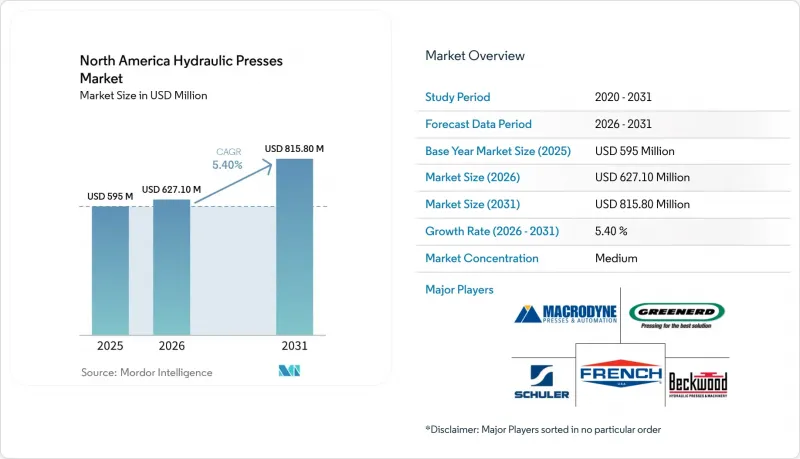
에 따르면 북미의 유압 프레스 시장 규모는 2025년에 5억 9,500만 달러로 평가되며, 2026년 6억 2,710만 달러에서 2031년까지 8억 1,580만 달러에 달할 것으로 예측되고 있으며, 예측 기간(2026-2031년)에 CAGR은 5.40%에 달할 전망입니다.
북미 유압 프레스 시장의 동향 및 인사이트
자동차 경량화 및 첨단 소재 성형
북미 유압 프레스 시장은 차체 구조 및 배터리 시스템에 알루미늄, 초고장력강 및 기타 소재를 채택하는 자동차 프로그램의 혜택을 받고 있습니다. 배터리 트레이, 사이드 실, 충돌 안전 부품 등은 성형시 제어된 힘과 유지 시간이 필요합니다. 노벨리스(Novelis)에 따르면 알루미늄으로 제작된 배터리 트레이는 동등한 강철 설계에 비해 최대 50%의 경량화가 가능하며, 단위당 에너지 밀도를 30% 향상시킬 수 있다고 합니다. 유압 시스템에서는 프로그래밍된 램 속도, 풀 스트로크 시의 톤수, 그리고 제어된 체류 시간을 활용함으로써 이러한 요구 사항을 충족할 수 있습니다. 미시간주, 온타리오주, 코아우일라주의 Tier 1 및 Tier 2 공급업체들은 1,200 MPa의 첨단 고장력 강종을 가공할 수 있도록 구형 생산 라인을 업데이트하고 있습니다. 따라서 북미 유압 프레스 시장에서는 배터리 팩 엔지니어와 프레스 공장의 금형 팀이 점점 더 깊이 관여해야 하는 사양이 요구되고 있으며, 이로 인해 조달 기간이 길어지는 한편 설비에 대한 요구 사항도 높아지고 있습니다.
리쇼어링과 국내 생산 능력 확대
신규 공장에 대한 투자로 인해 북미 생산 거점에서의 성형 설비 수요가 증가하고 있습니다. ‘리쇼어링 구상’ 보고서에 따르면 조사 대상 OEM(자사 브랜드 제조업체)의 63%가 리쇼어링 또는 국내 생산 확대를 목적으로 2026년 또는 2027년에 미국내 설비 투자를 계획하고 있습니다. 존 디어(John Deere)는 10년간 200억 달러를 투자하는 미국 제조 투자 계획의 일환으로, 노스캐롤라이나주 카너스빌에 7,000만 달러를 투자해 굴착기 공장을 건설할 것이라고 발표했습니다. 지속적으로 확장하는 OEM(Original Equipment Manufacturer)에 공급하는 수탁제조업체(CMO)는 최종 차량 및 장비 생산이 본격화되기 전에 프레스 설비의 생산 능력을 확보해야 할 필요가 있습니다. 이러한 일련의 흐름으로 인해 설비 발주가 이루어지기 전부터 북미 유압 프레스 시장에서 신규 공장 건설 계획이 중요시되고 있습니다. 또한 이는 구조용 프레스 가공 및 단조 라인에서 사용되는 H-프레임식 및 4주식 시스템의 수요를 지원하는 결과로 이어집니다.
초기 투자액이 높고, 설비 회수 기간이 길다
막대한 자본 수요는 중소규모 제조업체의 구매를 제한할 가능성이 있습니다. 자동화, 금형, 설치를 포함한 맞춤형 고톤수 시스템에는 수백만 달러 규모의 투자가 필요하며, 회수 기간은 7년 12년까지 소요될 수 있습니다. NIST는 자본 비용의 예측 가능성과 설비 회수 기간을 미국 제조업체에게 중요한 경쟁 제약 요인으로 지목했습니다. 구매자가 신규 라인의 운영자나 유지보수 인력을 확보하지 못할 경우, 인력 확보에 대한 우려가 이 문제를 더욱 심각하게 만들 수 있습니다. 리스, 부품 단위 과금 방식, 공공 설비 융자는 초기 진입 장벽을 낮출 수 있지만, 많은 중견 기업에서는 이러한 활용이 여전히 제한적입니다. 따라서 북미 유압 프레스 시장에는 견실한 프로젝트 파이프라인이 존재하는 반면, 계획된 투자의 일부는 확정 주문으로 이어지기까지 시간이 걸릴 수 있습니다.
부문 분석
2025년, H형 및 스트레이트 사이드형 프레스는 북미 유압 프레스 시장 점유율의 48%를 차지했습니다. 이러한 프레스는 기브 가이드식 램 구조를 채택하고 있으며, 편심 하중 하에서도 평행성을 유지하기 쉽습니다. 따라서 이 구성은 일관된 치수가 요구되는 대량 생산 자동차 프레스 가공 및 항공우주용 구조 부품 제조에 적합합니다. ANDRITZ Schuler사는 2026년 1월, 정격 하중 3,200-15,500 kN, 서보 제어식 유압 펌프 구동을 갖춘 ‘HFA plus+’ 파인 블랭킹 프레스 시리즈를 출시했습니다. 이 회사에 따르면 이 새로운 구동 시스템 덕분에 에너지 효율이 두 자릿수만큼 개선되었다고 합니다. 또한 H형 프레임 구조의 규모가 크기 때문에 설비의 수명이 긴 만큼, 개조나 제어 시스템 업그레이드가 더욱 경제적이 됩니다.
C-프레임 및 갭 프레임 프레스는 2026-2031년에 연평균 성장률(CAGR) 8.2%를 기록하며 가장 빠르게 성장하는 구성으로 자리매김하고 있습니다. 이러한 오픈 스로트 설계로 인해 3방향에서 접근이 가능하며, 수작업이나 로봇을 통한 로딩이 가능한 제조 셀에 대응합니다. 설치 면적이 작기 때문에 전자기기, 의료기기 및 소량 생산 자동차 부품 공급업체의 시설에 적합합니다. 배터리 셀 부품 조립, 커넥터 스테이킹, 센서 하우징 성형으로 인해 20-150톤급 C-프레임 프레스에 대한 수요가 증가하고 있습니다. 4주식 및 2기둥식 구성은 복합재 성형, 분말 성형, 고무 성형 분야에서 여전히 중요한 역할을 하고 있습니다. 벤치탑 프레스는 연구 및 시제품 제작 작업에 활용되는 반면, 특수 시스템은 항공우주 분야의 등온 성형 및 초소성 성형을 지원합니다.
2025년에는 101-500톤급이 해당 부문 매출의 48.3%를 차지했습니다. 이 용량 범위는 판금 프레스 가공, 심압착, 굽힘 가공 및 일반적인 제조 공정에 대응합니다. 자동차 업계의 Tier 1 및 Tier 2 공급업체가 사용하는 많은 알루미늄 및 초고장력강 용도에 대응할 수 있습니다. 이 범위는 북미 유압 프레스 시장에서 신규 프레스 라인의 일반적인 사양으로 자리 잡고 있습니다. 국내 제조사와 유럽의 시스템 통합사업자 모두 이 범위의 설비를 제공하고 있으며, 이에 따라 경쟁이 활발하게 유지되고 가격 투명성도 비교적 높은 편입니다. 고객 기반이 넓기 때문에 특정 최종사용자 부문의 수요가 둔화되더라도 수요를 안정시키는 데 도움이 되고 있습니다.
2,000톤을 초과하는 프레스는 가장 빠르게 성장하는 톤수 부문이며, 2031년까지 연평균 성장률(CAGR)은 6.8%로 예측됩니다. 항공우주 및 방위 분야 고객들은 이러한 시스템을 활용하여 단일 사이클로 성형되는 대형 티타늄 및 알루미늄 구조물을 제조하고 있습니다. 이러한 접근 방식을 통해 항공기 및 해군 플랫폼에서 사용되는 패스너의 수량과 조립 시간을 줄일 수 있습니다. 전투기, 조선 및 초음속 시스템용 프로그램에서는 2,000톤에서 3만 톤에 이르는 요구 사항을 충족하고 있습니다. 501-1,000톤급 및 1,001-2,000톤급은 단조 및 대형 구조물의 성형을 지원합니다. 100톤 이하의 프레스는 작업대 조립, 코인 성형 및 소량 생산 프로토타입 작업에 여전히 유용하지만, 안전 요건은 모든 출력 등급에서 시운전 및 설치 비용에 영향을 미칩니다.
기타 혜택:
- 엑셀 형식의 시장 예측(ME) 시트
- 3개월간의 애널리스트 지원
자주 묻는 질문
목차
제1장 서론
- 조사 전제조건과 시장 정의
- 조사 범위
제2장 조사 방법
제3장 개요
제4장 시장 구도
- 시장 개요
- 밸류체인 및 공급망의 분석
- 규제 상황
- 기술 전망
- 지정학적 및 무역 상황의 동향이 미치는 영향
- 산업 및 제조업의 동향
- 지속가능성과 에너지 효율
제5장 시장 규모와 성장 예측
- 프레임/구조 구성별
- 톤수/프레스력별
- 용도/성형 프로세스별
- 최종 용도 산업별
- 지역별
- 미국
- 캐나다
- 멕시코
제6장 경쟁 구도
- 전략적 동향
- 시장 점유율 분석
- 기업 개요
- ANDRITZ Schuler
- Macrodyne Technologies Inc.
- Beckwood Press Company
- Greenerd Press & Machine Company, Inc.
- French Oil Mill Machinery Co.
- Enerpac Tool Group Corp.
- Pacific Press Technologies
- HPM North America
- Neff Press
- Dake Corp.
- Betenbender Manufacturing, Inc.
- Multipress, Inc.
- Sutherland Presses
- Eagle Press & Equipment Co. Ltd.
- AIDA Engineering, Ltd.
- Komatsu Ltd.
- JIER Machine-Tool Group Co., Ltd.
- Fagor Arrasate
- Siempelkamp
- LASCO Umformtechnik GmbH
제7장 시장 기회와 향후 전망
KSA 26.10.30According to Mordor Intelligence, the North America hydraulic presses market size was valued at USD 595 million in 2025 and is estimated to grow from USD 627.10 million in 2026 to reach USD 815.80 million by 2031, at a CAGR of 5.40% during the forecast period (2026-2031).
North America Hydraulic Presses Market Trends and Insights
Automotive Lightweighting and Advanced Material Forming
The North America hydraulic presses market benefits from vehicle programs that use aluminum, ultra-high-strength steel, and other materials in body structures and battery systems. Battery trays, side sills, and crash-management parts need controlled force and dwell time during forming. Novelis stated that aluminum battery enclosures can reduce weight by up to 50% compared with equivalent steel designs and improve energy density by 30% per unit. Hydraulic systems can use programmed ram speed, full-stroke tonnage, and controlled dwell to support these requirements. Tier 1 and Tier 2 suppliers in Michigan, Ontario, and Coahuila are updating older lines to process 1,200 MPa advanced high-strength steel grades. The North America hydraulic presses market, therefore, faces specifications that increasingly involve battery-pack engineers as well as press-shop tooling teams, which can extend procurement while raising equipment requirements.
Reshoring and Domestic Manufacturing Capacity Expansion
New factory investment is increasing the need for forming equipment in North American production locations. The Reshoring Initiative reported that 63% of surveyed original equipment manufacturers planned United States capital expenditure in 2026 or 2027 for reshoring or domestic expansion. John Deere announced a USD 70 million excavator factory in Kernersville, North Carolina, within a USD 20 billion United States manufacturing commitment over 10 years. Contract manufacturers that supply expanding original equipment manufacturers may need press capacity before final vehicle or equipment production reaches scale. This sequence makes new plant plans relevant to the North America hydraulic presses market before equipment orders are placed. It also supports demand for H-frame and four-column systems used in structural stamping and forging lines.
High Initial Investment and Long Equipment Payback
High capital requirements can limit purchases by small and medium-sized fabricators. Custom high-tonnage systems that include automation, tooling, and installation can require multi-million-dollar commitments and payback periods of 7 to 12 years. NIST identified capital-cost predictability and equipment payback horizons as important competitiveness constraints for United States manufacturers. Staffing concerns can compound this issue when a buyer cannot secure operators and maintenance personnel for a new line. Leasing, pay-per-part arrangements, and public equipment financing can reduce the initial barrier, although their use remains limited in many mid-sized businesses. The North America hydraulic presses market can therefore have a strong project pipeline, while some planned investments take longer to become firm orders.
Other drivers and restraints analyzed in the detailed report include:
- Automation, Robotics, and Smart-Press Integration
- Demand for High-Force Forming in Aerospace and Defense
- Hydraulic Component, Steel, and Energy Cost Volatility
For complete list of drivers and restraints, kindly check the Table Of Contents.
Segment Analysis
H-Frame and Straight-Side presses held 48% of the North America hydraulic presses market share in 2025. Their gib-guided ram architecture helps maintain parallelism under eccentric loading. This makes the configuration suitable for high-volume automotive stamping and aerospace structural parts that need consistent dimensions. ANDRITZ Schuler launched the HFA plus+ fineblanking press series in January 2026, with force ratings from 3,200 to 15,500 kN and a servo-controlled hydraulic-pump drive. The company stated that the new drive provides double-digit energy-efficiency improvements. H-frame scale also makes rebuilds and control upgrades more economical over longer equipment lifecycles.
C-Frame and Gap-Frame presses represent the fastest-growing configuration, with an 8.2% CAGR from 2026 to 2031. Their open-throat design provides access from 3 sides, which supports manual work and robot-loaded manufacturing cells. The smaller footprint can suit electronics, medical-device, and small-batch automotive supplier facilities. Battery-cell component assembly, connector staking, and sensor-housing forming are adding demand for C-frame presses in the 20 to 150 ton range. Four-Post and Two-Post configurations remain relevant for composite molding, powder compaction, and rubber forming. Benchtop presses serve research and prototype work, while specialized systems cover isothermal and superplastic aerospace forming.
The 101-500 ton class accounted for 48.3% of segment revenue in 2025. This capacity range serves sheet-metal stamping, deep drawing, bending, and general fabrication. It can handle many aluminum and advanced high-strength steel applications used by automotive Tier 1 and Tier 2 suppliers. The range is a common specification for new stamping lines across the North America hydraulic presses market. Domestic builders and European integrators both offer equipment in this range, which keeps competition active and prices relatively transparent. Its broad customer base helps stabilize demand even when a single end-use sector slows.
Presses above 2,000 tons are the fastest-growing tonnage segment, with a forecast 6.8% CAGR through 2031. Aerospace and defense customers use these systems for large titanium and aluminum structures formed in a single cycle. This approach can reduce fastener counts and assembly time on airframes and naval platforms. Programs for fighter aircraft, shipbuilding, and hypersonic systems support requirements from 2,000 to 30,000 tons. The 501-1,000 ton and 1,001-2,000 ton classes support forging and heavy structural forming. Presses up to 100 tons remain useful for bench assembly, coining, and low-volume prototype work, while safety requirements influence commissioning and installation costs across every force class.
Complete Report Scope:
- By Frame / Structural Configuration
- C-Frame / Gap-Frame Hydraulic Presses
- H-Frame / Straight-Side / Gib-Guided Hydraulic Presses
- Four-Post / Four-Column Hydraulic Presses
- Two-Post / Column Hydraulic Presses
- Benchtop / Workshop Hydraulic Presses
- Other Specialized Hydraulic Press Configurations
- By Tonnage / Press Force
- Up to 100 Tons
- 101-500 Tons
- 501-1,000 Tons
- 1,001-2,000 Tons
- Above 2,000 Tons
- By Application / Forming Process
- Sheet Metal Forming and Deep Drawing
- Forging
- Bending and Straightening
- Punching, Blanking, and Coining
- Compression Molding
- Powder Compaction
- Hydroforming
- Assembly, Press-Fitting, and General Pressing
- Other Specialized Applications
- By End-Use Industry
- Automotive and Transportation
- Aerospace and Defense
- Industrial Machinery and General Manufacturing
- Electrical and Electronics
- Plastics, Rubber, and Composites
- Construction and Heavy Equipment
- Energy and Power Equipment
- Rail and Marine
- Powder Metallurgy, Ceramics, and Advanced Materials
- Other End-Use Industries
- By Geography
- United States
- Canada
- Mexico
List of Companies Covered in this Report:
- ANDRITZ Schuler
- Macrodyne Technologies Inc.
- Beckwood Press Company
- Greenerd Press & Machine Company, Inc.
- French Oil Mill Machinery Co.
- Enerpac Tool Group Corp.
- Pacific Press Technologies
- HPM North America
- Neff Press
- Dake Corp.
- Betenbender Manufacturing, Inc.
- Multipress, Inc.
- Sutherland Presses
- Eagle Press & Equipment Co. Ltd.
- AIDA Engineering, Ltd.
- Komatsu Ltd.
- JIER Machine-Tool Group Co., Ltd.
- Fagor Arrasate
- Siempelkamp
- LASCO Umformtechnik GmbH
Additional Benefits:
- The market estimate (ME) sheet in Excel format
- 3 months of analyst support
TABLE OF CONTENTS
1 Introduction
- 1.1 Study Assumptions and Market Definition
- 1.2 Scope of the Study
2 Research Methodology
3 Executive Summary
4 Market Landscape
- 4.1 Market Overview
- 4.1.1 Market Drivers
- 4.1.1.1 Automotive Lightweighting and Advanced Material Forming
- 4.1.1.2 Reshoring and Domestic Manufacturing Capacity Expansion
- 4.1.1.3 Automation, Robotics, and Smart-Press Integration
- 4.1.1.4 Demand for High-Force Forming in Aerospace and Defense
- 4.1.1.5 Retrofit Demand from Installed Press Bases and Local Service Requirements
- 4.1.1.6 Energy Efficiency Mandates and Demand for Servo-Hydraulic Press Upgrades
- 4.1.2 Market Restraints
- 4.1.2.1 High Initial Investment and Long Equipment Payback
- 4.1.2.2 Hydraulic Component, Steel, and Energy Cost Volatility
- 4.1.2.3 Tariff, Trade-Policy, and Cross-Border Supply-Chain Uncertainty
- 4.1.2.4 Skilled Workforce Shortage and Technician Availability Constraints
- 4.1.1 Market Drivers
- 4.2 Value Chain and Supply Chain Analysis
- 4.2.1 Raw Materials and Structural Components
- 4.2.2 Hydraulic Power Units, Pumps, Valves, and Cylinders
- 4.2.3 Controls, Sensors and Automation Components
- 4.2.4 Tooling and Die Ecosystem
- 4.2.5 Installation, Maintenance, Retrofit, and Rebuild Services
- 4.3 Regulatory Landscape
- 4.3.1 Hydraulic Press Machinery and Occupational Safety Requirements
- 4.3.2 Hydraulic Fluid, Noise, and Environmental Compliance Requirements
- 4.3.3 Regional Machinery Safety and Conformity Requirements
- 4.4 Technological Outlook
- 4.4.1 Servo-Hydraulic and Energy-Efficient Drive Systems
- 4.4.2 Advanced Controls and Closed-Loop Force/Position Control
- 4.4.3 Automation, Robotics, and Automated Material Handling
- 4.4.4 Connected Presses, IIoT, and Condition Monitoring
- 4.4.5 Predictive Maintenance and Process Traceability
- 4.4.6 Hybrid Hydraulic-Electric Press Technologies
- 4.4.7 Advanced Material and Composite Forming Technologies
- 4.5 Impact of Geopolitical and Trade Developments
- 4.5.1 Tariffs and Import Restrictions
- 4.5.2 Supply-Chain Risks for Hydraulic and Control Components
- 4.5.3 Localization of Hydraulic Press Manufacturing
- 4.6 Industry and Manufacturing Trends
- 4.7 Sustainability and Energy Efficiency
5 Market Size & Growth Forecasts
- 5.1 By Frame / Structural Configuration
- 5.1.1 C-Frame / Gap-Frame Hydraulic Presses
- 5.1.2 H-Frame / Straight-Side / Gib-Guided Hydraulic Presses
- 5.1.3 Four-Post / Four-Column Hydraulic Presses
- 5.1.4 Two-Post / Column Hydraulic Presses
- 5.1.5 Benchtop / Workshop Hydraulic Presses
- 5.1.6 Other Specialized Hydraulic Press Configurations
- 5.2 By Tonnage / Press Force
- 5.2.1 Up to 100 Tons
- 5.2.2 101-500 Tons
- 5.2.3 501-1,000 Tons
- 5.2.4 1,001-2,000 Tons
- 5.2.5 Above 2,000 Tons
- 5.3 By Application / Forming Process
- 5.3.1 Sheet Metal Forming and Deep Drawing
- 5.3.2 Forging
- 5.3.3 Bending and Straightening
- 5.3.4 Punching, Blanking, and Coining
- 5.3.5 Compression Molding
- 5.3.6 Powder Compaction
- 5.3.7 Hydroforming
- 5.3.8 Assembly, Press-Fitting, and General Pressing
- 5.3.9 Other Specialized Applications
- 5.4 By End-Use Industry
- 5.4.1 Automotive and Transportation
- 5.4.2 Aerospace and Defense
- 5.4.3 Industrial Machinery and General Manufacturing
- 5.4.4 Electrical and Electronics
- 5.4.5 Plastics, Rubber, and Composites
- 5.4.6 Construction and Heavy Equipment
- 5.4.7 Energy and Power Equipment
- 5.4.8 Rail and Marine
- 5.4.9 Powder Metallurgy, Ceramics, and Advanced Materials
- 5.4.10 Other End-Use Industries
- 5.5 By Geography
- 5.5.1 United States
- 5.5.2 Canada
- 5.5.3 Mexico
6 Competitive Landscape
- 6.1 Strategic Moves
- 6.2 Market Share Analysis
- 6.3 Company Profiles (Includes Global Level Overview, Market Level Overview, Core Segments, Financials as Available, Strategic Information, Products and Services, Recent Developments)
- 6.3.1 ANDRITZ Schuler
- 6.3.2 Macrodyne Technologies Inc.
- 6.3.3 Beckwood Press Company
- 6.3.4 Greenerd Press & Machine Company, Inc.
- 6.3.5 French Oil Mill Machinery Co.
- 6.3.6 Enerpac Tool Group Corp.
- 6.3.7 Pacific Press Technologies
- 6.3.8 HPM North America
- 6.3.9 Neff Press
- 6.3.10 Dake Corp.
- 6.3.11 Betenbender Manufacturing, Inc.
- 6.3.12 Multipress, Inc.
- 6.3.13 Sutherland Presses
- 6.3.14 Eagle Press & Equipment Co. Ltd.
- 6.3.15 AIDA Engineering, Ltd.
- 6.3.16 Komatsu Ltd.
- 6.3.17 JIER Machine-Tool Group Co., Ltd.
- 6.3.18 Fagor Arrasate
- 6.3.19 Siempelkamp
- 6.3.20 LASCO Umformtechnik GmbH
7 Market Opportunities & Future Outlook
- 7.1 White-Space and Unmet-Need Assessment
- 7.1.1 Energy-Efficient and Servo-Hydraulic Presses
- 7.1.2 Retrofit and Modernization of Legacy Presses
- 7.1.3 Automated and Connected Hydraulic Press Systems
- 7.1.4 Emerging-Market Manufacturing Expansion
- 7.1.5 High-Tonnage Applications
- 7.1.6 Advanced Materials and Composite Forming
- 7.1.7 Replacement vs. New-Capacity Demand Outlook


