

|
시장보고서
상품코드
2157094
베트남의 유압 프레스 : 시장 점유율 분석, 업계 동향과 통계, 성장 예측(2026-2031년)Vietnam Hydraulic Presses - Market Share Analysis, Industry Trends & Statistics, Growth Forecasts (2026 - 2031) |
||||||
 Mordor Intelligence
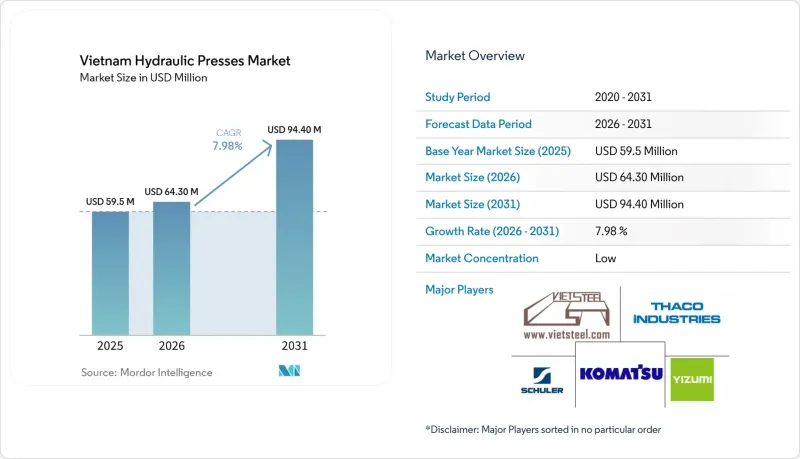
에 따르면 베트남의 유압 프레스 시장 규모는 2025년 5,950만 달러에서 2026년에는 6,430만 달러로 확대하며, 2031년까지 9,440만 달러에 달할 것으로 예상되고 있으며, 2026-2031년에 CAGR 7.98%로 성장할 것으로 전망되고 있습니다.
베트남 유압 프레스 시장의 동향 및 인사이트
자동차 및 전기자동차(EV) 부품의 현지화
베트남의 전기자동차 현지화 노력은 2026년 유압 프레스 신규 조달의 주요 요인이 되고 있습니다. VinFast사는 2025년 말까지 현지화율이 60%에 도달하고, 하틴성에서 VinES 배터리 셀 생산이 본격화되는 2026년에는 80%를 목표로 한다고 발표했습니다. 현지화율 향상에 따라 공급업체들은 완성 부품을 조달하는 대신 베트남 국내에서 배터리 케이스 및 구조용 브래킷을 성형해야 합니다. 이러한 요건으로 인해 1차 및 2차 공급망 전반에 걸쳐 2,000톤 미만의 유압 프레스 구매가 촉진되고 있습니다. 결정 제929/QD-TTg호에서는 2030년까지 자동차 부품의 현지 조달률을 22%에서 30%로 높이는 목표가 설정되어 있으며, 이에 따라 대상 공급업체들 사이에서 국내 성형 라인에 대한 수요가 증가하고 있습니다. 따라서 베트남의 유압 프레스 시장은 단일 자동차 제조사의 생산 주기를 넘어선 정책 방향으로부터 혜택을 받고 있습니다.
자동차 차체 및 섀시용 프레스 생산 능력 확대
자동차 분야에 대한 투자로 인해 차체 및 섀시 생산 라인 전반에 걸쳐 여러 기계에 대한 수요가 발생하고 있습니다. 도요타 모터 베트남은 2026년 8월, 등록 투자액을 3억 7,300만 달러 이상으로 증액하고, 펜더, 도어, 보닛, 플로어 팬을 제조하는 프레스 공장을 신설하는 승인을 받아 2029년 가동을 시작할 예정입니다. 현지에서의 프레스 가공을 통해 완성 부품 수입이 대체되며, 차체 패널 공급업체들 사이에서 관련 수요가 창출됩니다. THACO 인더스트리즈는 2026년 2월, 다낭에 7,000만 달러를 투자한 제조 복합 시설을 개장했습니다. 이 시설에는 자동화 생산 라인이 도입되어 있으며, 2026년 수출 목표는 6,000만 달러로 설정되어 있습니다. 또한 현대 탄콩도 2026년에 1만 5,280대의 차량 및 부품 세트 수출을 목표로 하고 있으며, 여기에는 멕시코로 수출되는 ‘크레타’도 포함됩니다. 이러한 프로젝트들을 통해 베트남의 유압 프레스 시장은 일반적인 짧은 설비 갱신 주기보다 더 장기적인 수주 전망을 확보하게 될 것입니다.
높은 자본 비용과 중소기업 대상 대출 제한
높은 자본 비용은 중소규모 제조업체의 유압 프레스 구매를 지연시키는 요인이 될 수 있습니다. 정식 대출에 대한 접근성은 여전히 불균형하여, 이로 인해 소규모 제조업체가 구형 설비를 갱신하는 능력이 제한받고 있습니다. 이러한 제약은 구매자가 종종 내부 현금 흐름에 의존하는 저톤수 기계 구매에서 가장 두드러집니다. 기존의 공공 지원 제도는 기계 집약형 기업에 대한 담보 및 대출 장벽을 완전히 제거하지는 못하고 있습니다. 따라서 생산 수요가 개선되더라도 베트남의 유압 프레스 시장에서는 설비 교체 주기가 장기화될 가능성이 있습니다. 자금 조달 파트너십이나 리스 계약은 설비 접근성을 개선할 수 있지만, 이러한 수단의 이용 가능 여부는 소규모 구매자에게 여전히 중요한 조건으로 남아 있습니다.
부문 분석
2025년, 베트남 유압 프레스 시장에서 C-프레임 및 갭 프레임식 유압 프레스는 35.8%의 점유율을 차지했습니다. 이러한 프레스는 삼면이 개방된 구조로 되어 있으며, 전자기기, 가전제품, 자동차 부품 및 일반 가공 분야의 판금, 프레스 가공, 굽힘 가공, 펀칭, 조립 작업에 대응합니다. 이러한 구조 덕분에 프레스 셀 전체를 재설계하지 않고도 로봇을 이용한 자재 이송 장치를 도입할 수 있으며, 제조 시설의 단계적 자동화를 지원합니다. 이러한 유연성은 금형을 빈번하게 교체하며 여러 부품을 생산하는 중소규모 공장에 적합합니다. 또한 작업 구역에 접근하기 쉬워, 빈번한 설비 변경이 필요한 전자기기 조립 라인에도 대응하고 있습니다. 수요는 베트남의 확대되는 제조 기반에 의해 더욱 지원되고 있으며, 공급업체 측에서는 CNC 장비, 자동 공급 시스템, 그리고 인라인 검사와 통합 가능한 소형 프레스기에 대한 수요가 증가하고 있습니다.
H-프레임식, 스트레이트 사이드식 및 기브 가이드식 유압 프레스는 2031년까지 연평균 성장률(CAGR) 10.1%로 성장할 것으로 예측됩니다. 이러한 프레스의 램 평행도는 불균일한 하중이나 더 엄격한 패널 공차가 요구되는 상황에서 큰 가치를 발휘합니다. 이러한 프레스는 더 높은 강성과 재현성이 요구되는 자동차 차체 부품, 구조 부품, 두꺼운 판금 성형 및 산업용 가공 분야에서 점점 더 적합한 선택지가 되고 있습니다. 4주식 프레스는 대형 플레이트 전체에 힘을 가해야 하는 심압연이나 복합 성형 용도에 적합합니다. 압력을 보다 균일하게 분산시키는 능력 덕분에 대형 공작물이나 다단계 성형 공정이 수반되는 용도에도 대응할 수 있습니다. 2기둥식 및 벤치탑형 시스템은 전자기기 조립, 유지보수 작업, 시제품 제작과 같은 소규모 용도에 대응합니다. TCVN 11310:2015 준수를 통해 OEM 관련 공장에서 추적 가능한 안전 문서를 갖춘 표준화된 구성이 촉진되고 있습니다. 베트남 제조업체들이 자동화를 추진하고 고부가가치 생산으로 전환함에 따라 프레스 선정시 프로그래머블 제어, 서보 유압 시스템, 에너지 효율, 안전 인터록, 그리고 자동 이송 장치와의 호환성이 점점 더 중요한 요소로 대두되고 있습니다.
2025년에는 101-500톤급이 매출의 38%를 차지했습니다. 이 등급은 자동차 업계의 2차 공급업체, 전자기기 케이스 제조업체 및 가전제품 프레임 제조업체에 서비스를 제공하고 있습니다. 이 톤수 범위는 많은 중규모 외국계 공급업체의 투자 능력에 적합하며, 브래킷, 케이스, 패널, 프레임 및 성형 판금 부품에 대한 일반적인 요구 사항에도 부합합니다. 또한 적당한 힘과 빈번한 금형 교체가 요구되는 순차 프레스, 굽힘, 펀칭, 성형 가공에도 대응하고 있습니다. 수요는 베트남내 전자기기, 자동차 부품, 전기 기기, 가전제품의 제조 거점 확장에 힘입어 증가하고 있습니다. 공급업체들은 자동 공급 장치, 로봇 핸들링, 프로그래머블 제어, 인라인 검사 시스템과 통합 가능한 프레스 기계를 점점 더 많이 요구하고 있습니다. 그 결과, 베트남의 유압 프레스 업계는 중규모 설비에 대한 광범위하고 안정적인 수요 기반을 갖추고 있습니다.
2,000톤을 초과하는 프레스 기계의 경우, 2031년까지 연평균 성장률(CAGR) 10.4%로 성장할 것으로 예측됩니다. 수요는 상용차 섀시, 배터리용 구조 케이스, 단조 및 철도 차량 제조에서 발생하고 있습니다. 이러한 분야는 더 높은 압력을 필요로 하는 프레스 기계에 대한 새로운 수요원이 되고 있습니다. 대용량 프레스기는 초대형 구조 부품, 중하중 성형, 그리고 높은 베드 강성과 균일한 힘 분포가 필요한 용도에도 적합합니다. 501-1,000톤 및 1,001-2,000톤 범위의 프레스는 계속해서 트럭 차체, 농업기계, 건설 기계 및 더 무거운 판금 가공을 지원하고 있습니다. 이러한 톤수 대역에서 구매자들은 정격 프레스 용량 외에도 자동화 대응성, 사이클 타임 효율성, 압력 제어, 작업자 안전 및 에너지 소비량을 점점 더 중요하게 여기고 있습니다.
기타 장점:
- 엑셀 형식의 시장 예측(ME) 시트
- 3개월간의 애널리스트 지원
자주 묻는 질문
목차
제1장 서론
- 조사 전제조건과 시장 정의
- 조사 범위
제2장 조사 방법
제3장 개요
제4장 시장 구도
- 시장 개요
- 시장 성장 촉진요인
- 시장 성장 억제요인
- 가치 및 공급망 분석
- 규제 상황
- 기술 전망
- 지정학적 및 무역 상황의 동향이 미치는 영향
- 산업 및 제조업의 동향
- 지속가능성과 에너지 효율
제5장 시장 규모와 성장 예측
- 프레임/구조 구성별
- 톤수/프레스력별
- 용도/성형 프로세스별
- 최종 용도 산업별
제6장 경쟁 구도
- 시장 집중도
- 전략적 동향
- 시장 점유율 분석
- 기업 개요
- THACO INDUSTRIES
- Vietsteel Machinery Co., Ltd.
- Schuler AG
- Komatsu Ltd.
- Yizumi Group
- SMS group GmbH
- Jiangsu Xuduan Co. Ltd.
- Sanki Seiko Co., Ltd.
- Amino Corporation
- An Hung Mechanical and Equipment Joint Stock Company
- Siempelkamp Maschinen-und Anlagenbau GmbH
- AUTOMECH Manufacturing Automation Equipment, Dies and Tools Joint Stock Company
- LASCO Umformtechnik GmbH
- CUNMAC Company Limited
- DORST Technologies GmbH and Co. KG
- Beckwood Press Company
- Macrodyne Technologies Inc.
- Greenerd Press and Machine Company
- French Oil Mill Machinery Company
- Wabash MPI
- Gasbarre Products, Inc.
- Santec Exim Pvt. Ltd.
- Japan Automatic Machine Co., Ltd.
- AIDA Engineering, Ltd.
- Tianjin Tianduan Press Co., Ltd.
- Yangli Group
제7장 시장 기회와 향후 전망
KSA 26.10.30According to Mordor Intelligence, the Vietnam hydraulic presses market size is expected to increase from USD 59.5 million in 2025 to USD 64.30 million in 2026 and reach USD 94.40 million by 2031, growing at a CAGR of 7.98% over 2026-2031.
Vietnam Hydraulic Presses Market Trends and Insights
Automotive and EV Component Localization
Vietnam's EV localization effort is a major source of new hydraulic press procurement in 2026. VinFast stated that its localization rate reached 60% by late 2025 and that it targets 80% in 2026 as VinES battery-cell output in Ha Tinh reaches full capacity. Higher local content requires suppliers to form battery casings and structural brackets within Vietnam rather than source finished components. That requirement supports purchases of presses below 2,000 tons across first-tier and second-tier supply networks. Decision 929/QD-TTg sets an automotive-component localization target of 22% to 30% by 2030, which increases the need for domestic forming lines among eligible suppliers. The Vietnam hydraulic presses market, therefore, benefits from a policy direction that extends beyond a single vehicle maker's production cycle.
Expansion of Automotive Body and Chassis Pressing Capacity
Automotive investment is generating requirements for several machines across body and chassis production lines. Toyota Motor Vietnam received approval in August 2026 to raise registered investment above USD 373 million and add a stamping workshop for fenders, doors, hoods, and floor pans, with operations planned for 2029. Local stamping replaces imports of finished parts and creates related demand among body-panel suppliers. THACO Industries opened a USD 70 million manufacturing complex in Da Nang in February 2026 with automated production lines and a USD 60 million export target for 2026. Hyundai Thanh Cong also targets exports of 15,280 vehicle units and component sets in 2026, including Creta shipments to Mexico. These projects give the Vietnam hydraulic presses market a longer order horizon than typical short equipment replacement cycles.
High Capital Cost and Limited SME Financing
Capital costs can delay hydraulic press purchases by small and medium-sized manufacturers. Access to formal credit remains uneven, which limits the ability of smaller fabricators to replace older equipment. This constraint is strongest in lower-tonnage purchases, where buyers often rely on internal cash flow. Existing public support mechanisms have not fully removed collateral and lending barriers for machinery-intensive firms. The Vietnam hydraulic presses market can therefore experience longer replacement cycles even when production demand improves. Financing partnerships and leasing arrangements could improve equipment access, but their availability remains an important condition for smaller buyers.
Other drivers and restraints analyzed in the detailed report include:
- Electronics, Electrical Equipment, and Appliance Manufacturing Growth
- Automation, Robotics, and Connected Press Adoption
- Competition from Mechanical, Electric, and Alternative Forming Technologies
For complete list of drivers and restraints, kindly check the Table Of Contents.
Segment Analysis
C-Frame and gap-frame hydraulic presses held 35.8% of the Vietnam hydraulic presses market share in 2025. Their open three-sided construction supports sheet metal, stamping, bending, punching, and assembly work across electronics, appliances, automotive components, and general fabrication. The configuration can accommodate robotic material handlers without redesigning the entire press cell, supporting gradual automation in manufacturing facilities. This flexibility suits small and medium-sized shops that change dies often and produce multiple parts. It also supports electronics assembly lines that require accessible work areas and frequent setup changes. Demand is further supported by Vietnam's expanding manufacturing base, where suppliers increasingly require compact presses that can be integrated with CNC equipment, automated feeding systems, and in-line inspection.
H-Frame, straight-side, and gib-guided hydraulic presses are forecast to grow at a 10.1% CAGR through 2031. Their ram parallelism is valuable where uneven loads and tighter panel tolerances are present. These presses are increasingly suitable for automotive body components, structural parts, heavy sheet-metal forming, and industrial fabrication, where higher rigidity and repeatability are required. Four-post presses serve deep drawing and composite molding applications that require force across large platens. Their ability to distribute pressure more uniformly also supports applications involving larger workpieces and multi-stage forming operations. Two-post and benchtop systems address smaller applications in electronics assembly, maintenance operations, and prototype work. Compliance with TCVN 11310:2015 is encouraging standardized configurations with traceable safety documentation in OEM-linked plants. As Vietnamese manufacturers increase automation and move toward higher-value production, press selection is increasingly influenced by programmable controls, servo-hydraulic systems, energy efficiency, safety interlocks, and compatibility with automated loading and unloading equipment.
The 101-500-ton category held 38% of revenue in 2025. It serves automotive Tier-2 suppliers, electronics housing producers, and appliance-frame fabricators. This tonnage range fits the investment capacity of many mid-sized, foreign-invested suppliers and aligns with common requirements for brackets, housings, panels, frames, and formed sheet components. It also supports progressive stamping, bending, punching, and forming operations where moderate force and frequent die changes are required. Demand is reinforced by Vietnam's growing electronics, automotive-component, electrical equipment, and appliance manufacturing base. Suppliers increasingly seek presses that can integrate with automated feeding, robotic handling, programmable controls, and in-line inspection systems. As a result, the Vietnam hydraulic presses industry has a wide and stable base of mid-range equipment demand.
Presses above 2,000 tons are forecast to grow at a 10.4% CAGR through 2031. Demand comes from commercial-vehicle chassis, structural battery enclosures, forging, and rail manufacturing. That facility introduces a new source of higher-force press requirements. Large-capacity presses are also suited to oversized structural parts, heavy-duty forming, and applications requiring high bed rigidity and consistent force distribution. The 501-1,000-ton and 1,001-2,000-ton ranges continue to support truck bodies, agricultural equipment, construction machinery, and heavier sheet-metal fabrication. Across these tonnage bands, buyers are increasingly prioritizing automation compatibility, cycle-time efficiency, pressure control, operator safety, and energy consumption alongside rated pressing capacity.
Complete Report Scope:
- By Frame / Structural Configuration
- C-Frame / Gap-Frame Hydraulic Presses
- H-Frame / Straight-Side / Gib-Guided Hydraulic Presses
- Four-Post / Four-Column Hydraulic Presses
- Two-Post / Column Hydraulic Presses
- Benchtop / Workshop Hydraulic Presses
- Other Specialized Hydraulic Press Configurations
- By Tonnage / Press Force
- Up to 100 Tons
- 101-500 Tons
- 501-1,000 Tons
- 1,001-2,000 Tons
- Above 2,000 Tons
- By Application / Forming Process
- Sheet Metal Forming and Deep Drawing
- Forging
- Bending and Straightening
- Punching, Blanking and Coining
- Compression Molding
- Powder Compaction
- Hydroforming
- Assembly, Press-Fitting and General Pressing
- Other Specialized Applications
- By End-Use Industry
- Automotive and Transportation
- Aerospace and Defense
- Industrial Machinery and General Manufacturing
- Electrical and Electronics
- Plastics, Rubber and Composites
- Construction and Heavy Equipment
- Energy and Power Equipment
- Rail and Marine
- Powder Metallurgy, Ceramics and Advanced Materials
- Other End-Use Industries
List of Companies Covered in this Report:
- THACO INDUSTRIES
- Vietsteel Machinery Co., Ltd.
- Schuler AG
- Komatsu Ltd.
- Yizumi Group
- SMS group GmbH
- Jiangsu Xuduan Co. Ltd.
- Sanki Seiko Co., Ltd.
- Amino Corporation
- An Hung Mechanical and Equipment Joint Stock Company
- Siempelkamp Maschinen- und Anlagenbau GmbH
- AUTOMECH Manufacturing Automation Equipment, Dies and Tools Joint Stock Company
- LASCO Umformtechnik GmbH
- CUNMAC Company Limited
- DORST Technologies GmbH and Co. KG
- Beckwood Press Company
- Macrodyne Technologies Inc.
- Greenerd Press and Machine Company
- French Oil Mill Machinery Company
- Wabash MPI
- Gasbarre Products, Inc.
- Santec Exim Pvt. Ltd.
- Japan Automatic Machine Co., Ltd.
- AIDA Engineering, Ltd.
- Tianjin Tianduan Press Co., Ltd.
- Yangli Group
Additional Benefits:
- The market estimate (ME) sheet in Excel format
- 3 months of analyst support
TABLE OF CONTENTS
1 Introduction
- 1.1 Study Assumptions and Market Definition
- 1.2 Scope of the Study
2 Research Methodology
3 Executive Summary
4 Market Landscape
- 4.1 Market Overview
- 4.2 Market Drivers
- 4.2.1 Automotive and EV Component Localization
- 4.2.2 Expansion of Automotive Body and Chassis Pressing Capacity
- 4.2.3 Electronics, Electrical Equipment, and Appliance Manufacturing Growth
- 4.2.4 Automation, Robotics, and Connected Press Adoption
- 4.2.5 Brownfield Replacement of Obsolete Presses and Controls
- 4.2.6 Regional Tooling, Die, and Process-Validation Ecosystem Development
- 4.3 Market Restraints
- 4.3.1 High Capital Cost and Limited SME Financing
- 4.3.2 Competition from Mechanical, Electric, and Alternative Forming Technologies
- 4.3.3 Shortage of Hydraulic, Controls, and Commissioning Specialists
- 4.3.4 Imported Components, Service Delays, and Compliance Complexity
- 4.4 Value and Supply-Chain Analysis
- 4.4.1 Raw Materials and Structural Components
- 4.4.2 Hydraulic Power Units, Pumps, Valves and Cylinders
- 4.4.3 Controls, Sensors, and Automation Components
- 4.4.4 Tooling and Die Ecosystem
- 4.4.5 Installation, Maintenance, Retrofit, and Rebuild Services
- 4.5 Regulatory Landscape
- 4.5.1 TCVN 11310:2015 Hydraulic Press Safety Requirements
- 4.5.2 Occupational Safety Inspection and Certification Requirements
- 4.5.3 Machinery Import, Conformity and Technical Documentation Requirements
- 4.5.4 Hydraulic Fluid, Noise, Electrical and Environmental Compliance
- 4.5.5 Automotive Quality Requirements, Including IATF 16949
- 4.6 Technological Outlook
- 4.6.1 Servo-Hydraulic and Energy-Efficient Drive Systems
- 4.6.2 Closed-Loop Force, Position and Parallelism Control
- 4.6.3 Robot Loading, Unloading and Automated Die Change
- 4.6.4 IIoT Connectivity, Condition Monitoring and Predictive Maintenance
- 4.6.5 Hybrid Hydraulic-Electric and Accumulator-Assisted Systems
- 4.6.6 Advanced Material, Composite and Hydroforming Processes
- 4.7 Impact of Geopolitical and Trade Developments
- 4.7.1 China-Origin Equipment and Component Dependence
- 4.7.2 South Korea and Japan Equipment-Supply Relationships
- 4.7.3 Tariffs, Import Restrictions and Customs Procedures
- 4.7.4 Localization of Press Manufacturing and Aftermarket Support
- 4.8 Industry and Manufacturing Trends
- 4.9 Sustainability and Energy Efficiency
5 Market Size & Growth Forecasts
- 5.1 By Frame / Structural Configuration
- 5.1.1 C-Frame / Gap-Frame Hydraulic Presses
- 5.1.2 H-Frame / Straight-Side / Gib-Guided Hydraulic Presses
- 5.1.3 Four-Post / Four-Column Hydraulic Presses
- 5.1.4 Two-Post / Column Hydraulic Presses
- 5.1.5 Benchtop / Workshop Hydraulic Presses
- 5.1.6 Other Specialized Hydraulic Press Configurations
- 5.2 By Tonnage / Press Force
- 5.2.1 Up to 100 Tons
- 5.2.2 101-500 Tons
- 5.2.3 501-1,000 Tons
- 5.2.4 1,001-2,000 Tons
- 5.2.5 Above 2,000 Tons
- 5.3 By Application / Forming Process
- 5.3.1 Sheet Metal Forming and Deep Drawing
- 5.3.2 Forging
- 5.3.3 Bending and Straightening
- 5.3.4 Punching, Blanking and Coining
- 5.3.5 Compression Molding
- 5.3.6 Powder Compaction
- 5.3.7 Hydroforming
- 5.3.8 Assembly, Press-Fitting and General Pressing
- 5.3.9 Other Specialized Applications
- 5.4 By End-Use Industry
- 5.4.1 Automotive and Transportation
- 5.4.2 Aerospace and Defense
- 5.4.3 Industrial Machinery and General Manufacturing
- 5.4.4 Electrical and Electronics
- 5.4.5 Plastics, Rubber and Composites
- 5.4.6 Construction and Heavy Equipment
- 5.4.7 Energy and Power Equipment
- 5.4.8 Rail and Marine
- 5.4.9 Powder Metallurgy, Ceramics and Advanced Materials
- 5.4.10 Other End-Use Industries
6 Competitive Landscape
- 6.1 Market Concentration
- 6.2 Strategic Moves
- 6.3 Market Share Analysis
- 6.4 Company Profiles (Includes Global Level Overview, Market Level Overview, Core Segments, Financials as Available, Strategic Information, Products and Services, Recent Developments)
- 6.4.1 THACO INDUSTRIES
- 6.4.2 Vietsteel Machinery Co., Ltd.
- 6.4.3 Schuler AG
- 6.4.4 Komatsu Ltd.
- 6.4.5 Yizumi Group
- 6.4.6 SMS group GmbH
- 6.4.7 Jiangsu Xuduan Co. Ltd.
- 6.4.8 Sanki Seiko Co., Ltd.
- 6.4.9 Amino Corporation
- 6.4.10 An Hung Mechanical and Equipment Joint Stock Company
- 6.4.11 Siempelkamp Maschinen- und Anlagenbau GmbH
- 6.4.12 AUTOMECH Manufacturing Automation Equipment, Dies and Tools Joint Stock Company
- 6.4.13 LASCO Umformtechnik GmbH
- 6.4.14 CUNMAC Company Limited
- 6.4.15 DORST Technologies GmbH and Co. KG
- 6.4.16 Beckwood Press Company
- 6.4.17 Macrodyne Technologies Inc.
- 6.4.18 Greenerd Press and Machine Company
- 6.4.19 French Oil Mill Machinery Company
- 6.4.20 Wabash MPI
- 6.4.21 Gasbarre Products, Inc.
- 6.4.22 Santec Exim Pvt. Ltd.
- 6.4.23 Japan Automatic Machine Co., Ltd.
- 6.4.24 AIDA Engineering, Ltd.
- 6.4.25 Tianjin Tianduan Press Co., Ltd.
- 6.4.26 Yangli Group
7 Market Opportunities & Future Outlook
- 7.1 White-Space and Unmet-Need Assessment
- 7.1.1 Energy-Efficient and Servo-Hydraulic Presses
- 7.1.2 Retrofit and Modernization of Legacy Presses
- 7.1.3 Automated and Connected Hydraulic Press Systems
- 7.1.4 Battery Case and Advanced Material Forming
- 7.1.5 Compact Presses for High-Mix Japanese Manufacturing
- 7.1.6 High-Tonnage Forging and Special-Purpose Applications


