

|
시장보고서
상품코드
2063698
언매니지드 스위치 : 시장 점유율 분석, 업계 동향 및 통계, 성장 예측(2026-2031년)Unmanaged Switch - Market Share Analysis, Industry Trends & Statistics, Growth Forecasts (2026 - 2031) |
||||||
 Mordor Intelligence
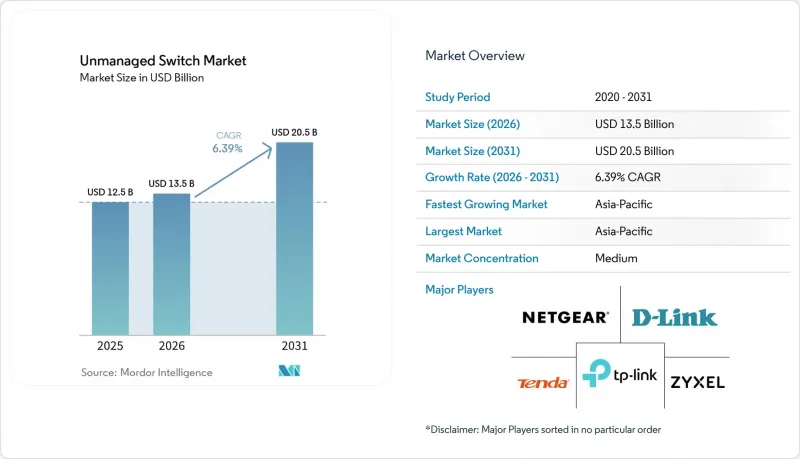
Mordor Intelligence에 의하면, 언매니지드 스위치 시장 규모는 2025년에 125억 달러로 평가되었습니다. 2026년 135억 달러에서 2031년까지 205억 달러에 이를 것으로 예상되며, 예측 기간(2026-2031년) CAGR은 6.39%를 나타낼 전망입니다.
본 보고서는 포트 수(5포트 이하, 6-8포트, 9-16포트, 17-24포트, 24포트 이상), PoE 기능(비 PoE, PoE, PoE+, PoE++), 도입 환경(주택·홈 오피스, 중소기업, 기업·캠퍼스, 산업용·견고형, 데이터센터 에지), 지역(북미 등)에 따라 분류되어 있습니다. 시장 전망은 금액(달러) 기준으로 제시되어 있습니다.
세계의 언매니지드 스위치 시장 동향 및 인사이트
비용 효율성이 뛰어난 플러그 앤 플레이형 네트워크에 대한 중소기업(SMB) 수요가 급증하고 있습니다.
가격에 민감한 소규모 기업은 전담 IT 인력을 배치하는 경우가 거의 없기 때문에 포트 속도를 자동으로 협상하고 별도의 설정이 필요 없는 언매니지드 장비를 도입하고 있습니다. 일반적인 8포트 기가비트 모델의 소매 가격은 100달러보다 훨씬 저렴하며, 사용자당 단말기 수가 평균 3대로 증가하더라도 이 가격은 여전히 매력적입니다. 제로 터치 도입은 배선 재배치가 빈번하게 필요한 팝업형 소매 키오스크나 코워킹 스페이스를 지원합니다. 동남아시아의 수출 거점에서는 현지 부가가치 재판매업체들이 저가형 스위치와 클라우드 라우터를 묶어 판매함으로써, 전자상거래 사업에 처음 진출하는 업체들의 디지털 도입을 가속화하고 있습니다. 하이브리드 근무 방식이 정착됨에 따라, 직원들이 자택과 사무실 책상을 오가며 지점의 연결 수요가 더욱 높아지면서, 콤팩트한 폼 팩터의 제품에 대한 재고 보충 주기가 유지되고 있습니다.
PoE가 필요한 영상 중심의 감시 인프라 확대
세계적으로 아날로그 CCTV에서 고해상도 IP 카메라로의 전환은 Power over Ethernet(PoE) 예산과 직접적인 관련이 있습니다. 왜냐하면 모든 카메라가 동일한 케이블을 통해 데이터와 전원을 모두 필요로 하기 때문입니다. 새로운 산업용 PoE++ 스위치는 포트당 최대 90와트를 공급할 수 있게 되어, 고속도로나 중요 인프라에서 적외선 기능을 탑재한 PTZ 장치의 운영을 지원합니다. 편의점이나 시영 주차장 등 소규모 설치 환경에서는 4포트 및 8포트 언매니지드 PoE 모델로 충분하며, IT 엔지니어가 아닌 전기 기술자도 카메라를 신속하게 설치할 수 있게 됩니다. 분석 기능이 카메라 본체로 이전됨에 따라 프로세서에 가해지는 부하가 증가하고 전력 소비가 늘어나면서, 기존의 802.3af 플랫폼에서 802.3bt 하드웨어로의 전환이 가속화되고 있습니다.
저가형 관리형 스위치의 기능 확충이 언매니지드 스위치의 판매를 잠식하고 있습니다.
2025년에는 48포트 스마트 매니지드 모델의 가격이 300달러 미만으로 떨어졌습니다. 여기에는 과거에는 엔터프라이즈급 프리미엄 기능으로 여겨졌던 VLAN 태깅, SNMP 모니터링, 클라우드 대시보드가 포함되어 있습니다. 2026년에 출시된 Zyxel의 XMG2230 시리즈는 직관적인 앱 기반 설정을 유지하면서, 멀티 기가비트 속도와 2,400와트의 PoE 공급 능력을 중소기업용 제품에 탑재하고 있습니다. 16-24포트급 제품을 구매하는 고객들은 관리 기능을 생략해도 비용 절감 효과가 거의 없다고 느끼게 되면서, 일반 사무실용 언매니지드 제품의 매출이 감소하고 있습니다. 각 벤더사는 로터리 스위치로 설정 가능한 하이브리드 모델을 통해 이에 대응하고 있지만, 이러한 중간적인 접근 방식은 제품 포트폴리오의 양쪽 분야 모두에 타격을 줄 위험을 내포하고 있습니다.
부문별 분석
2025년에도 6-8포트 모델의 언매니지드 스위치 시장 규모가 여전히 지배적이었습니다. 이는 매장, 진료소, 재택 사무실에서는 일반적으로 유선 기기가 10대 미만으로만 필요하기 때문입니다. 컴팩트한 플라스틱 케이스와 벽걸이형 전원 설계 덕분에 도입 비용을 낮게 유지할 수 있어, 판매 대수 측면에서 경쟁력이 강화되고 있습니다. 한편, 24포트를 초과하는 섀시급 제품(대부분 랙 마운트형)은 랙당 수십 개의 센서를 통합하는 데이터센터 에지 및 산업용 제어반의 도입으로 인해 혜택을 보고 있습니다. 이 등급의 장비에 멀티 기가비트 업링크와 SFP+ 슬롯이 도입되고 있어, 관리형 소프트웨어 스택으로의 전환을 기다릴 필요 없이 원활한 스파인 연결이 가능해졌습니다.
9-24포트급 제품에 대한 수요는 기능이 풍부한 스마트 매니지드형 대체 제품으로 인한 치열한 경쟁에 직면해 있습니다. 이 제품들은 현재 소매 가격이 약간 높은 편이지만, 시장 세분화보다는 순수하게 대역폭을 중시하는 구매자라면 D-Link가 새로 출시한 2.5기가비트 언매니지드 제품 라인을 고려해 볼 수도 있습니다. 각 제조업체들은 팬리스 설계, 내장 전원, 그리고 에너지 절약 모드의 전면 패널 DIP 제어를 제공함으로써 시장 점유율 유지를 위해 노력하고 있습니다. 그 결과, 스마트 캠퍼스 내 빌딩 측 에지 집약이 제로 터치 프로비저닝을 도입함에 따라, 초고밀도 범주의 언매니지드 스위치 시장 점유율은 2031년까지 가장 빠르게 증가할 것으로 예측됩니다.
지역별 분석
아시아태평양은 2025년에 33.85%의 점유율로 언매니지드 스위치 시장을 주도했으며, 제조업체들이 중국 본토 이외의 지역으로도 사업을 확장함에 따라 연평균 성장률(CAGR) 7.56%를 기록하며 세계 평균을 지속적으로 상회했습니다. 베트남의 남북 산업 회랑, 인도의 생산 연계형 인센티브 구역, 말레이시아의 조호르 전자 산업 클러스터에서는 분기마다 총 수천 대의 머신 레벨 이더넷 노드가 도입되고 있습니다. 이와 동시에, 서울과 싱가포르에서 진행 중인 스마트시티 시범 사업에서는 가로등과 신호등에 언매니지드 PoE 정션 박스가 설치되어, 무선 보급률이 높아지고 있음에도 불구하고 포트 밀도를 높이고 있습니다.
북미는 여전히 주요 수익원이지만, 오픈 플랜 사무실이나 코워킹 스페이스 분야에서 저비용 관리형 제품 시장 진입으로 인한 시장 잠식 문제에 직면해 있습니다. 그럼에도 불구하고, 하이브리드 근무 방식에 따른 재택 근무 환경의 업그레이드로 인해 5포트 및 8포트 데스크톱 장비의 지속적인 교체 주기가 뒷받침되고 있는 한편, PoE++ 액세스 포인트 교체를 위한 민간 부문의 지출이 교육 분야 수요를 유지하고 있습니다. Fiber-to-the-Room(FTTR) 라미네이트 방식을 채택한 기업 캠퍼스에서는 층별 집약형 클로젯에 24포트 이상의 랙 마운트 섀시를 도입하여 동선 케이블의 종단 처리를 수행하고 있습니다.
유럽 시장에서는 개정된 ‘건축물의 에너지 성능에 관한 지침(EPBD)’이 전기차 충전, 계량기, 센서용 구조화 배선을 의무화하고 있어, 규제에 따른 수요가 반영되고 있습니다. 비용 효율성이 뛰어난 언매니지드 스위치 시장 도입은 중앙 집중형 빌딩 관리 소프트웨어가 이미 클라우드 서비스 형태로 제공되고 있는 상업시설의 리모델링 과정에서 층별 통합 요구를 충족시키고 있습니다. 중동 및 아프리카의 성장은 변전소, CCTV를 광범위하게 활용하는 공공 안전 네트워크, 유전 원격 측정소 등의 분야에 집중되어 있으며, 이 모든 분야는 IP67 규격의 케이스와 광범위한 온도 범위에서 운용이 요구되는 환경입니다. 남미에서는 브라질의 소매 체인과 멕시코의 마키라도라 공장이 주도적인 역할을 하며, 공급 제약이 완화되고 환율의 역풍이 가라앉음에 따라 언매니지드 PoE 장비의 교체가 서서히 진행되고 있습니다.
기타 혜택 :
- 엑셀 형식 시장 예측(ME) 시트
- 3개월간의 애널리스트 지원
자주 묻는 질문
목차
제1장 서론
제2장 조사 방법
제3장 주요 요약
제4장 시장 구도
제5장 시장 규모 및 성장 예측
제6장 경쟁 구도
제7장 시장 기회 및 향후 전망
KTH 26.06.24According to Mordor Intelligence, the unmanaged switch market size was valued at USD 12.50 billion in 2025 and is estimated to grow from USD 13.50 billion in 2026 to reach USD 20.50 billion by 2031, at a CAGR of 6.39% during the forecast period (2026-2031).
This report is Segmented by Port Count (5 Ports and Below, 6-8 Ports, 9-16 Ports, 17-24 Ports, and Above 24 Ports), Poe Capability (Non-PoE, Poe, Poe+, and PoE++), Deployment Environment (Residential and Home Office, Small and Medium Business, Enterprise and Campus, Industrial and Rugged, and Data Center Edge), and Geography (North America, and More). The Market Forecasts are Provided in Terms of Value (USD).
Global Unmanaged Switch Market Trends and Insights
Surging SMB Demand For Cost-Effective Plug-And-Play Networking
Price-sensitive small firms rarely allocate dedicated IT staff, so they adopt unmanaged devices that negotiate port speeds automatically and require no configuration. Typical 8-port Gigabit models retail well under USD 100, a figure that remains compelling even as devices per user rise to three endpoints on average. Zero-touch installation supports pop-up retail kiosks and coworking floors where cabling must be re-routed frequently. In Southeast Asian export hubs, local value-added resellers bundle low-cost switches with cloud routers to accelerate digital onboarding for first-time e-commerce merchants. Hybrid work routines further elevate branch connectivity needs as employees rotate between home and office desks, sustaining replenishment cycles for compact form factors.
Expansion Of Video-Centric Surveillance Infrastructure Requiring PoE
The global shift from analog CCTV to high-resolution IP cameras ties directly to Power over Ethernet budgets because every camera needs both data and power over the same cable. New industrial PoE++ switches now deliver up to 90 watts per port, supporting infrared-equipped PTZ units on highways and critical infrastructure. For small installations such as convenience stores or municipal parking lots, 4- and 8-port unmanaged PoE models remain adequate, enabling electricians, not IT engineers, to hang cameras quickly. As analytics migrate onto cameras themselves, higher processor loads raise wattage draw, which in turn accelerates refresh from legacy 802.3af platforms toward 802.3bt hardware.
Feature Creep Of Low-Cost Managed Switches Cannibalizing Unmanaged Sales
Smart-managed models dipped below USD 300 for 48 ports in 2025, bundling VLAN tagging, SNMP monitoring, and cloud dashboards that once carried enterprise-grade premiums. Zyxel's XMG2230 series, released in 2026, layers multi-gigabit speeds and 2,400-watt PoE budgets onto SMB offerings while retaining intuitive app-based setup. Buyers in 16- to 24-port bands increasingly perceive minimal savings when foregoing management, eroding unmanaged volumes in mainstream offices. Vendors answer with hybrid profiles configured by rotary switches, yet this middle ground risks cannibalizing both sides of the portfolio.
Other drivers and restraints analyzed in the detailed report include:
- Home-Office Upgrades Driven By Hybrid Work Trends
- Industrial Ethernet Migration In Mid-Tier Automation Lines
- Security Vulnerabilities From Lack Of Traffic Segmentation
For complete list of drivers and restraints, kindly check the Table Of Contents.
Segment Analysis
The unmanaged switch market size for 6-8 port models remained dominant in 2025 as shops, clinics, and home offices typically require fewer than ten wired devices. Compact plastics enclosures and wall-wart power designs keep acquisition costs low, reinforcing volume leadership. Conversely, above-24-port chassis class products, often rack-mounted, benefit from data-center edge and industrial control-panel rollouts that aggregate dozens of sensors per rack. Multi-gigabit uplinks and SFP+ cages are entering this tier, enabling seamless spine connections without stepping up to managed software stacks.
Demand in 9- to 24-port bands faces stiff headwinds from feature-rich smart-managed alternatives that now retail only slightly higher, yet buyers focused purely on bandwidth, not segmentation, may consider D-Link's newly released 2.5-gigabit unmanaged lines. Manufacturers strive to retain share by offering fanless thermal designs, integrated power supplies, and front-panel DIP control of energy-saving modes. Consequently, the unmanaged switch market share for ultra-dense categories is projected to climb fastest through 2031 as building-side edge aggregation embraces zero-touch provisioning in smart campuses.
Geography Analysis
Asia-Pacific led unmanaged switch market share at 33.85% in 2025 and continues to outpace global averages at a 7.56% CAGR as manufacturers diversify beyond mainland China. Vietnam's north-south industrial corridor, India's production-linked incentive districts, and Malaysia's Johor electronics clusters collectively commission thousands of machine-level Ethernet nodes each quarter. In parallel, smart-city pilots in Seoul and Singapore install unmanaged PoE junction boxes at lamp posts and traffic signals, boosting port densities despite rising wireless penetration.
North America remains a sizeable contributor yet confronts cannibalization from low-cost managed entrants in open-plan offices and co-working venues. Still, hybrid-work home upgrades support ongoing refresh cycles for five- and eight-port desktop units, while private-sector spending on PoE++ access-point refresh sustains demand in the education vertical. Enterprise campuses that adopt fiber-to-the-room laminates deploy above-24-port rack-mount chassis at floor aggregation closets to terminate copper runs.
Europe's market reflects regulatory pull as the recast Energy Performance of Buildings Directive prescribes structured cabling for EV charging, meters, and sensors. Cost-effective unmanaged switch market deployments satisfy per-floor consolidation needs in commercial retrofits where centralized building-management software already resides in cloud services. Middle East and Africa growth gravitates toward utility substations, CCTV-heavy public-safety grids, and oilfield telemetry huts, all environments that require IP67 casings and extended temperature operations. South America, led by Brazil's retail chains and Mexico's maquiladora factories, gradually embraces unmanaged PoE refresh as supply constraints ease and currency headwinds stabilize.
- Netgear Inc.
- TP-Link Corporation Limited
- D-Link Corporation
- Zyxel Communications Corporation
- Shenzhen Tenda Technology Co., Ltd.
- PLANET Technology Corporation
- TRENDnet, Inc.
- Buffalo Inc.
- Linksys Holdings, Inc.
- Antaira Technologies, LLC
- ORing Industrial Networking Corp.
- Moxa Inc.
- Kyland Technology Co., Ltd.
- Phoenix Contact GmbH and Co. KG
- Siemens AG
- Belden Inc.
- Allied Telesis Holdings K.K.
- Ubiquiti Inc.
- MikroTikls SIA
- Ruijie Networks Co., Ltd.
Additional Benefits:
- The market estimate (ME) sheet in Excel format
- 3 months of analyst support
TABLE OF CONTENTS
1 INTRODUCTION
- 1.1 Study Assumptions and Market Definition
- 1.2 Scope of the Study
2 RESEARCH METHODOLOGY
3 EXECUTIVE SUMMARY
4 MARKET LANDSCAPE
- 4.1 Market Drivers
- 4.1.1 Surging SMB Demand for Cost-Effective Plug-and-Play Networking
- 4.1.2 Expansion of Video-Centric Surveillance Infrastructure Requiring PoE
- 4.1.3 Home-Office Upgrades Driven by Hybrid Work Trends
- 4.1.4 Industrial Ethernet Migration in Mid-Tier Automation Lines
- 4.1.5 Government Smart-Building Mandates Embracing Low-Power Wired Backbones
- 4.1.6 Accelerated Fiber-to-the-Room Deployments Creating Edge Switch Refresh
- 4.2 Market Restraints
- 4.2.1 Feature Creep of Low-Cost Managed Switches Cannibalising Unmanaged Sales
- 4.2.2 Security Vulnerabilities From Lack of Traffic Segmentation
- 4.2.3 Wi-Fi 6E and 7 Reducing Edge Port Growth in SOHO
- 4.2.4 Semiconductor Supply Disruptions Elevating BOM Costs
- 4.3 Industry Supply-Chain Analysis
- 4.4 Regulatory Landscape
- 4.5 Technological Outlook
- 4.6 Impact of Macroeconomic Factors on the Market
- 4.7 Porter's Five Forces Analysis
- 4.7.1 Threat of New Entrants
- 4.7.2 Bargaining Power of Suppliers
- 4.7.3 Bargaining Power of Buyers
- 4.7.4 Threat of Substitutes
- 4.7.5 Competitive Rivalry
5 MARKET SIZE AND GROWTH FORECASTS (VALUE)
- 5.1 By Port Count
- 5.1.1 5 Ports and Below
- 5.1.2 6 - 8 Ports
- 5.1.3 9 - 16 Ports
- 5.1.4 17 - 24 Ports
- 5.1.5 Above 24 Ports
- 5.2 By PoE Capability
- 5.2.1 Non-PoE
- 5.2.2 PoE (802.3af)
- 5.2.3 PoE+ (802.3at)
- 5.2.4 PoE++ (802.3bt)
- 5.3 By Deployment Environment
- 5.3.1 Residential and Home Office
- 5.3.2 Small and Medium Business
- 5.3.3 Enterprise and Campus
- 5.3.4 Industrial and Rugged
- 5.3.5 Data Center Edge
- 5.4 By Geography
- 5.4.1 North America
- 5.4.1.1 United States
- 5.4.1.2 Canada
- 5.4.1.3 Mexico
- 5.4.2 South America
- 5.4.2.1 Brazil
- 5.4.2.2 Argentina
- 5.4.2.3 Rest of South America
- 5.4.3 Europe
- 5.4.3.1 Germany
- 5.4.3.2 United Kingdom
- 5.4.3.3 France
- 5.4.3.4 Italy
- 5.4.3.5 Spain
- 5.4.3.6 Russia
- 5.4.3.7 Rest of Europe
- 5.4.4 Asia-Pacific
- 5.4.4.1 China
- 5.4.4.2 Japan
- 5.4.4.3 India
- 5.4.4.4 South Korea
- 5.4.4.5 Australia and New Zealand
- 5.4.4.6 Rest of Asia-Pacific
- 5.4.5 Middle East
- 5.4.5.1 Saudi Arabia
- 5.4.5.2 United Arab Emirates
- 5.4.5.3 Turkey
- 5.4.5.4 Rest of Middle East
- 5.4.6 Africa
- 5.4.6.1 South Africa
- 5.4.6.2 Egypt
- 5.4.6.3 Nigeria
- 5.4.6.4 Rest of Africa
- 5.4.1 North America
6 COMPETITIVE LANDSCAPE
- 6.1 Market Concentration
- 6.2 Strategic Moves
- 6.3 Market Share Analysis
- 6.4 Company Profiles (includes Global Level Overview, Market Level Overview, Core Segments, Financials as available, Strategic Information, Market Rank/Share, Products and Services, Recent Developments)
- 6.4.1 Netgear Inc.
- 6.4.2 TP-Link Corporation Limited
- 6.4.3 D-Link Corporation
- 6.4.4 Zyxel Communications Corporation
- 6.4.5 Shenzhen Tenda Technology Co., Ltd.
- 6.4.6 PLANET Technology Corporation
- 6.4.7 TRENDnet, Inc.
- 6.4.8 Buffalo Inc.
- 6.4.9 Linksys Holdings, Inc.
- 6.4.10 Antaira Technologies, LLC
- 6.4.11 ORing Industrial Networking Corp.
- 6.4.12 Moxa Inc.
- 6.4.13 Kyland Technology Co., Ltd.
- 6.4.14 Phoenix Contact GmbH and Co. KG
- 6.4.15 Siemens AG
- 6.4.16 Belden Inc.
- 6.4.17 Allied Telesis Holdings K.K.
- 6.4.18 Ubiquiti Inc.
- 6.4.19 MikroTikls SIA
- 6.4.20 Ruijie Networks Co., Ltd.
7 MARKET OPPORTUNITIES AND FUTURE OUTLOOK
- 7.1 White-Space and Unmet-Need Assessment


