

|
시장보고서
상품코드
2073288
리프 스파인 스위치 : 시장 점유율 분석, 업계 동향 및 통계, 성장 예측(2026-2031년)Leaf-Spine Switch - Market Share Analysis, Industry Trends & Statistics, Growth Forecasts (2026 - 2031) |
||||||
 Mordor Intelligence
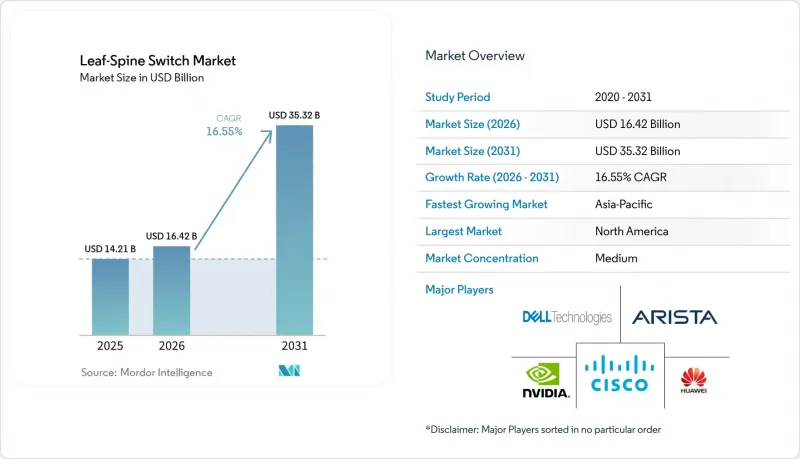
Mordor Intelligence에 의하면, 리프 스파인 스위치 시장 규모는 2025년 142억 1,000만 달러로 평가되었습니다. 2026년에는 164억 2,000만 달러로 확대되어 2031년까지 353억 2,000만 달러에 이를 것으로 예상되며 2026년부터 2031년에 걸쳐 CAGR 16.55%로 성장할 전망입니다.
본 보고서는 스위치의 역할(리프 스위치 및 스파인 스위치), 제품 유형(고정형 및 모듈형 스위치), 포트 속도(최대 25GbE, 25GbE 초과-100 GbE, 기타), 데이터센터 유형(코로케이션 데이터센터, 기타), 최종 사용자 산업(클라우드 서비스 제공업체, 통신 사업자, 기타) 및 지역별로 분류되어 있습니다. 시장 전망은 금액(달러) 기준으로 제시되어 있습니다.
세계의 리프 스파인 스위치 시장 동향 및 인사이트
하이퍼스케일러에 의한 AI 클러스터용 400G 및 800G 패브릭 도입
AI 클러스터는 대용량이며 지연 시간이 짧은 이스트-웨스트 대역폭 없이는 확장할 수 없기 때문에 하이퍼스케일러의 투자가 리프-스파인 스위치 시장의 성장 속도를 좌우하고 있습니다. 통신 사업자들은 현재 400G 및 800G급 패브릭을 특별한 예외 사례로 취급하지 않고, 표준 설계 요소로 도입하고 있습니다. 구글은 2026년 4월, 13만 4,000개의 TPU 칩을 연결하여 섹션 간 대역폭이 초당 47페타비트에 달하는 평면형 2층 네트워크 ‘Virgo"를 발표했습니다. 이는 대규모 AI 패브릭이 전용 가속기 환경의 더 깊은 부분까지 침투하고 있음을 보여줍니다. Arista는 2026년 5월, 800G 이더넷 누적 고객 수가 100개사를 돌파했다고 발표했으며, 2026년 AI 네트워킹 매출 목표를 35억 달러로 상향 조정했습니다. 이는 상업적 수요가 이미 몇 건의 초기 도입 사례를 넘어 확대되고 있음을 뒷받침하고 있습니다. 또한, 이는 리프-스파인 스위치 시장의 제품 경계를 변화시키고 있습니다. 왜냐하면 고래디 800G 시스템이 AI 백엔드 통합 계층으로서뿐만 아니라 기존의 이스트-웨스트 스파인으로도 점점 더 많이 활용되고 있기 때문입니다. 이러한 변화로 인해 섀시당 수익 밀도가 높아지며, 운영상의 복잡성을 증가시키지 않으면서 고밀도 플랫폼을 제공할 수 있는 공급업체가 유리한 입장에 서게 됩니다.
동서 방향 트래픽 증가와 데이터센터 패브릭의 현대화
현재 이스트-웨스트 트래픽은 가상화 및 AI 중심의 데이터센터 환경에서 주류를 이루고 있으며, 이에 따라 리프-스파인 스위치 시장은 단순한 포트 교체가 아닌 패브릭 현대화와 밀접하게 연결되어 있습니다. 3계층 스위칭에서 2계층 리프-스파인 설계로의 아키텍처 전환은 지연 시간을 줄이고, 경로 설정을 간소화하며, AI 훈련 환경에 필요한 1대1 비차단 비율을 지원합니다. 비용 측면에서의 장점도 중요합니다. 400G는 100G에 비해 비트당 비용이 대폭 낮기 때문에 800G로 전면 전환하지 않고 대역폭 확장이 필요한 사업자들에게 400G는 기본적인 선택지가 되고 있습니다. 오버구독에 대한 변경 사항도 마찬가지로 중요합니다. 많은 기존 엔터프라이즈 설계는 3대 1 비율로 운영되었지만, GPU 클러스터는 비차단 동작을 요구하기 때문에 동일한 컴퓨팅 실적라도 훨씬 더 많은 활성 스위칭 용량이 필요하기 때문입니다. 그 결과, 리프-스파인 스위치 시장은 새로운 AI 도입뿐만 아니라, 계층형 설계를 보다 평평한 패브릭 아키텍처로 대체하는 기존 설비의 업그레이드 프로그램에서도 혜택을 보고 있습니다. 이를 바탕으로 한 비즈니스 기회는 광범위합니다. 왜냐하면 현대화를 통해 성능, 전력 효율, 운영 목표가 동시에 달성될 수 있게 되었기 때문에 통신 사업자들이 업그레이드를 미루기 어려워졌기 때문입니다.
400G 및 800G로의 업그레이드에 따른 설비 투자와 전환 과정의 복잡성
리프-스파인 스위치 시장은 400G 및 800G로의 전환에 스위치 구매 이상의 조치가 필요하기 때문에 현실적인 투자 장벽에 직면해 있습니다. 광섬유 호환성 문제, 커넥터 불일치, 트렁크 재구축 등은 가동 중인 시설 내 수천 개의 링크에 걸쳐 프로젝트 비용을 대폭 증가시킬 가능성이 있습니다. 전력 또한 제약 요인 중 하나입니다. 800G 시스템은 800-1,000와트를 소비하기 때문에 고밀도 AI 포드를 염두에 두고 설계되지 않은 구형 사이트에서는 도입이 어렵습니다. 그 때문에 많은 통신 사업자의 경우, 네트워크, 케이블 배선, 시설 담당 팀들이 차례로 대응해야 하기 때문에 도입 의지가 높더라도 도입이 지연되고 맙니다. 이로 인해 리프-스파인 스위치 시장에서는 양극화가 나타나고 있습니다. 전담 엔지니어링 팀을 보유한 하이퍼스케일러는 신속하게 대응할 수 있는 반면, 엔터프라이즈 및 중견 시장 통신 사업자들은 업데이트 주기를 여러 예산 기간에 걸쳐 연장하는 경우가 많아지고 있습니다. 그 결과, 수요 자체가 약한 것은 아니며, 수요 발생 시기에 편차가 생기고 있습니다. 이것이 중기적인 도입 전망이 여전히 견조함에도 불구하고, 수주 동향에 편차가 나타나는 이유입니다.
부문별 분석
리프 스위치는 2025년 매출의 66.14%를 차지하며, 리프·스파인 스위치 시장 점유율에서 1위를 차지했습니다. 이는 모든 GPU 노드와 대부분의 서버 엔드포인트가 여전히 랙 상단 계층에서 종단되기 때문입니다. 클러스터 노드 수 증가가 개별 클러스터 수 증가를 상회하고 있기 때문에 이 도입 구조는 여전히 견고하며, 설계 효율화가 진행되어도 리프 계층의 규모는 유지되고 있습니다. 또한, 대규모 AI 및 클라우드 구축의 경우, 홀이나 캠퍼스 전체에서 랙 수준의 구성이 대규모로 복제되므로, 랙 상단의 리프 배치는 재현성 측면에서도 이점이 있습니다. 리프 스파인 스위치 업계에서 이는 가치가 더 고밀도인 집약형 시스템으로 전환되고 있는 상황에서도 고정형 리프 플랫폼이 폭넓은 도입 기반을 계속 유지해 나갈 것임을 의미합니다. End of Row의 리프 시스템은 랙 단위로 구축하기 어려운 엔터프라이즈 환경, 특히 운영자가 레거시 컴퓨팅 공간의 일부만 현대화하고 있는 경우에 여전히 활용되고 있습니다.
스파인 스위치는 2031년까지 연평균 성장률(CAGR) 18.45%를 나타낼 것으로 예측되며, 역할별 수요 측면에서 리프·스파인·스위치 시장 규모 중 가장 빠르게 성장하는 역할을 차지하고 있습니다. 그 이유는 스위치의 대수 때문만은 아닙니다. 하나의 섀시가 다수의 800G 업링크를 통합함으로써, 고정형 스파인 유닛보다 훨씬 높은 평균 판매 가격(ASP)을 실현하여 수익이 집중되기 때문입니다. 알리스타는 시스템당 최대 576개의 800G 포트를 갖춘 모듈형 스파인 제품군 ‘7800R4"를 발매했습니다. 이는 아키텍처의 중심이 어떻게 점점 더 적은 수의 대규모 집약형 시스템으로 이동하고 있는지를 보여줍니다. 스케일아웃형 AI 트래픽은 예측 가능한 혼잡 거동과 간단한 관리 기능을 갖춘 고라디 플랫폼을 제공할 수 있는 벤더에게 유리하게 작용하기 때문에 스파인의 성장은 그 유닛 수에서 예상되는 것보다 더 강력해 보입니다. 따라서 역할의 균형이 역전된 것은 아니지만, 리프 스파인 스위치 시장 내의 수익 분배가 AI 트레이닝 패브릭의 중심에 위치한 프리미엄 스파인 시스템 쪽으로 이동하고 있습니다.
2025년 매출액 중 고정 구성 스위치가 72.43%를 차지했으며, 이는 리프-스파인 스위치 시장의 상당 부분이 여전히 신규 데이터센터 건설 시 설치되는 리프 스위치의 총 수에 의존하고 있음을 반영합니다. 이 계산은 간단명료합니다. 왜냐하면, 스파인 계층을 훨씬 적은 수의 섀시 시스템으로 처리할 수 있는 경우라도, 매우 대규모 클러스터에서는 수천 대의 고정형 리프 유닛이 필요할 수 있기 때문입니다. 1U 및 2U 카테고리가 여전히 중요한 이유는 통신 사업자들이 반복 가능한 랙 설계에 부합하는 고밀도 고정형 플랫폼을 중심으로 Top-of-Rack(ToR) 구축의 표준화를 추진하고 있기 때문입니다. 2026년에는 64x800G 및 32x1.6T의 고정 구성이 운영 환경에 도입되기 시작했으며, 이는 고정 폼 팩터가 구식 계층이 아니라 AI 리프의 역할을 수행하기 위해 여전히 진화를 거듭하고 있는 기반임을 보여줍니다. 이로 인해 프리미엄 지출이 다른 분야로 이동하고 있음에도 불구하고, 고정형 시스템은 리프 스파인 스위치 시장의 거래량 중심을 계속 차지하고 있습니다.
모듈형 스위치는 2031년까지 연평균 성장률(CAGR) 18.12%를 나타낼 것으로 예측되며, 리프-스파인 스위치 시장 내 제품 유형 중 가장 빠른 성장세를 보이고 있습니다. 이러한 성장은 하이퍼스케일 AI 클러스터와 밀접한 관련이 있으며, 스파인의 업데이트 주기에서 고정형 시스템으로는 효율적으로 대응할 수 없는 고밀도화 및 대규모화가 요구되고 있기 때문입니다. Arista사는 자사의 7800R4 제품군이 이전 세대인 7800R3 시리즈에 비해 전력 소비를 65% 줄였다고 밝혔으며, 이는 모듈형 시스템 분야에서 공급업체 간의 경쟁이 포트 수에 그치지 않고 에너지 효율 및 운영 비용 분야로 확대되고 있음을 보여줍니다. 또한, 버퍼 설계와 혼잡 제어 역시 뚜렷한 차별화 요소로 부상하고 있습니다. 이는 혼합 속도의 AI 패브릭에서는 운영 담당자에게 복잡한 우회 조치를 강요하지 않으면서도 버스트 형태의 트래픽을 흡수할 수 있는 시스템이 필요하기 때문입니다. 단일 관리 평면 내에서 모듈형 스파인 제품과 고정형 리프 시스템을 결합할 수 있는 벤더는 경쟁 우위를 확보하고 있습니다. 이는 구매자가 수년에 걸친 리프레시 프로그램에서 운영상의 단절을 최소화하기를 원하기 때문입니다. 따라서, 설령 고정형 플랫폼이 총 도입 대수 측면에서 여전히 지배적인 위치를 차지하고 있다 하더라도, 모듈형 플랫폼의 성장은 리프-스파인 스위치 시장에 있어 전략적으로 중요한 의미를 지닙니다.
지역별 분석
북미는 2025년 매출의 41.43%를 차지하며, 지역별로는 가장 큰 기여를 하는 지역이자 리프·스파인·스위치 시장 점유율에서 가장 확고한 기반을 형성했습니다. 이 지역은 하이퍼스케일 AI 훈련 인프라의 가장 높은 집중도, 벤더와의 가장 긴밀한 관계, 그리고 하이엔드 데이터센터 스위칭 분야에서 가장 견고한 도입 기반을 갖추고 있는 이점을 누리고 있습니다. 미국은 대규모 조달 프로그램, 플랫폼 검증, AI 클러스터 구축의 대부분이 미국을 중심으로 진행되고 있기 때문에 여전히 그 수요의 핵심을 차지하고 있습니다. 또한, 시스코, 알리스타, 엔비디아 및 화이트박스 벤더들이 하이퍼스케일 및 엔터프라이즈 패브릭 예산을 놓고 가장 직접적으로 경쟁하고 있는 분야이기도 합니다. 이러한 집중 현상으로 인해, 성장이 지리적으로 확대되기 시작했음에도 불구하고 북미는 리프 스파인 스위치 시장의 중심적인 위치를 계속 차지하고 있습니다.
아시아태평양은 2031년까지 연평균 성장률(CAGR) 17.52%를 나타낼 것으로 예측되며, 리프 스파인 스위치 시장에서 가장 빠른 성장세를 보이고 있습니다. 이 지역은 광범위한 데이터센터 건설 계획, 정부 주도의 컴퓨팅 프로그램, 그리고 하이퍼스케일, 코로케이션, 엔터프라이즈용 오픈 네트워킹의 도입 비율이 높아지는 데 힘입어 성장하고 있습니다. 말레이시아, 인도, 일본, 한국, 태국 및 기타 허브 지역에서는 병행하여 투자가 유치되고 있으며, 이를 통해 특정 국가의 건설 주기에 대한 의존도가 낮아지고 있습니다. 또한 일본에서는 2026년, EXEO Group이 BE Networks의 Verity 플랫폼을 통해 관리되는 SONiC 기반 리프-스파인 패브릭의 본격적인 도입을 완료하며, 오픈 네트워킹으로의 전환 움직임이 나타났습니다. 이는 소프트웨어를 통한 분산화 접근 방식이 해당 지역의 엔터프라이즈 부문에서 신뢰도를 높이고 있음을 보여주는 징후입니다.
유럽은 북미에 비해 시장 규모가 작지만, 데이터 주권 및 규제 대상 워크로드에 관한 규정으로 인해 국내 네트워크 인프라에 대한 수요가 발생하고 있어, 리프-스파인 스위치 시장에서 구조적으로 중요한 지역으로 자리매김하고 있습니다. 에퀴닉스는 2026년에 “Fabric Geo Zones"를 확대하여 스위스 및 영국 등 시장에서 미리보기 서비스를 시작했습니다. 이는 멀티테넌트 상호 연결 환경에서 스위칭과 규정 준수가 점점 더 밀접하게 연결되고 있음을 보여줍니다. 남미는 여전히 발전의 초기 단계에 있으며, 브라질이 주요 시장으로 자리 잡고 있습니다. 한편, 중동 및 아프리카에서는 사우디아라비아와 UAE의 주권 클라우드 프로그램이 정책상의 의무를 물리적 네트워크 구축으로 전환시키고 있기 때문에 더욱 빠른 진전을 보이고 있습니다. 그 결과, 리프 스파인 스위치 시장에 대한 지리적 수요 기반이 확대되었으며, 현재 여러 지역에서 상업적 프로젝트와 정책 주도형 프로젝트가 동시에 진행되고 있습니다.
기타 혜택 :
- 엑셀 형식 시장 예측(ME) 시트
- 3개월간의 애널리스트 지원
자주 묻는 질문
목차
제1장 서론
제2장 조사 방법
제3장 주요 요약
제4장 시장 구도
제5장 시장 규모 및 성장 예측
제6장 경쟁 구도
제7장 시장 기회 및 향후 전망
KTH 26.07.08According to Mordor Intelligence, the leaf-spine switch market size is expected to increase from USD 14.21 billion in 2025 to USD 16.42 billion in 2026 and reach USD 35.32 billion by 2031, growing at a CAGR of 16.55% over 2026-2031.
This report is Segmented by Switch Role (Leaf Switches, and Spine Switches), Product Type (Fixed Configuration, and Modular Switches), Port Speed (Up To 25 GbE, More Than 25 To 100 GbE, and More), Data Center Type (Colocation Data Centers, and More), End User Industry (Cloud Service Providers, Telecommunication Providers, and More), and Geography. The Market Forecasts are Provided in Terms of Value (USD).
Global Leaf-Spine Switch Market Trends and Insights
Hyperscaler AI Cluster 400G And 800G Fabric Rollouts
Hyperscaler spending is setting the pace for the leaf-spine switch market because AI clusters cannot scale without large volumes of low-latency east-west bandwidth. Operators are now buying fabrics around 400G and 800G as standard design points instead of treating them as premium edge cases. Google disclosed Virgo in April 2026 as a flat, two-layer network linking 134,000 TPU chips with 47 petabits per second of bisectional bandwidth, which shows how large AI fabrics are moving deeper into purpose-built accelerator environments. Arista stated in May 2026 that it had surpassed 100 cumulative 800G Ethernet customers and raised its 2026 AI networking revenue target to USD 3.5 billion, which confirms that commercial demand is already broadening beyond a handful of early deployments. This is also changing product boundaries inside the leaf-spine switch market, because high-radix 800G systems are increasingly serving as both AI back-end aggregation layers and conventional east-west spines. That shift raises revenue density per chassis and favors vendors that can supply dense platforms without adding operational complexity.
East-West Traffic Growth And Data Center Fabric Modernization
East-west traffic now dominates virtualized and AI-oriented data center environments, which keeps the leaf-spine switch market tied to fabric modernization rather than to simple port replacement. The architectural move from three-tier switching to two-tier leaf-spine design reduces latency, simplifies pathing, and supports the 1:1 non-blocking ratios that AI training environments require. The cost logic also matters because 400G delivers materially lower cost-per-bit than 100G, which makes it the default step for operators that need bandwidth growth without taking on a full 800G migration. The oversubscription change is equally important because many legacy enterprise designs ran at 3:1, while GPU clusters demand non-blocking behavior and therefore need far more active switching capacity for the same compute footprint. As a result, the leaf-spine switch market is gaining from both greenfield AI deployments and brownfield refresh programs that replace hierarchical designs with flatter fabric architectures. The underlying opportunity is wide because modernization now serves performance, power, and operational goals at the same time, which is why the upgrade case is harder for operators to delay.
400G And 800G Refresh Capex And Migration Complexity
The leaf-spine switch market faces a real spending barrier because 400G and 800G transitions require more than a switch purchase. Fiber compatibility problems, connector mismatches, and trunk rework can add large project costs across thousands of links in active facilities. Power is another constraint because 800G systems can draw 800 to 1,000 watts, which makes it harder for older sites that were not designed for dense AI pods. Many operators, therefore, need network, cabling, and facility teams to move in sequence, which slows deployment even when procurement intent is strong. This creates a split in the leaf-spine switch market, where hyperscalers with dedicated engineering teams can move quickly, while enterprise and mid-market operators often stretch refresh cycles across multiple budget periods. The result is uneven demand timing, not weak demand, which is why order flow can look lumpy even when the medium-term adoption case remains intact.
Other drivers and restraints analyzed in the detailed report include:
- 51.2T Switch Silicon Enabling Flatter Leaf-Spine Topologies
- Colocation Expansion And Tenant-Ready EVPN-VXLAN Fabrics
- EVPN-VXLAN And RoCE Operations Talent Shortages
For complete list of drivers and restraints, kindly check the Table Of Contents.
Segment Analysis
Leaf switches held 66.14% of 2025 revenue, which gave them the largest position in the leaf-spine switch market share because every GPU node and most server endpoints still terminate at the top-of-rack layer. That installed logic remains strong because cluster node counts are rising faster than the number of distinct clusters, which keeps the leaf layer broad even as designs become more efficient. The top-of-rack leaf position also benefits from repeatability, since large AI and cloud builds replicate rack-level patterns at scale across halls and campuses. In the leaf-spine switch industry, that means fixed leaf platforms retain a wide deployment base even when value is shifting upward into denser aggregation systems. End-of-row leaf systems still serve enterprise environments where a rack-by-rack build is harder to justify, especially when operators are modernizing only a portion of legacy compute space.
Spine switches are projected to grow at an 18.45% CAGR through 2031, which makes them the fastest-growing role in the leaf-spine switch market size profile for role-based demand. The reason is not switch count alone, it is the revenue concentration created when one chassis aggregates a large number of 800G uplinks and carries a much higher average selling price than a fixed spine unit. Arista launched its 7800R4 modular spine family with up to 576x800G ports per system, which illustrates how the architectural center of gravity is moving toward fewer, larger aggregation systems. This is why spine growth looks stronger than its unit footprint suggests, because scale-out AI traffic rewards vendors that can deliver high-radix platforms with predictable congestion behavior and simpler management. The role balance is therefore not reversing, but it is re-weighting revenue inside the leaf-spine switch market toward premium spine systems that sit at the center of AI training fabrics.
Fixed configuration switches accounted for 72.43% of 2025 revenue, which reflects how much of the leaf-spine switch market still depends on the sheer number of leaf positions across new data center builds. That arithmetic is direct because a very large cluster can require thousands of fixed leaf units even when the spine layer can be handled by a much smaller number of chassis systems. The 1U and 2U categories remain important because operators continue to standardize top-of-rack deployment around dense fixed platforms that fit repeatable rack designs. In 2026, fixed configurations with 64x800G and 32x1.6T are entering production environments, which shows that fixed form factors are not a legacy layer, but a still-evolving foundation for AI leaf roles. This keeps fixed systems at the volume center of the leaf-spine switch market even as premium spending migrates elsewhere.
Modular switches are forecast to grow at a 18.12% CAGR through 2031, which gives them the fastest momentum among product types in the leaf-spine switch market. That growth is tied to hyperscale AI clusters where spine refresh cycles require densities and scale characteristics that fixed systems cannot match efficiently. Arista stated that its 7800R4 family delivers 65% lower power consumption than the prior 7800R3 series, which shows how vendor competition in modular systems is expanding beyond port count into energy efficiency and operating cost. Buffer design and congestion control are also becoming clearer differentiators because mixed-speed AI fabrics need systems that can absorb bursty traffic without forcing operators into complex workarounds. Vendors that can pair modular spine products with fixed leaf systems inside one management plane are gaining an advantage, since buyers want fewer operational seams across multi-year refresh programs. That makes modular growth strategically important to the leaf-spine switch market even if fixed platforms continue to dominate total deployment count.
Complete Report Scope:
- By Switch Role
- Leaf Switches
- Top-of-Rack Leaf Switches
- End-of-Row Leaf Switches
- Spine Switches
- Fixed Spine Switches
- Chassis-based Spine Switches
- Leaf Switches
- By Product Type
- Fixed Configuration
- 1U
- 2U and Above
- Modular Switches
- 4-slot to 8-slot
- 10-slot and Above
- Fixed Configuration
- By Port Speed
- Up to 25 GbE
- More than 25 to 100 GbE
- More than 100 to 400 GbE
- 800 GbE and Above
- By Data Center Type
- Colocation Data Centers
- Hyperscale / Cloud Service Provider Data Centers
- Enterprise Data Centers
- Edge Data Centers
- By End User Industry
- Cloud Service Providers
- Telecommunication Providers
- Large Enterprises
- Government and Public Sector
- Other end user Industries
- By Geography
- North America
- United States
- Canada
- Mexico
- South America
- Brazil
- Argentina
- Chile
- Colombia
- Europe
- Germany
- United Kingdom
- France
- Netherlands
- Ireland
- Italy
- Spain
- Rest of Europe
- Asia-Pacific
- China
- Japan
- India
- South Korea
- Singapore
- Australia
- New Zealand
- Rest of Asia-Pacific
- Middle East and Africa
- Middle East
- Saudi Arabia
- United Arab Emirates
- Turkey
- Rest of Middle East
- Africa
- South Africa
- Nigeria
- Rest of Africa
- Middle East
- North America
Geography Analysis
North America held 41.43% of 2025 revenue, which made it the largest regional contributor and the clearest anchor of the leaf-spine switch market share by geography. The region benefits from the heaviest concentration of hyperscale AI training infrastructure, the deepest set of vendor relationships, and the strongest installed base for high-end data center switching. The United States remains the core of that demand because most large procurement programs, platform validations, and AI cluster launches are centered there. It is also the region where Cisco, Arista, NVIDIA, and white-box suppliers compete most directly for hyperscale and enterprise fabric budgets. This concentration keeps North America central to the leaf-spine switch market even as growth begins to broaden geographically.
Asia-Pacific is projected to grow at an 17.52% CAGR through 2031, which gives it the fastest regional growth path in the leaf-spine switch market. The region is being supported by a wide data center build pipeline, sovereign compute programs, and a rising mix of hyperscale, colocation, and enterprise open networking deployments. Malaysia, India, Japan, South Korea, Thailand, and other hubs are attracting parallel investment, which reduces reliance on any single national build cycle. Japan also showed movement toward open networking in 2026 when EXEO Group completed a production deployment of a SONiC-based leaf-spine fabric managed by BE Networks' Verity platform, a sign that software-disaggregated approaches are gaining credibility in the regional enterprise segment.
Europe is growing from a smaller base than North America, but the region is structurally important to the leaf-spine switch market because data sovereignty and regulated workload rules are creating demand for in-country fabrics. Equinix expanded Fabric Geo Zones in 2026 with preview availability in markets including Switzerland and the United Kingdom, which shows how switching and compliance are becoming more closely linked in multi-tenant interconnection environments. South America remains earlier in development, with Brazil as the key market, while the Middle East and Africa are moving faster because sovereign cloud programs in Saudi Arabia and the UAE are turning policy mandates into physical network build-outs. The result is a broader geographic demand base for the leaf-spine switch market, with commercial and policy-driven projects now advancing at the same time across several regions.
- Cisco Systems, Inc.
- Arista Networks, Inc.
- NVIDIA Corporation
- Huawei Technologies Co., Ltd.
- Dell Technologies Inc.
- Juniper Networks, Inc.
- Hewlett Packard Enterprise Aruba Networking
- H3C Technologies Co., Limited
- ZTE Corporation
- Lenovo Group Limited
- Edgecore Networks Corporation
- Accton Technology Corporation
- Celestica Inc.
- Ruijie Networks Co., Ltd.
- Nokia Corporation
- Extreme Networks, Inc.
- Quanta Cloud Technology (QCT)
- UfiSpace Technology Inc.
- Super Micro Computer, Inc. (Supermicro)
- Netberg Ltd.
- Delta Electronics, Inc.
- Asterfusion Data Technology Co., Ltd.
Additional Benefits:
- The market estimate (ME) sheet in Excel format
- 3 months of analyst support
TABLE OF CONTENTS
1 INTRODUCTION
- 1.1 Study Assumptions and Market Definition
- 1.2 Scope of the Study
2 RESEARCH METHODOLOGY
3 EXECUTIVE SUMMARY
4 MARKET LANDSCAPE
- 4.1 Market Overview
- 4.2 Market Drivers
- 4.2.1 Hyperscaler AI Cluster 400G and 800G Fabric Rollouts
- 4.2.2 East-west Traffic Growth and Data Center Fabric Modernization
- 4.2.3 Colocation Expansion and Tenant-ready EVPN-VXLAN Fabrics
- 4.2.4 51.2T Switch Silicon Enabling Flatter Leaf-spine Topologies
- 4.2.5 Ethernet Replacing InfiniBand in AI Scale-out Networks
- 4.2.6 Sovereign Cloud Zones Multiplying Local Fabric Builds
- 4.3 Market Restraints
- 4.3.1 400G and 800G Refresh Capex and Migration Complexity
- 4.3.2 EVPN-VXLAN and RoCE Operations Talent Shortages
- 4.3.3 Power and Thermal Retrofit Burden in Dense AI Pods
- 4.3.4 Merchant Silicon and Optics Supply Concentration
- 4.4 Industry Value Chain Analysis
- 4.5 Regulatory Landscape
- 4.6 Technological Outlook
- 4.7 Porter's Five Forces
- 4.7.1 Bargaining Power of Suppliers
- 4.7.2 Bargaining Power of Buyers
- 4.7.3 Threat of New Entrants
- 4.7.4 Threat of Substitutes
- 4.7.5 Industry Rivalry
5 MARKET SIZE AND GROWTH FORECASTS (VALUE)
- 5.1 By Switch Role
- 5.1.1 Leaf Switches
- 5.1.1.1 Top-of-Rack Leaf Switches
- 5.1.1.2 End-of-Row Leaf Switches
- 5.1.2 Spine Switches
- 5.1.2.1 Fixed Spine Switches
- 5.1.2.2 Chassis-based Spine Switches
- 5.1.1 Leaf Switches
- 5.2 By Product Type
- 5.2.1 Fixed Configuration
- 5.2.1.1 1U
- 5.2.1.2 2U and Above
- 5.2.2 Modular Switches
- 5.2.2.1 4-slot to 8-slot
- 5.2.2.2 10-slot and Above
- 5.2.1 Fixed Configuration
- 5.3 By Port Speed
- 5.3.1 Up to 25 GbE
- 5.3.2 More than 25 to 100 GbE
- 5.3.3 More than 100 to 400 GbE
- 5.3.4 800 GbE and Above
- 5.4 By Data Center Type
- 5.4.1 Colocation Data Centers
- 5.4.2 Hyperscale / Cloud Service Provider Data Centers
- 5.4.3 Enterprise Data Centers
- 5.4.4 Edge Data Centers
- 5.5 By End User Industry
- 5.5.1 Cloud Service Providers
- 5.5.2 Telecommunication Providers
- 5.5.3 Large Enterprises
- 5.5.4 Government and Public Sector
- 5.5.5 Other end user Industries
- 5.6 By Geography
- 5.6.1 North America
- 5.6.1.1 United States
- 5.6.1.2 Canada
- 5.6.1.3 Mexico
- 5.6.2 South America
- 5.6.2.1 Brazil
- 5.6.2.2 Argentina
- 5.6.2.3 Chile
- 5.6.2.4 Colombia
- 5.6.3 Europe
- 5.6.3.1 Germany
- 5.6.3.2 United Kingdom
- 5.6.3.3 France
- 5.6.3.4 Netherlands
- 5.6.3.5 Ireland
- 5.6.3.6 Italy
- 5.6.3.7 Spain
- 5.6.3.8 Rest of Europe
- 5.6.4 Asia-Pacific
- 5.6.4.1 China
- 5.6.4.2 Japan
- 5.6.4.3 India
- 5.6.4.4 South Korea
- 5.6.4.5 Singapore
- 5.6.4.6 Australia
- 5.6.4.7 New Zealand
- 5.6.4.8 Rest of Asia-Pacific
- 5.6.5 Middle East and Africa
- 5.6.5.1 Middle East
- 5.6.5.1.1 Saudi Arabia
- 5.6.5.1.2 United Arab Emirates
- 5.6.5.1.3 Turkey
- 5.6.5.1.4 Rest of Middle East
- 5.6.5.2 Africa
- 5.6.5.2.1 South Africa
- 5.6.5.2.2 Nigeria
- 5.6.5.2.3 Rest of Africa
- 5.6.5.1 Middle East
- 5.6.1 North America
6 COMPETITIVE LANDSCAPE
- 6.1 Market Concentration
- 6.2 Strategic Moves
- 6.3 Market Share Analysis
- 6.4 Company Profiles (includes Global level Overview, Market level overview, Core Segments, Financials as available, Strategic Information, Market Rank/Share for key companies, Products and Services, and Recent Developments)
- 6.4.1 Cisco Systems, Inc.
- 6.4.2 Arista Networks, Inc.
- 6.4.3 NVIDIA Corporation
- 6.4.4 Huawei Technologies Co., Ltd.
- 6.4.5 Dell Technologies Inc.
- 6.4.6 Juniper Networks, Inc.
- 6.4.7 Hewlett Packard Enterprise Aruba Networking
- 6.4.8 H3C Technologies Co., Limited
- 6.4.9 ZTE Corporation
- 6.4.10 Lenovo Group Limited
- 6.4.11 Edgecore Networks Corporation
- 6.4.12 Accton Technology Corporation
- 6.4.13 Celestica Inc.
- 6.4.14 Ruijie Networks Co., Ltd.
- 6.4.15 Nokia Corporation
- 6.4.16 Extreme Networks, Inc.
- 6.4.17 Quanta Cloud Technology (QCT)
- 6.4.18 UfiSpace Technology Inc.
- 6.4.19 Super Micro Computer, Inc. (Supermicro)
- 6.4.20 Netberg Ltd.
- 6.4.21 Delta Electronics, Inc.
- 6.4.22 Asterfusion Data Technology Co., Ltd.
7 MARKET OPPORTUNITIES AND FUTURE OUTLOOK
- 7.1 White-Space and Unmet-Need Assessment


