

|
시장보고서
상품코드
2073075
SDN 지원 스위치 시장 : 점유율 분석, 업계 동향과 통계, 성장 예측(2026-2031년)SDN-Enabled Switch - Market Share Analysis, Industry Trends & Statistics, Growth Forecasts (2026 - 2031) |
||||||
 Mordor Intelligence
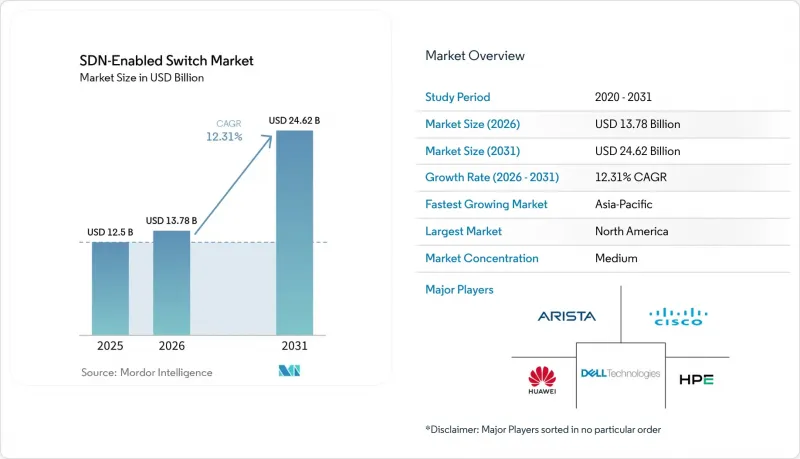
Mordor Intelligence에 의하면, SDN 지원 스위치 시장 규모는 2025년에 125억 달러로 평가되었고 2026년 137억 8,000만 달러에서 2031년까지 246억 2,000만 달러에 이를 것으로 예측되며, 예측 기간(2026-2031년) CAGR은 12.31%를 나타낼 전망입니다.
본 보고서는 SDN 구현 유형(퓨어 SDN, 하이브리드 SDN, 오버레이형 SDN), 포트 속도(1 GbE 이하, 2.5/5GbE 멀티기가, 10 GbE, 25/40 GbE, 100 GbE, 기타), 네트워크 계층(액세스, 디스트리뷰션, 코어), 최종 사용자(클라우드 및 데이터센터 제공업체, 기업, 통신 서비스 제공업체, 기타), 그리고 지역별로 분류되어 있습니다. 시장 전망은 금액(달러) 기준으로 제시되어 있습니다.
전 세계 SDN 지원 스위치 시장 동향 및 인사이트
하이퍼스케일 데이터센터에서의 급속한 확장성 요구
대규모 언어 모델의 훈련으로 인해 발생하는 트래픽 급증은 사전 예고 없이 갑작스럽게 일어나는 경우가 많아, 고정 기능 스위치로는 대응하기 어렵습니다. 텔레메트리 기반의 혼잡 제어 기능을 갖춘 SDN 지원 하드웨어를 통해 운영 담당자는 수천 개의 400 GbE 링크를 몇 초 만에 재할당할 수 있으며, GPU 활용률을 90% 이상으로 유지할 수 있습니다. Meta의 분산형 스위치 패브릭은 10만 대 이상의 서버를 보유한 클러스터에서 테일 지연 시간을 40% 줄였습니다. 마찬가지로, 구글과 아마존은 텍사스주와 미네소타주의 새로운 캠퍼스에 차세대 스파인-리프 패브릭을 도입하기로 결정했습니다. 이러한 성과는 엑사스케일 운영에 있어 소프트웨어 기반 제어가 필수적이라는 견해를 뒷받침하는 것입니다.
마이크로서비스 아키텍처로 인한 동서 방향 트래픽의 급증
현재 마이크로서비스는 데이터센터 내 패킷의 약 80%를 차지하며, 지난 수십 년간 주류를 이루었던 클라이언트-서버 모델을 뒤엎고 있습니다. 레거시 3계층 네트워크는 수백 개에 달하는 임시 포드를 오케스트레이션하는 서비스 메시의 트래픽을 더 이상 감당하지 못하고 있습니다. SDN을 지원하는 스파인-리프 설계는 비차단 대역폭과 동등한 비용의 멀티패스 라우팅을 제공하여, 오버구독으로 인한 병목 현상을 방지합니다. 2025년 중반까지 Kubernetes 운영 클러스터 수는 560만 개를 넘어설 것이며, 각 클러스터에서는 정적 IP 주소 대신 파드의 레이블을 참조하는 정책이 적용되어야 합니다. Vector Packet Processing과 통합된 SONiC와 같은 오픈소스 NOS 솔루션은 초당 1억 패킷을 10마이크로초 미만의 지터로 처리하며, 전용 ASIC을 사용하지 않고도 캐리어급 성능을 구현합니다.
기존 네트워크 관리 도구의 통합에 따른 복잡성
HP Network Node Manager나 SolarWinds Network Performance Monitor와 같은 레거시 도구는 SNMP 폴링이나 syslog 분석에 의존하고 있지만, 이러한 도구들은 SDN 컨트롤러가 실시간 정책 적용에 필요한 1초 미만의 텔레메트리 스트림을 포착할 수 없습니다. 운영 담당자가 수동 설정 템플릿이나 승인 프로세스에 기반해 구축된 기존의 변경 관리 워크플로우로는 SDN 플랫폼이 제공하는 인텐트 기반 추상화를 지원할 수 없다는 사실을 깨닫게 되면, 마이그레이션 프로젝트는 종종 정체되곤 합니다. 2025년에 340명의 네트워크 아키텍트를 대상으로 실시한 설문조사에서 응답자의 62%가 SDN 도입의 주요 장애물로 통합의 복잡성을 꼽았으며, 이는 예산 제약이나 벤더 종속성에 대한 우려를 앞질렀습니다.
부문별 분석
2025년, SDN 지원 스위치 시장 점유율의 48.72%를 하이브리드 설계가 차지했습니다. 이는 운영자가 OpenFlow나 NETCONF 정책과 병행하여, 익숙한 OSPF나 BGP 프로세스를 유지할 수 있기 때문입니다. 이러한 공존을 통해 컨트롤러 정지에 따른 위험에 대한 인식이 낮아집니다. 2031년까지 연평균 성장률(CAGR) 13.84%를 나타낼 것으로 예측되는 퓨어 SDN 스위치는 레거시 도구가 없는 새로운 하이퍼스케일 캠퍼스에서 보급이 확대되고 있습니다. NVIDIA Spectrum-4 및 Arista 7060X6 플랫폼이 중앙 집중식 관리를 통한 제어가 라인 레이트에서 독점 기술에 필적한다는 사실을 입증함에 따라, 순수 SDN 도입에 있어 SDN 지원 스위치 시장 규모는 급속히 확대될 전망입니다. VXLAN이나 NVGRE에 의존하는 오버레이 기반 변형들은 하드웨어 업그레이드에 제약이 있는 지사나 캠퍼스를 위한 과도기적 솔루션으로 계속해서 활용되고 있습니다.
듀얼 스택 하이브리드에서 순수한 SDN으로의 점진적인 전환은 IPv4에서 IPv6로의 전환을 연상시킵니다. 얼리 어답터들은 장래의 운영 효율 향상을 염두에 두고 당장의 복잡함을 감수하고 있는 것입니다. Arista의 P4 기반 프로그래밍 가능한 파이프라인을 통해 운영 담당자는 워크로드별 텔레메트리 데이터를 통합할 수 있게 되었으며, 차세대 칩의 차별화 요소는 포트 밀도가 아니라 소프트웨어의 유연성에 있다는 점이 부각되고 있습니다. PCI-DSS와 같은 규정 준수 프레임워크로 인해 대규모 하드웨어 교체가 금지된 환경에서는 오버레이 어플라이언스가 여전히 중요한 역할을 하고 있지만, 컨트롤러의 내결함성에 대한 오해가 해소된다면 그 시장 점유율은 감소할 것입니다.
25/40 GbE 부문은 엔터프라이즈용 Top-of-Rack(ToR) 장비의 교체 수요를 배경으로, 2025년에는 매출의 27.91%를 차지했습니다. 그러나 AI 팩토리가 GPU당 200 Gbps라는 임계치에 도달함에 따라, 400 GbE 이상의 부문은 연평균 성장률(CAGR) 18.63%로 성장할 전망입니다. 400 GbE 스파인용 SDN 지원 스위치 시장 규모는 북미 및 아시아태평양에서 가장 빠르게 확대되고 있으며, 이 지역에서는 주니퍼의 QFX5230과 델의 PowerSwitch Z9864F가 신규 설계 시장을 주도하고 있습니다. 한편, 산업용 게이트웨이의 엣지 환경에서는 여전히 1 GbE가 사용되고 있으며, 데이터베이스 복제 클러스터에서는 100 GbE가 비용과 밀도의 균형을 맞추고 있습니다.
각 벤더사는 이미 IEEE 802.3ck 규격을 준수하는 800 GbE 및 1.6 TbE 라인 카드의 샘플 공급을 시작했으며, 광 모듈 가격이 하락할 2027년 이후의 양산 확대에 대비하고 있습니다. NVIDIA의 Spectrum-SN5600은 64포트의 400 GbE 블록과 GPU 기반 혼잡 제어 기능을 결합한 제품으로, 단순한 포트 수 경쟁 대신 워크로드에 최적화된 칩의 시대가 도래할 것임을 시사합니다. 또한, 상용화 일정을 앞당기기 위해서는 광모듈, 케이블, ASIC 등 각 공급망 전반에 걸친 생태계 구축이 필수적입니다.
지역별 분석
북미는 2025년 매출의 36.84%를 차지하며, 버지니아주, 오리건주, 텍사스주, 아이오와주에서 4,000억 달러를 넘는 하이퍼스케일 데이터센터에 대한 투자가 이를 주도하고 있습니다. 지속적인 용량 확충과 400 GbE 패브릭의 조기 도입을 통해, 이 지역은 AI 및 클라우드 워크로드를 위한 소프트웨어 정의 스위칭 도입에서 선두에 서 있습니다. 미국 공군의 “Enterprise IT CONNECT”이와 같은 엄격한 연방 프로그램 덕분에, 캠퍼스 및 광역 네트워크 분야에서 프로그래밍 가능한 인프라에 대한 수요가 더욱 확대되고 있습니다.
아시아태평양은 2031년까지 연평균 성장률(CAGR) 15.94%를 나타낼 것으로 전망됩니다. 이는 인도가 2026년 IT 부하 용량을 2GW 조금 넘는 수준에서 2030년대 초반까지 8GW로 확대할 계획이 원동력이 되고 있습니다. 구글, 마이크로소프트, 아마존이 주도하는 하이퍼스케일러 기업들은 해당 국가에 400억 달러 이상을 투자하고 있으며, 이러한 투자로 인해 화이트박스 ODM(주문자 상표 제조) 업체와 기존 브랜드 제조업체 양측 모두에 스위치 수주가 집중되고 있습니다. 중국은 여전히 해당 지역 내에서 가장 큰 단일 시장이며, 국내에서 설계된 네트워크 스택 사용을 의무화하는 정부 규제로 인해 화웨이, H3C, Ruijie가 유리한 입지를 점하고 있습니다.
유럽에서는 데이터 주권에 관한 규정이 각 회원국마다 다르기 때문에 각 회원국에서 인프라의 현지화가 요구되고 있어 비용 증가와 업데이트 주기의 장기화를 초래하고 있지만, 꾸준한 속도로 진전이 이루어지고 있습니다. 그럼에도 불구하고, 2024년 10월에 발효되는 NIS2 지침에 따라 통신 사업자는 네트워크 가시성과 정책을 일원화해야 할 의무가 있으며, 이는 SDN의 "싱글 페인" 오케스트레이션 모델과 일치합니다. 남미에서는 브라질이 AWS와 마이크로소프트의 새로운 클라우드 리전 개설을 환영하고 있어, 초기 성장세가 눈에 띕니다.
기타 혜택:
- 엑셀 형식 시장 예측(ME) 시트
- 3개월간의 애널리스트 지원
자주 묻는 질문
목차
제1장 서론
제2장 조사 방법
제3장 주요 요약
제4장 시장 구도
제5장 시장 규모와 성장 예측
제6장 경쟁 구도
제7장 시장 기회와 향후 전망
JHS 26.07.03According to Mordor Intelligence, the SDN-enabled switch market size was valued at USD 12.5 billion in 2025 and estimated to grow from USD 13.78 billion in 2026 to reach USD 24.62 billion by 2031, at a CAGR of 12.31% during the forecast period (2026-2031).
This report is Segmented by SDN Implementation Type (Pure SDN, Hybrid SDN, and Overlay-Based SDN), Port Speed (1 GbE and Below, 2. 5/5 GbE Multi-Gig, 10 GbE, 25/40 GbE, 100 GbE, and More), Network Layer (Access, Distribution, and Core), End-User (Cloud and Data Center Providers, Enterprise, Telecommunication Service Providers, and More), and Geography. The Market Forecasts are Provided in Terms of Value (USD).
Global SDN-Enabled Switch Market Trends and Insights
Rapid Scalability Needs in Hyperscale Data Centers
Traffic surges triggered by large-language-model training often spike without notice, making fixed-function switches impractical. SDN-enabled hardware with telemetry-driven congestion control lets operators reassign thousands of 400 GbE links in seconds, sustaining GPU utilization above 90%. Meta's distributed switch fabric cut tail latency by 40% in clusters with more than 100,000 servers. Similarly, Google and Amazon committed to next-generation spine-leaf fabrics in new Texas and Minnesota campuses. These outcomes reinforce the view that software-defined control is a prerequisite for operating at exascale.
Surge in East-West Traffic Owing to Microservices Architectures
Microservices now produce roughly 80% of intra-data-center packets, reversing the client-server model that dominated past decades. Legacy three-tier networks buckle under the chatter of service meshes that orchestrate hundreds of ephemeral pods. SDN-enabled spine-leaf designs offer non-blocking bandwidth and equal-cost multipath routing, preventing oversubscription bottlenecks. Kubernetes passed 5.6 million production clusters by mid-2025, each requiring policy enforcement that references pod labels, not static IP addresses. Open-source NOS options such as SONiC, integrated with Vector Packet Processing, process 100 million packets per second at sub-10 microsecond jitter, delivering carrier-grade performance without proprietary ASICs.
Complexity of Integrating Legacy Network Management Tools
Legacy tools such as HP Network Node Manager and SolarWinds Network Performance Monitor rely on SNMP polling and syslog parsing, which cannot capture the sub-second telemetry streams that SDN controllers require for real-time policy enforcement. Migration projects frequently stall when operators discover that existing change-management workflows, built around manual configuration templates and approval chains, cannot accommodate the intent-based abstractions that SDN platforms expose. A 2025 survey of 340 network architects found that 62% cited integration complexity as the primary barrier to SDN adoption, ahead of budget constraints or vendor lock-in concerns.
Other drivers and restraints analyzed in the detailed report include:
- Network Automation Mandates to Lower OPEX
- Adoption of White-Box Switches by Tier-1 Cloud Providers
- Limited Skilled Workforce for SDN Programming Languages
For complete list of drivers and restraints, kindly check the Table Of Contents.
Segment Analysis
Hybrid designs accounted for 48.72% of the SDN-enabled switch market share in 2025, as they allow operators to keep familiar OSPF and BGP processes alongside OpenFlow or NETCONF policies. This coexistence lowers the perceived risk of controller outages. Pure SDN switches, projected to grow at a 13.84% CAGR through 2031, gain traction in greenfield hyperscale campuses where no legacy tooling exists. The SDN-enabled switch market size for pure deployments is set to expand rapidly as NVIDIA Spectrum-4 and Arista 7060X6 platforms prove that centralized control can match proprietary features at line rate. Overlay-based variants, reliant on VXLAN or NVGRE, remain a bridge solution for branches and campuses constrained by hardware refreshes.
The gradual shift from dual-stack hybrids to pure SDN echoes the IPv4-to-IPv6 migration: early adopters absorb added complexity for a future of leaner operations. Arista's P4-programmable pipelines enable operators to embed workload-specific telemetry, underscoring how software freedom, not port density, will differentiate next-generation silicons. Overlay appliances still retain importance where compliance frameworks such as PCI-DSS forbid large-scale hardware swaps, yet their share will decline once controller resilience myths fade.
The 25/40 GbE tier delivered 27.91% revenue in 2025, underpinned by enterprise top-of-rack refreshes. However, 400 GbE and above will accelerate at an 18.63% CAGR as AI factories saturate 200 Gbps-per-GPU thresholds. The SDN-enabled switch market size for 400 GbE spines is climbing fastest in North America and Asia-Pacific, where Juniper QFX5230 and Dell PowerSwitch Z9864F dominate new designs. Meanwhile, 1 GbE persists at the edge in industrial gateways, and 100 GbE balances cost versus density for database replication clusters.
Vendors already sample 800 GbE and 1.6 TbE line cards standardized under IEEE 802.3ck, preparing for post-2027 ramps once optics prices fall. NVIDIA's Spectrum-SN5600 couples 64-port 400 GbE blocks with GPU-aware congestion control, hinting at a wave of workload-optimized silicon in place of generic port-count races. Additionally, ecosystem readiness across optics, cabling, and ASIC supply chains will be critical to accelerate commercialization timelines.
Complete Report Scope:
- By SDN Implementation Type
- Pure SDN Switches
- Hybrid SDN Switches
- Overlay-based SDN Switches
- By Port Speed
- 1 GbE and Below
- 2.5/5 GbE Multi-Gig
- 10 GbE
- 25/40 GbE
- 100 GbE
- 400 GbE and Above
- By Network Layer
- Access
- Distribution
- Core
- By End User
- Cloud and Data Center Providers
- Enterprise (Commercial Offices and Campuses)
- Telecommunication Service Providers
- Government and Defense
- Other End Users
- By Geography
- North America
- United States
- Canada
- Mexico
- South America
- Brazil
- Argentina
- Rest of South America
- Europe
- Germany
- United Kingdom
- France
- Italy
- Spain
- Russia
- Rest of Europe
- Asia-Pacific
- China
- Japan
- India
- South Korea
- Australia and New Zealand
- Rest of Asia-Pacific
- Middle East
- Saudi Arabia
- United Arab Emirates
- Turkey
- Rest of Middle East
- Africa
- South Africa
- Nigeria
- Rest of Africa
- North America
Geography Analysis
North America contributed 36.84% of 2025 revenue, anchored by more than USD 400 billion in hyperscale data-center spending across Virginia, Oregon, Texas, and Iowa. Continuous capacity additions and early adoption of 400 GbE fabrics place the region at the forefront of software-defined switching deployments for AI and cloud workloads. Stringent federal programs such as the United States Air Force's Enterprise IT CONNECT further expand demand for programmable infrastructure in campus and wide-area domains.
Asia-Pacific is forecast to post a 15.94% CAGR through 2031, propelled by India's plan to lift installed IT load from just above 2 GW in 2026 toward 8 GW by the early 2030s. Hyperscalers led by Google, Microsoft, and Amazon have committed more than USD 40 billion to the country, funneling switch orders to white-box original design manufacturers and branded incumbents alike. China remains the single-largest national market inside the region, where government mandates for domestically designed networking stacks favor Huawei, H3C, and Ruijie.
Europe advances at a steadier clip as fragmented data-sovereignty rules require localized infrastructure in each member state, adding cost and elongating refresh cycles. Even so, the NIS2 Directive, effective October 2024, obliges operators to centralize network visibility and policy, which aligns with SDN's single-pane orchestration model. The Middle East and Africa, though smaller in revenue, are seeing first-wave commercial 5G-Advanced slicing projects that rely on SDN controllers to assure end-to-end quality of service, while South America shows early momentum as Brazil welcomes new cloud regions from AWS and Microsoft.
- Arista Networks Inc.
- Cisco Systems Inc.
- Hewlett Packard Enterprise Company
- Dell Technologies Inc.
- Huawei Technologies Co. Ltd.
- NEC Corporation
- Extreme Networks Inc.
- NVIDIA Corporation (Mellanox Technologies)
- Edgecore Networks Corporation
- Cumulus Networks LLC
- Pica8 Inc.
- NoviFlow Inc.
- Centec Networks Co. Ltd.
- Quanta Cloud Technology LLC
- Pluribus Networks Inc.
- Volta Networks Inc.
- Barefoot Networks Inc.
- Fortinet Inc.
- Ruijie Networks Co. Ltd.
- ZTE Corporation
- MikroTik SIA
- Radisys Corporation
Additional Benefits:
- The market estimate (ME) sheet in Excel format
- 3 months of analyst support
TABLE OF CONTENTS
1 INTRODUCTION
- 1.1 Study Assumptions and Market Definition
- 1.2 Scope of the Study
2 RESEARCH METHODOLOGY
3 EXECUTIVE SUMMARY
4 MARKET LANDSCAPE
- 4.1 Market Overview
- 4.2 Market Drivers
- 4.2.1 Rapid Scalability Needs in Hyperscale Data Centers
- 4.2.2 Surge in East-West Traffic Owing to Micro-services Architectures
- 4.2.3 Network Automation Mandates to Lower OPEX
- 4.2.4 Adoption of White-Box Switches by Tier-1 Cloud Providers
- 4.2.5 Disaggregation Trend Enabled by Open Compute Project
- 4.2.6 Government Initiatives Funding 5G Transport Networks
- 4.3 Market Restraints
- 4.3.1 Complexity of Integrating Legacy Network Management Tools
- 4.3.2 Limited Skilled Workforce for SDN Programming Languages
- 4.3.3 Perceived Security Risks around Centralised Controllers
- 4.3.4 Vendor Interoperability Gaps in Southbound APIs
- 4.4 Industry Value Chain Analysis
- 4.5 Regulatory Landscape
- 4.6 Technological Outlook
- 4.7 Impact of Macroeconomic Factors on the Market
- 4.8 Porter's Five Forces Analysis
- 4.8.1 Threat of New Entrants
- 4.8.2 Bargaining Power of Suppliers
- 4.8.3 Bargaining Power of Buyers
- 4.8.4 Threat of Substitutes
- 4.8.5 Intensity of Competitive Rivalry
5 MARKET SIZE AND GROWTH FORECASTS (VALUE)
- 5.1 By SDN Implementation Type
- 5.1.1 Pure SDN Switches
- 5.1.2 Hybrid SDN Switches
- 5.1.3 Overlay-based SDN Switches
- 5.2 By Port Speed
- 5.2.1 1 GbE and Below
- 5.2.2 2.5/5 GbE Multi-Gig
- 5.2.3 10 GbE
- 5.2.4 25/40 GbE
- 5.2.5 100 GbE
- 5.2.6 400 GbE and Above
- 5.3 By Network Layer
- 5.3.1 Access
- 5.3.2 Distribution
- 5.3.3 Core
- 5.4 By End User
- 5.4.1 Cloud and Data Center Providers
- 5.4.2 Enterprise (Commercial Offices and Campuses)
- 5.4.3 Telecommunication Service Providers
- 5.4.4 Government and Defense
- 5.4.5 Other End Users
- 5.5 By Geography
- 5.5.1 North America
- 5.5.1.1 United States
- 5.5.1.2 Canada
- 5.5.1.3 Mexico
- 5.5.2 South America
- 5.5.2.1 Brazil
- 5.5.2.2 Argentina
- 5.5.2.3 Rest of South America
- 5.5.3 Europe
- 5.5.3.1 Germany
- 5.5.3.2 United Kingdom
- 5.5.3.3 France
- 5.5.3.4 Italy
- 5.5.3.5 Spain
- 5.5.3.6 Russia
- 5.5.3.7 Rest of Europe
- 5.5.4 Asia-Pacific
- 5.5.4.1 China
- 5.5.4.2 Japan
- 5.5.4.3 India
- 5.5.4.4 South Korea
- 5.5.4.5 Australia and New Zealand
- 5.5.4.6 Rest of Asia-Pacific
- 5.5.5 Middle East
- 5.5.5.1 Saudi Arabia
- 5.5.5.2 United Arab Emirates
- 5.5.5.3 Turkey
- 5.5.5.4 Rest of Middle East
- 5.5.6 Africa
- 5.5.6.1 South Africa
- 5.5.6.2 Nigeria
- 5.5.6.3 Rest of Africa
- 5.5.1 North America
6 COMPETITIVE LANDSCAPE
- 6.1 Market Concentration
- 6.2 Strategic Moves
- 6.3 Market Share Analysis
- 6.4 Company Profiles (includes Global Level Overview, Market Level Overview, Core Segments, Financials as available, Strategic Information, Market Rank/Share, Products and Services, Recent Developments)
- 6.4.1 Arista Networks Inc.
- 6.4.2 Cisco Systems Inc.
- 6.4.3 Hewlett Packard Enterprise Company
- 6.4.4 Dell Technologies Inc.
- 6.4.5 Huawei Technologies Co. Ltd.
- 6.4.6 NEC Corporation
- 6.4.7 Extreme Networks Inc.
- 6.4.8 NVIDIA Corporation (Mellanox Technologies)
- 6.4.9 Edgecore Networks Corporation
- 6.4.10 Cumulus Networks LLC
- 6.4.11 Pica8 Inc.
- 6.4.12 NoviFlow Inc.
- 6.4.13 Centec Networks Co. Ltd.
- 6.4.14 Quanta Cloud Technology LLC
- 6.4.15 Pluribus Networks Inc.
- 6.4.16 Volta Networks Inc.
- 6.4.17 Barefoot Networks Inc.
- 6.4.18 Fortinet Inc.
- 6.4.19 Ruijie Networks Co. Ltd.
- 6.4.20 ZTE Corporation
- 6.4.21 MikroTik SIA
- 6.4.22 Radisys Corporation
7 MARKET OPPORTUNITIES AND FUTURE OUTLOOK
- 7.1 White-Space and Unmet-Need Assessment


