

|
시장보고서
상품코드
2065593
IT 하드웨어 유통 시장 : 점유율 분석, 업계 동향과 통계, 성장 예측(2026-2031년)IT Hardware Distribution And Channel - Market Share Analysis, Industry Trends & Statistics, Growth Forecasts (2026 - 2031) |
||||||
 Mordor Intelligence
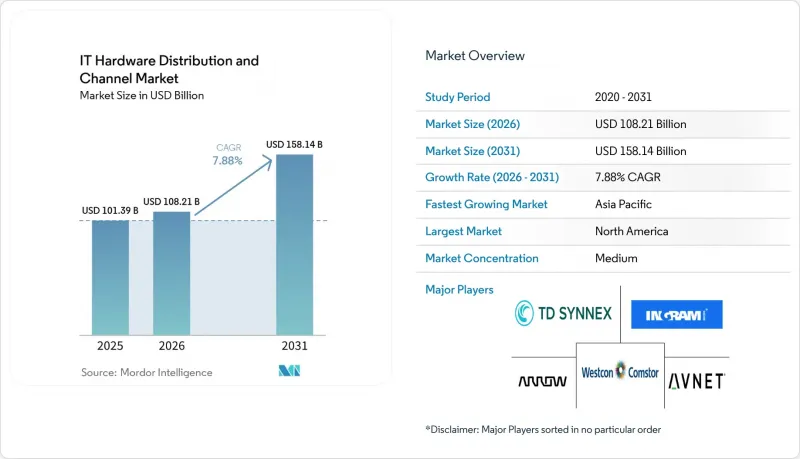
Mordor Intelligence에 의하면, IT 하드웨어 유통시장 규모는 2025년 1,013억 9,000만 달러에서 2026년에는 1,082억 1,000만 달러로 확대되어 2031년까지 1,581억 4,000만 달러에 이를 것으로 예상되고 있어 2026년부터 2031년까지 CAGR 7.88%로 성장할 전망입니다.
본 보고서는 제품 유형(서버, 스토리지 시스템, 네트워크 하드웨어 등), 유통 채널 유형(브로드라인 유통업체, 부가가치형 유통업체 등), 최종 사용 산업(대기업, 중소기업 등), 서비스 모델(부가가치형 유통 등) 및 지역별로 분류되어 있습니다. 시장 전망은 금액(달러) 기준으로 제시되어 있습니다.
세계 IT 하드웨어 유통 시장 동향과 인사이트
클라우드 데이터센터 확장에 대한 수요 증가
각 하이퍼스케일러 기업들은 2026년에 6,000억 달러가 넘는 설비 투자를 계획하고 있으며, 아마존, 마이크로소프트, 구글이 대개 브로드라인 중개업체를 거치지 않는 다중 리전 서버 구매를 주도하고 있습니다. OEM이나 화이트박스 업체와의 직접 거래는 일반 상품의 이익률을 압박하는 한편, 코로케이션 제공업체나 지역 클라우드 사업자를 지원하는 유통업체에게는 관련 서비스 분야로의 진출 기회를 창출하고 있습니다. AWS가 루이지애나주에서 진행하는 120억 달러 규모의 시설 확장은 이러한 프로젝트가 북미에 집중되어 있음을 여실히 보여주고 있습니다. 한편, 인도의 2,070메가와트 규모 계획과 일본의 260억 달러 투자 발표는 아시아태평양의 지속적인 성장세를 보여주고 있습니다. 현지 재고 확보, 냉각 시스템 통합, 규정 준수 컨설팅 제공이 가능한 유통업체는 직접 조달로 전환되는 추세 속에서도 추가 수익을 창출하고 있습니다.
엣지 컴퓨팅 인프라 도입 확대
기업들은 지연 시간을 줄이고 클라우드 이그레스 요금을 절감하기 위해 공장, 소매점, 휴대전화 기지국에 추론 노드를 도입하고 있습니다. 엣지 사이트에서는 NPU 기반 서버, E3.S 스토리지, 그리고 견고한 스위치가 요구되지만, 종합 유통업체가 이러한 제품을 대규모로 재고로 보유하는 경우는 드물기 때문에 틈새 시장을 공략하는 부가가치 파트너들에게 비즈니스 기회가 생겨나고 있습니다. 이 솔루션은 수냉 모듈 및 오케스트레이션 소프트웨어를 포함한 턴키 번들로 제공되므로, 이익률이 향상됩니다. 2026년에 시작된 시스코의 ‘360 파트너 프로그램’은 엣지 오케스트레이션 엔지니어 인증을 받은 유통업체에 보상을 제공함으로써 기술적 종속성을 강화하고 있습니다. 세분화된 업계별 고유 요건은 전 세계 유통업체들이 수익성을 확보하기 어려운 방식으로 SKU나 자금 조달을 맞춤화할 수 있는 지역 전문 업체들에게 유리하게 작용합니다.
반도체 공급망의 혼란
고대역폭 메모리는 2026년 말까지 품절 상태가 지속될 전망이며, 1분기 DRAM 현물 가격은 거의 2배로 치솟았고, 3나노미터 제품의 리드타임은 50주를 넘어섰습니다. 이에 대해 OEM 각사는 제품 수명 주기의 중반에 가격 인상을 단행했으나, 그 결과 기업의 교체 일정이 지연되면서 유통업체의 이익률은 120-150 베이시스 포인트 하락했습니다. 파운드리 공급 제약으로 인해 직접 할당을 협상할 수 있는 하이퍼스케일러가 우대받는 반면, 채널 파트너들은 비용을 3%-5% 끌어올리는 현물 시장을 샅샅이 뒤져야만 하는 상황에 처해 있습니다. 여러 OEM을 아우르는 헤지 전략을 갖춘 유통업체는 단일 공급처에 의존하는 동종 업계 경쟁사들보다 가격 급등의 영향을 더 잘 극복하고 있습니다.
부문별 분석
서버 출하량은 2025년 매출의 34.32%를 차지했으나, 하이퍼스케일러들이 직접 조달을 시작함에 따라 이 부문의 성장률은 둔화되었고, 유통업체의 잠재 고객 기반은 축소되고 있습니다. 반면, 모빌리티 기기 시장은 기업들이 하이브리드 근무를 실현하고 기기에서 AI를 실행하기 위해 노트북과 태블릿을 교체함에 따라, 2031년까지 연평균 성장률(CAGR) 9.08%로 성장이 가속화될 것으로 전망됩니다. 모빌리티 기기용 IT 하드웨어 유통 시장은 Windows 11로의 전환 기한이 다가오고, NPU가 탑재된 노트북이 시장에 출시됨에 따라 꾸준히 성장할 것으로 전망됩니다. 유통업체는 이미징, 자산 태그 부착, 연장 보증 등 OEM이 규모를 확대하여 재현하기 어려운 서비스를 묶어 제공함으로써 이익률을 확보하고 있습니다.
엣지 AI 워크로드는 E3.S 폼 팩터의 고밀도 스토리지에 대한 수요를 촉진하고 있습니다. 한편, 견고한 네트워크 하드웨어는 기업들이 사전 설정된 방화벽이나 규정 준수 관련 문서를 강력히 요구하기 때문에 여전히 유통업체의 주력 상품으로 자리 잡고 있습니다. TD SYNNEX의 Hyve Solutions 부문은 지역 클라우드 사업자로부터 맞춤형 화이트박스 서버 사업을 수주함에 따라 2026년 초 판매량을 거의 두 배로 늘렸습니다. 수냉식 및 고효율 GPU 랙이 주류를 이루게 됨에 따라, 이러한 기술에 정통한 공인 엔지니어를 보유한 부가가치형 유통업체는 프리미엄 가격을 책정할 수 있게 되었습니다. 보안 어플라이언스, 제로 트러스트 게이트웨이, 침입 감지 장치가 통합 번들의 일부로 출하됨에 따라, 네트워크 장비 분야의 IT 하드웨어 유통 시장 점유율은 더욱 확대되고 있습니다.
2025년 매출에서 브로드라인 유통업체가 차지하는 비중은 31.28%였으나, 고객들이 ‘클릭 투 쿼트(Click-to-Quote)’ 포털로 전환함에 따라 매출총이익률 하락에 직면하고 있습니다. 연평균 성장률(CAGR) 9.18%를 기록하며 성장하고 있는 전자상거래 스토어프론트는 즉시 구매 가능성과 자동화된 규정 준수 대응이라는 구매자의 기대에 부응하고 있습니다. 잉그램 마이크로의 ‘Xvantage’는 물리적 하드웨어에 SaaS 구독 서비스를 결합한 서비스를 제공하고 있는 반면, 델의 ‘Premier’ 플랫폼은 이미 매일 수십만 건의 기업 거래를 처리하고 있습니다.
부가가치형 유통업체는 구성 연구소, 스테이징 센터, 금융 데스크를 통합함으로써 방어력이 있는 틈새 시장을 개척하고, 가격 투명화가 미치는 영향을 완화하고 있습니다. 시스템 통합사업자는 총 청구액의 절반 미만을 하드웨어가 차지하는 수백만 달러 규모의 프로젝트를 수주하고 있지만, 보증 및 라이프사이클 서비스 측면에서는 채널 관리가 여전히 매우 중요합니다. 소매 업계는 장기적인 쇠퇴 추세를 보이고 있지만, 당일 수령 서비스나 기술 지원을 제공하는 전문 체인점들은 중소기업 고객들의 충성도를 유지하고 있습니다. 폭넓은 상품 라인업과 부가가치가 높은 전문 지식을 융합한 하이브리드형 비즈니스가 탄력을 받고 있으며, IT 하드웨어 유통 시장 전망은 적응력이 뛰어난 양상을 띨 것으로 예측됩니다.
지역별 분석
북미는 하이퍼스케일 데이터센터 건설과 구독형 하드웨어 모델의 조기 도입에 힘입어 2025년 매출의 29.41%를 차지했습니다. 미국이 지출의 대부분을 차지하고 있지만, 아마존, 마이크로소프트, 구글을 통한 직접 조달로 인해 브로드라인 제품의 취급량은 감소하고 있습니다. 캐나다는 공공 부문의 디지털화와 미국 재고 허브와의 근접성이라는 이점을 누리고 있는 반면, 멕시코는 내환경성이 뛰어난 엣지 기기에 대한 수요를 높이는 니어쇼어링의 이점을 누리고 있습니다. 이 지역의 유통업체는 규정 준수 컨설팅, 역물류, 클라우드 마켓플레이스와의 통합을 결합함으로써 이익률 하락을 상쇄하고 있습니다.
아시아태평양은 연평균 성장률(CAGR) 8.88%로 성장할 전망이며, 이는 세계에서 가장 빠른 성장 속도입니다. 인도는 2029년까지 총 출력 2,070메가와트에 달하는 52곳의 신규 데이터센터 시설을 건설할 계획이며, 이에 따라 냉각, 전원, 규정 준수 관련 번들 제품 분야에서 판매 채널을 통한 비즈니스 기회가 창출되고 있습니다. 일본의 260억 달러 규모 클라우드 프로젝트는 전력망 구축에 수년 단위의 지연이 발생하고 있으며, 이에 따라 각 유통업체들은 디젤 발전기 및 배터리 어레이의 재고를 확보하고 있습니다. 중국에서는 집중 조달 제도에 따라 국내 OEM 업체들이 우대받고 있어, 해외 유통업체 시장 진입 경로가 복잡해지는 동시에 규정 준수 관련 부담도 커지고 있습니다. 한국의 반도체 생태계는 클린룸용 서버 수요를 견인하고 있는 반면, 호주 및 뉴질랜드에서는 보안 어플라이언스에 대한 투자가 활발해지고 있습니다.
유럽은 순환형 경제에 관한 규제와 거시경제적 역풍이 복잡하게 얽혀 있는 독특한 상황에 직면해 있습니다. ‘수리권 지침’과 더욱 엄격해진 WEEE(폐전기 및 전자기기) 규정에 따라, 역물류 인프라가 부족한 유통업체의 운영 비용은 매출액의 최대 1.8%까지 증가하고 있습니다. 그럼에도 불구하고, 재생 하드웨어의 출하량은 전 세계 총량의 30%를 넘어섰으며, 인증된 재생 생산 라인을 보유한 파트너 기업들에게 새로운 수익원이 되고 있습니다. 중동 및 아프리카는 절대적인 규모로는 작지만, 아랍에미리트(UAE)의 데이터센터용량이 1,000메가와트를 돌파하는 등 퍼블릭 클라우드 도입이 급속히 진행되고 있습니다. 환율 변동과 분절된 통관 제도는 여전히 장벽으로 작용하고 있지만, 현지 창고를 보유하고 유연한 신용 체계를 갖춘 유통업체들이 시장 점유율을 확대되고 있습니다. 브라질을 필두로 한 남미에서는 니어쇼어링과 5G 구축을 활용해 엣지 인프라에 대한 수요를 촉진하고 있으며, IT 하드웨어 유통 시장의 지역적 다양성을 더욱 강화하고 있습니다.
기타 혜택:
- 엑셀 형식 시장 예측(ME) 시트
- 3개월간의 애널리스트 지원
자주 묻는 질문
목차
제1장 서론
제2장 조사 방법
제3장 주요 요약
제4장 시장 구도
제5장 시장 규모와 성장 예측
제6장 경쟁 구도
제7장 시장 기회와 향후 전망
JHS 26.06.29According to Mordor Intelligence, the iT hardware distribution market size is expected to increase from USD 101.39 billion in 2025 to USD 108.21 billion in 2026 and reach USD 158.14 billion by 2031, growing at a CAGR of 7.88% over 2026-2031.
This report is Segmented by Product Type (Servers, Storage Systems, Networking Hardware, and More), Channel Type (Broadline Distributors, Value-Added Distributors, and More), End-User Vertical (Large Enterprises, and Small and Medium Businesses, and More), Service Model (Value-Added Distribution, and More), and Geography. The Market Forecasts are Provided in Terms of Value (USD).
Global IT Hardware Distribution And Channel Market Trends and Insights
Rising Demand for Cloud Data Center Expansion
Hyperscalers allocated more than USD 600 billion in capital expenditure during 2026, with Amazon, Microsoft, and Google leading multi-region server purchases that often bypass broadline intermediaries. Direct OEM and white-box engagement compresses commodity margins yet opens service adjacencies for distributors that support colocation providers and regional cloud operators. AWS's USD 12 billion Louisiana buildout underscores the North American concentration of these projects, while India's 2,070 megawatt pipeline and Japan's USD 26 billion commitment signal sustained Asia-Pacific momentum. Distributors capable of staging localized inventory, integrating cooling systems, and offering compliance consulting capture incremental revenue despite the trend toward direct sourcing.
Increasing Adoption of Edge Computing Infrastructure
Enterprises are deploying inference nodes in factories, retail stores, and cell towers to reduce latency and cloud egress fees. Edge sites demand NPU-centric servers, E3.S storage, and ruggedized switches that broadline distributors rarely stock at scale, creating white space for niche value-added partners. Margins rise because solutions ship as turnkey bundles that include liquid-cooling modules and orchestration software. Cisco's 360 Partner Program, launched in 2026, rewards distributors for certifying edge-orchestration engineers, reinforcing technical lock-in. Fragmented vertical requirements favor regional specialists that can customize SKUs and financing in ways global distributors find uneconomical.
Semiconductor Supply-Chain Disruptions
High-bandwidth memory sold out through year-end 2026, DRAM spot prices nearly doubled in Q1, and 3-nanometer lead times exceeded 50 weeks. OEMs responded with mid-cycle price increases that suppressed enterprise refresh schedules and shaved 120-150 basis points off distributor margins. Foundry constraints privilege hyperscalers that negotiate direct allocations, leaving channel partners to scour spot markets that add 3%-5% to costs. Distributors with multi-OEM hedging strategies weather price spikes better than peers tethered to single-source pipelines.
Other drivers and restraints analyzed in the detailed report include:
- Growth of E-Commerce Procurement Channels
- Vendor Channel Incentive Programs
- OEM-Channel Conflict From Direct-to-Customer Sales
For complete list of drivers and restraints, kindly check the Table Of Contents.
Segment Analysis
Server shipments accounted for 34.32% of 2025 revenue, but the segment's growth rate moderates as hyperscalers source directly, shrinking the distributor addressable base. Mobility devices, in contrast, are forecast to accelerate at 9.08% CAGR through 2031 as enterprises refresh laptops and tablets to enable hybrid work and run on-device AI. The IT hardware distribution market for mobility devices is projected to grow steadily as Windows 11 migration deadlines approach and NPU-equipped notebooks roll out. Distributors protect margins by bundling imaging, asset tagging, and extended warranties, services difficult for OEMs to replicate at scale.
Edge AI workloads spur demand for high-density storage in E3.S form factors, while ruggedized networking hardware remains a distributor staple because enterprises insist on pre-configured firewalls and compliance paperwork. TD SYNNEX's Hyve Solutions division nearly doubled volume in early 2026 by capturing custom white-box server business from regional cloud operators. As liquid-cooling and power-efficient GPU racks become mainstream, value-added distributors that employ certified engineers in these technologies enjoy premium pricing. The IT hardware distribution market share for networking gear is further boosted when security appliances, zero-trust gateways, and intrusion detection devices ship as part of integrated bundles.
Broadline distributors accounted for 31.28% of 2025 revenue but face gross-margin erosion as clients migrate to click-to-quote portals. E-commerce storefronts, growing at 9.18% CAGR, meet buyer expectations for instant availability and automated compliance. Ingram Micro's Xvantage stacks SaaS subscriptions on top of physical hardware, while Dell's Premier platform already processes hundreds of thousands of corporate transactions daily.
Value-added distributors carve out defensible niches by embedding configuration labs, staging centers, and financing desks, reducing the impact of price transparency. System integrators capture multi-million-dollar projects in which hardware accounts for less than half of the total bill, yet channel control remains critical for warranty and lifecycle services. Retail continues its secular decline, though specialty chains that offer same-day pickup and technical support retain loyal small-business customers. The hybrid blend of broadline inventory and value-added expertise gains traction, signaling an adaptive future for the IT hardware distribution market.
Geography Analysis
North America retained 29.41% of 2025 revenue, buoyed by hyperscale data-center builds and early adoption of subscription hardware models. The United States dominates spending, yet the direct-sourcing behavior of Amazon, Microsoft, and Google diminishes broadline volumes. Canada benefits from public-sector digitalization and proximity to U.S. inventory hubs, while Mexico gains from nearshoring that raises demand for ruggedized edge gear. Distributors in the region offset margin erosion by layering compliance consulting, reverse logistics, and cloud marketplace integration.
Asia-Pacific is set to grow at an 8.88% CAGR, the fastest globally. India plans to build 52 new data center facilities totaling 2,070 megawatts by 2029, creating channel opportunities for cooling, power, and compliance bundles. Japan's USD 26 billion cloud pipeline confronts multi-year power-grid delays, prompting distributors to stock diesel generators and battery arrays. China's centralized procurement favors domestic OEMs, complicating routes to market for foreign distributors and increasing compliance overhead. South Korea's semiconductor ecosystem drives demand for clean-room compliant servers, while Australia and New Zealand spend aggressively on security appliances.
Europe faces a unique blend of circular-economy regulation and macroeconomic headwinds. The Right to Repair Directive and stricter WEEE rules increase operating costs by up to 1.8% of revenue for distributors that lack reverse logistics infrastructure. Still, refurbished hardware volumes exceed 30% of global totals, creating fresh profit pools for partners with certified remanufacturing lines. The Middle East and Africa, though smaller in absolute value, show strong public-cloud uptake as the United Arab Emirates surpasses 1,000 megawatts of data-center capacity. Currency volatility and fragmented customs regimes remain obstacles, yet distributors with local warehousing and flexible credit win share. South America, led by Brazil, is leveraging nearshoring and 5G rollouts to stimulate demand for edge infrastructure, reinforcing the regional diversity of the IT hardware distribution market.
- TD SYNNEX Corporation
- Ingram Micro Inc.
- Arrow Electronics, Inc.
- Avnet, Inc.
- Westcon Group, Inc.
- ScanSource, Inc.
- ALSO Holding AG
- Exertis (UK) Ltd.
- Redington (India) Limited
- Digital China Holdings Limited
- WPG Holdings Limited
- Esprinet S.p.A.
- SiS Distribution (Thailand) Public Company Limited
- Intcomex Holdings, Inc.
- Synnex Technology International Corp.
- Sahara Computers (Pty) Ltd.
- Datatec Limited
- Logicom Public Ltd
- M.S. Distribution (India) Private Limited
- HNA Technology Co., Ltd.
Additional Benefits:
- The market estimate (ME) sheet in Excel format
- 3 months of analyst support
TABLE OF CONTENTS
1 INTRODUCTION
- 1.1 Study Assumptions and Market Definition
- 1.2 Scope of the Study
2 RESEARCH METHODOLOGY
3 EXECUTIVE SUMMARY
4 MARKET LANDSCAPE
- 4.1 Market Overview
- 4.2 Market Drivers
- 4.2.1 Rising Demand for Cloud Data Center Expansion
- 4.2.2 Increasing Adoption of Edge Computing Infrastructure
- 4.2.3 Growth of E-Commerce Procurement Channels
- 4.2.4 Vendor Channel Incentive Programs
- 4.2.5 Compliance-Driven Boom in Refurbished Hardware Trade
- 4.2.6 Expansion of Cyber-Security Hardware Bundling by Distributors
- 4.3 Market Restraints
- 4.3.1 Semiconductor Supply-Chain Disruptions
- 4.3.2 OEM-Channel Conflict From Direct-to-Customer Sales
- 4.3.3 EPR Rules Elevating Asset Take-Back Costs
- 4.3.4 Device-as-a-Service Models Curtailing Unit Shipments
- 4.4 Impact of Macroeconomic Factors on the Market
- 4.5 Industry Value Chain Analysis
- 4.6 Regulatory Landscape
- 4.7 Technological Outlook
- 4.8 Porter's Five Forces Analysis
- 4.8.1 Bargaining Power of Suppliers
- 4.8.2 Bargaining Power of Buyers
- 4.8.3 Threat of New Entrants
- 4.8.4 Threat of Substitutes
- 4.8.5 Intensity of Competitive Rivalry
5 MARKET SIZE AND GROWTH FORECASTS (VALUE)
- 5.1 By Product Type
- 5.1.1 Servers
- 5.1.2 Storage Systems
- 5.1.3 Networking Hardware
- 5.1.4 Personal Computers and Peripherals
- 5.1.5 Mobility Devices
- 5.1.6 Other Product Types
- 5.2 By Channel Type
- 5.2.1 Broadline Distributors
- 5.2.2 Value-Added Distributors
- 5.2.3 Resellers
- 5.2.4 Retail
- 5.2.5 E-Commerce
- 5.2.6 System Integrators
- 5.3 By End-User Vertical
- 5.3.1 Large Enterprises
- 5.3.2 Small and Medium Businesses
- 5.3.3 Government and Public Sector
- 5.3.4 Telecom Operators
- 5.3.5 Cloud Service Providers
- 5.3.6 Consumer
- 5.4 By Service Model
- 5.4.1 Value-Added Distribution
- 5.4.2 Broadline Distribution
- 5.4.3 Specialized Distribution
- 5.4.4 Hybrid Model
- 5.5 By Geography
- 5.5.1 North America
- 5.5.1.1 United States
- 5.5.1.2 Canada
- 5.5.1.3 Mexico
- 5.5.2 South America
- 5.5.2.1 Brazil
- 5.5.2.2 Argentina
- 5.5.2.3 Rest of South America
- 5.5.3 Europe
- 5.5.3.1 United Kingdom
- 5.5.3.2 Germany
- 5.5.3.3 France
- 5.5.3.4 Italy
- 5.5.3.5 Spain
- 5.5.3.6 Rest of Europe
- 5.5.4 Asia-Pacific
- 5.5.4.1 China
- 5.5.4.2 Japan
- 5.5.4.3 India
- 5.5.4.4 South Korea
- 5.5.4.5 Rest of Asia-Pacific
- 5.5.5 Middle East and Africa
- 5.5.5.1 Middle East
- 5.5.5.1.1 United Arab Emirates
- 5.5.5.1.2 Saudi Arabia
- 5.5.5.1.3 Rest of Middle East
- 5.5.5.2 Africa
- 5.5.5.2.1 South Africa
- 5.5.5.2.2 Egypt
- 5.5.5.2.3 Rest of Africa
- 5.5.5.1 Middle East
- 5.5.1 North America
6 COMPETITIVE LANDSCAPE
- 6.1 Market Concentration
- 6.2 Strategic Moves
- 6.3 Market Share Analysis
- 6.4 Company Profiles (includes Global Level Overview, Market Level Overview, Core Segments, Financials as available, Strategic Information, Market Rank/Share, Products and Services, Recent Developments)
- 6.4.1 TD SYNNEX Corporation
- 6.4.2 Ingram Micro Inc.
- 6.4.3 Arrow Electronics, Inc.
- 6.4.4 Avnet, Inc.
- 6.4.5 Westcon Group, Inc.
- 6.4.6 ScanSource, Inc.
- 6.4.7 ALSO Holding AG
- 6.4.8 Exertis (UK) Ltd.
- 6.4.9 Redington (India) Limited
- 6.4.10 Digital China Holdings Limited
- 6.4.11 WPG Holdings Limited
- 6.4.12 Esprinet S.p.A.
- 6.4.13 SiS Distribution (Thailand) Public Company Limited
- 6.4.14 Intcomex Holdings, Inc.
- 6.4.15 Synnex Technology International Corp.
- 6.4.16 Sahara Computers (Pty) Ltd.
- 6.4.17 Datatec Limited
- 6.4.18 Logicom Public Ltd
- 6.4.19 M.S. Distribution (India) Private Limited
- 6.4.20 HNA Technology Co., Ltd.
7 MARKET OPPORTUNITIES AND FUTURE OUTLOOK
- 7.1 White-Space and Unmet-Need Assessment


