

|
시장보고서
상품코드
2119068
지속가능 IT 하드웨어 : 시장 점유율 분석, 업계 동향 및 통계, 성장 예측(2026-2031년)Sustainable IT Hardware - Market Share Analysis, Industry Trends & Statistics, Growth Forecasts (2026 - 2031) |
||||||
 Mordor Intelligence
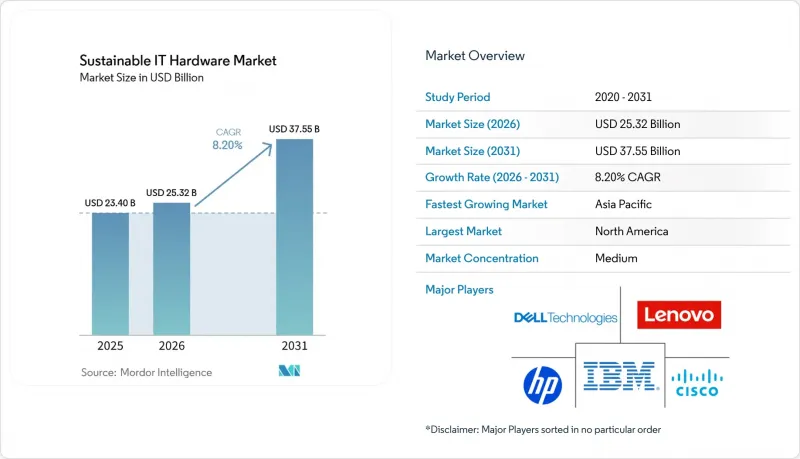
Mordor Intelligence에 의하면, 지속가능 IT 하드웨어 시장 규모는 2025년 234억 달러로 평가되었습니다. 2026년에는 253억 2,000만 달러로 확대되어 2031년까지 375억 5,000만 달러에 이를 것으로 예상되고 2026년부터 2031년에 걸쳐 CAGR 8.20%로 성장할 전망입니다.
본 보고서는 제품 유형(서버, 네트워크 장비, 개인용 컴퓨터 및 워크스테이션 등), 구성 요소(하드웨어, 소프트웨어, 서비스), 최종 사용자 산업(데이터센터, 은행, 금융서비스 및 보험(BFSI), 정부·공공 부문 등), 라이프사이클 단계(조달·제조, 운영·이용 등) 및 지역별로 분류되어 있습니다. 시장 전망은 금액(달러) 기준으로 제시되어 있습니다.
세계의 지속가능 IT 하드웨어 시장 동향 및 인사이트
전 세계 전자 폐기물 및 탄소 배출에 관한 엄격한 규제
2024년 유럽연합(EU)의 WEEE 지침 개정에 따라 회수 목표가 70%로 상향 조정되고, 회수 제도에 대한 자금 지원을 소홀히 한 제조업체에 대한 벌금이 도입됨에 따라, 설계 팀은 분해가 용이한 케이스와 표준화된 체결 부품을 우선적으로 채택하고 있습니다. 중국에서 개정된 회수 규정에 따라 엔터프라이즈급 스토리지 어레이 공급업체는 2026년까지 성(省) 단위의 회수 네트워크를 구축해야 할 의무가 부과됨에 따라, 역물류 허브에 대한 투자가 가속화되고 있습니다. 캘리포니아주 상원 법안 244호에서는 2028년까지 주 내에서 판매되는 모든 IT 기기에 사용 후 재활용 소재를 30% 함유하도록 의무화하고 있어, 인증된 재활용 플라스틱 및 저탄소 알루미늄에 대한 수요를 촉진하고 있습니다.
기업의 ESG 및 넷제로 조달 요건
2024년 탄소 공시 프로젝트(CDP) 조사에 따르면, 포춘 500대 기업의 68%가 서버 및 스토리지 제안 요청서(RFP)에 수명 주기 배출량 기준치를 포함하고 있었으며, 이는 2022년의 41%에서 증가한 수치입니다. 마이크로소프트의 ‘2025년 공급업체 행동 강령’에서는 ISO 14040을 준수하는 제품 수준의 수명 주기 평가와 테라플롭 또는 테라바이트당 연간 내재 탄소 감축량 증명을 의무화하고 있습니다. 구글은 2024년 서버 구매의 82%가 EPEAT Climate+ 기준을 충족했다고 밝혔으며, 이로 인해 재생에너지를 활용한 제조 및 검증된 상쇄 제도에 대한 업계 수요가 높아지고 있습니다.
지속가능 하드웨어 및 냉각 시스템 개조에 따른 높은 초기 비용
액체 냉각식 랙의 설치 비용은 냉각액 분배 장치, 누출 센서, 시설 내 배관 개조 등의 비용으로 인해 동등한 공랭식 랙에 비해 40%-60% 더 높습니다. 따라서 전기 요금이 1kWh당 0.08달러 미만인 지역에서는 투자 회수 기간이 3년을 초과하게 됩니다. ENERGY STAR 인증을 획득한 스토리지 어레이는 저전력 NAND 메모리, 고급 오류 정정 기능 및 검증 비용의 영향으로 정가가 12%-18% 더 비싸며, 이는 활용률이 낮은 환경에서 효율화를 통한 비용 절감 효과를 상쇄하고 있습니다.
부문별 분석
서버는 2025년 매출의 37.6%를 차지했으며, 하이퍼스케일 클라우드가 생성형 AI 추론 워크로드에 최적화된 수냉식 섀시를 채택함에 따라 이 카테고리 내에서 가장 높은 연평균 성장률(CAGR) 10.9%를 나타낼 것으로 예측됩니다. 이러한 보급은 서버의 지속가능 IT 하드웨어 시장 규모를 뒷받침하며, 사업자가 연산 밀도를 2배로 높이고 신규 건축 허가 취득을 미룰 수 있게 해줍니다. 칩렛 기반 x86 및 ARM 프로세서에는 실리콘 카바이드(SiC) 파워 모듈이 통합되어 있어, 변환 손실을 최대 25%까지 줄임으로써 기업의 넷 제로 로드맵에 부합합니다. 스토리지 벤더들은 NVMe-over-Fabrics 및 시게이트의 ‘Exos CORVAULT’와 같은 컴퓨테이셔널 드라이브로 전환하고 있습니다. 이 제품은 I/O 사이클당 에너지 소비를 줄이면서 데이터 유출까지의 평균 시간(MTD)을 350만 시간 이상으로 연장합니다. 네트워크 장비의 경우, 800Gbps 스위치용 실리콘이 기가비트당 전력 소비를 35% 개선하여, AI 클러스터 패브릭의 확장에 따라 지속가능 IT 하드웨어 시장 점유율 확대를 뒷받침하고 있습니다.
주변기기, PC 및 전원 장치는 USB Power Delivery 3.1, 절전 모드 센서, 예측형 UPS 분석 등의 기술 발전에 힘입어 꾸준한 성장을 이루고 있습니다. 이러한 혁신은 에너지 효율과 지속가능성을 중시하는 더욱 엄격해진 ENERGY STAR 버전 9.0의 기준을 충족하기 위해 필수적입니다. 예를 들어, Vertiv사의 머신러닝을 활용한 UPS 알고리즘은 10년 동안 배터리 교체 시기를 최대 20% 늦추는 효과가 입증되었습니다. 이를 통해 운영 비용이 절감될 뿐만 아니라, 전체 수명 주기 동안의 배출량이 대폭 감소하여 환경의 지속가능성에 기여하고 있습니다. 또한, 이러한 기술 혁신은 범용 금속을 보존하고 제조 공정에 재도입하는 것을 보장함으로써 순환형 조달 관행을 종합적으로 지원하고, 보다 지속가능하며 자원 효율적인 생산 주기를 촉진하고 있습니다.
2025년에는 지속가능 IT 하드웨어 시장 매출의 61.9%를 하드웨어가 차지했으나, 기업들이 탄소 회계, 자산 추적, 재활용 처리를 외부에 위탁함에 따라 서비스 부문은 연평균 성장률(CAGR) 9.4%로 확대되고 있습니다. 이러한 추세는 특히 사내에 폐기 처리 역량을 갖추지 못한 전 세계 은행 및 소매업체를 중심으로, 관리형 서비스가 지속가능 IT 하드웨어 시장에서 점유율을 확대하는 데 기여하고 있습니다. 슈나이더 일렉트릭의 ‘EcoStruxure IT’는 워크로드를 비수기 시간대로 전환함으로써 2024년에 포춘 100대 기업 중 한 곳의 데이터센터 전력 소비량을 14% 절감했습니다. HPE GreenLake Sustainability Services는 구매 품목에 대한 Scope 3 요건을 준수하고, 배출량 감축 및 물 절약량에 대한 분기별 보고서를 공개하고 있습니다. 아이언 마운틴(Iron Mountain)과 같은 물류 전문 기업들은 2024년에 230만 대의 IT 장비에서 1만 8,500메트르톤의 철강 및 귀금속을 회수하여 폐쇄형 공급망을 강화했습니다.
소프트웨어 지출은 하드웨어의 업데이트 주기와 연동되어 있으며, AI 기반 워크로드 배치 엔진과 디지털 트윈을 활용함으로써 운영 담당자는 열역학 및 전력망을 실시간으로 모델링할 수 있게 되었습니다. 이러한 첨단 기술을 통해 기업은 에너지 소비를 최적화하고, 운영상의 비효율성을 줄이며, 시스템 전반의 성능을 향상시킬 수 있습니다. AI를 통한 인사이트력을 활용함으로써, 운영 담당자는 잠재적인 문제를 예측 및 완화하고, 원활한 운영을 보장하는 동시에 가동 중지 시간을 최소화할 수 있습니다. 또한, 이러한 오케스트레이션 계층은 유휴 설비를 줄이고 자원을 보다 효율적으로 활용할 수 있게 해줍니다. 이러한 추세에 따라 보안, 에너지 관리, 라이프사이클 대시보드 등의 필수 기능을 묶은 구독형 라이선스에 대한 수요가 점차 증가하고 있으며, 현대의 운영 과제에 대한 종합적인 솔루션이 제공되고 있습니다.
지역별 분석
북미는 하이퍼스케일 클라우드, 엄격한 ENERGY STAR 기준, 그리고 대규모 보고 의무를 지닌 기업을 대상으로 IT 자산에서 발생하는 Scope 3 배출량 감사를 의무화하는 미국 증권거래위원회(SEC)의 새로운 기후 변화 정보 공개 규정의 영향으로 2025년 매출의 53.8%를 차지했습니다. 연방 정부 기관 및 29개 주가 EPEAT 실버 이상 등급을 의무화하고 있어, 공급업체들은 제품 수준의 탄소 발자국 공개를 요구받고 있습니다. 캐나다의 ‘정부 친환경화 전략’에서는 2030년까지 순배출 제로(Net Zero) 운영을 의무화하고 있어, 고효율 서버 및 노트북 조달이 더욱 촉진되고 있습니다.
아시아태평양은 2031년까지 연평균 성장률(CAGR)이 12.2%로 가장 빠르게 성장하는 지역입니다. 인도에서는 국내 서버 제조 및 재생 에너지를 활용하는 공장에 1,700억 루피(20억 4,000만 달러)의 인센티브가 지급되어, 이를 통해 현지 공급망이 강화되고 있습니다. 일본의 ‘그린 트랜스포메이션 리그(Green Transformation League)’는 희토류 자석 재활용에 관한 실증 사업에 자금을 지원하고 있는 반면, 한국의 ‘K-순환경제법’은 재활용 소재 함유율에 관한 의무적 기준을 정하고, 판매부터 해체에 이르기까지 기기의 추적을 실시했습니다. 싱가포르와 인도네시아의 하이퍼스케일러들은 증발 냉각에 의존하지 않고 열대의 더위를 극복하기 위해 수냉식 AI 클러스터를 도입하고 있으며, 이를 통해 동남아시아 전역에서 지속가능 IT 하드웨어 시장 점유율을 유지하고 있습니다. 유럽은 ‘지속가능 제품을 위한 에코디자인 규정’과 데이터센터의 폐열 회수 설비 개조를 지원하는 보조금의 힘에 힘입어 2위를 차지했습니다.
독일은 지역 난방 네트워크에 열을 공급하는 시설에 5억 유로(5억 6,000만 달러)를 예산으로 편성했으며, 이로 인해 60°C의 토출 온도에서 효율적인 열 재사용을 가능하게 하는 수냉식 랙 수요가 견인되고 있습니다. 영국의 규정안에서는 500kW를 초과하는 데이터센터에 대해 월별 전력 사용량 및 물 사용량 지표를 공개하도록 의무화하고 있어, 계측 시스템의 업그레이드가 가속화되고 있습니다. 중동에서는 경제 다각화의 일환으로 사우디아라비아와 아랍에미리트(UAE)에서 AI 대응 캠퍼스가 건설되고 있으며, 주요 임차인들로부터 재생에너지 구매 계약 및 디지털 여권 도입이 요구되고 있습니다. 아프리카 성장의 중심은 남아프리카공화국에 있으며, 요하네스버그에 위치한 Teraco사의 20메가와트 규모 태양광 발전 데이터센터는 전력 공급이 불안정한 시장에서 지속가능 컴퓨팅의 지역적 모델로 자리 잡고 있습니다.
기타 혜택 :
- 엑셀 형식 시장 예측(ME) 시트
- 3개월간의 애널리스트 지원
자주 묻는 질문
목차
제1장 서론
제2장 조사 방법
제3장 개요
제4장 시장 구도
제5장 시장 규모 및 성장 예측
제6장 경쟁 구도
제7장 시장 기회 및 향후 전망
KTH 26.09.02According to Mordor Intelligence, the sustainable IT hardware market size is expected to increase from USD 23.4 billion in 2025 to USD 25.32 billion in 2026 and reach USD 37.55 billion by 2031, growing at a CAGR of 8.20% over 2026-2031.
This report is Segmented by Product Type (Servers, Networking Equipment, Personal Computers and Workstations, and More), Component (Hardware, Software, and Services), End-User Industry (Data Centers, BFSI, Government and Public Sector, and More), Lifecycle Phase (Procurement and Manufacturing, Operation and Usage, and More), and Geography. The Market Forecasts are Provided in Terms of Value (USD).
Global Sustainable IT Hardware Market Trends and Insights
Stringent E-Waste and Carbon Regulations Globally
Amendments to the European Union's WEEE Directive in 2024 lifted collection targets to 70% and introduced financial penalties for manufacturers that fail to fund take-back schemes, prompting design teams to prioritize easy-to-disassemble chassis and standardized fasteners. China's updated recovery rules require suppliers of enterprise-grade storage arrays to set up provincial collection networks by 2026, accelerating investment in reverse logistics hubs. California's Senate Bill 244 mandates 30% post-consumer recycled content in all IT equipment sold in the state by 2028, driving demand for certified recycled plastics and low-carbon aluminum.
Enterprise ESG and Net-Zero Procurement Mandates
A 2024 Carbon Disclosure Project survey found that 68% of Fortune 500 firms embedded lifecycle-emission thresholds into server and storage requests for proposals, up from 41% in 2022. Microsoft's 2025 Supplier Code of Conduct now requires product-level lifecycle assessments aligned with ISO 14040 and evidence of annual embodied-carbon reductions per teraflop or terabyte. Google disclosed that 82% of its 2024 server purchases met EPEAT Climate+ criteria, lifting industry demand for renewable-powered manufacturing and verified offset schemes.
High Upfront Cost of Sustainable Hardware and Cooling Retrofits
Liquid-cooled racks cost 40%-60% more to install than air-cooled equivalents because of coolant distribution units, leak sensors, and facility piping upgrades, extending payback periods beyond three years in regions where electricity prices remain below USD 0.08 per kWh. ENERGY STAR-certified storage arrays carry 12%-18% higher list prices driven by low-power NAND, advanced error correction, and verification fees, offsetting efficiency savings in low-utilization environments.
Other drivers and restraints analyzed in the detailed report include:
- Rapid Expansion of Hyperscale and Edge Data Centers
- Growing Demand for Energy-Efficient High-Density AI Servers
- Supply Chain Volatility for Low-Carbon Components
For complete list of drivers and restraints, kindly check the Table Of Contents.
Segment Analysis
Servers accounted for 37.6% of 2025 revenue and are forecast to grow at a 10.9% CAGR, the highest among categories, as hyperscale clouds adopt liquid-cooled chassis optimized for generative-AI inference workloads. This uptake supports the sustainable IT hardware market size for servers, enabling operators to double compute density and defer new building permits. Chiplet-based x86 and ARM processors integrate silicon-carbide power modules that cut conversion losses up to 25%, aligning with corporate net-zero roadmaps. Storage vendors pivot to NVMe-over-Fabrics and computational drives like Seagate's Exos CORVAULT, which extends mean-time-to-data-loss past 3.5 million hours while lowering energy per I/O cycle. Networking equipment benefits from 800 Gbps switch silicon that delivers 35% better watts per gigabit, sustaining sustainable IT hardware market share gains as AI cluster fabrics expand.
Peripherals, PCs, and power equipment are experiencing steady growth, driven by advancements in technologies such as USB Power Delivery 3.1, sleep-mode sensors, and predictive UPS analytics. These innovations are essential to meet the stricter ENERGY STAR Version 9.0 thresholds, which emphasize energy efficiency and sustainability. For instance, Vertiv's machine-learning UPS algorithms have proven effective in delaying battery replacements by up to 20% over a ten-year period. This not only reduces operational costs but also significantly curtails lifecycle emissions, contributing to environmental sustainability. Furthermore, these advancements collectively support circular procurement practices by ensuring that commodity metals are preserved and reintroduced into manufacturing processes, thereby promoting a more sustainable and resource-efficient production cycle.
Hardware delivered 61.9% of sustainable IT hardware market revenue in 2025, though services are expanding at a 9.4% CAGR as enterprises outsource carbon accounting, asset tracking and refurbishment. This dynamic underpins a rising sustainable IT hardware market share for managed services, especially among global banks and retailers that lack in-house disposal capacity. Schneider Electric's EcoStruxure IT shifted workloads to off-peak windows, cutting one Fortune 100 firm's data-center power by 14% in 2024. HPE GreenLake Sustainability Services publishes quarterly reports on avoided emissions and water savings, aligning with Scope 3 requirements for purchased goods. Logistics specialists such as Iron Mountain recovered 18,500 metric tons of steel and precious metals from 2.3 million IT units in 2024, reinforcing closed-loop supply chains.
Software spending mirrors hardware refresh cycles, with AI workload-placement engines and digital twins enabling operators to model thermodynamics and electricity grids in real time. These advanced technologies allow businesses to optimize energy consumption, reduce operational inefficiencies, and enhance overall system performance. By leveraging AI-driven insights, operators can predict and mitigate potential issues, ensuring seamless operations and minimizing downtime. Additionally, these orchestration layers reduce stranded capacity, enabling more efficient resource utilization. This trend drives incremental demand for subscription licenses that bundle essential features such as security, energy management, and lifecycle dashboards, offering a comprehensive solution for modern operational challenges.
Complete Report Scope:
- By Product Type
- Servers
- Storage Devices
- Networking Equipment
- Personal Computers and Workstations
- Peripherals and Accessories
- UPS and Power Distribution Units
- By Component
- Hardware
- Software
- Services
- By End-User Industry
- Data Centers
- Large Enterprises
- Small and Medium Enterprises
- Government and Public Sector
- Healthcare
- BFSI
- Telecom and IT
- Other End-User Industries
- By Lifecycle Phase
- Procurement and Manufacturing
- Operation and Usage
- Maintenance and Upgrades
- End-of-Life and Recycling
- By Geography
- North America
- United States
- Canada
- Mexico
- Europe
- Germany
- United Kingdom
- France
- Russia
- Rest of Europe
- Asia-Pacific
- China
- Japan
- India
- South Korea
- Rest of Asia Pacific
- Middle East
- Saudi Arabia
- United Arab Emirates
- Rest of Middle East
- Africa
- South Africa
- Nigeria
- Rest of Africa
- South America
- Brazil
- Argentina
- Rest of South America
- North America
Geography Analysis
North America captured 53.8% of 2025 revenue, powered by hyperscale clouds, stringent ENERGY STAR standards, and new U.S. Securities and Exchange Commission climate-disclosure rules that force large filers to audit Scope 3 emissions from IT assets. Federal agencies and 29 states require EPEAT-Silver or higher ratings, pushing vendors to publish product-level carbon footprints. Canada's Greening Government Strategy mandates net-zero operations by 2030, further boosting procurement of high-efficiency servers and laptops.
Asia-Pacific is the fastest-growing region at a 12.2% CAGR through 2031. India's INR 170 billion (USD 2.04 billion) incentive for domestic server manufacturing and renewable-powered factories strengthens local supply chains. Japan's Green Transformation League funds pilots to recycle rare-earth magnets, while South Korea's K-Circular Economy Act sets mandatory recycled-content thresholds and tracks devices from sale to dismantling. Hyperscalers in Singapore and Indonesia deploy liquid-cooled AI clusters to manage tropical heat without evaporative cooling, sustaining sustainable IT hardware market share across Southeast Asia. Europe ranks second, boosted by the Ecodesign for Sustainable Products Regulation and grants to retrofit data centers with waste-heat recovery.
Germany budgets EUR 500 million (USD 560 million) for facilities that supply district-heating networks, driving demand for liquid-cooled racks with 60°C outlet temperatures that enable efficient heat reuse. The United Kingdom's draft rules compel data centers above 500 kilowatts to publish monthly power-usage and water-usage metrics, accelerating metering upgrades. The Middle East builds AI-ready campuses in Saudi Arabia and the UAE as part of diversification agendas, with anchor tenants demanding renewable-energy purchase agreements and digital passports. Africa's growth centers on South Africa, where Teraco's 20-megawatt solar data center in Johannesburg sets a regional template for sustainable compute in markets with intermittent grids.
- Lenovo Group Limited
- HP Inc.
- Dell Technologies Inc.
- International Business Machines Corporation
- Cisco Systems Inc.
- Huawei Technologies Co., Ltd.
- Inspur Electronic Information Industry Co., Ltd.
- Super Micro Computer, Inc.
- Fujitsu Limited
- NEC Corporation
- Hewlett Packard Enterprise Company
- Schneider Electric SE
- Vertiv Holdings Co.
- Eaton Corporation plc
- Delta Electronics, Inc.
- Seagate Technology Holdings plc
- Western Digital Corporation
- Pure Storage, Inc.
- Advanced Micro Devices, Inc.
- NVIDIA Corporation
Additional Benefits:
- The market estimate (ME) sheet in Excel format
- 3 months of analyst support
TABLE OF CONTENTS
1 INTRODUCTION
- 1.1 Study Assumptions and Market Definition
- 1.2 Scope of the Study
2 RESEARCH METHODOLOGY
3 EXECUTIVE SUMMARY
4 MARKET LANDSCAPE
- 4.1 Market Overview
- 4.2 Market Drivers
- 4.2.1 Stringent E-Waste and Carbon Regulations Globally
- 4.2.2 Enterprise ESG and Net-Zero Procurement Mandates
- 4.2.3 Rapid Expansion of Hyperscale and Edge Data Centers
- 4.2.4 Growing Demand for Energy-Efficient High-Density AI Servers
- 4.2.5 Emergence of Circular Economy IT-as-a-Service Models
- 4.2.6 Advancements in Low-Voltage Silicon Carbide and GaN Power Components
- 4.3 Market Restraints
- 4.3.1 High Upfront Cost of Sustainable Hardware and Cooling Retrofits
- 4.3.2 Supply Chain Volatility for Low-Carbon Components
- 4.3.3 Lack of Standardized Sustainability Metrics Across Regions
- 4.3.4 Rising Water Stress Impacting Liquid Cooling Adoption in Emerging Asia
- 4.4 Industry Value Chain Analysis
- 4.5 Regulatory Landscape
- 4.6 Technological Outlook
- 4.7 Impact of Macroeconomic Factors on the Market
- 4.8 Porter's Five Forces Analysis
- 4.8.1 Threat of New Entrants
- 4.8.2 Bargaining Power of Suppliers
- 4.8.3 Bargaining Power of Buyers
- 4.8.4 Threat of Substitutes
- 4.8.5 Competitive Rivalry
5 MARKET SIZE AND GROWTH FORECASTS (VALUE)
- 5.1 By Product Type
- 5.1.1 Servers
- 5.1.2 Storage Devices
- 5.1.3 Networking Equipment
- 5.1.4 Personal Computers and Workstations
- 5.1.5 Peripherals and Accessories
- 5.1.6 UPS and Power Distribution Units
- 5.2 By Component
- 5.2.1 Hardware
- 5.2.2 Software
- 5.2.3 Services
- 5.3 By End-User Industry
- 5.3.1 Data Centers
- 5.3.2 Large Enterprises
- 5.3.3 Small and Medium Enterprises
- 5.3.4 Government and Public Sector
- 5.3.5 Healthcare
- 5.3.6 BFSI
- 5.3.7 Telecom and IT
- 5.3.8 Other End-User Industries
- 5.4 By Lifecycle Phase
- 5.4.1 Procurement and Manufacturing
- 5.4.2 Operation and Usage
- 5.4.3 Maintenance and Upgrades
- 5.4.4 End-of-Life and Recycling
- 5.5 By Geography
- 5.5.1 North America
- 5.5.1.1 United States
- 5.5.1.2 Canada
- 5.5.1.3 Mexico
- 5.5.2 Europe
- 5.5.2.1 Germany
- 5.5.2.2 United Kingdom
- 5.5.2.3 France
- 5.5.2.4 Russia
- 5.5.2.5 Rest of Europe
- 5.5.3 Asia-Pacific
- 5.5.3.1 China
- 5.5.3.2 Japan
- 5.5.3.3 India
- 5.5.3.4 South Korea
- 5.5.3.5 Rest of Asia Pacific
- 5.5.4 Middle East
- 5.5.4.1 Saudi Arabia
- 5.5.4.2 United Arab Emirates
- 5.5.4.3 Rest of Middle East
- 5.5.5 Africa
- 5.5.5.1 South Africa
- 5.5.5.2 Nigeria
- 5.5.5.3 Rest of Africa
- 5.5.6 South America
- 5.5.6.1 Brazil
- 5.5.6.2 Argentina
- 5.5.6.3 Rest of South America
- 5.5.1 North America
6 COMPETITIVE LANDSCAPE
- 6.1 Market Concentration
- 6.2 Strategic Moves
- 6.3 Market Share Analysis
- 6.4 Company Profiles (includes Global Level Overview, Market Level Overview, Core Segments, Financials as available, Strategic Information, Market Rank/Share, Products and Services, Recent Developments)
- 6.4.1 Lenovo Group Limited
- 6.4.2 HP Inc.
- 6.4.3 Dell Technologies Inc.
- 6.4.4 International Business Machines Corporation
- 6.4.5 Cisco Systems Inc.
- 6.4.6 Huawei Technologies Co., Ltd.
- 6.4.7 Inspur Electronic Information Industry Co., Ltd.
- 6.4.8 Super Micro Computer, Inc.
- 6.4.9 Fujitsu Limited
- 6.4.10 NEC Corporation
- 6.4.11 Hewlett Packard Enterprise Company
- 6.4.12 Schneider Electric SE
- 6.4.13 Vertiv Holdings Co.
- 6.4.14 Eaton Corporation plc
- 6.4.15 Delta Electronics, Inc.
- 6.4.16 Seagate Technology Holdings plc
- 6.4.17 Western Digital Corporation
- 6.4.18 Pure Storage, Inc.
- 6.4.19 Advanced Micro Devices, Inc.
- 6.4.20 NVIDIA Corporation
7 MARKET OPPORTUNITIES AND FUTURE OUTLOOK
- 7.1 White-Space and Unmet-Need Assessment


