

|
시장보고서
상품코드
2119066
IT 하드웨어 구독 및 DaaS(Device-as-a-Service) : 시장 점유율 분석, 산업 동향 및 통계 데이터, 성장 예측(2026-2031년)IT Hardware Subscription and Device-as-a-Service (DaaS) - Market Share Analysis, Industry Trends & Statistics, Growth Forecasts (2026 - 2031) |
||||||
 Mordor Intelligence
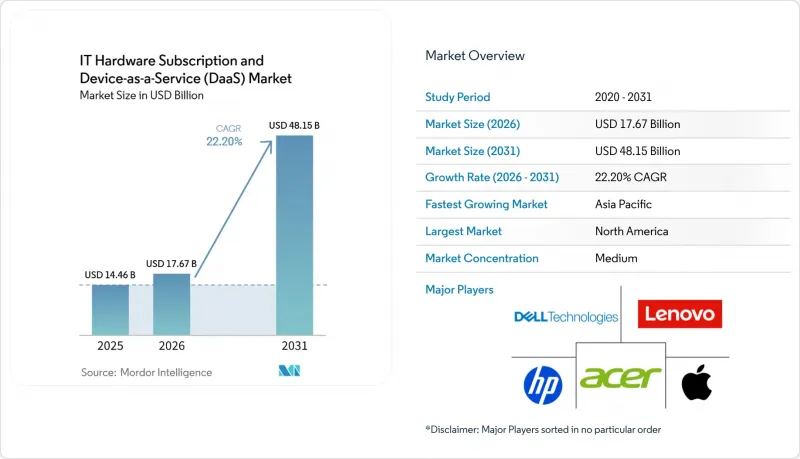
Mordor Intelligence에 따르면 IT 하드웨어 구독·DaaS(Device-as-a-Service) 시장 규모는 2025년 144억 6,000만 달러에서 2026년에는 176억 7,000만 달러로 확대하며, 2031년까지 481억 5,000만 달러에 달할 것으로 예상되고 있으며, 2026-2031년에 CAGR 22.2%로 성장할 것으로 전망되고 있습니다.
이 보고서는 기기 유형(노트북, 데스크톱·워크스테이션 등), 서비스 유형(하드웨어 전용 구독, 하드웨어+소프트웨어 지원 등), 최종사용자 산업(IT·통신, 의료 등), 조직 규모(대기업 등) 및 지역별로 분류되어 있습니다. 시장 전망은 금액(달러) 기준으로 제시되어 있습니다.
글로벌 IT 하드웨어 구독 및 DaaS(Device-as-a-Service) 시장 동향 및 인사이트
하이브리드 근무 방식의 급속한 확산
하이브리드 근무는 일시적인 대응에서 표준적인 근무 방식으로 전환되고 있으며, 2025년까지 96%의 조직이 분산형 정책을 정착시킬 전망입니다. 현재 미국 지식 근로자의 절반 이상이 적어도 주 1회 이상 원격으로 업무를 수행하고 있으며, 기기의 신속한 배송, 이미징 및 회수에 대한 수요가 지속적으로 증가하고 있습니다. DaaS(Device-as-a-Service) 플랫폼은 이러한 워크플로우를 자동화하여 평균 온보딩 시간을 며칠에서 몇 시간으로 단축합니다. 가트너는 관리형 기기 수명주기의 보급률이 2028년까지 70%에 달할 것으로 예측하며, 이 모델이 얼마나 정착되었는지를 여실히 보여주고 있습니다. 자본 소유형 모델에 집착하는 기업은 IT 인건비 증가와 대응 시간 장기화에 직면하게 되며, 원활한 원격 기술이 당연시되는 시대에 인재 확보에 불리한 입장에 놓이게 됩니다.
OPEX 기반 IT 예산으로의 전환
거시경제 상황의 변동으로 인해 재무 책임자들은 예측 가능한 월별 지출을 선호하는 추세입니다. 2026년 1분기 조사에 따르면 CFO의 68%가 IT 비용 상승을 예상하고 있는 반면, 막대한 자본 지출 승인에는 소극적인 것으로 나타났습니다. 구독 계약을 통해 불규칙한 구매가 안정적인 경비로 전환되고, 승인 주기가 단축됨과 동시에 현금 흐름의 가시성이 향상됩니다. 캡제미니의 조사에 따르면 온디맨드형 기술이 전체 IT 예산에서 차지하는 비중은 2025년 29%에서 2027년까지 41%로 상승할 전망입니다. 특히 중소규모 기업은 신용 한도 제약을 피하면서 분기별 자본 지출 심사를 거치지 않고도 하드웨어를 더 자주 업데이트할 수 있으며, 가장 큰 혜택을 누리게 될 것입니다.
데이터 주권에 대한 우려
인도의 ‘디지털 개인 데이터 보호법’이나 유럽연합(EU)의 GDPR과 같은 법률에서는 특정 사용자 텔레메트리 및 인증 정보를 국내에 보관하도록 의무화하고 있습니다. DaaS 공급업체는 지역별 데이터센터를 유지해야 하며, 이로 인해 비용이 증가하고 배포 일정이 지연됩니다. 공급자가 모든 관할 구역에서 원활하게 작동하는 통합 플랫폼을 제공하지 못할 경우, 다국적 기업은 큰 과제에 직면하게 됩니다. 이러한 통합의 부재는 관리 시스템의 파편화를 초래하여 비효율성과 운영의 복잡성을 야기하는 경우가 많습니다. 또한 규제가 엄격한 시장에서 강화된 규정 준수 요건 역시 관리 비용 증가의 한 요인이 되고 있습니다.
부문 분석
노트북 부문은 2025년 매출의 41.8%를 차지하며, IT 하드웨어 구독 및 DaaS(Device-as-a-Service) 시장에서 생산성의 기반으로서 필수적인 역할을 하고 있음이 부각되고 있습니다. 한편, 스마트폰 및 핸드헬드 단말기는 물류 및 소매 업계에서 5G 현장 애플리케이션의 확대와 내환경형 단말기의 사용 사례 증가를 반영하여, 2031년까지 연평균 성장률(CAGR) 24.8%를 기록할 것으로 예상됩니다. 기업이 단일 콘솔을 통해 관리되는 통합형 모빌리티 스택을 요구하는 가운데, 스캐너나 RFID 리더기를 탑재한 견고한 핸드헬드 단말기가 기존의 PDA를 대체하고 있습니다. 태블릿은 교육 현장이나 병상에서의 임상 워크플로우에서 여전히 수요가 있지만, 기업용 소프트웨어와의 호환성이 제한적이어서 더 광범위한 보급에는 제동이 걸려 있습니다. 데스크톱 및 워크스테이션은 높은 연산 밀도와 멀티 모니터 구성이 여전히 필수적인 엔지니어링, 설계 및 트레이딩 플로어에서 계속해서 사용되고 있습니다.
주변 기기 및 액세서리는 IT 하드웨어 구독·DaaS(Device-as-a-Service) 시장에서 차지하는 비중은 작지만, 현재는 대부분의 계약에 번들로 제공되고 있습니다. HP가 2025년에 재생산 주변기기를 확대할 계획인 것은 기업이 지속가능성 목표를 달성하기 위해 재생산 모니터와 도킹 스테이션을 수용할 것임을 시사합니다. 장치 선호도는 산업별로 갈라지고 있습니다. 개발자는 고급 노트북을 선호하고, 의료 업계는 항균 태블릿을 중시하며, 소매 업계는 내구성이 뛰어난 스마트폰을 선호합니다. 구매자가 새로운 워크플로우 수요에 맞춰 구성을 미세 조정하는 가운데, 중기적인 교체를 허용하고 혼합 환경의 기기군을 지원하는 공급업체는 타의 추종을 불허하는 성장을 이룰 것입니다.
전체 수명 주기를 포괄하는 관리 서비스는 2025년 매출의 37.2%를 차지하며 연평균 성장률(CAGR) 25.6%를 기록하고 있는데, 이는 IT 하드웨어 구독 및 DaaS(Device-as-a-Service) 시장 전체에서 가장 높은 성장률입니다. 조달, 도입, 모니터링, 수리, 리프레시 및 인증된 폐기를 포괄하는 계약을 통해 단일 벤더에 의한 책임 체제가 확립됩니다. 2026년 포레스터(Forrester)의 조사에 따르면 3년 계약 기간 중 기기당 최대 1,000유로(1,130달러)의 비용 절감에 더해 IT 인건비를 6.5시간 분량 절감할 수 있는 것으로 추산됩니다. 하드웨어 전용 구독은 이미징 및 보안 업무를 내부에서 관리하는 정부 기관에서 여전히 인기가 높습니다. OS 라이선스 및 엔드포인트 보안을 포함하는 하이브리드형 번들은 턴키 지원이 필요한 중소기업의 지지를 받고 있습니다.
환경·사회·지배구조(ESG) 정보 공개에 따라 구매자들의 관심은 CO₂ 추적 대시보드와 탄소 상쇄 기능을 통합한 레노버의 ‘TruScale DaaS for Sustainability’와 같은 서비스로 쏠리고 있습니다. 하드웨어와 관리형 서비스를 결합한 플랜에는 현재 구성 요소의 고장을 예측하는 AI 기반 분석 기능이 포함되어 있으며, 가동 중단 시간을 더욱 줄이고 있습니다. 서비스 선택은 IT 성숙도의 지표로 자리 잡고 있습니다. 조기 도입 기업은 수명주기 전체를 위탁하는 반면, 성숙한 기업은 사내 기술 역량을 보완할 개별 모듈을 엄선하여 도입하고 있습니다.
지역별 분석
2025년 IT 하드웨어 구독 및 DaaS(Device-as-a-Service) 시장의 총 수익 중 34.7%를 북미가 차지했습니다. 미국 기업, 특히 기술, 금융, 헬스케어 부문에서는 하이브리드 근무 모델을 지원하고 엄격한 규정 준수 요건을 충족하기 위해 대규모 도입을 주도했습니다. 2026년 조사에 따르면 미국 지식 근로자의 58%가 주당 최소 1일은 원격 근무를 하고 있으며, 이는 효율적인 기기 프로비저닝에 대한 지속적인 수요를 견인하고 있습니다. 마찬가지로 캐나다도 이러한 추세를 따르고 있으며, 교육 및 공공 부문에서는 유연하고 계절에 맞춘 기기 관리 솔루션이 채택되고 있습니다. 지역 서비스 제공업체들은 하드웨어 고장을 예측하고 교체 부품을 자동으로 조달하는 AI 기반 지원 시스템을 제공함으로써 차별화를 꾀하고 있으며, 이는 시장의 성숙도와 경쟁 구도를 반영하고 있습니다.
유럽에서는 ‘수리받을 권리’에 관한 규제, 순환 경제에 대한 노력, 그리고 야심 찬 탄소 배출 감축 목표가 시장 성장을 주도하고 있습니다. 독일, 영국, 프랑스 등의 주요 시장이 도입을 주도하고 있으며, 많은 경우 탄소 중립 하드웨어와 상세한 유통 이력(체인 오브 카스투디)의 문서화가 요구되고 있습니다. 레노버의 탄소 추적 포털은 이 지역에서 지지를 얻고 있지만, GDPR(일반 데이터 보호 규정) 준수를 위해서는 현지화된 데이터센터가 필요하여 벤더의 운영 비용이 증가하고 있습니다. 한편, 러시아에서는 서구산 하드웨어 수입을 제한하는 제재 조치로 인해 큰 제약을 겪고 있으며, 그 결과 DaaS(Device-as-a-Service) 기능이 그다지 발전하지 않은 국내 제조업체로 수요가 이동하고 있습니다.
아시아태평양은 가장 빠르게 성장하는 시장으로 부상하고 있으며, IT 하드웨어 구독 및 DaaS(Device-as-a-Service) 부문에서 2031년까지 연평균 성장률(CAGR) 24.2%를 달성할 것으로 예측됩니다. 중국에서는 국내 공급업체가 우선시되는 경향이 있으며, 외국계 기업에게는 과제가 되고 있지만, 디지털 정부 구상에 대한 막대한 투자로 인해 시장 전반의 기회는 확대되고 있습니다. 인도에서는 데이터 보호법 도입으로 국경을 넘는 데이터 유통이 복잡해지고 있지만, 동시에 현지 호스팅 요건을 준수하는 지역 공급업체에게는 이점을 가져다주고 있습니다. 일본과 한국은 첨단인 5G 인프라를 활용하여 지연에 민감한 엣지 워크로드를 지원하고 있으며, 그 자금은 구독형 모델을 통해 조달되고 있습니다. 남미에서는 브라질이 시장을 주도하고 있지만, 환율 변동이 가격 책정상 과제로 대두되고 있습니다. 한편, 중동에서는 사우디아라비아와 아랍에미리트의 스마트 시티 프로젝트가 고부가가치 멀티 디바이스 계약에 대한 수요를 견인하고 있습니다. 아프리카는 도입 초기 단계에 머물러 있지만, 케냐나 나이지리아 등 국가에서 스마트폰 중심의 구독형 모델은 모바일 광대역 인프라 확장이 지속되는 가운데 잠재적인 성장 기회를 부각시키고 있습니다.
기타 혜택:
- Excel 형식의 시장 예측(ME) 시트
- 3개월간의 애널리스트 지원
자주 묻는 질문
목차
제1장 서론
제2장 분석 방법
제3장 개요
제4장 시장 구도
제5장 시장 규모·성장률 예측
제6장 경쟁 구도
제7장 시장 기회와 향후 전망
KSA 26.09.02According to Mordor Intelligence, the IT hardware subscription and device-as-a-service market size is expected to increase from USD 14.46 billion in 2025 to USD 17.67 billion in 2026 and reach USD 48.15 billion by 2031, growing at a CAGR of 22.2% over 2026-2031.
This report is Segmented by Device Type (Laptops and Notebooks Desktops and Workstations, and More), Service Type (Hardware-Only Subscription, Hardware Plus Software Support, and More), End-User Industry (IT and Telecom, Healthcare, and More), Organization Size (Large Enterprises, and More), and Geography. The Market Forecasts are Provided in Terms of Value (USD).
Global IT Hardware Subscription and Device-as-a-Service (DaaS) Market Trends and Insights
Surge in Hybrid Work Adoption
Hybrid work has shifted from contingency to norm, with 96% of organizations embedding distributed policies by 2025. More than half of the United States' knowledge workers now operate remotely at least once per week, driving persistent demand for rapid device shipping, imaging, and retrieval. Device-as-a-service platforms automate these workflows, reducing the average onboarding time from days to hours. Gartner projects managed device lifecycle penetration will climb to 70% by 2028, underscoring how permanent the model has become. Firms that cling to capital-ownership models face rising IT labor overhead and longer response times, handicapping talent attraction in an era where seamless remote technology is the baseline.
Preference for OPEX-Based IT Budgets
Volatile macro conditions have prompted finance chiefs to favor predictable monthly outlays. A Q1 2026 survey showed 68% of CFOs expect IT costs to rise, but are reluctant to approve large capital allotments. Subscription contracts convert lumpy purchases into smooth expenses, quickening approval cycles and improving cash flow visibility. Capgemini research indicates that on-demand technology's share of total IT budgets should climb from 29% in 2025 to 41% by 2027. Smaller firms benefit most, sidestepping credit constraints while refreshing hardware more frequently without multi-quarter capital reviews.
Data Sovereignty Concerns
Laws such as India's Digital Personal Data Protection Act and the European Union's GDPR mandate that certain user telemetry and credentials remain inside national borders.DaaS vendors must maintain regional data centers, which increases costs and delays rollout schedules. Multinational corporations face significant challenges when providers fail to deliver unified platforms that operate seamlessly across all jurisdictions. This lack of integration often results in fragmented management systems, leading to inefficiencies and operational complexities. Additionally, the increased compliance requirements in heavily regulated markets contribute to higher administrative costs.
Other drivers and restraints analyzed in the detailed report include:
- Security-Driven Rapid Refresh Cycles
- Expansion of 5G-Edge Devices
- Vendor Lock-In Anxiety
For complete list of drivers and restraints, kindly check the Table Of Contents.
Segment Analysis
The laptops cohort accounted for 41.8% of 2025 revenue, underscoring its role as the default productivity anchor in the IT hardware subscription and device-as-a-service market. However, smartphones and handhelds are expected to post a 24.8% CAGR to 2031, reflecting expanding 5G field applications and ruggedized use cases in logistics and retail. Rugged handhelds equipped with scanners and RFID readers are displacing legacy PDAs as enterprises seek unified mobility stacks managed through a single console. Tablets maintain traction in education and bedside clinical workflows, though limited enterprise software compatibility curbs broader uptake. Desktops and workstations persist in engineering, design, and trading floors where high compute density and multi-monitor arrays remain essential.
Peripherals and accessories, while a smaller slice of the IT hardware subscription and device-as-a-service market, are now bundled into most contracts. HP's 2025 refurbished-peripheral expansion shows enterprises will accept remanufactured monitors and docks to hit sustainability targets.Device preferences are fragmenting along vertical lines. Developers favor high-end laptops, healthcare leans on antimicrobial tablets, and retail pushes rugged smartphones. Providers that allow mid-term swaps and support mixed fleets will capture disproportionate growth as buyers fine-tune configurations to emerging workflow demands.
Full lifecycle management services represented 37.2% of 2025 revenue and are on pace for a 25.6% CAGR, the fastest within the IT hardware subscription and device-as-a-service market size. Contracts covering procurement, deployment, monitoring, repair, refresh, and certified disposal deliver single-vendor accountability. A 2026 Forrester study quantified savings at up to EUR 1,000 (USD 1,130) per device plus 6.5 hours of IT labor across a three-year term. Hardware-only subscriptions remain popular in government contexts where agencies keep imaging and security tasks in-house. Hybrid bundles that include operating system licenses and endpoint security resonate with SMEs needing turnkey support.
Environmental, social, and governance disclosure is steering buyers toward offerings such as Lenovo's TruScale DaaS for Sustainability, which embeds CO2 tracking dashboards and carbon offsets. Hardware plus managed service tiers now package AI-driven analytics that forecast component failures, further reducing downtime. Service selection is becoming a proxy for IT maturity. Early adopters delegate the end-to-end lifecycle, whereas sophisticated enterprises cherry-pick discrete modules that complement internal skill sets.
Complete Report Scope:
- By Device Type
- Laptops and Notebooks
- Desktops and Workstations
- Tablets
- Smartphones and Handhelds
- Peripherals and Accessories
- By Service Type
- Hardware-Only Subscription
- Hardware plus Software Support
- Hardware plus Managed Services
- Full Lifecycle Management Services
- By End User Industry
- IT and Telecom
- Banking, Financial Services and Insurance
- Healthcare
- Education
- Government and Public Sector
- Retail and E-Commerce
- Manufacturing
- Rest of End User Industries
- By Organization Size
- Large Enterprises
- Small and Medium Enterprises
- By Geography
- North America
- United States
- Canada
- Mexico
- South America
- Brazil
- Argentina
- Rest of South America
- Europe
- Germany
- United Kingdom
- France
- Russia
- Rest of Europe
- Asia-Pacific
- China
- Japan
- India
- South Korea
- Rest of Asia-Pacific
- Middle East
- Saudi Arabia
- United Arab Emirates
- Rest of Middle East
- Africa
- South Africa
- Nigeria
- Rest of Africa
- North America
Geography Analysis
North America accounted for 34.7% of the total revenue in the IT hardware subscription and device-as-a-service market in 2025. Enterprises in the United States, particularly in the technology, finance, and healthcare sectors, spearheaded large-scale deployments to support hybrid work models and comply with stringent compliance requirements. A 2026 survey revealed that 58% of US knowledge workers worked remotely at least one day per week, driving sustained demand for efficient device provisioning. Similarly, Canada followed this trend, with the education and public sectors adopting flexible, seasonal fleet solutions. Regional service providers are increasingly differentiating themselves by offering AI-driven support systems that predict hardware failures and automatically dispatch replacement parts, reflecting a maturing and competitive market landscape.
In Europe, market growth is driven by right-to-repair regulations, circular economy initiatives, and ambitious carbon-reduction goals. Key markets such as Germany, the United Kingdom, and France are leading adoption, often requiring carbon-neutral hardware and detailed chain-of-custody documentation. Lenovo's carbon-tracking portal has gained traction in the region, while GDPR compliance necessitates localized data centers, increasing operational costs for vendors. Meanwhile, Russia faces significant constraints due to sanctions limiting access to Western hardware imports, redirecting demand to domestic manufacturers with less advanced device-as-a-service capabilities.
The Asia-Pacific region is emerging as the fastest-growing market, projected to achieve a 24.2% CAGR through 2031 in the IT hardware subscription and device-as-a-service segment. China's preference for domestic suppliers poses challenges for foreign companies, although substantial investments in digital government initiatives are expanding the overall market opportunity. In India, the introduction of data-protection laws complicates cross-border data flows but simultaneously benefits regional providers that comply with local hosting requirements. Japan and South Korea are leveraging their advanced 5G infrastructure to support latency-sensitive edge workloads, financed through subscription-based models. In South America, Brazil leads the market, although currency fluctuations present pricing challenges. Meanwhile, in the Middle East, smart-city projects in Saudi Arabia and the United Arab Emirates are driving demand for high-value, multi-device contracts. Africa remains in the early stages of adoption, but smartphone-centric subscription models in countries like Kenya and Nigeria highlight potential growth opportunities as mobile broadband infrastructure continues to expand.
- HP Inc.
- Dell Technologies Inc.
- Lenovo Group Limited
- Apple Inc.
- Acer Inc.
- ASUSTeK Computer Inc.
- Samsung Electronics Co., Ltd.
- Microsoft Corporation
- Fujitsu Limited
- Panasonic Holdings Corporation
- Dynabook Inc.
- Toshiba Corporation
- LG Electronics Inc.
- Huawei Technologies Co., Ltd.
- Xiaomi Corporation
- Getac Technology Corporation
- Compal Electronics, Inc.
- Wistron Corporation
- Inventec Corporation
- Pegatron Corporation
Additional Benefits:
- The market estimate (ME) sheet in Excel format
- 3 months of analyst support
TABLE OF CONTENTS
1 INTRODUCTION
- 1.1 Study Assumptions and Market Definition
- 1.2 Scope of the Study
2 RESEARCH METHODOLOGY
3 EXECUTIVE SUMMARY
4 MARKET LANDSCAPE
- 4.1 Market Overview
- 4.2 Market Drivers
- 4.2.1 Surge in Hybrid Work Adoption among Enterprises
- 4.2.2 Rising Preference for OPEX over CAPEX in IT Budgeting
- 4.2.3 Rapid Device Refresh Cycles due to Security and Compliance Needs
- 4.2.4 Expansion of 5G-Enabled Edge Devices Requiring Flexible Financing Models
- 4.2.5 Integration of AI-Driven Predictive Maintenance in Device Management
- 4.2.6 Bundling of Carbon-Neutral Hardware Subscription Offerings
- 4.3 Market Restraints
- 4.3.1 Data Sovereignty Concerns in Cross-Border Device Management
- 4.3.2 Vendor Lock-In Fears among Large Enterprises
- 4.3.3 Inflation-Driven Hardware Cost Volatility Affecting Subscription Pricing
- 4.3.4 Limited Partner Ecosystems in Emerging Economies
- 4.4 Industry Value Chain Analysis
- 4.5 Regulatory Landscape
- 4.6 Technological Outlook
- 4.7 Impact of Macroeconomic Factors on the Market
- 4.8 Porter's Five Forces Analysis
- 4.8.1 Threat of New Entrants
- 4.8.2 Bargaining Power of Suppliers
- 4.8.3 Bargaining Power of Buyers
- 4.8.4 Threat of Substitutes
- 4.8.5 Competitive Rivalry
5 MARKET SIZE AND GROWTH FORECASTS (VALUE)
- 5.1 By Device Type
- 5.1.1 Laptops and Notebooks
- 5.1.2 Desktops and Workstations
- 5.1.3 Tablets
- 5.1.4 Smartphones and Handhelds
- 5.1.5 Peripherals and Accessories
- 5.2 By Service Type
- 5.2.1 Hardware-Only Subscription
- 5.2.2 Hardware plus Software Support
- 5.2.3 Hardware plus Managed Services
- 5.2.4 Full Lifecycle Management Services
- 5.3 By End User Industry
- 5.3.1 IT and Telecom
- 5.3.2 Banking, Financial Services and Insurance
- 5.3.3 Healthcare
- 5.3.4 Education
- 5.3.5 Government and Public Sector
- 5.3.6 Retail and E-Commerce
- 5.3.7 Manufacturing
- 5.3.8 Rest of End User Industries
- 5.4 By Organization Size
- 5.4.1 Large Enterprises
- 5.4.2 Small and Medium Enterprises
- 5.5 By Geography
- 5.5.1 North America
- 5.5.1.1 United States
- 5.5.1.2 Canada
- 5.5.1.3 Mexico
- 5.5.2 South America
- 5.5.2.1 Brazil
- 5.5.2.2 Argentina
- 5.5.2.3 Rest of South America
- 5.5.3 Europe
- 5.5.3.1 Germany
- 5.5.3.2 United Kingdom
- 5.5.3.3 France
- 5.5.3.4 Russia
- 5.5.3.5 Rest of Europe
- 5.5.4 Asia-Pacific
- 5.5.4.1 China
- 5.5.4.2 Japan
- 5.5.4.3 India
- 5.5.4.4 South Korea
- 5.5.4.5 Rest of Asia-Pacific
- 5.5.5 Middle East
- 5.5.5.1 Saudi Arabia
- 5.5.5.2 United Arab Emirates
- 5.5.5.3 Rest of Middle East
- 5.5.6 Africa
- 5.5.6.1 South Africa
- 5.5.6.2 Nigeria
- 5.5.6.3 Rest of Africa
- 5.5.1 North America
6 COMPETITIVE LANDSCAPE
- 6.1 Market Concentration
- 6.2 Strategic Moves
- 6.3 Market Share Analysis
- 6.4 Company Profiles (includes Global level Overview, Market level overview, Core Segments, Financials as available, Strategic Information, Market Rank/Share for key companies, Products and Services, and Recent Developments)
- 6.4.1 HP Inc.
- 6.4.2 Dell Technologies Inc.
- 6.4.3 Lenovo Group Limited
- 6.4.4 Apple Inc.
- 6.4.5 Acer Inc.
- 6.4.6 ASUSTeK Computer Inc.
- 6.4.7 Samsung Electronics Co., Ltd.
- 6.4.8 Microsoft Corporation
- 6.4.9 Fujitsu Limited
- 6.4.10 Panasonic Holdings Corporation
- 6.4.11 Dynabook Inc.
- 6.4.12 Toshiba Corporation
- 6.4.13 LG Electronics Inc.
- 6.4.14 Huawei Technologies Co., Ltd.
- 6.4.15 Xiaomi Corporation
- 6.4.16 Getac Technology Corporation
- 6.4.17 Compal Electronics, Inc.
- 6.4.18 Wistron Corporation
- 6.4.19 Inventec Corporation
- 6.4.20 Pegatron Corporation
7 MARKET OPPORTUNITIES AND FUTURE OUTLOOK
- 7.1 White-Space and Unmet-Need Assessment


