

|
시장보고서
상품코드
2120397
프랑스의 공장 자동화 및 산업용 제어 : 시장 점유율 분석, 업계 동향과 통계, 성장 예측(2026-2031년)France Factory Automation And Industrial Controls - Market Share Analysis, Industry Trends & Statistics, Growth Forecasts (2026 - 2031) |
||||||
 Mordor Intelligence
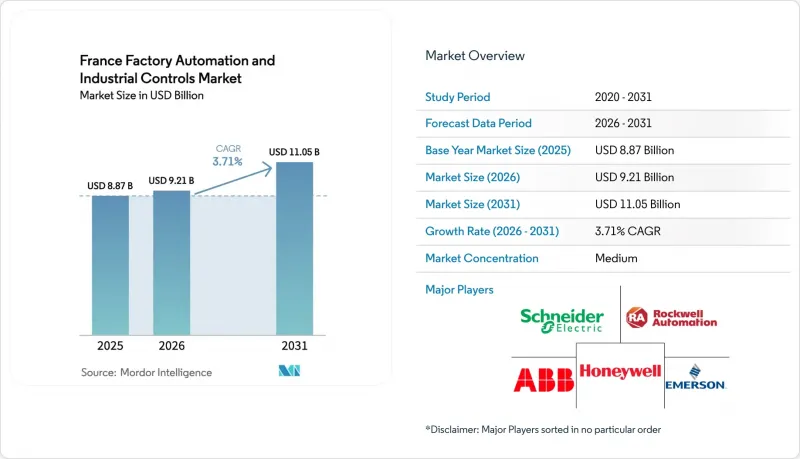
Mordor Intelligence에 따르면 프랑스의 공장 자동화 및 산업용 제어 시장 규모는 2025년 88억 7,000만 달러에서 2026년에는 92억 1,000만 달러로 확대하며, 2026-2031년에 CAGR 3.71%로 추이하며, 2031년에는 110억 5,000만 달러에 달할 것으로 예측됩니다.
이 보고서는 유형별(산업 제어 시스템, 필드 디바이스), 구성 요소별(하드웨어, 소프트웨어, 서비스), 최종사용자 산업별(석유 및 가스,식품 및 음료 등), 배포 방식별(온프레미스, 클라우드 기반, 하이브리드), 판매 채널별(최종사용자 직접 판매, 시스템 통합사업자 등)로 분류되어 있습니다. 시장 전망은 금액(달러) 기준으로 제시되어 있습니다.
프랑스 공장 자동화 및 산업용 제어 시장의 동향과 인사이트
자동차 및 항공우주 업계에서의 인더스트리 4.0 도입 가속화
자동차 및 항공우주 제조업체들은 사이클 타임 단축과 결함 감소를 위해 실시간 분석, 협업 로봇, 증강현실(AR)을 활용한 작업 지시를 도입하고 있습니다. 이러한 접근 방식은 에어버스사가 툴루즈의 A321 최종 조립 라인에서 실증한 바 있습니다. 르노가 22개 공장에 도입한 예측 유지보수 플랫폼은 연간 8,000만 유로(9,000만 달러)의 비용 절감을 실현하여, 기존 설비(브라운필드) 환경에서 디지털 트윈의 유효성을 입증했습니다. 전기자동차(EV) 플랫폼에는 기존의 프로그래머블 로직 컨트롤러(PLC)로는 표준적으로 지원할 수 없는 고정밀 토크 제어 및 열 모니터링이 요구되고 있으며, 고속 비전 기능을 갖춘 모듈형 PLC에 대한 수요가 증가하고 있습니다. 2024년에는 산업용 로봇 도입 대수가 24% 감소한 4,900대를 기록했으나, 2026년 설비 투자의 회복에 힘입어 수주 잔고가 다시 증가하고 있습니다. ISO 9001 등의 규제 체계에서는 현재 디지털 감사 추적이 필수로 규정되어 있으며, 이에 따라 통합형 제조 실행 소프트웨어로의 전환이 정착되고 있습니다.
제조업의 인건비 급등과 숙련 기술자 부족
2024년에는 프랑스 제조업체의 81%가 인력 확보에 어려움을 겪었습니다. 주요 지역에서는 시급이 25유로(28달러)를 초과하고 있으며, 숙련된 기술자들이 은퇴하는 물결이 다가오고 있기 때문입니다. 협동 로봇이 5년 내에 인건비보다 저렴해지는 비용 전환점은 일드프랑스 광역권에서 이미 도래하여, 로봇 도입이 가속화되고 있습니다. 특히 항공우주·방위 산업 클러스터에서는 숙련된 근로자가 은퇴하기 전에 AI를 활용한 문제 해결을 통해 암묵적 지식의 디지털화가 진행되고 있습니다. 2019-2025년에 생산성 증가율은 연평균 0.8%로 둔화되고 있으며, 반복적이고 위험하거나 정밀한 작업의 자동화에 대한 압박이 커지고 있습니다. ISO 45001 산업안전보건 규격은 고용주의 법적 책임을 경감하기 위해 화학물질 취급 및 고온 용접의 자동화를 더욱 촉진하고 있습니다.
본격적인 자동화에는 막대한 초기 투자가 필요합니다.
보조금을 받은 후에도 중규모 공장의 ‘인더스트리 4.0’으로의 포괄적인 개조에는 50만-200만 유로(56만 3,000-225만 달러)의 비용이 소요되며, 이는 프랑스 중소기업의 60%가 연간 자본 예산으로 책정한 금액을 초과합니다. 식품 가공과 같이 이익률이 낮은 업계에서는 인력 부족에도 불구하고 투자를 미루는 경우가 많습니다. 유럽중앙은행(ECB)의 금리 인상으로 차입 비용이 상승함에 따라 ‘리스 투 오운(Lease-to-Own)’나 ‘AaaS(Automation-as-a-Service)’와 같은 모델이 매력적으로 보이지만, 여전히 대형 공급업체로 한정되어 있습니다. 많은 중소기업은 자동화를 ‘전부 하거나 아예 하지 않는’ 이분법적인 선택으로 간주하여, 기존 PLC에 IoT 모듈을 도입하는 것과 같은 단계적인 개조를 간과하고 있습니다. 하지만 ISO 9001 및 ISO 14001 감사에서는 자동화된 데이터 수집이 점점 더 중요시되고 있으며, 도입에 소극적이던 기업도 점진적인 도입으로 방향을 전환하고 있습니다.
부문 분석
2025년, 프랑스 공장 자동화 및 산업용 제어 시장에서 산업 제어 시스템은 37.40%의 점유율을 차지했습니다. 이러한 위상은 화학 산업의 분산형 제어 아키텍처와 자동차 공장의 프로그래머블 컨트롤러에 힘입은 것입니다. 한편, 필드 디바이스는 더욱 빠르게 성장하고 있으며, 산업용 로봇은 2024년에 도입 대수가 24% 감소했음에도 불구하고 2031년까지 연평균 성장률(CAGR)이 4.36%에 달할 것으로 예측됩니다. AGEC의 추적성 규정을 충족해야 하는 식품 및 음료 생산 라인에서는 머신 비전 매출이 연평균 18% 증가하고 있습니다. 모터 및 드라이브는 C3IV 세액 공제의 혜택을 받고 있으며, 시멘트 가마에서 15-20%의 전력 절감을 실현하고 있습니다.
센서, 특히 무선 LoRaWAN 지원 제품은 배선 공사가 어려운 기존 설비(브라운필드)의 개조를 용이하게 하고 있지만, 중요 인프라에서는 암호화 미비 문제가 여전히 장벽으로 작용하고 있습니다. ISO 13849 규격을 준수하는 안전 시스템은 로봇 도입에 약 9개월의 시차를 두고 뒤따르고 있습니다. 감시 시스템은 클라우드 호스팅으로 전환되고 있으며, AVEVA의 2025년 AWS 검증 결과에 따라 온프레미스 서버에 대한 지출이 30% 감소했습니다. 인간-기계 인터페이스(HMI) 분야에서는 태블릿 기반의 증강현실(AR) 오버레이 활용이 증가하고 있으며, 이를 통해 운영자의 교육 기간이 단축되고 있습니다.
2025년, 프랑스 공장 자동화 및 산업용 제어 시장 규모에서 하드웨어는 46.20%의 점유율을 유지했으나, 가장 빠르게 성장하고 있는 분야는 소프트웨어로, 연평균 성장률(CAGR)은 4.38%를 기록했습니다. 르노의 산업용 메타버스는 이러한 변화를 상징하는 사례로, 15,000개의 자산에서 매일 30억 개 이상의 데이터 포인트를 수집하여 누적 7억 유로(7억 8,800만 달러)의 비용 절감을 실현하고 있습니다. 클라우드 네이티브 MES 플랫폼은 온프레미스형에 비해 총 소유 비용(TCO)을 30% 절감하여 전환을 촉진하고 있습니다. 한편, Eclipse 4diac과 같은 오픈소스 프레임워크는 기본적인 제어 로직을 범용화하고 있습니다.
서비스는 가동 시간을 보장하는 성과 기반 계약으로 진화하고 있으며, 공급업체의 인센티브를 제조업체의 운영 목표와 일치시키고 있습니다. 다만, 인증된 통합 업체가 부족한 지역에서는 서비스 성장이 저해되고 있지만, EcoSpare와 같은 마켓플레이스는 표준화된 도입 가이드를 통해 이러한 격차를 해소하고 있습니다. 견고한 게이트웨이와 이중화된 전원 공급 장치가 필요한 수소 및 배터리 기가팩토리에서는 하드웨어 수요가 여전히 견고합니다.
기타 혜택:
- 엑셀 형식의 시장 예측(ME) 시트
- 3개월간의 애널리스트 지원
자주 묻는 질문
목차
제1장 서론
제2장 조사 방법
제3장 개요
제4장 시장 구도
제5장 시장 규모와 성장 예측
제6장 경쟁 구도
제7장 시장 기회와 향후 전망
KSA 26.09.02According to Mordor Intelligence, the France factory automation and industrial controls market size is expected to grow from USD 8.87 billion in 2025 to USD 9.21 billion in 2026 and is forecast to reach USD 11.05 billion by 2031 at 3.71% CAGR over 2026-2031.
This report is Segmented by Type (Industrial Control Systems, and Field Devices), Component (Hardware, Software, and Services), End-User Industry (Oil and Gas, Food and Beverage, and More), Deployment Mode (On-Premise, Cloud-Based, and Hybrid), and Sales Channel (Direct To End-User, System Integrators, and More). The Market Forecasts are Provided in Terms of Value (USD).
France Factory Automation And Industrial Controls Market Trends and Insights
Accelerating Industry 4.0 Adoption in Automotive and Aerospace
Automotive and aerospace producers are embedding real-time analytics, collaborative robots, and augmented-reality work instructions to compress cycle times and reduce defects, an approach demonstrated by Airbus at its Toulouse A321 final assembly line. Predictive-maintenance platforms deployed by Renault across 22 plants save EUR 80 million (USD 90 million) annually and validate digital twins in brownfield settings. Electric-vehicle platforms require precision torque control and thermal monitoring that legacy programmable-logic controllers cannot natively support, spurring demand for modular PLCs with high-speed vision add-ons. Although industrial-robot installations fell 24% to 4,900 units in 2024, renewed capital spending in 2026 is reviving backlogs. Regulatory frameworks such as ISO 9001 now insist on digital audit trails, anchoring the migration toward integrated manufacturing-execution software.
Rising Labor Cost and Skill Shortages in Manufacturing
Eighty-one percent of French manufacturers faced hiring difficulties in 2024, with wage levels above EUR 25 (USD 28) per hour in key regions and a looming retirement wave that removes experienced technicians. The cost crossover that makes collaborative robots less expensive than manual labour over five years has already arrived in Ile-de-France, accelerating robot uptake. Companies are digitizing tacit knowledge through AI-assisted troubleshooting before skilled workers exit, particularly in aerospace and defense clusters. Productivity growth slowed to 0.8% a year between 2019 and 2025, intensifying pressure to automate repetitive, hazardous, or precision tasks. ISO 45001 occupational-health standards further incentivize automated handling of chemicals and high-temperature welding to reduce employer liability.
High Initial Capital Expenditure for Full-Scale Automation
Even after subsidies, a comprehensive Industry 4.0 retrofit can cost EUR 500,000 - 2 million (USD 563,000 - 2.25 million) for a mid-size plant, exceeding annual capital budgets for 60% of French SMEs. Thin-margin sectors like food processing often defer investments despite labour shortages. European Central Bank rate hikes have raised borrowing costs, making lease-to-own and automation-as-a-service models attractive yet still limited to large suppliers. Many small firms still view automation as an all-or-nothing commitment, overlooking phased retrofits such as IoT modules on existing PLCs. ISO 9001 and ISO 14001 audits nonetheless increasingly favour automated data capture, pushing reluctant firms toward gradual adoption.
Other drivers and restraints analyzed in the detailed report include:
- Government Incentives for Energy-Efficient Upgrades in SMEs
- Expansion of Renewable-Hydrogen Projects Requiring Advanced Controls
- Integration Complexity with Legacy Brownfield Facilities
For complete list of drivers and restraints, kindly check the Table Of Contents.
Segment Analysis
Industrial Control Systems commanded 37.40% of the France factory automation and industrial controls market share in 2025, a position anchored in distributed control architectures across chemicals and programmable controllers in automotive plants. Field Devices, however, are growing faster, with Industrial Robotics slated for a 4.36% CAGR through 2031 despite a 24% installation dip in 2024. Machine-vision sales are rising 18% annually in food and beverage lines that must meet AGEC traceability rules. Motors and drives benefit from C3IV tax credits, enabling 15-20% electricity savings in cement kilns.
Sensors, especially wireless LoRaWAN variants, facilitate brownfield retrofits where cabling is prohibitive, though encryption gaps remain a hurdle in critical infrastructure. Safety systems tied to ISO 13849 regulations track robot adoption with a lag of about nine months. Supervisory systems are shifting to cloud hosting, cutting on-premises server spend by 30% following AVEVA's 2025 AWS validation. Human-machine interfaces increasingly use tablet-based augmented-reality overlays that shorten operator training cycles.
Hardware retained 46.20% of the France factory automation and industrial controls market size in 2025, yet the fastest expansion is in Software at a 4.38% CAGR. Renault's industrial metaverse exemplifies the shift, ingesting more than 3 billion data points daily from 15,000 assets and delivering EUR 700 million (USD 788 million) cumulative savings. Cloud-native MES platforms lower total cost of ownership by 30% against on-premises alternatives, spurring conversions, while open-source frameworks such as Eclipse 4diac commoditize base control logic.
Services evolve toward outcome-based contracts that guarantee uptime, aligning vendor incentives with manufacturer operating goals. Still, services growth is curbed in regions lacking certified integrators, a gap that marketplaces like EcoSpare address through standardized installation guides. Hardware demand remains resilient in hydrogen and battery gigafactories that require ruggedized gateways and redundant power supplies.
Complete Report Scope:
- By Type
- Industrial Control Systems
- Distributed Control System (DCS)
- Programmable Logic Controller (PLC)
- Supervisory Control and Data Acquisition (SCADA)
- Product Lifecycle Management (PLM)
- Manufacturing Execution System (MES)
- Human Machine Interface (HMI)
- Other Industrial Control Systems
- Field Devices
- Machine Vision
- Industrial Robotics
- Motors and Drives
- Safety Systems
- Sensors and Transmitters
- Other Field Devices
- Industrial Control Systems
- By Component
- Hardware
- Software
- Services
- By End-user Industry
- Oil and Gas
- Chemical and Petrochemical
- Power and Utilities
- Food and Beverage
- Automotive and Transportation
- Pharmaceutical
- Other End-user Industries
- By Deployment Mode
- On-premise
- Cloud-based
- Hybrid
- By Sales Channel
- Direct to End-user
- System Integrators
- Distributor / Reseller
- Online Industrial Marketplace
List of Companies Covered in this Report:
- Schneider Electric SE
- Siemens AG
- ABB Ltd.
- Rockwell Automation Inc.
- Honeywell International Inc.
- Emerson Electric Co.
- Mitsubishi Electric Corporation
- Omron Corporation
- Yokogawa Electric Corporation
- FANUC Corporation
- Bosch Rexroth AG
- Beckhoff Automation GmbH
- Phoenix Contact GmbH
- Festo SE and Co. KG
- SEW-EURODRIVE GmbH
- WAGO Kontakttechnik GmbH
- Parker Hannifin Corp.
- B&R Industrial Automation GmbH
- Yaskawa Electric Corp.
- Fuji Electric Co., Ltd.
Additional Benefits:
- The market estimate (ME) sheet in Excel format
- 3 months of analyst support
TABLE OF CONTENTS
1 INTRODUCTION
- 1.1 Study Assumptions and Market Definition
- 1.2 Scope of the Study
2 RESEARCH METHODOLOGY
3 EXECUTIVE SUMMARY
4 MARKET LANDSCAPE
- 4.1 Market Overview
- 4.2 Industry Value-Chain Analysis
- 4.3 Regulatory Landscape
- 4.4 Technological Outlook
- 4.5 Impact of Macroeconomic Factors on the Market
- 4.6 Porter's Five Forces Analysis
- 4.6.1 Threat of New Entrants
- 4.6.2 Bargaining Power of Suppliers
- 4.6.3 Bargaining Power of Buyers
- 4.6.4 Threat of Substitutes
- 4.6.5 Intensity of Competitive Rivalry
- 4.7 Market Drivers
- 4.7.1 Accelerating Industry 4.0 Adoption Across Automotive and Aerospace
- 4.7.2 Government Incentives for Energy-Efficient Upgrades in SMEs
- 4.7.3 Rising Labor Cost and Skill Shortages in Manufacturing
- 4.7.4 Expansion of Renewable-Hydrogen Projects Requiring Advanced Controls
- 4.7.5 National AI Strategy Driving Intelligent Edge Control Systems
- 4.7.6 Circular Economy Compliance Creating Need for Traceability Automation
- 4.8 Market Restraints
- 4.8.1 High Initial Capital Expenditure for Full-Scale Automation
- 4.8.2 Integration Complexity with Legacy Brownfield Facilities
- 4.8.3 Cybersecurity Concerns Around IT/OT Convergence in Mid-Cap Firms
- 4.8.4 Limited Availability of Certified System Integrators Outside Industrial Hubs
5 MARKET SIZE AND GROWTH FORECASTS (VALUE)
- 5.1 By Type
- 5.1.1 Industrial Control Systems
- 5.1.1.1 Distributed Control System (DCS)
- 5.1.1.2 Programmable Logic Controller (PLC)
- 5.1.1.3 Supervisory Control and Data Acquisition (SCADA)
- 5.1.1.4 Product Lifecycle Management (PLM)
- 5.1.1.5 Manufacturing Execution System (MES)
- 5.1.1.6 Human Machine Interface (HMI)
- 5.1.1.7 Other Industrial Control Systems
- 5.1.2 Field Devices
- 5.1.2.1 Machine Vision
- 5.1.2.2 Industrial Robotics
- 5.1.2.3 Motors and Drives
- 5.1.2.4 Safety Systems
- 5.1.2.5 Sensors and Transmitters
- 5.1.2.6 Other Field Devices
- 5.1.1 Industrial Control Systems
- 5.2 By Component
- 5.2.1 Hardware
- 5.2.2 Software
- 5.2.3 Services
- 5.3 By End-user Industry
- 5.3.1 Oil and Gas
- 5.3.2 Chemical and Petrochemical
- 5.3.3 Power and Utilities
- 5.3.4 Food and Beverage
- 5.3.5 Automotive and Transportation
- 5.3.6 Pharmaceutical
- 5.3.7 Other End-user Industries
- 5.4 By Deployment Mode
- 5.4.1 On-premise
- 5.4.2 Cloud-based
- 5.4.3 Hybrid
- 5.5 By Sales Channel
- 5.5.1 Direct to End-user
- 5.5.2 System Integrators
- 5.5.3 Distributor / Reseller
- 5.5.4 Online Industrial Marketplace
6 COMPETITIVE LANDSCAPE
- 6.1 Market Concentration
- 6.2 Strategic Moves
- 6.3 Market Share Analysis
- 6.4 Company Profiles (includes Global Level Overview, Market Level Overview, Core Segments, Financials as Available, Strategic Information, Market Rank/Share for Key Companies, Products and Services, and Recent Developments)
- 6.4.1 Schneider Electric SE
- 6.4.2 Siemens AG
- 6.4.3 ABB Ltd.
- 6.4.4 Rockwell Automation Inc.
- 6.4.5 Honeywell International Inc.
- 6.4.6 Emerson Electric Co.
- 6.4.7 Mitsubishi Electric Corporation
- 6.4.8 Omron Corporation
- 6.4.9 Yokogawa Electric Corporation
- 6.4.10 FANUC Corporation
- 6.4.11 Bosch Rexroth AG
- 6.4.12 Beckhoff Automation GmbH
- 6.4.13 Phoenix Contact GmbH
- 6.4.14 Festo SE and Co. KG
- 6.4.15 SEW-EURODRIVE GmbH
- 6.4.16 WAGO Kontakttechnik GmbH
- 6.4.17 Parker Hannifin Corp.
- 6.4.18 B&R Industrial Automation GmbH
- 6.4.19 Yaskawa Electric Corp.
- 6.4.20 Fuji Electric Co., Ltd.
7 MARKET OPPORTUNITIES AND FUTURE OUTLOOK
- 7.1 White-Space and Unmet-Need Assessment


