

|
시장보고서
상품코드
2155592
남미의 광 트랜스폰더 : 시장 점유율 분석, 업계 동향과 통계, 성장 예측(2026-2031년)South America Optical Transponder - Market Share Analysis, Industry Trends & Statistics, Growth Forecasts (2026 - 2031) |
||||||
 Mordor Intelligence
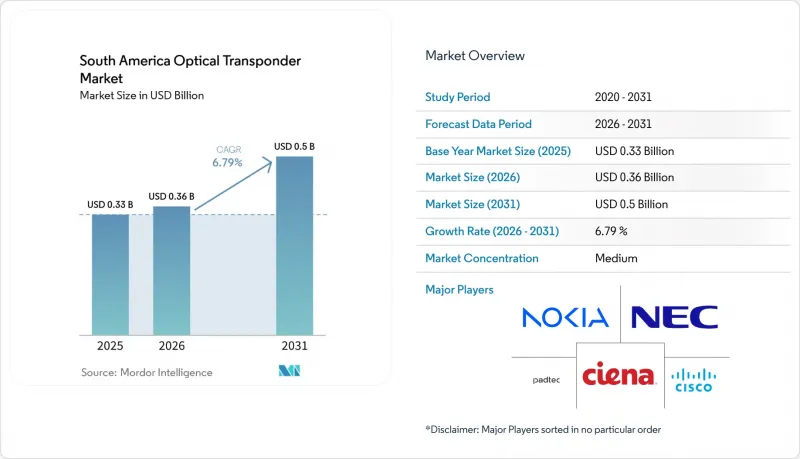
에 따르면 남미의 광 트랜스폰더 시장 규모는 2025년에 3억 3,000만 달러, 2026년에 3억 6,000만 달러에 달하고, 2031년까지 5억 달러에 달할 것으로 예측되며, 2026년부터 2031년까지 CAGR 6.79%로 성장할 것으로 전망됩니다.
남미 광 트랜스폰더 시장의 동향 및 분석
5G 및 광 백홀의 용량 확대
5G 미드밴드 구축에 따라 애그리게이션 노드에서 백홀에 대한 스펙트럼 요구 사항이 증가하고 있습니다. 섹터당 수요는 4G 애그리게이션의 10배에 달할 가능성이 있으며, 마이크로파 링크로는 더욱 고밀도화된 트래픽 부하에 필요한 용량을 제공할 수 없습니다. Telecom Argentina는 2025년 말까지 1,000곳의 5G 기지국을 가동하고, 2026년 말까지 2,000곳 이상을 목표로 하는 한편, Claro Argentina는 2026년 중 광섬유 및 5G에 5억 달러를 투자하겠다고 밝혔습니다. ‘OpenRAN&Brasil’ 프로그램은 RNP 네트워크를 MPLS 아키텍처에서 SRv6 프로토콜로 현대화하고 있으며, 이를 통해 보다 개방적인 무선 액세스 구축을 위한 전송 계획을 지원하고 있습니다. 이러한 전개로 인해, 기존에는 트래픽 밀도가 낮아 대용량 광통신에 대한 투자가 적었던 지방 도시에서도 일관된 전송 요건이 요구되고 있습니다. 따라서 남미의 광 트랜스폰더 시장은 기존의 장거리 회선뿐만 아니라 액세스 네트워크 및 집약 네트워크에서도 수요를 확보하고 있습니다.
클라우드, AI 및 데이터센터 간 연결 트래픽의 성장
AI 워크로드는 버스트성 트래픽을 발생시키며, 데이터센터 간에 저지연 및 예측 가능한 광통신 용량을 필요로 합니다. 에퀴닉스(Equinix)는 1억 1,400만 달러를 투자하여 2026년 4월 산타나 데 파르나이바에 AI 지원 SP6 사이트를 개설했습니다. 또한, 테크토 데이터센터(Tecto Data Centers)는 2028년까지 브라질 내 5개 시설을 대상으로 20억 달러 규모의 확장 계획을 발표했습니다. Brasscom사는 2025년 브라질의 데이터센터 투자액을 90억 달러(이 중 70억 달러는 설비 투자)로 예측하고 있으며, 2031년까지의 누적 투자액은 920억 달러(이 중 690억 달러는 설비 투자)에 달할 것으로 전망하고 있습니다. 이는 상호연결 용량의 견고한 기반을 확립하는 것입니다. Cirion사는 브라질 내 70곳 이상의 데이터센터를 연결하는 ‘DC Connect’ 서비스를 통해, 1.6 Tb/s의 단일 캐리어 파장을 지원하는 Ciena사의 WaveLogic 6 Extreme 기술을 도입하고 있습니다. 그 결과, 남미의 광 트랜스폰더 시장은 용량, 도달 거리, 지연을 종합적으로 평가하는 더 대용량의 상호연결 서비스로 전환되고 있습니다.
통화 약세와 수입 장비 비용 상승
코히어런트 광 트랜스폰더 장비의 90% 이상이 해외에서 조달되고 있기 때문에 브라질 레알의 가치 하락으로 인해 현지 통화 기준 장비 비용이 10%에서 15%까지 상승할 가능성이 있습니다. 이러한 압박은 소규모 인터넷 서비스 제공업체의 설비 투자 여력을 위축시키고, 장비 교체 주기를 장기화시킬 우려가 있습니다. Telecom Argentina는 2025년에 설비 투자를 대폭 늘려 관련 압박을 상쇄했으나, 소규모 지역 사업자의 경우 환율 변동을 관리할 수 있는 선택지가 제한적입니다. 대형 통신 사업자는 헤지 거래나 달러 표시 조달 계약을 활용할 수 있지만, 지역 사업자는 일반적으로 현지에서 발생하는 비용 상승을 직접 부담할 수밖에 없습니다. 따라서 남미의 광 트랜스폰더 시장에서는 대형 사업자와 중소 사업자 간에 조달 조건에 격차가 발생하고 있습니다.
부문 분석
2025년, 코히어런트 전송 기술은 지역 매출의 80.39%를 차지했으며, 2031년까지 연평균 성장률(CAGR) 7.45%로 확대될 것으로 전망됩니다. 남미 광 트랜스폰더 시장에서 디지털 신호 처리(DSP) 플랫폼의 시장 지위는 장거리 네트워크에서 스펙트럼 효율성과 적응형 전송 거리를 제공할 수 있는 능력을 반영합니다. 확률적 콘스텔레이션 셰이핑은 사업자가 링크 상황에 따라 용량을 조정할 수 있도록 지원함으로써 이러한 성능 요건을 뒷받침합니다. 네트워크 사업자들은 장거리 또는 변동하는 트래픽 패턴으로 인해 고정된 전송 설정이 적합하지 않은 경우 이러한 기능을 활용하고 있습니다. 또한, 코히어런트 플랫폼은 백본 현대화 및 데이터센터 간 상호연결에 필요한 더 높은 채널 속도도 지원합니다.
비코히어런트 시스템은 트래픽 양이나 거리 측면에서 코히어런트 디지털 신호 프로세서의 비용이 효율적이지 않은 80km 미만의 캠퍼스 내 및 도시권 내 링크에서 여전히 중요한 역할을 수행하고 있습니다. 다만, 용량 집약형 구축에서 코히어런트 플러그인 가능 모듈이 비트당 비용 면에서 코히어런트 시스템에 가까워지고 있기 때문에 그 역할은 점차 축소되고 있습니다. EletroNet은 백본 현대화를 위해 노키아의 1830 PSS 및 1830 GX 플랫폼을 채택하여 최대 1.2 Tb/s의 채널 속도를 실현했습니다. 이 프로젝트는 800 Gbps를 초과하는 코히어런트 용량이 브라질의 장거리 경로에서 실용적인 조달 옵션이 되고 있음을 보여줍니다. 이러한 기술적 전환을 통해 통신 사업자, 인터넷 서비스 제공업체 및 데이터센터의 각 네트워크에서 보다 일관된 장비 도입 접근 방식이 가능해집니다.
2025년, 100 Gbps에서 400 Gbps의 대역폭 계층은 지역 전체 매출의 49.16%를 차지했습니다. 남미의 광 트랜스폰더 시장에서 이 대역폭 계층은 통신 사업자와 인터넷 서비스 제공업체에게 주요 상용 선택지가 되어, 구형 100G 장비를 대체하고 있습니다. Padtec은 남미 전역에서 TMD400G 1,000대를 판매했다고 보고했으며, 이는 전환이 지역 인터넷 서비스 제공업체의 네트워크까지 확대되고 있음을 보여줍니다. 유연한 속도 지원 400G 시스템을 통해 사업자는 기존 채널 속도를 향상시킬 수 있으며, 개별적인 단일 속도 100G 장비를 별도로 조달할 필요성이 줄어듭니다. 이 기능 덕분에 이 대역은 광범위한 네트워크 업데이트 프로그램에 적합합니다.
최대 100 Gbps 대역은 트래픽 증가 시 더 높은 속도를 지원할 수 있는 유연한 플랫폼을 사업자들이 선호함에 따라 시장 점유율이 하락하고 있습니다. 400 Gbps에서 800 Gbps 대역은 용량 수요가 증가하고 있으며, 도입 조건이 다양한 국내 백본 업그레이드의 과도기적 단계로 기능하고 있습니다. 800 Gbps를 초과하는 대역폭은 해저 케이블 종단, 하이퍼스케일 상호연결 및 차세대 백본 프로젝트에 힘입어 2031년까지 연평균 성장률(CAGR) 11.60%를 기록할 것으로 예측됩니다. Eletronet의 현대화 프로그램을 통해 채널당 최대 1.2 Tb/s가 가능해짐에 따라, 대용량 백본 조달로의 전환이 나타나고 있습니다. 따라서 남미의 광 트랜스폰더 시장에서는 400G를 판매량의 기반으로 유지하면서, 더 대용량인 플랫폼의 채택이 확대되고 있습니다.
기타 혜택:
- 엑셀 형식의 시장 예측(ME) 시트
- 3개월간의 애널리스트 지원
자주 묻는 질문
목차
제1장 소개
- 조사 가정과 시장 정의
- 조사 범위
제2장 조사 방법
제3장 주요 요약
제4장 시장 구도
- 시장 개요
- 시장 성장 촉진요인
- 시장 성장 억제요인
- 업계 밸류체인 분석
- 규제 상황
- Porter's Five Forces 분석
- 거시경제 요인이 시장에 미치는 영향
제5장 시장 규모와 성장 예측
- 전송 기술별
- 데이터 레이트별
- 네트워크 용도별
- 최종사용자별
- 국가별
- 브라질
- 아르헨티나
- 기타 남미 국가
제6장 경쟁 구도
- 시장 집중도
- 전략적 동향
- 시장 점유율 분석
- 기업 개요
- Ciena Corporation
- Nokia Corporation
- Huawei Technologies Co., Ltd.
- Cisco Systems, Inc.
- ZTE Corporation
- NEC Corporation
- Padtec S.A.
- Datacom S.A.(Intelbras S.A.)
- Ribbon Communications Inc.
- Juniper Networks, Inc.
- Coherent Corp.
- Lumentum Holdings Inc.
- FiberHome Telecommunication Technologies Co., Ltd.
제7장 시장 기회와 향후 전망
KSM 26.10.30According to Mordor Intelligence, the South America optical transponder market size is projected to be USD 0.33 billion in 2025, USD 0.36 billion in 2026, and reach USD 0.5 billion by 2031, growing at a CAGR of 6.79% from 2026 to 2031.
South America Optical Transponder Market Trends and Insights
5G and Fiber-Backhaul Capacity Expansion
5G mid-band deployment is increasing backhaul spectral requirements at aggregation nodes, where demand can be 10 times greater per sector than for 4G aggregation, and microwave links do not provide the capacity needed for denser traffic loads. Telecom Argentina closed 2025 with 1,000 5G sites and targets more than 2,000 sites by the end of 2026, while Claro Argentina committed USD 500 million to fiber and 5G during 2026. The "OpenRAN@Brasil" program is modernizing the RNP network from an MPLS architecture to SRv6 protocols, thereby supporting transport planning for more open radio access deployments. These deployments bring coherent transport requirements to secondary cities, where historically lower traffic density has supported fewer high-capacity optical investments. The South America optical transponder market, therefore, gains demand from access and aggregation networks as well as from established long-haul corridors.
Cloud, AI, and Data Center Interconnect Traffic Growth
AI workloads generate bursty traffic that requires low-latency, predictable optical capacity between data center locations. Equinix opened the AI-ready SP6 site in Santana de Parnaiba in April 2026 after investing USD 114 million, and Tecto Data Centers announced a USD 2 billion expansion plan for 5 facilities in Brazil through 2028. Brasscom projected USD 9 billion in Brazilian data center investment in 2025, including USD 7 billion for equipment, and a cumulative investment of USD 92 billion through 2031, including USD 69 billion in equipment, which establishes a strong base for interconnection capacity. Cirion is deploying Ciena WaveLogic 6 Extreme technology for 1.6 Tb/s single-carrier wavelengths through its DC Connect service, which connects more than 70 data centers in Brazil. The South America optical transponder market is consequently moving toward higher-capacity interconnection services, in which capacity, reach, and latency are assessed together.
Currency Depreciation and Imported Equipment Cost Inflation
More than 90% of coherent optical transponder equipment is sourced internationally, so depreciation of the Brazilian real can increase local-currency equipment costs by 10% to 15%. This pressure reduces available capital expenditure at smaller internet service providers and can lengthen their equipment replacement cycles. Telecom Argentina absorbed related pressure through a major increase in capital expenditure in 2025, but smaller regional providers have fewer options for managing currency volatility. Large carriers can use hedging arrangements or U.S.-dollar procurement contracts, whereas regional providers generally face the local cost increase directly. The South America optical transponder market, therefore, has uneven purchasing conditions between large operators and smaller providers.
Other drivers and restraints analyzed in the detailed report include:
- Hyperscale And Carrier Investment In High-Capacity Subsea Routes
- Regional Migration From 100G To 400G And 800G Coherent Wavelengths
- Fragmented Certification And Type-Approval Requirements
For complete list of drivers and restraints, kindly check the Table Of Contents.
Segment Analysis
Coherent transmission technology accounted for 80.39% of regional revenue in 2025 and is projected to expand at a 7.45% CAGR through 2031. In the South America optical transponder market, the market position reflects the ability of digital signal processor platforms to provide spectral efficiency and adaptable reach over long network spans. Probabilistic constellation shaping supports these performance requirements by helping operators adjust capacity to link conditions. Network operators use these features where long distances and changing traffic patterns make fixed transmission settings less suitable. Coherent platforms also support the higher channel rates needed for backbone modernization and data center interconnection.
Non-coherent systems remain relevant for campus and intra-metro links below 80 km, where traffic volumes and distances do not always justify the costs of coherent digital signal processors. Their role is narrowing as coherent pluggable modules move closer to cost parity on a per-bit basis for capacity-intensive deployments. Eletronet selected Nokia 1830 PSS and 1830 GX platforms for its backbone modernization, enabling channel speeds of up to 1.2 Tb/s. The project shows that coherent capacity above 800 Gbps is becoming a practical procurement option for Brazilian long-haul routes. This technology shift supports a more consistent equipment approach across carrier, internet service provider, and data center networks.
The above 100 Gbps to 400 Gbps tier held 49.16% of regional revenue in 2025. Within the South America optical transponder market, this tier is the main commercial choice for carriers and internet service providers, replacing older 100G equipment. Padtec reported sales of 1,000 TMD400G units across South America, which indicates that the transition has reached regional internet service provider networks. Flexible-rate 400G systems allow operators to increase channel rates in place, reducing the need to procure separate single-rate 100G equipment. This capability makes the tier suitable for broad network refresh programs.
The up to 100 Gbps tier is losing value share as operators favor flexible platforms that can support higher rates when traffic rises. The above 400 Gbps to 800 Gbps tier serves as a transition stage for national backbone upgrades where capacity needs are rising, but deployment conditions vary. The above 800 Gbps tier is projected to record an 11.60% CAGR through 2031, supported by subsea terminations, hyperscale interconnection, and next-generation backbone projects. Eletronet's modernization program enables up to 1.2 Tb/s per channel, indicating a shift toward higher-capacity backbone procurement. The South America optical transponder market has therefore retained 400G as its volume base while increasing adoption of higher-capacity platforms.
Complete Report Scope:
- By Transmission Technology
- Coherent
- Non-Coherent
- By Data Rate
- Up to 100 Gbps
- Above 100 Gbps to 400 Gbps
- Above 400 Gbps to 800 Gbps
- Above 800 Gbps
- By Network Application
- Metro
- Long-Haul
- Data Center Interconnect
- Submarine
- Other Network Applications
- By End-User
- Telecommunication Service Providers
- Cloud and Hyperscale Data Center Operators
- Enterprises
- Government and Defense
- Other End-Users
- By Country
- Brazil
- Argentina
- Rest of South America
List of Companies Covered in this Report:
- Ciena Corporation
- Nokia Corporation
- Huawei Technologies Co., Ltd.
- Cisco Systems, Inc.
- ZTE Corporation
- NEC Corporation
- Padtec S.A.
- Datacom S.A. (Intelbras S.A.)
- Ribbon Communications Inc.
- Juniper Networks, Inc.
- Coherent Corp.
- Lumentum Holdings Inc.
- FiberHome Telecommunication Technologies Co., Ltd.
Additional Benefits:
- The market estimate (ME) sheet in Excel format
- 3 months of analyst support
TABLE OF CONTENTS
1 INTRODUCTION
- 1.1 Study Assumptions and Market Definition
- 1.2 Scope of the Study
2 RESEARCH METHODOLOGY
3 EXECUTIVE SUMMARY
4 MARKET LANDSCAPE
- 4.1 Market Overview
- 4.2 Market Drivers
- 4.2.1 5G and Fiber-Backhaul Capacity Expansion
- 4.2.2 Cloud, AI, and Data-Center Interconnect Traffic Growth
- 4.2.3 Hyperscale and Carrier Investment in High-Capacity Subsea Routes
- 4.2.4 Regional Migration From 100G to 400G and 800G Coherent Wavelengths
- 4.2.5 Brazil's OPGW-Based Backbone and Edge-Data-Center Expansion
- 4.2.6 Open Optical Networking Adoption Among Regional ISPs
- 4.3 Market Restraints
- 4.3.1 Currency Depreciation and Imported-Equipment Cost Inflation
- 4.3.2 Fragmented Certification and Type-Approval Requirements
- 4.3.3 Shortage of Coherent-Optics Engineering and Field-Service Skills
- 4.3.4 Legacy-Fiber Reach, Power, and Site-Economics Constraints Outside Major Hubs
- 4.4 Industry Value Chain Analysis
- 4.5 Regulatory Landscape
- 4.6 Porter's Five Forces Analysis
- 4.6.1 Threat of New Entrants
- 4.6.2 Bargaining Power of Suppliers
- 4.6.3 Bargaining Power of Buyers
- 4.6.4 Threat of Substitutes
- 4.6.5 Competitive Rivalry
- 4.7 Impact of Macroeconomic Factors on the Market
5 MARKET SIZE AND GROWTH FORECASTS (VALUE)
- 5.1 By Transmission Technology
- 5.1.1 Coherent
- 5.1.2 Non-Coherent
- 5.2 By Data Rate
- 5.2.1 Up to 100 Gbps
- 5.2.2 Above 100 Gbps to 400 Gbps
- 5.2.3 Above 400 Gbps to 800 Gbps
- 5.2.4 Above 800 Gbps
- 5.3 By Network Application
- 5.3.1 Metro
- 5.3.2 Long-Haul
- 5.3.3 Data Center Interconnect
- 5.3.4 Submarine
- 5.3.5 Other Network Applications
- 5.4 By End-User
- 5.4.1 Telecommunication Service Providers
- 5.4.2 Cloud and Hyperscale Data Center Operators
- 5.4.3 Enterprises
- 5.4.4 Government and Defense
- 5.4.5 Other End-Users
- 5.5 By Country
- 5.5.1 Brazil
- 5.5.2 Argentina
- 5.5.3 Rest of South America
6 COMPETITIVE LANDSCAPE
- 6.1 Market Concentration
- 6.2 Strategic Moves
- 6.3 Market Share Analysis
- 6.4 Company Profiles (includes Global Level Overview, Market Level Overview, Core Segments, Financials as available, Strategic Information, Market Rank/Share, Products and Services, Recent Developments)
- 6.4.1 Ciena Corporation
- 6.4.2 Nokia Corporation
- 6.4.3 Huawei Technologies Co., Ltd.
- 6.4.4 Cisco Systems, Inc.
- 6.4.5 ZTE Corporation
- 6.4.6 NEC Corporation
- 6.4.7 Padtec S.A.
- 6.4.8 Datacom S.A. (Intelbras S.A.)
- 6.4.9 Ribbon Communications Inc.
- 6.4.10 Juniper Networks, Inc.
- 6.4.11 Coherent Corp.
- 6.4.12 Lumentum Holdings Inc.
- 6.4.13 FiberHome Telecommunication Technologies Co., Ltd.
7 MARKET OPPORTUNITIES AND FUTURE OUTLOOK
- 7.1 White-Space and Unmet-Need Assessment


