

|
시장보고서
상품코드
2157033
유럽의 광트랜스폰더 : 시장 점유율 분석, 업계 동향과 통계, 성장 예측(2026-2031년)Europe Optical Transponder - Market Share Analysis, Industry Trends & Statistics, Growth Forecasts (2026 - 2031) |
||||||
 Mordor Intelligence
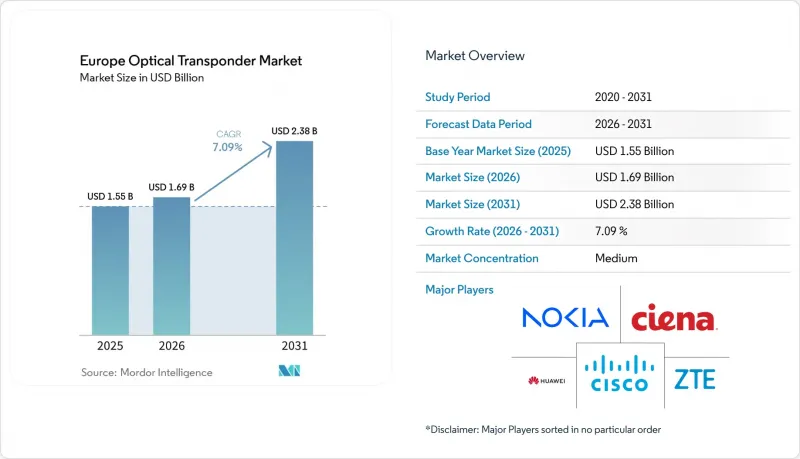
에 따르면 유럽의 광트랜스폰더 시장 규모는 2025년 15억 5,000만 달러에서 2026년에는 16억 9,000만 달러로 확대하며, 2026-2031년에 CAGR 7.09%로 추이하며, 2031년까지 23억 8,000만 달러에 달할 것으로 예측됩니다.
유럽 광 트랜스폰더 시장의 동향 및 인사이트
AI 및 하이퍼스케일러에 의한 데이터센터 상호 연결 확대
AI 훈련 시스템에서는 단일 사이트가 아닌 여러 데이터센터를 활용하는 사례가 늘어나고 있으며, 시설 간 고속 및 직접 연결에 대한 수요가 높아지고 있습니다. 이러한 분산형 워크로드에는 캠퍼스, 메트로, 지역 간 경로를 통해 저지연으로 데이터를 전송할 수 있는 대용량 코히어런트 트랜스폰더가 필요합니다. 노키아는 2026년 1분기에 8억 2,100만 유로(9억 5,900만 달러)의 광 네트워크 매출을 기록했으며, 하이퍼스케일 데이터센터 고객의 수요가 실적을 지원하고 있습니다. 클라우드 제공업체는 통신사업자가 주도하는 입찰 과정을 거치지 않고도 광 시스템을 조달할 수 있으므로 이러한 수요 덕분에 벤더는 더 대규모의 직접 고객 기반을 확보할 수 있습니다. 프랑크푸르트, 암스테르담, 파리, 더블린 및 기타 연결된 거점에서 통신사업자가 주요 데이터센터 클러스터를 확장함에 따라 유럽의 광 트랜스폰더 시장은 혜택을 볼 것입니다.
5G 독립형(SA) 방식의 백홀 및 미드홀 용량 증설
독립형 5G 네트워크에는 무선 기지국, 엣지 시스템, 코어 네트워크 간의 안정적이고 지연 시간이 짧은 전송이 필요합니다. 기존의 SDH 및 멀티서비스 전송 플랫폼은 이러한 링크가 요구하는 타이밍 및 용량 요건을 충족하도록 설계되지 않았습니다. 고밀도 도시 지역 광섬유 네트워크는 공유 경로에서 고정형 광대역과 모바일 백홀을 동시에 지원할 수 있으며, 기존 인프라의 활용 효율을 높입니다. 이로 인해 광섬유 액세스와 5G 전송을 동시에 업그레이드하는 통신사업자에게 코히어런트 파장 시스템의 유용성이 높아집니다. 각 전송 업그레이드가 여러 네트워크 서비스를 지원할 수 있으므로 유럽의 광 트랜스폰더 시장은 이러한 시너지 효과로 인해 혜택을 보고 있습니다.
전용 코히어런트 DSP 및 포토닉 패키지에 대한 의존
고급 코히어런트 시스템은 전용 디지털 신호 프로세서, 인듐 인화물(InP) 기반 포토닉 부품, 그리고 대용량 제조 공정에 의존하고 있습니다. 가용성 제약으로 인해 통신사업자가 신규 노선에 대한 자금 조달을 확약했더라도 장비 납품이 지연될 가능성이 있습니다. 이러한 제약은 첨단 부품 및 패키징이 필요한 800G 및 향후 1.6 Tbps 제품에서 가장 두드러집니다. 노키아는 2025년 2월 28일, 인피넬라(Infinera)를 23억 달러에 인수하는 절차를 완료하고, 해당 회사의 인듐 인화물 포토닉 집적회로 기술을 자사의 광 네트워크 사업에 통합했습니다. 유럽의 광 트랜스폰더 시장은 해당 지역 네트워크 사업자의 영향력을 훨씬 뛰어넘는 요인에 의해 결정되는 공급 상황의 영향을 계속 받고 있습니다.
부문별 분석
2025년, 코히어런트 기술은 유럽 광 트랜스폰더 시장 점유율의 82.34%를 차지하고 있으며, 이는 메트로, 장거리, 해저 회선 등 폭넓은 용도로 채택되고 있음을 반영합니다. 이 기술은 한 쌍의 광섬유당 더 많은 데이터를 전송할 수 있으며, 용량과 도달 거리가 가장 중요한 경로에 적합합니다. RETN사는 2026년 7월, 자사의 IP/MPLS 백본 트래픽의 50%가 400G 코히어런트 ZR 및 ZR+ 인프라를 통해 전송되고 있다고 발표했습니다. 이 도입은 300km에서 950km의 백본 링크를 대상으로 하며, 코히어런트 플러그형 장비가 시험 단계에서 표준 네트워크 설계로 전환되었음을 보여줍니다. 비코히어런트 장비는 코히어런트 시스템의 추가 처리가 필요 없는 단거리 연결이나 레거시 액세스 네트워크에서 여전히 중요한 역할을 수행하고 있었습니다. 그러나 점점 더 많은 액세스 네트워크와 메트로 네트워크가 대용량 아키텍처로 전환됨에 따라 그 역할은 제한적으로 변하고 있었습니다.
이 부문은 2031년까지 연평균 성장률(CAGR) 7.72%로 확대될 것으로 예측되며, 이 기술 그룹 내에서 가장 높은 성장률을 보이고 있습니다. Coherent Corp.는 2025년 9월, 양방향 애플리케이션을 위한 듀얼 레이저 100G ZR QSFP28 모듈을 발표하며 코히어런트 기술의 적용 범위를 액세스 환경으로 확대했습니다. 이러한 움직임은 코히어런트 장비와 다이렉트 디텍트 장비의 경제적 경계가 더 짧은 거리의 링크로 이동하고 있음을 시사합니다. 노키아는 OFC 2026에서 캠퍼스, 메트로, 데이터센터 간 연결, 장거리 및 해저 용도를 위한 새로운 코히어런트 제품군을 발표했습니다. 이 제품군은 단일 시스템 설계에 의존하지 않고, 다양한 거리와 용량 요구 사항을 충족하도록 설계되었습니다. 유럽의 광 트랜스폰더 시장에서는 통신사업자들이 여러 네트워크 계층에 걸친 공통된 전송 방식을 추구하는 가운데, 앞으로도 코히어런트 기술이 주류를 이룰 전망입니다.
2025년, 유럽의 광 트랜스폰더 시장에서 100Gbps 초과-400Gbps 대역이 45.19%를 차지했습니다. 400G 장비는 널리 도입되어 있으며, 통신사업자에게도 친숙한 기술이기 때문에 이 대역은 확립된 장거리 회선 및 대규모 메트로 회선의 실용적인 백본으로서의 지위를 유지했습니다. 한편, 최대 100Gbps 대역은 기존 액세스 회선, 기업 엣지 및 저용량 연결을 계속해서 지원했습니다. 400Gbps 초과-800Gbps 대역은 업그레이드가 필요하지만, 네이티브 800G 링크를 중심으로 네트워크를 재설계할 준비가 아직 되지 않은 고객을 지원했습니다. Arelion사는 2025년 2월, 스톡홀름과 함부르크 간 1,069km 구간에 걸쳐 800G ZR+IP 트래픽을 전송하는 현장 시험을 완료했습니다. 이 시험에서 해당 노선에 이전에 사용되던 기술과 비교하여 설비 투자가 66% 감소하고 운영비가 95% 절감된 것으로 보고되었습니다.
앞서 언급한 800Gbps 대역은 2031년까지 연평균 성장률(CAGR) 12.81%로 성장할 것으로 예측되며, 데이터 속도 부문에서 가장 빠르게 성장하는 분야가 될 전망입니다. 데이터센터 간이나 지역 허브 간에 AI 워크로드로 인해 대용량이 요구되는 상황에서 더 고속의 장비가 도입되고 있습니다. Marvell사는 2026년 3월, 1.6T ZR 및 ZR+를 지원하는 플러그인형 모듈 ‘COLORZ 1600’과 새로운 800G 플러그인형 모듈을 발표했습니다. 이 제품들은 800G에서 최대 1,000km의 메트로 AI 상호 연결 및 600G에서 최대 2,000km의 지역 간 링크를 위해 설계되었습니다. 유럽의 고속 장비용 광 트랜스폰더 시장 규모는 데이터센터 아키텍처, 전력 효율, 그리고 기존 광섬유 시스템의 지원 현황에 따라 결정됩니다. 800G+ 시스템에 대한 수요는 호환 가능한 라우터, 회선 시스템 및 광 컴포넌트의 가용성에 좌우될 것입니다.
기타 혜택:
- 엑셀 형식의 시장 예측(ME) 시트
- 3개월간의 애널리스트 지원
자주 묻는 질문
목차
제1장 서론
- 조사 전제조건과 시장 정의
- 조사 범위
제2장 조사 방법
제3장 개요
제4장 시장 구도
- 시장 개요
- 시장 성장 촉진요인
- 시장 성장 억제요인
- 업계 밸류체인 분석
- 규제 상황
- Porter's Five Forces 분석
- 거시경제 요인이 시장에 미치는 영향
제5장 시장 규모와 성장 예측
- 전송 기술별
- 데이터 레이트별
- 네트워크 애플리케이션별
- 최종사용자별
- 국가별
- 독일
- 영국
- 프랑스
- 이탈리아
- 스페인
- 기타 유럽 국가
제6장 경쟁 구도
- 시장 집중도
- 전략적 동향
- 시장 점유율 분석
- 기업 개요
- Nokia Corporation
- Huawei Technologies Co., Ltd.
- Ciena Corporation
- Cisco Systems, Inc.
- ADTRAN Holdings, Inc.
- Ekinops S.A.
- ZTE Corporation
- Fujitsu Limited
- NEC Corporation
- Ribbon Communications Inc.
- Coherent Corp.
- Lumentum Holdings Inc.
- Marvell Technology, Inc.
- Broadcom Inc.
- Sumitomo Electric Industries, Ltd.
- Mitsubishi Electric Corporation
- FiberHome Telecommunication Technologies Co., Ltd.
- UfiSpace Co., Ltd.
- Edgecore Networks Corporation
- Smartoptics Group ASA
제7장 시장 기회와 향후 전망
KSA 26.10.30According to Mordor Intelligence, the Europe optical transponder market size is expected to grow from USD 1.55 billion in 2025 to USD 1.69 billion in 2026, and is forecast to reach USD 2.38 billion by 2031, at a 7.09% CAGR over 2026-2031.
Europe Optical Transponder Market Trends and Insights
AI and Hyperscaler Data Center Interconnect Expansion
AI training systems increasingly use multiple data centers rather than a single site, increasing the need for fast, direct connections between facilities. These distributed workloads require high-capacity, coherent transponders that can transport data across campus, metro, and regional routes with low delay. Nokia reported optical network revenue of EUR 821 million (USD 959 million) in the first quarter of 2026, with demand from hyperscale data center customers supporting performance. This demand gives equipment vendors a larger direct customer base, since cloud providers can procure optical systems without using a carrier-led tender. The European optical transponder market benefits when operators expand major data center clusters in Frankfurt, Amsterdam, Paris, Dublin, and other connected locations.
5G Standalone Backhaul and Mid-Haul Capacity Upgrades
Standalone 5G networks require stable, low-latency transport between radio sites, edge systems, and core networks. Older SDH and multiservice transport platforms were not designed to meet the timing and capacity requirements of these links. Dense urban fiber networks can support fixed broadband and mobile backhaul on shared routes, improving the use of existing infrastructure. This makes coherent wavelength systems more useful for operators upgrading both fiber access and 5G transport simultaneously. The Europe optical transponder market gains from this overlap because each transport upgrade can support more than one network service.
Specialized Coherent DSP and Photonic Packaging Dependence
Advanced coherent systems rely on specialized digital signal processors, indium phosphide photonic components, and high-capacity manufacturing processes. Availability constraints can delay equipment deliveries even when operators have committed funding for new routes. The constraint is most visible for 800G and future 1.6 Tbps products, which need advanced components and packaging. Nokia completed its USD 2.3 billion acquisition of Infinera on February 28, 2025, adding Infinera's indium phosphide photonic integrated circuit capability to its optical networking business. The European optical transponder market remains exposed to supply conditions that are determined well beyond the region's network operators.
Other drivers and restraints analyzed in the detailed report include:
- Legacy SDH and SONET Replacement by Flexible-Grid Coherent OTN
- Cross-Border Fiber and Submarine Cable Resilience Investment
- Fragmented National Qualification and Security Reviews
For complete list of drivers and restraints, kindly check the Table Of Contents.
Segment Analysis
Coherent technology held 82.34% of the Europe optical transponder market share in 2025, reflecting its broad use across metro, long-haul, and submarine routes. The technology carries more data over each fiber pair and is suited to routes where capacity and reach matter most. RETN stated in July 2026 that 50% of its IP/MPLS backbone traffic was carried over 400G coherent ZR and ZR+ infrastructure. The deployment covered backbone links from 300 km to 950 km and showed that coherent pluggables had moved from trials into standard network design. Non-coherent equipment remained relevant for short connections and legacy access networks where the additional processing of coherent systems was not needed. Its role was narrower because more access and metro networks were also moving toward higher-capacity architectures.
The segment is projected to expand at a 7.72% CAGR through 2031, the fastest rate within this technology grouping. Coherent Corp. introduced a dual-laser 100G ZR QSFP28 module for bidirectional applications in September 2025, extending coherent options into access environments. This development suggested that the economic boundary between coherent and direct-detect equipment was moving toward shorter links. Nokia presented new coherent product families at OFC 2026 for campus, metro, data center interconnect, long-haul, and subsea use. The product range addressed different distances and capacity needs rather than relying on one system design. The European optical transponder market will continue to favor coherent technology as operators seek a common transport approach across several network layers.
The above-100 Gbps to 400 Gbps tier accounted for 45.19% of the European optical transponder market in 2025. This tier remained the practical backbone for established long-haul and large metro routes because 400G equipment is widely deployed and familiar to operators. The up to 100 Gbps range continued to serve legacy access, enterprise edge, and lower-capacity connections. The above 400 Gbps to 800 Gbps tier supported customers that needed an upgrade but were not yet ready to redesign their networks around native 800G links. Arelion completed a field trial in February 2025 that carried 800G ZR+ IP traffic across 1,069 km between Stockholm and Hamburg. The trial reported a 66% reduction in capital expenditure and a 95% reduction in operating expenditure compared with the earlier technology used on that route.
The above 800 Gbps tier is projected to grow at a 12.81% CAGR through 2031, making it the fastest-growing data-rate segment. Higher-speed equipment is being adopted where AI workloads require more capacity among data centers and between regional hubs. Marvell introduced the COLORZ 1600, a 1.6T ZR and ZR+ pluggable, and a new 800G pluggable in March 2026. The products were designed for metro AI interconnects up to 1,000 km at 800G and regional links up to 2,000 km at 600G. The European optical transponder market size for higher-rate equipment is being shaped by data center architecture, power efficiency, and the readiness of existing fiber systems. Demand for 800G+ systems will depend on the availability of compatible routers, line systems, and optical components.
Complete Report Scope:
- By Transmission Technology
- Coherent
- Non-Coherent
- By Data Rate
- Up to 100 Gbps
- Above 100 Gbps to 400 Gbps
- Above 400 Gbps to 800 Gbps
- Above 800 Gbps
- By Network Application
- Metro
- Long-Haul
- Data Center Interconnect
- Submarine
- Other Network Applications
- By End-User
- Telecommunication Service Providers
- Cloud and Hyperscale Data Center Operators
- Enterprises
- Government and Defense
- Other End-Users
- By Country
- Germany
- United Kingdom
- France
- Italy
- Spain
- Rest of Europe
List of Companies Covered in this Report:
- Nokia Corporation
- Huawei Technologies Co., Ltd.
- Ciena Corporation
- Cisco Systems, Inc.
- ADTRAN Holdings, Inc.
- Ekinops S.A.
- ZTE Corporation
- Fujitsu Limited
- NEC Corporation
- Ribbon Communications Inc.
- Coherent Corp.
- Lumentum Holdings Inc.
- Marvell Technology, Inc.
- Broadcom Inc.
- Sumitomo Electric Industries, Ltd.
- Mitsubishi Electric Corporation
- FiberHome Telecommunication Technologies Co., Ltd.
- UfiSpace Co., Ltd.
- Edgecore Networks Corporation
- Smartoptics Group ASA
Additional Benefits:
- The market estimate (ME) sheet in Excel format
- 3 months of analyst support
TABLE OF CONTENTS
1 INTRODUCTION
- 1.1 Study Assumptions and Market Definition
- 1.2 Scope of the Study
2 RESEARCH METHODOLOGY
3 EXECUTIVE SUMMARY
4 MARKET LANDSCAPE
- 4.1 Market Overview
- 4.2 Market Drivers
- 4.2.1 AI and Hyperscaler Data Center Interconnect Expansion
- 4.2.2 5G Standalone Backhaul and Mid-Haul Capacity Upgrades
- 4.2.3 Legacy SDH/SONET Replacement by Flexible-Grid Coherent OTN
- 4.2.4 Cross-Border Fiber and Submarine Cable Resilience Investment
- 4.2.5 Distributed AI Infrastructure Requiring 800ZR+ Interconnects
- 4.2.6 European Digital Sovereignty and Secure Optical Infrastructure Programs
- 4.3 Market Restraints
- 4.3.1 Specialized Coherent DSP and Photonic Packaging Dependence
- 4.3.2 Fragmented National Qualification and Security Reviews
- 4.3.3 High Integration Cost Across Legacy and Open Optical Networks
- 4.3.4 Skilled Fiber-Deployment Labor Shortages
- 4.4 Industry Value Chain Analysis
- 4.5 Regulatory Landscape
- 4.6 Porter's Five Forces Analysis
- 4.6.1 Threat of New Entrants
- 4.6.2 Bargaining Power of Suppliers
- 4.6.3 Bargaining Power of Buyers
- 4.6.4 Threat of Substitutes
- 4.6.5 Competitive Rivalry
- 4.7 Impact of Macroeconomic Factors on the Market
5 MARKET SIZE AND GROWTH FORECASTS (VALUE)
- 5.1 By Transmission Technology
- 5.1.1 Coherent
- 5.1.2 Non-Coherent
- 5.2 By Data Rate
- 5.2.1 Up to 100 Gbps
- 5.2.2 Above 100 Gbps to 400 Gbps
- 5.2.3 Above 400 Gbps to 800 Gbps
- 5.2.4 Above 800 Gbps
- 5.3 By Network Application
- 5.3.1 Metro
- 5.3.2 Long-Haul
- 5.3.3 Data Center Interconnect
- 5.3.4 Submarine
- 5.3.5 Other Network Applications
- 5.4 By End-User
- 5.4.1 Telecommunication Service Providers
- 5.4.2 Cloud and Hyperscale Data Center Operators
- 5.4.3 Enterprises
- 5.4.4 Government and Defense
- 5.4.5 Other End-Users
- 5.5 By Country
- 5.5.1 Germany
- 5.5.2 United Kingdom
- 5.5.3 France
- 5.5.4 Italy
- 5.5.5 Spain
- 5.5.6 Rest of Europe
6 COMPETITIVE LANDSCAPE
- 6.1 Market Concentration
- 6.2 Strategic Moves
- 6.3 Market Share Analysis
- 6.4 Company Profiles (includes Global Level Overview, Market Level Overview, Core Segments, Financials as available, Strategic Information, Market Rank/Share, Products and Services, Recent Developments)
- 6.4.1 Nokia Corporation
- 6.4.2 Huawei Technologies Co., Ltd.
- 6.4.3 Ciena Corporation
- 6.4.4 Cisco Systems, Inc.
- 6.4.5 ADTRAN Holdings, Inc.
- 6.4.6 Ekinops S.A.
- 6.4.7 ZTE Corporation
- 6.4.8 Fujitsu Limited
- 6.4.9 NEC Corporation
- 6.4.10 Ribbon Communications Inc.
- 6.4.11 Coherent Corp.
- 6.4.12 Lumentum Holdings Inc.
- 6.4.13 Marvell Technology, Inc.
- 6.4.14 Broadcom Inc.
- 6.4.15 Sumitomo Electric Industries, Ltd.
- 6.4.16 Mitsubishi Electric Corporation
- 6.4.17 FiberHome Telecommunication Technologies Co., Ltd.
- 6.4.18 UfiSpace Co., Ltd.
- 6.4.19 Edgecore Networks Corporation
- 6.4.20 Smartoptics Group ASA
7 MARKET OPPORTUNITIES AND FUTURE OUTLOOK
- 7.1 White-Space and Unmet-Need Assessment


