

|
시장보고서
상품코드
2155610
아시아태평양의 광 트랜스폰더 : 시장 점유율 분석, 업계 동향과 통계, 성장 예측(2026-2031년)Asia-Pacific Optical Transponder - Market Share Analysis, Industry Trends & Statistics, Growth Forecasts (2026 - 2031) |
||||||
 Mordor Intelligence
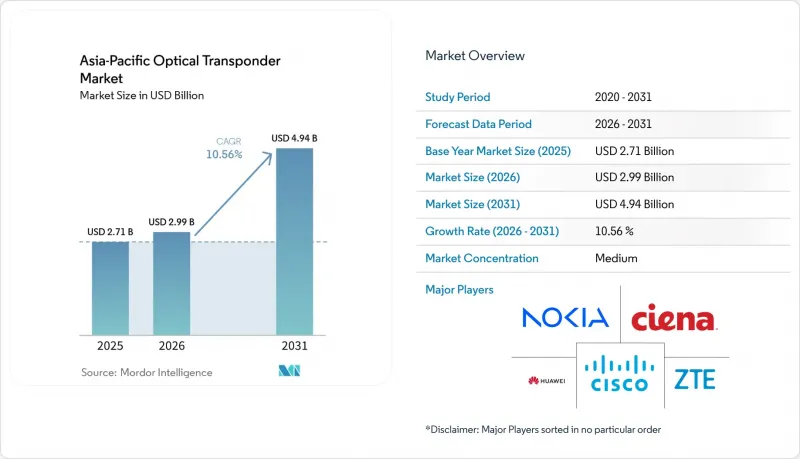
에 따르면 아시아태평양의 광 트랜스폰더 시장 규모는 2025년에 27억 1,000만 달러, 2026년에 29억 9,000만 달러에 달하고, 2031년까지 49억 4,000만 달러에 달할 것으로 예측되며, 2026년부터 2031년까지 CAGR 10.56%로 성장할 것으로 전망됩니다.
아시아태평양 광 트랜스폰더 시장의 동향 및 인사이트
하이퍼스케일러의 AI 트래픽 및 데이터센터 간 상호연결 확대
AI 훈련 및 추론 워크로드에는 서로 다른 위치에 설치된 GPU 클러스터 간에 예측 가능하고 지연 시간이 짧은 대역폭이 필요합니다. 이러한 요구 사항으로 인해 광 전송은 독립적인 백홀 계층이 아닌 컴퓨팅 환경의 일부가 되었습니다. 이에 따라 각 하이퍼스케일러 기업들은 WDM 트랜스폰더의 직접 구매를 늘려 독자적인 데이터센터 상호연결 용량을 구축하고 있습니다. 노키아는 800G ZR 및 ZR+ 플러그인 모듈이 다중 공급원 계약 및 상호 운용성 사양을 통해 폭넓은 지원을 받고 있어, AI 규모의 연결성에서 활용이 가능하다고 밝혔습니다. 아시아태평양의 광 트랜스폰더 시장은 이러한 변화의 영향을 받고 있습니다. 용량 증설을 결정하는 구매자가 더 이상 통신 사업자뿐만이 아니기 때문입니다. 알리바바, 텐센트, 바이트댄스는 이미 중국 및 싱가포르 노선에서 이러한 조달 변화의 흐름에 동참하고 있습니다.
5G 백홀의 고밀도화와 광 백본 업그레이드
마이크로파 백홀에서 광전송으로의 전환으로 인해, 액세스 네트워크 및 애그리게이션 네트워크에서 광통신 장비에 대한 지속적인 수요가 발생하고 있습니다. 독립형(SA) 방식의 5G 구축에서는 비독립형(NSA) 방식의 네트워크보다 더 높은 처리량과 더 낮은 지연 시간이 요구됩니다. 도시 지역의 고밀도 스몰 셀 네트워크에는 400G 및 800G 장비를 포함한 대용량 코히어런트 솔루션이 필요합니다. 반면, 지방이나 교외 지역에서의 구축에서는 충분한 단위 수요를 유지하기 위해 여전히 100G 및 그 이하의 속도를 지원하는 장비가 필요합니다. 인도의 ‘BharatNet’ 프로그램이나 말레이시아의 통신탑 광섬유화 사업은 이러한 저속 요구 사항을 뒷받침하고 있습니다. NTT 도코모는 2025년에 전국 규모의 100G 코히어런트 백홀 구축을 완료하고, 향후 확장 현실(XR) 서비스를 위해 800G ZR+ 광 모듈의 시험 운영을 진행 중이며, 이는 모바일 네트워크 요구 사항이 가입자 동향을 앞지를 가능성이 있음을 시사합니다.
Tier 2 통신 사업자의 설비 투자 동결 및 재고 조정
광 네트워크 업그레이드 주기에 대한 통신 사업자의 참여 상황은 지역에 따라 크게 다릅니다. 동남아시아, 태평양 제도 시장, 한국, 대만의 Tier 2 및 Tier 3 통신 사업자들은 부채 압박, 가입자 수익 부진, 그리고 2022년부터 2024년까지의 조달 주기 동안 축적된 재고 문제에 직면해 있습니다. 이러한 사업자들은 신규 구매를 미루고 이미 설치된 장비를 계속 사용하는 경우가 많습니다. 5G에 대한 투자가 지속되는 상황에서 800G로 업그레이드하는 데 드는 비용을 감당하기 어려울 수 있습니다. 또한, 중국의 주요 통신 사업자들도 지출의 일부를 AI 컴퓨팅 인프라로 전환하고 있어, 기존 WDM 장비에 대한 단기적인 수요를 감소시키고 있습니다. 이러한 불균형한 설비 투자로 인해, 클라우드 및 AI 관련 수요가 견조한 상황에서도 장비 발주가 둔화될 가능성이 있습니다.
부문별 분석
2025년에는 코히어런트 전송이 매출의 81.67%를 차지하며, 아시아태평양의 광 트랜스폰더 시장에서 지배적인 기술이 되었습니다. 이는 통신 사업자의 백본 및 데이터센터 간 연결에서 장거리 통신, 대용량, 그리고 기존 광섬유의 보다 효율적인 활용이 점점 더 요구되고 있기 때문입니다. 2031년까지 연평균 성장률(CAGR) 11.08%로 확대될 것으로 예측되며, 이는 플러그인 방식의 ZR 및 ZR+ 모듈이 더 광범위한 메트로 및 데이터센터 사용 사례에서 다이렉트 디텍트 방식의 장비를 대체하고 있음을 나타냅니다. DSP 비용의 하락으로 인해 코히어런트 기술의 도입 범위는 기존의 장거리 네트워크를 넘어, 그동안 통신 사업자들이 장비 비용을 더 중시해 왔던 단거리 링크까지 확대되고 있습니다. OFC 2026에서는 800G-OpenROADM, 800-ZR, 및 800GBASE-2xFR4 사양을 활용한 1,602km 멀티벤더 800G 실증 실험이 진행되었으며, 상호 운용 가능한 코히어런트 전송의 운영 준비가 완료되었음이 입증되었습니다.
비코히어런트 장비는 도달 거리 제한이나 저비용이 여전히 중요한 데이터센터 내 단거리 연결 및 일부 메트로 액세스 구축에서 계속해서 활용되고 있습니다. 이러한 도입 사례는 특히 용량 요구 사항이 낮은 경우 여전히 수요를 견인하고 있지만, 코히어런트 플러그어블 장비가 더 많은 100G급 메트로 애플리케이션에 적합해짐에 따라 그 적용 범위는 점차 좁아지고 있습니다. 노키아는 2026년 3월, 새로운 DSP와 포토닉 프론트엔드를 특징으로 하는 애플리케이션에 최적화된 코히어런트 솔루션을 발표했습니다. 이는 공급업체들의 개발 작업이 비코히어런트 기술의 새로운 혁신이 아닌, 코히어런트 성능에 중점을 두고 있음을 보여줍니다. NEC는 2025년 3월, 디스어그리게이트형 광 트랜스폰더 및 개방형 광 구축 모델을 지원하는 네트워크 운영체제로 Telecom Infra Project의 ‘피닉스 골드 배지’를 수상했습니다. 신뢰성 높은 코히어런트 DSP의 공급 체계를 확립하지 못한 벤더는, 통신 사업자들이 이 기술을 중심으로 용량 업그레이드를 표준화해 나가는 과정에서 불리한 입장에 놓이게 될 것입니다.
상기 100 Gbps-400 Gbps 대역은 2025년 매출의 47.29%를 차지하고 있으며, 구세대 코히어런트 단말기를 갖춘 광섬유 경로를 이용하는 통신 사업자의 백본 및 데이터센터 간 상호연결 업그레이드 프로그램에서 여전히 중요한 위치를 차지하고 있습니다. 이 대역의 2026년 수요 대부분은 기존 네트워크의 갱신이나 용량 증강에 기인하지만, 800 Gbps 초과 부문의 경우 하이퍼스케일러가 캠퍼스 규모의 AI 상호연결을 구축함에 따라 2031년까지 연평균 성장률(CAGR) 13.43%로 확대될 것으로 예측됩니다. Ciena는 2026년 3월, Vodafone Idea의 인도 국내 전송 네트워크에 WaveLogic 6 Extreme을 도입하여 단일 코히어런트 광 채널에서 1.6 Tb/s를 달성했습니다. 이를 통해 테라비트급 파장이 실제 운영 네트워크에 도입되고 있음을 입증했습니다. 하이퍼스케일러들의 800G ZR 및 ZR+ 플러그인 모듈 구매가 이 대용량 부문을 뒷받침하고 있습니다. 이는 분산형 GPU 클러스터에 별도의 데이터센터 거점에 걸쳐 확장 가능한 고밀도 및 저지연 링크가 필요하기 때문입니다. 그 결과, 아시아태평양의 광 트랜스폰더 시장에서는 400G의 방대한 도입 기반과 800G 이상의 속도를 지원할 수 있는 플랫폼에 대한 급속한 수요 사이에서 균형이 잡히고 있습니다.
앞서 언급한 400 Gbps-800 Gbps 범주는 멀티 레이트 전략을 지원하므로, 통신 사업자는 전체 단말 인프라를 즉시 교체하지 않고도 용량을 추가할 수 있습니다. 최대 100Gbps 범주는 지방 백홀, 공공 광대역 네트워크 및 BharatNet 관련 인프라에서 여전히 중요한 역할을 하고 있으며, 이러한 분야에서는 10G 및 100G 링크가 여전히 명확한 역할을 담당하고 있습니다. 기술이 정착됨에 따라 공급업체 간의 경쟁이 격화되고 있으며, 캐리어 및 엔터프라이즈 네트워크 전반에서 출하량이 여전히 일정 수준을 유지하고 있음에도 불구하고 400G 가격에는 압박이 가해지고 있습니다. Marvell은 2nm 공정의 800G ZR/ZR+ 코히어런트 DSP 플랫폼과 1.6T ZR/ZR+ 플러그인형 모듈 ‘COLORZ 1600’을 발표했습니다. 이는 플러그인형 광 모듈을 통해 이용 가능한 용량이 지속적으로 증가하고 있음을 보여줍니다. 이러한 플랫폼이 이용 가능해짐에 따라 전환 결정이 앞당겨질 가능성이 있으며, 그 결과 벤더들이 성숙한 400G급에 의존해야 하는 기간이 단축될 것입니다.
기타 혜택:
- 엑셀 형식의 시장 예측(ME) 시트
- 3개월간의 애널리스트 지원
자주 묻는 질문
목차
제1장 소개
- 조사 가정과 시장 정의
- 조사 범위
제2장 조사 방법
제3장 주요 요약
제4장 시장 구도
- 시장 개요
- 시장 성장 촉진요인
- 시장 성장 억제요인
- 업계 밸류체인 분석
- 규제 상황
- Porter's Five Forces 분석
- 거시경제 요인이 시장에 미치는 영향
제5장 시장 규모와 성장 예측
- 전송 기술별
- 데이터 레이트별
- 네트워크 용도별
- 최종사용자별
- 국가별
- 중국
- 일본
- 인도
- 한국
- 호주·뉴질랜드
- 기타 아시아태평양 국가
제6장 경쟁 구도
- 시장 집중도
- 전략적 동향
- 시장 점유율 분석
- 기업 개요
- Huawei Technologies Co., Ltd.
- Nokia Corporation
- ZTE Corporation
- Ciena Corporation
- Fujitsu Limited
- Cisco Systems, Inc.
- NEC Corporation
- FiberHome Telecommunication Technologies Co., Ltd.
- Ribbon Communications Inc.
- Tejas Networks Limited
- Sterlite Technologies Limited
- Lumentum Holdings Inc.
- Coherent Corp.
- Accelink Technologies Co., Ltd.
- Sumitomo Electric Industries, Ltd.
- Marvell Technology, Inc.
- Broadcom Inc.
- O-NET Technologies Group Co., Ltd.
제7장 시장 기회와 향후 전망
KSM 26.10.30According to Mordor Intelligence, the Asia-Pacific optical transponder market size is projected to be USD 2.71 billion in 2025, USD 2.99 billion in 2026, and reach USD 4.94 billion by 2031, growing at a CAGR of 10.56% from 2026 to 2031.
Asia-Pacific Optical Transponder Market Trends and Insights
Hyperscaler AI Traffic and Data Center Interconnect Expansion
AI training and inference workloads require predictable, low-latency bandwidth between GPU clusters in separate locations. This requirement makes optical transport part of the computing environment rather than a separate backhaul layer. Hyperscalers are therefore increasing direct purchases of WDM transponders and building their own data center interconnect capacity. Nokia states that 800G ZR and ZR+ pluggables have broad support through multi-source agreements and interoperability specifications, supporting their use in AI-scale connectivity. The Asia-Pacific optical transponder market is affected by this change because carriers are no longer the only buyers who determine capacity additions. Alibaba, Tencent, and ByteDance are already linked to this procurement shift on China and Singapore routes.
5G Backhaul Densification and Fiber Backbone Upgrades
The move from microwave backhaul toward fiber transport creates recurring demand for optical equipment in access and aggregation networks. Standalone 5G deployments need higher throughput and lower latency than non-standalone networks. Dense urban small-cell networks require higher-capacity coherent solutions, including 400G and 800G equipment. Rural and suburban programs still need 100G and lower-speed equipment to preserve meaningful unit demand. India's BharatNet program and Malaysia's tower fiberization work support that lower-speed requirement. NTT DOCOMO completed a nationwide 100G coherent backhaul rollout in 2025 and is trialing 800G ZR+ optics for future extended-reality services, demonstrating how mobile network requirements can outpace subscriber trends.
Tier-2 Carrier Capital Expenditure Freezes and Inventory Corrections
Carrier participation in the optical upgrade cycle varies widely across the region. Tier-2 and Tier-3 carriers in Southeast Asia, Pacific island markets, South Korea, and Taiwan face debt pressure, weaker subscriber revenue, and inventory accumulated during the 2022-2024 procurement cycle. These operators often defer new purchases and continue using installed equipment. The cost of 800G upgrades can be difficult to absorb while 5G commitments remain in place. China's larger carriers have also shifted part of their spending toward AI computing infrastructure, reducing near-term demand for traditional WDM equipment. This uneven capital spending can slow equipment orders even when cloud and AI-related demand remains strong.
Other drivers and restraints analyzed in the detailed report include:
- Government-Backed Broadband and Digital Infrastructure Investment
- Adoption of 400ZR, 800G, and Higher-Capacity Coherent Optics
- Export Controls on Advanced Coherent DSPs and Photonic Components
For complete list of drivers and restraints, kindly check the Table Of Contents.
Segment Analysis
Coherent transmission accounted for 81.67% of revenue in 2025, making it the dominant technology in the Asia-Pacific optical transponder market, as carrier backbones and data center interconnects increasingly require long reach, high capacity, and more efficient use of installed fiber. It is projected to expand at an 11.08% CAGR through 2031, indicating that pluggable ZR and ZR+ modules are replacing direct-detect equipment across a wider set of metro and data center use cases. Lower DSP costs have extended coherent deployment beyond traditional long-haul networks and into shorter links where operators previously placed greater weight on equipment cost. The 1,602 km multi-vendor 800G demonstration at OFC 2026 using 800G-OpenROADM, 800-ZR, and 800GBASE-2xFR4 specifications supports the operational readiness of interoperable coherent transmission.
Non-coherent equipment continues to serve short intra-data-center connections and selected metro access deployments where limited reach and lower cost remain important. These installations still drive demand, particularly where capacity requirements are lower, but their addressable scope is narrowing as coherent pluggables become suitable for more 100G-class metro applications. Nokia introduced application-optimized coherent solutions in March 2026, featuring new DSPs and photonic front-ends, indicating that supplier development work is focused on coherent performance rather than renewed non-coherent innovation. NEC received the Telecom Infra Project Phoenix Gold Badge in March 2025 for a network operating system that supports disaggregated optical transponders and open optical deployment models. Vendors that lack reliable, coherent DSP relationships face a weaker position as operators standardize their capacity upgrades around this technology.
The above 100 Gbps to 400 Gbps band accounted for 47.29% of revenue in 2025 and remains important for carrier backbone and data center interconnect upgrade programs that use fiber routes equipped with earlier generations of coherent terminals. Much of the band's 2026 demand comes from replacement and capacity upgrades on existing networks, while the above 800 Gbps segment is projected to expand at a 13.43% CAGR through 2031 as hyperscalers build campus-scale AI interconnects. Ciena deployed WaveLogic 6 Extreme on Vodafone Idea's India transport network in March 2026 and achieved 1.6 Tb/s on one coherent optical channel, demonstrating that terabit-class wavelengths are moving into operational networks. Hyperscaler purchases of 800G ZR and ZR+ pluggables support this higher-capacity category because distributed GPU clusters require dense, low-latency links that can be expanded across separate data center locations. The Asia-Pacific optical transponder market is consequently balancing a large installed base of 400G with rapid demand for platforms that can support 800G and higher rates.
The above 400 Gbps to 800 Gbps category supports multi-rate strategies, allowing operators to add capacity without immediately replacing their entire terminal base. The up to 100 Gbps category remains relevant for rural backhaul, public broadband networks, and BharatNet-related infrastructure, where 10G and 100G links still have a defined role. Greater supplier competition is putting pressure on 400G pricing as the technology becomes established, even as shipment volumes remain meaningful across carrier and enterprise networks. Marvell introduced a 2nm 800G ZR/ZR+ coherent DSP platform and COLORZ 1600, a 1.6T ZR/ZR+ pluggable, which indicates a continuing rise in the capacity available through pluggable optics. As these platforms become available, migration decisions could occur sooner, reducing the time equipment vendors have to rely on the mature 400G tier.
Complete Report Scope:
- By Transmission Technology
- Coherent
- Non-Coherent
- By Data Rate
- Up to 100 Gbps
- Above 100 Gbps to 400 Gbps
- Above 400 Gbps to 800 Gbps
- Above 800 Gbps
- By Network Application
- Metro
- Long-Haul
- Data Center Interconnect
- Submarine
- Other Network Applications
- By End-User
- Telecommunication Service Providers
- Cloud and Hyperscale Data Center Operators
- Enterprises
- Government and Defense
- Other End-Users
- By Country
- China
- Japan
- India
- South Korea
- Australia and New Zealand
- Rest of Asia-Pacific
List of Companies Covered in this Report:
- Huawei Technologies Co., Ltd.
- Nokia Corporation
- ZTE Corporation
- Ciena Corporation
- Fujitsu Limited
- Cisco Systems, Inc.
- NEC Corporation
- FiberHome Telecommunication Technologies Co., Ltd.
- Ribbon Communications Inc.
- Tejas Networks Limited
- Sterlite Technologies Limited
- Lumentum Holdings Inc.
- Coherent Corp.
- Accelink Technologies Co., Ltd.
- Sumitomo Electric Industries, Ltd.
- Marvell Technology, Inc.
- Broadcom Inc.
- O-NET Technologies Group Co., Ltd.
Additional Benefits:
- The market estimate (ME) sheet in Excel format
- 3 months of analyst support
TABLE OF CONTENTS
1 INTRODUCTION
- 1.1 Study Assumptions and Market Definition
- 1.2 Scope of the Study
2 RESEARCH METHODOLOGY
3 EXECUTIVE SUMMARY
4 MARKET LANDSCAPE
- 4.1 Market Overview
- 4.2 Market Drivers
- 4.2.1 Hyperscaler AI Traffic and Data-Center Interconnect Expansion
- 4.2.2 5G Backhaul Densification and Fiber Backbone Upgrades
- 4.2.3 Government-Backed Broadband and Digital Infrastructure Investment
- 4.2.4 Adoption of 400ZR, 800G, and Higher-Capacity Coherent Optics
- 4.2.5 Singapore-Led Low-Latency Regional Data-Center Interconnection
- 4.2.6 Open, Disaggregated Transponder and Optical Line-System Procurement
- 4.3 Market Restraints
- 4.3.1 Tier-2 Carrier Capital-Expenditure Freezes and Inventory Corrections
- 4.3.2 Export Controls on Advanced Coherent DSPs and Photonic Components
- 4.3.3 Concentrated Indium Phosphide Epitaxy and Advanced-Node DSP Supply
- 4.3.4 Multi-Vendor Integration, Certification, and Field-Engineering Gaps
- 4.4 Industry Value Chain Analysis
- 4.5 Regulatory Landscape
- 4.6 Porter's Five Forces Analysis
- 4.6.1 Threat of New Entrants
- 4.6.2 Bargaining Power of Suppliers
- 4.6.3 Bargaining Power of Buyers
- 4.6.4 Threat of Substitutes
- 4.6.5 Competitive Rivalry
- 4.7 Impact of Macroeconomic Factors on the Market
5 MARKET SIZE AND GROWTH FORECASTS (VALUE)
- 5.1 By Transmission Technology
- 5.1.1 Coherent
- 5.1.2 Non-Coherent
- 5.2 By Data Rate
- 5.2.1 Up to 100 Gbps
- 5.2.2 Above 100 Gbps to 400 Gbps
- 5.2.3 Above 400 Gbps to 800 Gbps
- 5.2.4 Above 800 Gbps
- 5.3 By Network Application
- 5.3.1 Metro
- 5.3.2 Long-Haul
- 5.3.3 Data Center Interconnect
- 5.3.4 Submarine
- 5.3.5 Other Network Applications
- 5.4 By End-User
- 5.4.1 Telecommunication Service Providers
- 5.4.2 Cloud and Hyperscale Data Center Operators
- 5.4.3 Enterprises
- 5.4.4 Government and Defense
- 5.4.5 Other End-Users
- 5.5 By Country
- 5.5.1 China
- 5.5.2 Japan
- 5.5.3 India
- 5.5.4 South Korea
- 5.5.5 Australia and New Zealand
- 5.5.6 Rest of Asia-Pacific
6 COMPETITIVE LANDSCAPE
- 6.1 Market Concentration
- 6.2 Strategic Moves
- 6.3 Market Share Analysis
- 6.4 Company Profiles (includes Global Level Overview, Market Level Overview, Core Segments, Financials as available, Strategic Information, Market Rank/Share, Products and Services, Recent Developments)
- 6.4.1 Huawei Technologies Co., Ltd.
- 6.4.2 Nokia Corporation
- 6.4.3 ZTE Corporation
- 6.4.4 Ciena Corporation
- 6.4.5 Fujitsu Limited
- 6.4.6 Cisco Systems, Inc.
- 6.4.7 NEC Corporation
- 6.4.8 FiberHome Telecommunication Technologies Co., Ltd.
- 6.4.9 Ribbon Communications Inc.
- 6.4.10 Tejas Networks Limited
- 6.4.11 Sterlite Technologies Limited
- 6.4.12 Lumentum Holdings Inc.
- 6.4.13 Coherent Corp.
- 6.4.14 Accelink Technologies Co., Ltd.
- 6.4.15 Sumitomo Electric Industries, Ltd.
- 6.4.16 Marvell Technology, Inc.
- 6.4.17 Broadcom Inc.
- 6.4.18 O-NET Technologies Group Co., Ltd.
7 MARKET OPPORTUNITIES AND FUTURE OUTLOOK
- 7.1 White-Space and Unmet-Need Assessment


