

|
시장보고서
상품코드
2157031
광트랜스폰더 : 시장 점유율 분석, 업계 동향과 통계, 성장 예측(2026-2031년)Optical Transponder - Market Share Analysis, Industry Trends & Statistics, Growth Forecasts (2026 - 2031) |
||||||
 Mordor Intelligence
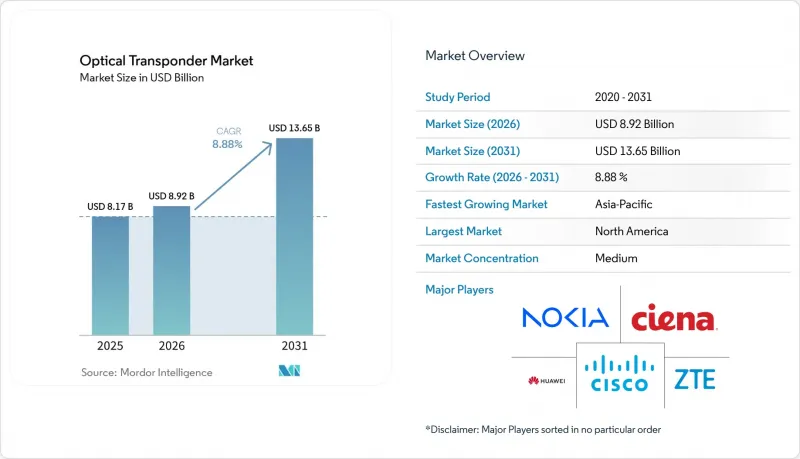
에 따르면 광트랜스폰더 시장 규모는 2025년 81억 7,000만 달러에서 2026년에는 89억 2,000만 달러로 확대하며, 2026-2031년에 CAGR 8.88%로 추이하며, 2031년에는 136억 5,000만 달러에 달할 것으로 예측됩니다.
전 세계 광 트랜스폰더 시장의 동향 및 인사이트
AI 클러스터 및 하이퍼스케일 데이터센터 간 상호 연결 확대
AI 훈련 및 추론 워크로드에서는 풀 라인 속도로 작동하기 위해 다수의 GPU 간 연결이 필요합니다. 구리선을 이용한 대체 수단은 단거리 링크를 초과할 경우, 필요한 거리, 처리량 및 지연 시간 요건을 충족할 수 없습니다. 클라우드 제공업체들은 이전의 트래픽 패턴에 맞춰 설계된 기존 전송 아키텍처에 단순히 포트를 추가하는 대신, 인접 캠퍼스 간 링크를 재설계하고 400G ZR 및 800G ZR+ 코히어런트 플러그어블을 채택하고 있습니다. 이로 인해 광 트랜스폰더 시장에서 독자적인 수요 범주가 생겨나고 있습니다. 이는 이러한 구매자들이 장비를 직접 조달하고, 엄격한 기술 요구 사항을 부과하며, 공급업체에 신속한 도입 일정에 맞춘 플랫폼 제공을 기대하고 있기 때문입니다. Alphabet, Amazon, Meta, Microsoft는 2026년의 주요인프라 투자를 AI 용량 확충에 할당하고 있습니다. NVIDIA는 2026년 3월, Coherent Corp.과 다년간의 계약을 발표했습니다. 여기에는 20억 달러 규모의 주식 투자 및 첨단 광학 제품 구매 약정이 포함되어 있습니다.
100G에서 400G, 800G, 1.6T로의 전환
더 높은 라인 레이트로의 전환에 따라 각 세대마다 디지털 신호 프로세서, 변조 방식, 스펙트럼 효율 목표 및 시스템 통합 접근 방식이 변화하므로 이는 단순한 정기적인 장비 업데이트가 아니라 광범위한 아키텍처 변경이 됩니다. 2024년 2월에 승인된 IEEE Std 802.3df-2024는 2025년까지 공급업체 인증을 지원하는 800G 이더넷 프레임워크를 확립했습니다. 초기 1.6T OSFP224 모듈은 IEEE P802.3dj의 제정이 완료되기 전인 2026년에 양산 출하가 시작될 예정입니다. 새로운 코히어런트 DSP의 각 세대에 대해서는 구매자가 작동 조건 하에서의 신뢰성, 상호 운용성, 전력 소비 및 성능을 평가할 수 있도록 상용 양산이 시작되기 전까지 12-24개월의 통신사 및 하이퍼스케일러 인증 기간이 필요합니다. 이 일정에 따르면 기술 도입 후 2-3년 후에 실질적인 수익을 얻을 수 있게 됩니다. Marvell은 자사의 Electra 2nm 코히어런트 DSP를 채택한 COLORZ 1600을 발표한 반면, Ciena는 2026년에 2nm 실리콘 설계의 1600ZR/ZR+ 플러그인 모듈을 발표했습니다.
코히어런트 DSP, 포토닉 엔진 및 인증에 드는 높은 비용이 도입을 제한
차세대 코히어런트 트랜스폰더 도입에는 DSP 비용 이상의 비용이 소요됩니다. 400G 또는 800G 시스템에는 InP 기반 포토닉 프론트엔드, 고정밀 광 서브어셈블리, 그리고 광범위한 시스템 테스트도 필요합니다. Tier 1 통신사 및 하이퍼스케일러의 인증을 받는 데는 상용 양산이 시작되기까지 12-24개월이 소요될 수 있습니다. Ciena사의 2nm 플랫폼 및 OFC 2026에서 발표된 Nokia사의 4가지 신형 DSP는 2027년 중반에 샘플 제공을 시작할 예정입니다. 이는 코히어런트 제품 개발의 경우 양산을 통해 수익을 창출하기까지 3-4년이 소요될 가능성이 있음을 나타내며, 자금 수요를 높이는 동시에 중소 기술 공급업체의 실행 위험을 더욱 가중시킬 것입니다. 소규모 통신사업자나 기업용 통신사업자는 코히어런트 솔루션이 여전히 고가이며, 트래픽 양이 완전 코히어런트 광전송의 자본 집약성을 정당화할 수 없는 단거리 연결에서 계속해서 그레이 옵틱스를 선택할 가능성이 있습니다.
부문 분석
광 트랜스폰더 시장에서 코히어런트 트랜스폰더는 2025년 매출의 83.22%를 차지하며, 2026-2031년까지 연평균 성장률(CAGR) 9.65%로 성장할 것으로 예상됩니다. 이러한 주도적인 지위는 통신사업자 및 하이퍼스케일러 간의 링크 거리가 80km를 초과하는 사례가 증가하고, 해당 거리에서는 코히어런트 검출이 상업적으로 필요하므로 확립되었습니다. 코히어런트 시스템 분야의 광 트랜스폰더 시장 규모는 구형 100G 장비에서 400G 및 800G 플랫폼으로의 교체에 힘입어 확대되고 있습니다. 또한 새로운 데이터센터 간 상호 연결 및 해저 케이블 설치도 시장 확대에 기여하고 있습니다. 코히어런트 검출 기술을 통해 장거리 전송, 더 높은 스펙트럼 효율, 그리고 대용량 전송이 가능해집니다. 이러한 기능 덕분에 이 기술은 프리미엄 네트워크 구축에서 계속해서 핵심적인 역할을 수행하고 있습니다. 이러한 환경에서 통신사업자들은 열악한 경로에서도 예측 가능한 성능을 필요로 하며, 제한된 광섬유 용량을 보다 효율적으로 활용하기를 원하고 있습니다. 코히어런트 트랜스폰더는 예측 기간 중 여전히 가장 크고 가장 빠르게 성장하는 전송 카테고리입니다.
Coherent Corp., Ciena, Cisco 및 Nokia는 OFC 2026에서 멀티레일 광 라인 시스템을 발표했습니다. 각사는 이러한 시스템을 통해 기존 인라인 증폭 장치에 비해 트랜스폰더 밀도를 최대 75%까지 향상시킬 수 있다고 밝혔습니다. 밀도는 라인 레이트 용량과 함께 중요한 경쟁 요소로 부상하고 있습니다. 비코히어런트 트랜스폰더는 10-40km 거리에 걸친 데이터센터, 캠퍼스 및 액세스 링크에서 계속해서 사용되고 있습니다. 이러한 용도에서는 비용이 저렴하므로 강도 변조 직접 검출(IMDD) 방식의 설계가 선호되는 경향이 있습니다. 노키아는 OFC 2026에서 저전력 단거리 용도를 위한 3.2T 코히어런트 라이트 플러그형 모듈을 발표했습니다. 800G OSFP 및 1.6T OSFP224 모듈의 보급이 확대됨에 따라 단거리 용도의 수요는 코히어런트 방식 또는 하이브리드 방식으로 더욱 이동할 것으로 예상됩니다.
광 트랜스폰더 시장에서 2025년에는 100-400Gbps 대역이 매출의 44.98%를 차지했습니다. 이 도입 기반은 2019-2025년에 완료된 100G, 200G 및 400G의 도입 상황을 반영하고 있습니다. 통신사업자들은 이러한 설비를 지속적으로 유지 관리하는 한편, 갱신 및 계획적인 용량 증설을 위해 장비를 구매하고 있습니다. 800Gbps를 초과하는 부문은 2026-2031년에 연평균 성장률(CAGR) 12.21%로 확대될 것으로 예측됩니다. 800G ZR 및 ZR+ 코히어런트 플러그어블은 하이퍼스케일 데이터센터 상호 연결 네트워크에 도입이 진행되고 있습니다. AI 인프라에 초기 1.6T 모듈이 도입되면서 이러한 수요가 더욱 가속화되고 있습니다. 이는 GPU가 밀집된 시설에서는 광섬유 쌍의 수를 비례적으로 늘리지 않고도 각 컴퓨팅 사이트 전체에 걸쳐 더 큰 용량이 필요하기 때문입니다.
800G 및 그 이상의 속도를 지원하는 광 트랜시버의 출하 대수는 2025년에 2,400만 대에 달할 것으로 예측되었습니다. AI 클러스터 도입이 양산 단계로 접어들면서, 2026년에는 6,300만 대에 육박할 것으로 전망되었습니다. IEEE 802.3df-2024는 2025년에 800G 모듈의 인증 시험 및 통신사 수용 시험을 지원했습니다. IEEE P802.3dj는 2026년 하반기에 완료될 전망이지만, 1.6T OSFP224의 초기 출하가 이미 시작되었습니다. 앞서 언급한 400Gbps에서 800Gbps 대역은 트래픽량이 가장 많은 경로를 업그레이드하는 통신사업자에게 과도기적 역할을 수행합니다. 최대 100Gbps 대역은 시장 점유율이 감소하고 있지만, 액세스 회선 및 기업 간 연결에서 여전히 중요한 위치를 차지하고 있습니다. Marvell사의 COLORZ 1600은 최대 1,000km의 1.6T 링크 및 최대 2,000km의 800G 지역 간 링크를 지원합니다.
지역별 분석
2025년, 북미는 광 트랜스폰더 시장의 35.98%를 차지했습니다. 이 지역에는 하이퍼스케일 AI 인프라 및 데이터센터 간 상호 연결에 대한 투자가 집중되어 있으며, 인접한 시설 간의 대용량 링크에 대한 수요를 지원하고 있습니다. 미국은 버지니아주 북부, 실리콘밸리, 댈러스-포트워스 캠퍼스를 통해 지역 수요의 대부분을 차지했습니다. 이러한 거점에서는 시설 간을 연결하는 대용량 코히어런트 링크가 요구되고 있습니다. 캐나다와 멕시코에서는 통신사업자의 백본 현대화 및 국경을 넘는 연결로 인해 수요가 확대되었습니다.
광 트랜스폰더 시장 전체에서 아시아태평양은 2026-2031년까지 연평균 성장률(CAGR) 10.58%로 확대될 것으로 예측됩니다. 중국은 알리바바, 텐센트, 바이두 및 국영 통신사업자들이 데이터센터 건설을 지원하고 있으며, 중요한 수요 거점이 되고 있습니다. 인도는 릴라이언스 지오(Reliance Jio)의 광섬유망 확장, 바티 에어텔(Bharti Airtel)의 5G 전송망 업그레이드, 그리고 바라트넷(BharatNet)을 통해 네트워크 현대화를 추진하고 있습니다. 일본과 한국에서는 OpenROADM 표준 도입 및 지속적인 5G 전송 용량 확대 프로그램을 통해 수요가 증가하고 있습니다. 동남아시아 국가들은 엣지 데이터센터와 지역내 해저 케이블 상륙의 혜택을 누리고 있습니다.
광 트랜스폰더 시장에서 유럽은 800G 백본 현대화를 위한 통신사업자의 투자로 인해 안정적이고 기술적으로 첨단인 수요 기반을 유지하고 있습니다. 프로크시마스는 벨기에 국내 700곳의 광 노드와 600곳 이상의 DWDM 사이트를 교체하는 ‘NEURON’ 프로그램에 에키노프스(Echinops)를 선정했습니다. 독일, 영국, 프랑스, 네덜란드에서는 통신사업자의 설비 갱신 및 기업용 다크 파이버 회선 구축에 힘입어 지역적 수요가 지원되고 있습니다. 남미는 브라질의 1억 5,700만 레알(3,040만 달러) 규모의 ‘Eletronet’ 현대화 프로그램을 필두로 새로운 투자 지역으로 부상하고 있습니다. 중동 및 아프리카는 여전히 규모는 작지만, 사우디아라비아와 UAE에서 데이터센터 및 육상 광섬유 노선 구축이 진행되고 있습니다.
기타 혜택:
- 엑셀 형식의 시장 예측(ME) 시트
- 3개월간의 애널리스트 지원
자주 묻는 질문
목차
제1장 서론
- 조사 전제조건과 시장 정의
- 조사 범위
제2장 조사 방법
제3장 개요
제4장 시장 구도
- 시장 개요
- 시장 성장 촉진요인
- 시장 성장 억제요인
- 업계 밸류체인 분석
- 규제 상황
- Porter's Five Forces 분석
- 거시경제 요인이 시장에 미치는 영향
제5장 시장 규모와 성장 예측
- 전송 기술별
- 데이터 레이트별
- 네트워크 애플리케이션별
- 최종사용자별
- 지역별
- 북미
- 미국
- 캐나다
- 멕시코
- 남미
- 브라질
- 아르헨티나
- 기타 남미 국가
- 유럽
- 독일
- 영국
- 프랑스
- 이탈리아
- 스페인
- 기타 유럽 국가
- 아시아태평양
- 중국
- 일본
- 인도
- 한국
- 호주·뉴질랜드
- 기타 아시아태평양 국가
- 중동
- 사우디아라비아
- 아랍에미리트
- 기타 중동 국가
- 아프리카
- 남아프리카공화국
- 나이지리아
- 기타 아프리카 국가
- 북미
제6장 경쟁 구도
- 시장 집중도
- 전략적 동향
- 시장 점유율 분석
- 기업 개요
- Huawei Technologies Co., Ltd.
- Ciena Corporation
- Nokia Corporation
- ZTE Corporation
- Cisco Systems, Inc.
- Coherent Corp.
- Lumentum Holdings Inc.
- Ekinops S.A.
- Fujitsu Limited
- NEC Corporation
- Adtran Networks SE
- Ribbon Communications Inc.
- Juniper Networks, Inc.
- Marvell Technology, Inc.
- Broadcom Inc.
- Accelink Technologies Co., Ltd.
- Eoptolink Technology Inc., Ltd.
- Source Photonics, Inc.
- Sumitomo Electric Industries, Ltd.
- Padtec Holding S.A.
제7장 시장 기회와 향후 전망
KSA 26.10.30According to Mordor Intelligence, the optical transponder market size is expected to grow from USD 8.17 billion in 2025 to USD 8.92 billion in 2026, and is forecast to reach USD 13.65 billion by 2031, at an 8.88% CAGR over 2026-2031.
Global Optical Transponder Market Trends and Insights
AI Cluster and Hyperscale Data Center Interconnect Expansion
AI training and inference workloads require many GPU-to-GPU connections to operate at full line rates. Copper alternatives cannot meet the required distance, throughput, and latency needs beyond short links. Cloud providers are redesigning links between nearby campuses to use 400G ZR and 800G ZR+ coherent pluggables, rather than simply adding ports to conventional transport architectures designed for earlier traffic patterns. This is creating a distinct demand category for the optical transponder market because these buyers procure equipment directly, set demanding technical requirements, and expect suppliers to align platforms with fast deployment schedules. Alphabet, Amazon, Meta, and Microsoft are directing major 2026 infrastructure spending toward AI capacity. NVIDIA announced a multiyear agreement with Coherent Corp. in March 2026, including a USD 2 billion equity investment and a purchase commitment for advanced optical products.
Migration From 100G to 400G, 800G, and 1.6T
The transition to higher line rates changes the digital signal processor, modulation format, spectral efficiency target, and system integration approach at each generation, making it a broad architectural change rather than a routine equipment refresh. IEEE Std 802.3df-2024, approved in February 2024, established an 800G Ethernet framework that supported vendor qualification through 2025. Early 1.6T OSFP224 modules are shipping in volume in 2026 before the completion of IEEE P802.3dj. Each new coherent DSP generation requires 12-24 months of carrier and hyperscaler qualification before commercial volumes begin, as buyers evaluate reliability, interoperability, power use, and performance under operating conditions. This timeline means that technical introductions can produce meaningful revenue two to three years later. Marvell introduced COLORZ 1600 using its Electra 2 nm coherent DSP, while Ciena introduced a 2 nm silicon-designed 1600ZR/ZR+ pluggable in 2026.
High Cost of Coherent DSPs, Photonic Engines, and Qualification Limits Adoption
Deploying a next-generation coherent transponder involves more than the cost of its DSP. A 400G or 800G system also requires an InP-based photonic front end, a precise optical subassembly, and extensive system testing. Qualification with tier-1 carriers and hyperscalers can take 12-24 months before commercial volume begins. Ciena's 2 nm platform and Nokia's four new DSPs announced at OFC 2026 are scheduled to begin sampling in mid-2027. This indicates that coherent product development can require three to four years before volume revenue, which raises funding needs and creates greater execution risk for smaller technology suppliers. Smaller carriers and enterprise operators may continue to select gray optics for short-reach connections where coherent solutions remain expensive, and traffic volumes do not yet justify the capital intensity of full coherent optical transport.
Other drivers and restraints analyzed in the detailed report include:
- 5G Backhaul and Broadband Fiber Modernization
- Open and Disaggregated Optical Networking Adoption
- InP, Silicon Photonics, and Advanced Packaging Capacity Constraints
For complete list of drivers and restraints, kindly check the Table Of Contents.
Segment Analysis
In the optical transponder market, coherent transponders accounted for 83.22% of revenue in 2025 and are expected to grow at a 9.65% CAGR from 2026 to 2031. This leading position developed as carrier and hyperscaler links increasingly exceeded 80 km, at which point coherent detection becomes commercially necessary. The optical transponder market size for coherent systems benefits from the replacement of older 100G equipment with 400G and 800G platforms. It also benefits from new data center interconnect and submarine cable installations. Coherent detection enables long-distance transmission, higher spectral efficiency, and large transport capacities. These functions keep the technology central to premium network deployments, where operators need predictable performance across demanding routes and seek to use scarce fiber capacity more efficiently. Coherent transponders remain the largest and fastest-expanding transmission category in the forecast period.
Coherent Corp., Ciena, Cisco, and Nokia introduced multi-rail photonic line systems at OFC 2026. The companies stated that these systems can increase transponder density by up to 75% compared with previous inline amplifier units. Density is becoming a key competitive factor alongside line-rate capacity. Non-coherent transponders continue to serve data center, campus, and access links over distances of 10-40 km. These applications often favor intensity-modulated direct-detection, IMDD, designs because of their lower cost. Nokia introduced a 3.2T coherent lite pluggable at OFC 2026 for lower-power short-reach use. Wider availability of 800G OSFP and 1.6T OSFP224 modules is expected to shift further short-reach demand toward coherent or hybrid designs.
Within the optical transponder market, the 100-400 Gbps tier accounted for 44.98% of revenue in 2025. This installed base reflects 100G, 200G, and 400G deployments completed from 2019 through 2025. Operators continue to maintain these fleets and purchase equipment for replacement and targeted capacity additions. The above 800 Gbps segment is projected to expand at a 12.21% CAGR between 2026 and 2031. 800G ZR and ZR+ coherent pluggables are being deployed in hyperscale data center interconnect networks. Early 1.6T module deployments in AI infrastructure reinforce this demand, as GPU-dense facilities require greater capacity across computing sites without a proportional increase in fiber pairs.
Shipments of 800G- and higher-speed optical transceivers were projected to reach 24 million units in 2025. They were expected to reach nearly 63 million units in 2026 as AI cluster deployments moved into volume implementation. IEEE 802.3df-2024 supported qualification and carrier acceptance testing for 800G modules in 2025. IEEE P802.3dj is expected to be completed in late 2026, while initial shipments of 1.6T OSFP224 are already underway. The above 400 Gbps to 800 Gbps tier serves as a transition layer for operators updating their highest-traffic routes. The up to 100 Gbps tier remains relevant to access and enterprise connections, although its share is declining. Marvell's COLORZ 1600 supports 1.6T links up to 1,000 km and 800G regional links up to 2,000 km.
Complete Report Scope:
- By Transmission Technology
- Coherent
- Non-Coherent
- By Data Rate
- Up to 100 Gbps
- Above 100 Gbps to 400 Gbps
- Above 400 Gbps to 800 Gbps
- Above 800 Gbps
- By Network Application
- Metro
- Long-Haul
- Data Center Interconnect
- Submarine
- Other Network Applications
- By End-User
- Telecommunication Service Providers
- Cloud and Hyperscale Data Center Operators
- Enterprises
- Government and Defense
- Other End-Users
- By Geography
- North America
- United States
- Canada
- Mexico
- South America
- Brazil
- Argentina
- Rest of South America
- Europe
- Germany
- United Kingdom
- France
- Italy
- Spain
- Rest of Europe
- Asia-Pacific
- China
- Japan
- India
- South Korea
- Australia and New Zealand
- Rest of Asia-Pacific
- Middle East
- Saudi Arabia
- United Arab Emirates
- Rest of Middle East
- Africa
- South Africa
- Nigeria
- Rest of Africa
- North America
Geography Analysis
North America held 35.98% of the optical transponder market in 2025. The region has a high concentration of hyperscale AI infrastructure and data center interconnect spending, which supports demand for higher-capacity links between closely located facilities. The United States accounted for most regional demand through campuses in Northern Virginia, Silicon Valley, and Dallas-Fort Worth. These sites require high-capacity coherent links between facilities. Canada and Mexico added demand through carrier backbone modernization and cross-border connectivity.
Across the optical transponder market, Asia-Pacific is projected to expand at a 10.58% CAGR from 2026 to 2031. China is an important volume center because Alibaba, Tencent, Baidu, and state-owned telecom operators have supported data center construction. India is advancing network modernization through Reliance Jio fiber expansion, Bharti Airtel 5G transport upgrades, and BharatNet. Japan and South Korea add demand through OpenROADM-compliant deployments and continued 5G transport capacity programs. Southeast Asian countries are benefiting from edge data centers and intra-regional cable landings.
In the optical transponder market, Europe remains a stable, technically advanced demand base with carrier investment in 800G backbone modernization. Proximus selected Ekinops for its NEURON program, which will replace 700 optical nodes and more than 600 DWDM sites in Belgium. Germany, the United Kingdom, France, and the Netherlands support regional demand by upgrading carriers and deploying enterprise dark-fiber links. South America is emerging as an investment area, led by Brazil's BRL 157 million (USD 30.4 million) Eletronet modernization program. The Middle East and Africa remain smaller but are adding data centers and terrestrial fiber routes in Saudi Arabia and the UAE.
- Huawei Technologies Co., Ltd.
- Ciena Corporation
- Nokia Corporation
- ZTE Corporation
- Cisco Systems, Inc.
- Coherent Corp.
- Lumentum Holdings Inc.
- Ekinops S.A.
- Fujitsu Limited
- NEC Corporation
- Adtran Networks SE
- Ribbon Communications Inc.
- Juniper Networks, Inc.
- Marvell Technology, Inc.
- Broadcom Inc.
- Accelink Technologies Co., Ltd.
- Eoptolink Technology Inc., Ltd.
- Source Photonics, Inc.
- Sumitomo Electric Industries, Ltd.
- Padtec Holding S.A.
Additional Benefits:
- The market estimate (ME) sheet in Excel format
- 3 months of analyst support
TABLE OF CONTENTS
1 INTRODUCTION
- 1.1 Study Assumptions and Market Definition
- 1.2 Scope of the Study
2 RESEARCH METHODOLOGY
3 EXECUTIVE SUMMARY
4 MARKET LANDSCAPE
- 4.1 Market Overview
- 4.2 Market Drivers
- 4.2.1 AI Cluster and Hyperscale Data Center Interconnect Expansion
- 4.2.2 Migration from 100G to 400G, 800G, and 1.6T
- 4.2.3 5G Backhaul and Broadband Fiber Modernization
- 4.2.4 Open and Disaggregated Optical Networking Adoption
- 4.2.5 Submarine Cable Buildout and Transoceanic Capacity Demand
- 4.2.6 Energy-Efficient Capacity Scaling per Fiber Pair
- 4.3 Market Restraints
- 4.3.1 High Cost of Coherent DSPs, Photonic Engines, and Qualification
- 4.3.2 InP, Silicon Photonics, and Advanced Packaging Capacity Constraints
- 4.3.3 Interoperability and MSA Fragmentation Across Network Layers
- 4.3.4 Hyperscaler Vertical Integration and Short-Reach Optical Substitution
- 4.4 Industry Value Chain Analysis
- 4.5 Regulatory Landscape
- 4.6 Porter's Five Forces Analysis
- 4.6.1 Threat of New Entrants
- 4.6.2 Bargaining Power of Suppliers
- 4.6.3 Bargaining Power of Buyers
- 4.6.4 Threat of Substitutes
- 4.6.5 Competitive Rivalry
- 4.7 Impact of Macroeconomic Factors on the Market
5 MARKET SIZE AND GROWTH FORECASTS (VALUE)
- 5.1 By Transmission Technology
- 5.1.1 Coherent
- 5.1.2 Non-Coherent
- 5.2 By Data Rate
- 5.2.1 Up to 100 Gbps
- 5.2.2 Above 100 Gbps to 400 Gbps
- 5.2.3 Above 400 Gbps to 800 Gbps
- 5.2.4 Above 800 Gbps
- 5.3 By Network Application
- 5.3.1 Metro
- 5.3.2 Long-Haul
- 5.3.3 Data Center Interconnect
- 5.3.4 Submarine
- 5.3.5 Other Network Applications
- 5.4 By End-User
- 5.4.1 Telecommunication Service Providers
- 5.4.2 Cloud and Hyperscale Data Center Operators
- 5.4.3 Enterprises
- 5.4.4 Government and Defense
- 5.4.5 Other End-Users
- 5.5 By Geography
- 5.5.1 North America
- 5.5.1.1 United States
- 5.5.1.2 Canada
- 5.5.1.3 Mexico
- 5.5.2 South America
- 5.5.2.1 Brazil
- 5.5.2.2 Argentina
- 5.5.2.3 Rest of South America
- 5.5.3 Europe
- 5.5.3.1 Germany
- 5.5.3.2 United Kingdom
- 5.5.3.3 France
- 5.5.3.4 Italy
- 5.5.3.5 Spain
- 5.5.3.6 Rest of Europe
- 5.5.4 Asia-Pacific
- 5.5.4.1 China
- 5.5.4.2 Japan
- 5.5.4.3 India
- 5.5.4.4 South Korea
- 5.5.4.5 Australia and New Zealand
- 5.5.4.6 Rest of Asia-Pacific
- 5.5.5 Middle East
- 5.5.5.1 Saudi Arabia
- 5.5.5.2 United Arab Emirates
- 5.5.5.3 Rest of Middle East
- 5.5.6 Africa
- 5.5.6.1 South Africa
- 5.5.6.2 Nigeria
- 5.5.6.3 Rest of Africa
- 5.5.1 North America
6 COMPETITIVE LANDSCAPE
- 6.1 Market Concentration
- 6.2 Strategic Moves
- 6.3 Market Share Analysis
- 6.4 Company Profiles (includes Global Level Overview, Market Level Overview, Core Segments, Financials as available, Strategic Information, Market Rank/Share, Products and Services, Recent Developments)
- 6.4.1 Huawei Technologies Co., Ltd.
- 6.4.2 Ciena Corporation
- 6.4.3 Nokia Corporation
- 6.4.4 ZTE Corporation
- 6.4.5 Cisco Systems, Inc.
- 6.4.6 Coherent Corp.
- 6.4.7 Lumentum Holdings Inc.
- 6.4.8 Ekinops S.A.
- 6.4.9 Fujitsu Limited
- 6.4.10 NEC Corporation
- 6.4.11 Adtran Networks SE
- 6.4.12 Ribbon Communications Inc.
- 6.4.13 Juniper Networks, Inc.
- 6.4.14 Marvell Technology, Inc.
- 6.4.15 Broadcom Inc.
- 6.4.16 Accelink Technologies Co., Ltd.
- 6.4.17 Eoptolink Technology Inc., Ltd.
- 6.4.18 Source Photonics, Inc.
- 6.4.19 Sumitomo Electric Industries, Ltd.
- 6.4.20 Padtec Holding S.A.
7 MARKET OPPORTUNITIES AND FUTURE OUTLOOK
- 7.1 White-Space and Unmet-Need Assessment


