

|
시장보고서
상품코드
2118159
컨테이너 디포 물류 시장 : 시장 점유율 분석, 업계 동향 및 통계, 성장 예측(2026-2031년)Container Depot Logistics - Market Share Analysis, Industry Trends & Statistics, Growth Forecasts (2026 - 2031) |
||||||
 Mordor Intelligence
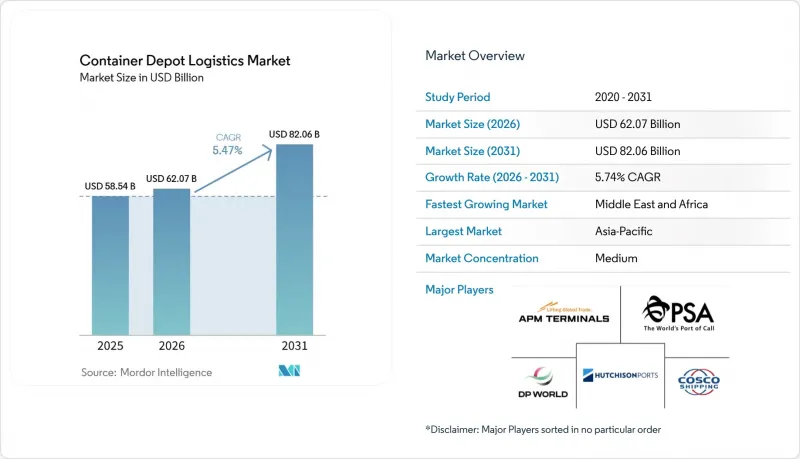
Mordor Intelligence에 의하면, 컨테이너 디포 물류 시장 규모는 2025년에 585억 4,000만 달러로 평가되었고, 2026년에는 620억 7,000만 달러로 추정되고, 2031년까지 820억 6,000만 달러에 이를 것으로 예측되며, 2026-2031년 CAGR 5.74%로 성장할 전망입니다.
컨테이너 무역량 증가에 따라 주요 해운 노선 전반에 걸쳐 항만 외부의 보관, 하역, 재배치 능력에 대한 수요가 높아지고 있어 시장이 확대되고 있습니다. 본 보고서는 디포 유형별(ICD, CFS 등), 서비스 유형별(보관, 하역, 유지보수·수리, 세척·세탁 등), 컨테이너 유형별(드라이 컨테이너, 리퍼 컨테이너), 무역 형태별(국제 무역 등), 지역별(북미, 남미, 아시아태평양, 유럽, 중동 및 아프리카)로 분류되어 있습니다. 시장 예측은 금액(달러) 기준으로 제시되어 있습니다.
세계의 컨테이너 디포 물류 시장 동향 및 인사이트
항만 외 버퍼 용량이 필요한 컨테이너 무역의 성장
사상 최고치를 기록한 무역량으로 인해, 컨테이너 디포 물류 시장 전반에 걸쳐 항만 외 보관 및 중계 공간에 대한 구조적인 수요가 발생하고 있습니다. 세계무역기구(WTO)는 2026년 세계 상품 무역 성장률을 3%로 예측하고 있으며, 관세 압박 속에서도 이 부문에는 명확한 수요 기반이 확보되어 있습니다. 또한, 유엔무역개발회의(UNCTAD)의 데이터에 따르면, 전 세계 해상 무역량은 120억 톤을 초과하여 컨테이너의 지속적인 순환과 주요 무역 거점에서의 일시적 보관에 대한 지속적인 수요를 뒷받침하고 있습니다. 컨테이너 디포 물류 시장에서 이러한 처리량 증가는 지역별로 균등하게 반영되지는 않습니다. 수출이 주를 이루는 지역에서는 성수기의 수출 화물을 흡수하는 반면, 수입 주도 지역에서는 빈 컨테이너의 체류를 처리해야 하기 때문입니다. 이러한 불균형으로 인해 수용 능력, 가격 책정, 가동률은 광범위한 세계 평균이 시사하는 것보다 지역별 특성에 더 크게 좌우되고 있습니다.
혼잡한 항만에서 컨테이너의 신속한 회전(턴어라운드)에 대한 수요 증가
항만의 혼잡은 컨테이너 디포 물류 시장을 지속적으로 견인하고 있습니다. 이는 게이트웨이 터미널의 공간이 부족할 때, 항만 외부에 위치한 디포가 ‘안전판’ 역할을 하기 때문입니다. 운송업체들은 슬롯 확보, 통관 지원, 트럭 운송 신속화를 제공할 수 있는 데포를 더욱 중요하게 여기고 있습니다. 이러한 기능 덕분에 사이클 타임이 단축되고 자산 가동률이 향상되기 때문입니다. 또한, 컨테이너 데포 물류 시장에서는 서류상 절차를 기다리는 컨테이너로 인해 가동률이 상승하는 현상도 관찰됩니다. 이 컨테이너들은 서류상으로는 운송 중이지만, 규정 준수 및 통관 검사가 완료될 때까지 물리적으로는 대기 상태에 있습니다. PSA 인터내셔널은 2025년 9월, PSA 뭄바이의 연간 처리 능력을 480만 TEU로 두 배로 늘렸습니다. 이는 각 운영사가 항만 확장과 보다 광범위한 내륙 처리량 계획을 어떻게 연계하고 있는지를 보여줍니다. 따라서 트럭 예약 시스템, OCR 지원 게이트, 야드 조정 기능 향상을 갖춘 디포는 서비스 측면에서 명확한 우위를 점하고 있습니다.
주요 항만 및 내륙 수요 집적지 주변의 야드 부지 부족
가장 분주한 항만 클러스터 인근에서는 처리 능력을 신속하게 확대할 수 없기 때문에 부지 부족은 여전히 컨테이너 디포 물류 시장에서 가장 심각한 제약 요소 중 하나입니다. 수요가 높은 회랑에는 광대한 부지, 트럭 접근성, 철도 및 도로와의 연결성이 요구되지만, 그러한 입지일수록 지가가 높고 인허가 취득에 가장 오랜 시간이 소요됩니다. 컨테이너 디포 물류 시장에서 이러한 상황은 JNPA 주변에서 두드러지게 나타납니다. 이 지역에서는 빈 컨테이너 야드 운영이 분산되어 있었던 점을 감안하여, RSA Global사는 라이가드 주 우란에 2,580 카롤 루피(3억 700만 달러)를 투자하여 62에이커 규모의 자동화 시설을 건설할 것이라고 발표했습니다. 이러한 대규모 프로젝트에는 수년에 걸친 부지 확보와 인프라 계획이 필요하기 때문에 그 결과 공급 확대는 수요 증가에 비해 훨씬 더디게 진행되고 있습니다. 유럽의 물류 회랑도 유사한 압박에 직면해 있습니다. 로테르담, 안트베르펜, 함부르크 근교의 내륙 터미널은 다른 산업용지나 주택용지와 경쟁할 수밖에 없기 때문입니다.
부문 분석
2025년, 내륙 컨테이너 디포는 컨테이너 디포 물류 시장 점유율의 34.16%를 차지하며 모든 디포 형태 중에서 1위를 유지했습니다. 그 강점은 화물 처리를 모두 항만 게이트 내에서만 처리하기를 원하지 않는 제조 지역에 있어, 내륙의 통관, 혼합 적재, 발송 거점으로서의 역할을 수행하고 있다는 점에 있습니다. 컨테이너 디포 물류 시장에서는 화물 철도 회랑, 국도 및 산업 지대를 따라 위치한 ICD(내륙 컨테이너 디포)가 계속해서 선호되고 있습니다. 이러한 회랑은 내륙 운송의 마찰을 줄이고, 운송업체가 항만의 처리 능력을 보다 효율적으로 활용할 수 있도록 지원하기 때문입니다. 이러한 입지 관계 덕분에 ICD는 생산 클러스터가 주요 터미널에서 멀리 떨어진 무역 노선에서도 중심적인 역할을 수행하고 있습니다.
컨테이너 디포 물류 시장에서 빈 컨테이너 디포는 2031년까지 연평균 성장률(CAGR) 8.60%로 확대될 것으로 예측되며, 가장 빠르게 성장하는 디포 유형이 될 전망입니다. 해운사들은 계절적 성수기나 운송 회랑이 혼잡할 때 예약을 신속하게 처리할 수 있도록 수출 구역 근처에 빈 컨테이너를 더 많이 배치하고 있습니다. JNPA 인근에 계획된 RSA Global의 자동화 야드는 컨테이너 디포 물류 시장이 세분화되고 수작업에 의존하던 빈 컨테이너 취급에서 더 대규모이며 기술을 활용하고 처리 능력 관리가 철저한 허브로 전환되고 있음을 보여줍니다. 컨테이너 화물 터미널(CFS)도 여전히 그 역할을 수행하고 있지만, 항구로의 직접 배송 정책과 토지 제약으로 인해 기존의 보관 기능에 점점 더 큰 압박이 가해지고 있습니다.
2025년, 컨테이너 보관 서비스는 컨테이너 디포 물류 시장 규모의 38.92%를 차지하며 서비스 부문 중 가장 큰 점유율을 기록했습니다. 이 선두 위치는 단순한 운영상의 사실을 반영합니다. 즉, 각 컨테이너는 하역, 통관, 발송, 재배치 과정 중 어느 단계에서든 여전히 일시적인 보관 장소가 필요하기 때문입니다. 또한, 컨테이너 디포 물류 업계에서는 교통량이 많은 거점에서 해운사, 포워더, 디포 운영자 간의 장기 계약을 통해 이 부문의 견조한 성장세를 유지하고 있습니다. 올카고 터미널(All Cargo Terminals)은 JNPA 인근에서 CFS 수용 능력을 확대하고, 2026년 1월 10년간의 계약 연장을 확보했습니다. 이는 기존 사업자가 오랜 기간 동안 쌓아온 항만과의 관계를 활용하여 가동률과 규모를 유지하고 있음을 보여주는 좋은 사례입니다.
컨테이너 디포 물류 시장에서 컨테이너 유지보수 및 수리 서비스는 2031년까지 연평균 성장률(CAGR) 9.76%를 나타낼 것으로 예측되며, 이는 시장 전체의 성장 속도를 크게 상회하는 수치입니다. 주요 요인은 지난 10년 초반 생산량이 급증함에 따라 컨테이너 선단의 더 큰 비율이 정기 점검 및 수리 기간에 접어들었기 때문입니다. 또한, 해운사가 규정 준수, 배상 책임 위험, 서비스 품질에 더욱 주의를 기울이게 됨에 따라 컨테이너 디포 물류 업계에서는 상태 점검이 더욱 엄격해지고 있습니다. 컨테이너 취급 서비스는 여전히 항만 취급량과 밀접한 관련이 있지만, 세척, 세탁, 훈증, 라벨 재부착, 재포장 등의 서비스는 새로운 부지를 임베디드하지 않고 성장을 목표로 하는 사업자에게 더 수익성 높은 선택지가 되고 있습니다.
지역별 분석
2025년, 아시아태평양은 컨테이너 디포 물류 시장의 59.99%를 차지하며 최대 지역이 되었습니다. 이 지역은 여전히 세계 무역의 주요 생산 및 수출 거점이며, 해안 및 내륙 회랑을 불문하고 ICD(내륙 컨테이너 터미널), CFS(컨테이너 화물 터미널) 부지, 빈 컨테이너 야드에 대한 지속적인 수요를 창출하고 있습니다. 컨테이너 디포 물류 시장은 특히 인도에서 활발하며, 이 나라에서는 항만 확장, 내륙 운송망 정비, 빈 컨테이너 야드에 대한 투자를 통해 공장과 해상 관문 간의 화물 및 장비 이동 방식이 재편되고 있습니다. PSA 뭄바이의 480만 TEU 규모로 2단계 확장이나 JNPA 인근에 쿠네-나겔이 새로운 CFS를 개설한 것은 모두 이러한 인프라 정비의 심화를 반영하고 있습니다. 일본도 물류 기반 확충을 추진하고 있으며, 국토교통성은 게이힌 항만권 내 새로운 물류 시설의 바닥 면적에 관한 계획을 수립하는 한편, 전략적인 컨테이너 항만 정책을 지속하고 있습니다.
북미와 유럽은 서비스 요금이 높고, 규정 준수 기준이 엄격하며, 인프라의 질도 높기 때문에 컨테이너 디포 물류 시장에서 여전히 고수익 시장으로 자리 잡고 있습니다. 니어쇼어링으로 인해 태평양을 경유해 내륙 제조 회랑으로 유입되는 컨테이너의 양이 증가함에 따라 멕시코의 중요성은 점점 더 커지고 있습니다. APM 터미널스는 2026년 3월 2단계 운영을 시작한 후 라살로 칼데나스에서의 확장을 가속화하고 있으며, 이는 제조업과 연계된 새로운 수요가 항만 및 디포의 용량 수요를 얼마나 빠르게 앞당기고 있는지를 보여줍니다. 유럽에서는 운영사들이 혼잡한 회랑을 가로질러 화물을 운송할 수 있는 보다 유연한 방법을 모색하는 가운데, 회복력 계획이 내륙 및 연안 인프라에 대한 투자를 뒷받침하고 있습니다. 남미 역시 농산물 및 식품 수출과 콜드체인 수요를 통해 컨테이너 데포 물류 시장에서 입지를 강화하고 있으며, 수아페의 완전 전기화 컨테이너 터미널은 냉장 컨테이너를 지원하고 지속가능성을 고려한 인프라의 새로운 기준을 확립하고 있습니다.
중동 및 아프리카는 2031년까지 연평균 성장률(CAGR) 7.61%를 나타낼 것으로 예측되며, 컨테이너 디포 물류 시장에서 가장 빠르게 확장되는 지역 블록이 될 전망입니다. 사우디아라비아, 아랍에미리트(UAE), 그리고 동아프리카의 관문들이 주목을 받고 있는 이유는 운송 경로의 변경, 물류 회랑의 개발, 그리고 민간 터미널의 자본 투입으로 인해 디포 수용 능력에 대한 수요가 증가하고 있기 때문입니다. DP 월드와 APM 터미널스는 2026년 2월, 제다 이슬람 항구에서의 전략적 제휴를 발표했습니다. 또한, 서던 컨테이너 터미널에서는 주당 선박 기항 횟수가 38회로 증가함에 따라 2025년에는 130만 TEU 이상을 처리했습니다. 따라서 이 지역의 컨테이너 데포 물류 시장은 많은 성숙한 지역보다 빠르게 확장되고 있으며, 특히 민간 투자자들이 공공 인프라 예산보다 앞서 건설에 적극적인 의지를 보이고 있는 지역에서 그 경향이 두드러집니다.
기타 혜택 :
- 엑셀 형식 시장 예측(ME) 시트
- 3개월간의 애널리스트 지원
자주 묻는 질문
목차
제1장 서론
제2장 조사 방법
제3장 주요 요약
제4장 시장 구도
제5장 시장 규모 및 성장 예측(금액, 2026-2031년)
제6장 경쟁 구도
제7장 시장 기회 및 향후 전망
AJY 26.09.03According to Mordor Intelligence, the container depot logistics market size was valued at USD 58.54 billion in 2025 and is projected to reach USD 62.07 billion in 2026, and reach USD 82.06 billion by 2031, growing at a CAGR of 5.74% from 2026 to 2031.
The market is expanding as higher containerized trade volumes drive demand for off-port storage, handling, and repositioning capacity across major shipping corridors. This report is Segmented by Depot Type (ICDs, CFS, and More), by Service Type (Storage, Handling, Maintenance and Repair, Cleaning and Washing, and More), by Container Type (Dry and Reefer), by Trade Orientation (International and More), and by Geography (North America, South America, Asia-Pacific, Europe, and Middle East and Africa). The Market Forecasts are Provided in Terms of Value (USD).
Global Container Depot Logistics Market Trends and Insights
Growth in Containerized Trade Requiring Off-Port Buffer Capacity
Record trade volumes are creating a structural need for off-port storage and staging space across the container depot logistics market. The World Trade Organization projects global merchandise trade growth of 3% in 2026, providing the sector with a clear demand base even under tariff pressure. UNCTAD also shows that global seaborne trade exceeded 12 billion tons, supporting sustained container circulation and recurring demand for temporary storage at major trade nodes. In the container depot logistics market, this rise in volume does not translate evenly because export-heavy locations absorb peak outbound loads while import-led locations handle return-empty backlogs. That imbalance is making capacity, pricing, and utilization more location-specific than broad global averages suggest.
Rising Need for Faster Container Turnaround at Congested Ports
Port congestion continues to support the container depot logistics market because off-port depots act as relief valves when gateway terminals run short of space. Carriers are placing greater value on depots that can offer guaranteed slots, customs support, and faster truck moves, as these features reduce cycle time and improve asset utilization. The container depot logistics market is also seeing higher occupancy from documentation-hold containers, which are still in transit on paper but remain physically idle until compliance or customs checks are completed. PSA International doubled annual handling capacity at PSA Mumbai to 4.8 million TEUs in September 2025, which shows how operators are pairing port expansion with broader landside throughput planning. Depots with truck appointment systems, OCR-enabled gates, and better yard coordination are therefore gaining a clear service advantage.
Yard Land Scarcity Near Major Ports and Inland Demand Clusters
Land scarcity remains one of the most significant constraints on the container depot logistics market because capacity cannot expand quickly near the busiest port clusters. High-demand corridors need large plots, truck access, and rail or road connectivity, yet those same locations also face the highest land values and the longest approval timelines. The container depot logistics market shows this clearly around JNPA, where fragmented empty yard operations prompted RSA Global to announce a 62-acre automated facility in Uran, Raigad, with an investment of INR 2,580 crore (USD 307 million). Large projects like that require years of site assembly and infrastructure planning, which means supply response is much slower than demand growth. European logistics corridors face similar pressure because inland terminals near Rotterdam, Antwerp, and Hamburg must compete with other industrial and residential uses.
Other drivers and restraints analyzed in the detailed report include:
- Expansion of Reefer and Specialized Container Handling Needs
- Digital Yard Visibility, Appointment Systems, and Real-Time Slot Allocation
- Volatile Empty Container Flows and Repositioning Inefficiencies
For complete list of drivers and restraints, kindly check the Table Of Contents.
Segment Analysis
Inland container depots accounted for 34.16% of the container depot logistics market share in 2025, maintaining their leading position across depot formats. Their strength lies in their role as inland customs, consolidation, and dispatch nodes for manufacturing regions that do not want all cargo processing to remain at the port gate. The container depot logistics market continues to favor ICDs along freight rail corridors, national highways, and industrial belts, as these links reduce friction in inland transit and help carriers use port capacity more efficiently. This position also makes ICDs central to trade lanes where production clusters are far from major terminals.
Empty container depots are projected to expand at a 8.60% CAGR through 2031 in the container depot logistics market, making them the fastest-growing depot type. Shipping lines are placing more empty units near export zones to meet bookings faster during seasonal peaks and corridor disruptions. The RSA Global automated yard planned near JNPA shows how the container depot logistics market is moving from fragmented, manual empty-handling to larger, technology-enabled hubs with stronger throughput discipline. Container freight stations still play a role, but direct port delivery policies and land constraints are putting more pressure on their traditional storage function.
Container storage services accounted for 38.92% of the container depot logistics market size in 2025, giving them the largest share among service categories. This lead reflects a simple operational fact: each container still needs a temporary holding point at some stage between discharge, clearance, dispatch, and repositioning. The container depot logistics industry also keeps this segment resilient through long-term contracts between carriers, freight forwarders, and depot operators at high-traffic nodes. Allcargo Terminals expanded its CFS capacity near JNPA and secured a 10-year contract extension in January 2026, demonstrating how incumbents leverage long-standing port relationships to maintain utilization and scale.
Container maintenance and repair services are forecast to grow at a 9.76% CAGR through 2031 in the container depot logistics market, well above the overall pace. The main driver is that a larger share of the fleet is moving into scheduled inspection and repair windows after the production surge earlier in the decade. The container depot logistics industry is also seeing stricter condition checks as carriers pay closer attention to compliance, liability exposure, and service quality. Container handling services still move closely with port throughput, while cleaning, washing, fumigation, relabeling, and repackaging offer a more profitable route for operators that want growth without buying more land.
Complete Report Scope:
- By Depot Type
- Inland Container Depots (ICDs)
- Container Freight Stations (CFS)
- Empty Container Depots (ECDs)
- Port-Based Container Depots
- By Service Type
- Container Storage Services
- Container Handling Services
- Container Maintenance and Repair (M&R) Services
- Container Cleaning and Washing Services
- Other Value-Added Logistics Services
- By Container Type
- Dry Containers
- Reefer Containers
- By Trade Orientation
- International/Transshipment Container Handling
- Domestic Container Movement
- By Region/Country
- North America
- United States
- Canada
- Mexico
- South America
- Brazil
- Peru
- Chile
- Argentina
- Rest of South America
- Asia-Pacific
- China
- Japan
- India
- South Korea
- Australia
- South East Asia
- Rest of Asia-Pacific
- Europe
- United Kingdom
- Germany
- France
- Spain
- Italy
- BENELUX (Belgium, Netherlands, and Luxembourg)
- NORDICS (Denmark, Finland, Iceland, Norway, and Sweden)
- Rest of Europe
- Middle East and Africa
- United Arab Emirates
- Saudi Arabia
- South Africa
- Nigeria
- Rest of the Middle East And Africa
- North America
Geography Analysis
Asia-Pacific accounted for 59.99% of the container depot logistics market share in 2025, making it the leading region. The region remains the main production and export base for global trade, generating persistent demand for ICDs, CFS sites, and empty yards across both coastal and inland corridors. The Container depot logistics market is particularly active in India, where port expansion, inland links, and investment in empty yards are reshaping how cargo and equipment move between factories and maritime gateways. PSA Mumbai's Phase 2 expansion to 4.8 million TEUs and Kuehne+Nagel's new CFS near JNPA both reflect that deeper infrastructure buildout. Japan is also expanding its logistics base, with the Ministry of Land, Infrastructure, Transport and Tourism outlining plans for new logistics facility floor space in the Keihin Port complex and continuing its strategic container port policy.
North America and Europe remain high-value revenue pools in the container depot logistics market because service fees are higher, compliance standards are stricter, and infrastructure quality is stronger. Mexico is becoming increasingly important as nearshoring drives more container flows through the Pacific and into inland manufacturing corridors. APM Terminals accelerated expansion at Lazaro Cardenas after inaugurating Phase II in March 2026, demonstrating how quickly new manufacturing-linked demand is pulling forward port and depot capacity needs. In Europe, resilience planning is supporting investment in inland and coastal infrastructure as operators seek more flexible ways to move cargo across congested corridors. South America is also gaining weight in the container depot logistics market through agrifood exports and cold chain demand, with Suape's fully electrified container terminal setting a new benchmark for reefer-ready, sustainability-linked infrastructure.
The Middle East and Africa are projected to grow at a 7.61% CAGR through 2031, making it the fastest-expanding regional bloc in the container depot logistics market. Saudi Arabia, the UAE, and East African gateways are attracting attention because rerouted flows, logistics corridor development, and private terminal capital are increasing the need for supporting depot capacity. DP World and APM Terminals announced a strategic partnership at Jeddah Islamic Port in February 2026, and the Southern container terminal handled more than 1.3 million TEUs in 2025 as weekly vessel calls rose to 38. The container depot logistics market is therefore opening faster in this region than in many mature geographies, especially where private investors are willing to build ahead of public infrastructure budgets.
- APM Terminals
- DP World
- PSA International
- COSCO SHIPPING Lines Co., Ltd.
- Hutchison Ports
- Shanghai International Port (Group) Co., Ltd.
- CMA CGM Group
- SSA Marine
- International Container Terminal Services, Inc.
- Adani Ports and Special Economic Zone Limited
- Eurogate Container Terminal GmbH
- Mediterranean Shipping Company S.A.
- Container Corporation of India Limited
- Gateway Distriparks Limited
- Qube Holdings Limited
- China Merchants Port Holdings
- Abu Dhabi Ports Group
- Rhenus Group (Including Contargo)
- Allcargo Logistics Limited
- Depot Connect International
- Den Hartogh Logistics
- Bertschi Group
Additional Benefits:
- The market estimate (ME) sheet in Excel format
- 3 months of analyst support
TABLE OF CONTENTS
1 Introduction
- 1.1 Study Assumptions and Market Definition
- 1.2 Scope of the Study
2 Research Methodology
3 Executive Summary
4 Market Landscape
- 4.1 Market Overview and Importance of Container Depot Logistics
- 4.2 Market Drivers
- 4.2.1 Growth In Containerized Trade Requiring Off-Port Buffer Capacity
- 4.2.2 Rising Need for Faster Container Turnaround at Congested Ports
- 4.2.3 Expansion of Reefer And Specialized Container Handling Needs
- 4.2.4 Digital Yard Visibility, Appointment Systems, and Real-Time Slot Allocation
- 4.2.5 Shift Toward Outsourced Depot Operations By Shipping Lines and NVOCCs
- 4.2.6 Decarbonization Pressure Encouraging Depot-Level Electrification and Idle-Time Reduction
- 4.3 Market Restraints
- 4.3.1 Yard Land Scarcity Near Major Ports and Inland Demand Clusters
- 4.3.2 Depot Labor Intensity and Safety Compliance Costs
- 4.3.3 Volatile Empty Container Flows And Repositioning Inefficiencies
- 4.3.4 Automation Payback Uncertainty in Mid-Sized Depots
- 4.4 Regulatory Framework
- 4.5 Value Chain and Distribution Channel Architecture Analysis
- 4.6 Technology Innovations Outlook
- 4.7 Porter's Five Forces Analysis
- 4.7.1 Threat of New Entrants
- 4.7.2 Bargaining Power of Suppliers
- 4.7.3 Bargaining Power of Buyers
- 4.7.4 Threat of Substitutes
- 4.7.5 Rivalry Among Competitors
- 4.8 Container Throughput Trends
- 4.9 Import-Export Trade Analysis
- 4.10 Port and Terminal Infrastructure Analysis
- 4.11 Sustainability and ESG Analysis
- 4.12 Evolution of Container Depot Logistics Market
- 4.13 Impact of Geo-Political Events on Supply Chain Shifts
5 Market Size and Growth Forecasts (Value, 2026-2031)
- 5.1 By Depot Type
- 5.1.1 Inland Container Depots (ICDs)
- 5.1.2 Container Freight Stations (CFS)
- 5.1.3 Empty Container Depots (ECDs)
- 5.1.4 Port-Based Container Depots
- 5.2 By Service Type
- 5.2.1 Container Storage Services
- 5.2.2 Container Handling Services
- 5.2.3 Container Maintenance and Repair (M&R) Services
- 5.2.4 Container Cleaning and Washing Services
- 5.2.5 Other Value-Added Logistics Services
- 5.3 By Container Type
- 5.3.1 Dry Containers
- 5.3.2 Reefer Containers
- 5.4 By Trade Orientation
- 5.4.1 International/Transshipment Container Handling
- 5.4.2 Domestic Container Movement
- 5.5 By Region/Country
- 5.5.1 North America
- 5.5.1.1 United States
- 5.5.1.2 Canada
- 5.5.1.3 Mexico
- 5.5.2 South America
- 5.5.2.1 Brazil
- 5.5.2.2 Peru
- 5.5.2.3 Chile
- 5.5.2.4 Argentina
- 5.5.2.5 Rest of South America
- 5.5.3 Asia-Pacific
- 5.5.3.1 China
- 5.5.3.2 Japan
- 5.5.3.3 India
- 5.5.3.4 South Korea
- 5.5.3.5 Australia
- 5.5.3.6 South East Asia
- 5.5.3.7 Rest of Asia-Pacific
- 5.5.4 Europe
- 5.5.4.1 United Kingdom
- 5.5.4.2 Germany
- 5.5.4.3 France
- 5.5.4.4 Spain
- 5.5.4.5 Italy
- 5.5.4.6 BENELUX (Belgium, Netherlands, and Luxembourg)
- 5.5.4.7 NORDICS (Denmark, Finland, Iceland, Norway, and Sweden)
- 5.5.4.8 Rest of Europe
- 5.5.5 Middle East and Africa
- 5.5.5.1 United Arab Emirates
- 5.5.5.2 Saudi Arabia
- 5.5.5.3 South Africa
- 5.5.5.4 Nigeria
- 5.5.5.5 Rest of the Middle East And Africa
- 5.5.1 North America
6 Competitive Landscape
- 6.1 Market Concentration
- 6.2 Key Strategic Moves
- 6.3 Market Share Analysis
- 6.4 Company Profiles (includes Global level Overview, Market level overview, Core Segments, Financials as available, Strategic Information, Market Rank/Share for key companies, Products & Services, and Recent Developments)
- 6.4.1 APM Terminals
- 6.4.2 DP World
- 6.4.3 PSA International
- 6.4.4 COSCO SHIPPING Lines Co., Ltd.
- 6.4.5 Hutchison Ports
- 6.4.6 Shanghai International Port (Group) Co., Ltd.
- 6.4.7 CMA CGM Group
- 6.4.8 SSA Marine
- 6.4.9 International Container Terminal Services, Inc.
- 6.4.10 Adani Ports and Special Economic Zone Limited
- 6.4.11 Eurogate Container Terminal GmbH
- 6.4.12 Mediterranean Shipping Company S.A.
- 6.4.13 Container Corporation of India Limited
- 6.4.14 Gateway Distriparks Limited
- 6.4.15 Qube Holdings Limited
- 6.4.16 China Merchants Port Holdings
- 6.4.17 Abu Dhabi Ports Group
- 6.4.18 Rhenus Group (Including Contargo)
- 6.4.19 Allcargo Logistics Limited
- 6.4.20 Depot Connect International
- 6.4.21 Den Hartogh Logistics
- 6.4.22 Bertschi Group
7 Market Opportunities and Future Outlook
- 7.1 White-space and Unmet-Need Assessment


