

|
시장보고서
상품코드
2122760
물류 자동화 : 시장 점유율 분석, 업계 동향 및 통계, 성장 예측(2026-2031년)Logistics Automation - Market Share Analysis, Industry Trends & Statistics, Growth Forecasts (2026 - 2031) |
||||||
 Mordor Intelligence
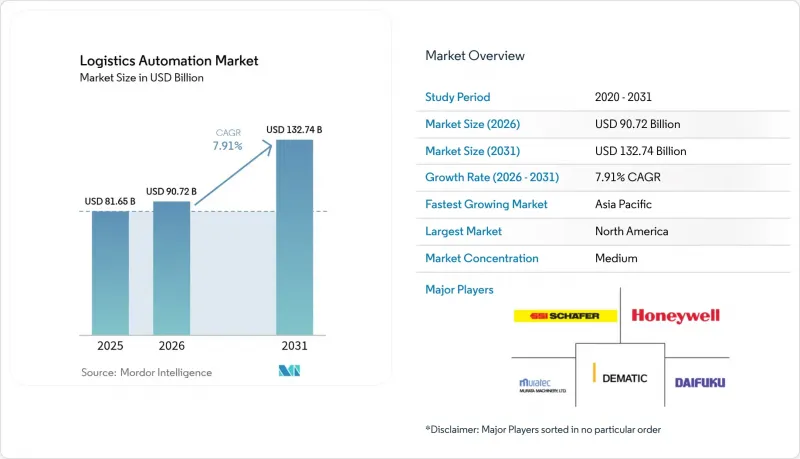
Mordor Intelligence에 의하면, 물류 자동화 시장 규모는 2025년 816억 5,000만 달러로 평가되었습니다. 2026년에는 907억 2,000만 달러로 확대되어 2031년까지 1,327억 4,000만 달러에 이를 것으로 예상되고 2026-2031년에 걸쳐 CAGR 7.91%로 성장할 전망입니다.

본 보고서는 기능별(창고 자동화, 운송 자동화), 자동화 수준별(완전 자동화 시스템, 반자동화 시스템), 구성 요소별(하드웨어, 소프트웨어, 서비스), 최종 사용자 산업별(전자상거래·소포, 식음료, 식료품 소매,의류 및 패션, 제조업, 기타), 지역별로 분류되어 있습니다. 시장 전망은 금액(달러) 기준으로 제시되어 있습니다.
세계의 물류 자동화 시장 동향 및 인사이트
급증하는 전자상거래 소포 처리량
소포 처리량은 전년 대비 10% 증가한 1,210억 건을 기록했으며, 소비자들의 ‘당일 배송’에 대한 기대가 정착되고 있습니다. 이에 따라 소매업체들은 기존 매장 내에 1만-2만제곱피트 규모의 마이크로 풀필먼트 거점을 설치하여 라스트 마일 거리를 최대 60% 단축하고 있습니다. Instacart가 Fabric과 제휴하여 10만 곳의 소매점에 자동화된 마이크로 풀필먼트 거점을 구축하고 있는 사례는 식료품 소매업체들이 기존 부동산을 활용하여 독립형 다크 스토어의 자본 집약성을 피하고 있음을 보여줍니다. 설계의 초점은 ‘시간당 팔레트 수’에서 ‘제곱피트당 소포 수’로 이동하고 있으며, 각 벤더는 더 고밀도인 보관 그리드, 경량 로봇, 수직 공간 활용도를 최적화하는 소프트웨어 개발을 서두르고 있습니다. 그 결과, 선순환이 만들어지고 있습니다. 주문 밀도의 향상으로 자동화에 대한 추가 투자가 정당화되고, 이는 배송 시간의 추가 단축과 경쟁 수준 향상으로 이어지고 있습니다.
심화되는 인력 부족과 임금 인플레이션
임금 상승에도 불구하고 제조업 및 물류 산업의 구인 부족은 확대되고 있으며, 미국에서는 2030년까지 최대 380만 명의 인력 부족이 예상됩니다. 아마존이 2024년에 초임 시급을 22달러로 인상한 후에도 계절 근로자 공급이 수요를 따라가지 못해 로봇 도입이 가속화되고 있습니다. 일본에서는 생산연령인구의 감소로 인해 로봇 밀도가 근로자 1만 명당 399대에 달하고 있어, 사업자들은 자동화를 추진하거나 처리 능력의 한계에 직면할 수밖에 없는 상황에 놓여 있습니다. 노동력 부족에 기인한 ROI(투자 수익률)의 개선은 현저합니다. 자동 창고 시스템의 투자 회수 기간은 2020년 5년에서 2025년에는 3년 이하로 단축되었습니다. 자동화는 단순한 비용 절감 수단에서 노동력 부족 시장 속에서 처리 능력을 유지하기 위한 전제조건으로 변화하고 있습니다.
고액의 초기 설비 투자
대규모 자동 창고에는 500만 달러에서 2,500만 달러의 초기 설비 투자가 필요하며, 이러한 장벽으로 인해 대부분의 중소규모 물류 사업자는 완전 자동화 시스템 도입을 보류할 수밖에 없습니다. 재무위원회는 특히 온라인 판매량이 정점에 달하고 여러 식료품 소매업체가 대규모 프로젝트를 일시 중단한 것을 계기로, 회수 기간을 3년 이하로할 것을 빈번히 요구하고 있습니다. ‘RaaS(Robotics-as-a-Service)’ 모델은 설비 투자(CAPEX)를 운영비(OPEX)로 전환하지만, 수명 주기 비용을 20-30% 증가시키기 때문에 수요 변동이 심한 거점에서의 도입으로 제한됩니다. 그 결과, 시장 확대는 여러 고객 계약을 통해 투자를 상각할 수 있는 Tier 1 3PL(제3자 물류) 사업자로 편중되어, 대기업과 중소기업 간의 디지털 격차를 더욱 확대시키고 있습니다.
부문별 분석
2025년, 창고 자동화는 전 세계 물류 자동화 시장 매출의 56.82%를 차지하며, 그 성숙도와 광범위한 도입 실적을 입증했습니다. SKU 회전율이 높은 환경에서는 큐브형 보관 시스템, 로봇 피킹 암, 고속 분류기가 계속해서 설비 투자 계획의 중심을 차지하고 있습니다. 한편, 차량 관리 플랫폼 및 자율 주행형 야드 트럭을 포함한 운송 자동화는 7.96%라는 가장 높은 예측 연평균 성장률(CAGR)을 기록하고 있으며, 이는 공차 비율 감소 및 배기가스 목표 달성에 대한 시급성이 높아지고 있음을 반영합니다. 물류 자동화 시장에서는 창고 및 도로 네트워크 전반에 걸친 실시간 자산 가시화를 실현하는 공급업체가 계속해서 높은 평가를 받고 있으며, 기능적 경계가 모호해지면서 종단 간 최적화가 가능해졌습니다.
2026년에 도입될 소프트웨어 주도형 화물 매칭을 통해 운송업체는 공차 주행 거리를 두 자릿수 비율로 줄일 수 있게 되며, 고도로 자동화된 물류 센터를 보유한 화주들 사이에서도 운송 자동화의 우선순위가 더욱 높아지고 있습니다. 운송 오케스트레이션 부문의 물류 자동화 시장은 운송 사업자들이 AI를 활용한 경로 재설계에 투자함에 따라 꾸준히 성장할 전망입니다. 이와 동시에, 창고 운영 사업자들은 고정식 컨베이어에서 수요에 따라 유연하게 배치를 변경할 수 있는 자율 주행 로봇으로 예산을 전환하고 있으며, 이는 피크 시간대의 처리 능력 확대보다 유연한 자본 배분이 점점 더 중요시되고 있음을 반영합니다.
2025년 지출 중 반자동화 구성이 61.48%를 차지했습니다. 이는 예외 처리나 깨지기 쉬운 상품의 피킹 과정에서 사람이 계속해서 프로세스의 일부로 관여하는 시설이 주도한 결과입니다. 그러나 부품 비용의 하락과 안전 인증을 획득한 AI 추론 칩의 등장을 배경으로, 완전 자동화 시스템은 2031년까지 연평균 성장률(CAGR) 7.99%를 나타낼 것으로 예측됩니다. 완전히 로봇화된 마이크로 풀필먼트 센터에서는 이미 50명 미만의 직원으로 하루 최대 1만 8,000건의 주문을 처리하고 있어, 주문 밀도가 높은 경우의 경제적 타당성이 입증되었습니다.
사업자들은 완전 자동화된 레이아웃에는 이중화된 전원, 예측 분석, 미션 크리티컬 네트워크와 같은 독자적인 아키텍처상의 선택이 필요하다는 점을 인식하고 있습니다. 이로 인해 설비 투자(CAPEX)는 약 15-20% 증가하지만, 예기치 않은 가동 중지 시간을 가동 시간의 1% 이하로 억제할 수 있습니다. 인증 관련 병목 현상이 완화됨에 따라 물류 자동화 시장에서 완전 자동화 시스템의 점유율은 꾸준히 상승할 것으로 예측됩니다. 특히 재고 가치나 규제상 관리 요건으로 인해 고액 투자가 정당화되는 의약품 및 전자기기 부문에서는 이러한 경향이 두드러질 것으로 보입니다.
지역별 분석
북미는 높은 인건비, 높은 전자상거래 보급률, 설비 투자를 여러 계약에 분산할 수 있는 성숙한 제3자 물류(3PL) 생태계의 뒷받침을 받아 2025년 매출의 34.84%를 차지했습니다. 미국 사업자들은 새로운 자동화 기술을 빈번하게 검토하고 도입하고 있으며, 아시아태평양보다 인구는 적지만 이 지역은 공급업체의 로드맵에 매우 큰 영향력을 행사하고 있습니다. 강력한 벤처 캐피탈의 자금 지원이 제품 개선을 더욱 가속화하여, 이 지역의 물류 자동화 시장 혁신의 선순환을 강화하고 있습니다.
아시아태평양은 가장 빠르게 성장하는 지역으로, 2031년 연평균 성장률(CAGR)은 8.11%를 기록할 전망입니다. 이는 중국만 해도 2030년까지 256억 달러 규모의 창고 자동화 투자를 목표로 하고 있기 때문입니다. 일본의 높은 로봇 도입 밀도, 산업용 5G의 적극적인 확산, 인도의 제조업 회랑에서 진행 중인 대규모 그린필드 프로젝트가 맞물려 지속적인 성장을 견인하고 있습니다. 정부의 물류 현대화 프로그램은 재정적 인센티브와 민간 투자를 결합하여 주요 도시와 지방 도시의 물류 자동화 시장 잠재 규모를 확대되고 있습니다.
상당한 시장 점유율을 차지하는 유럽은 엄격한 노동법과 탄소 배출 감축 의무라는 이중의 압박 속에서 발전하고 있습니다. 독일의 ‘인더스트리 4.0’ 이니셔티브는 창고 설계에 디지털 트윈과 예측 분석을 주류로 자리 잡게 하고 있는 반면, 영국의 도시 구역 지정 개혁은 마이크로 풀필먼트 거점 구축을 촉진하고 있습니다. 남미, 중동 및 아프리카는 현재 시장 규모가 작지만, 니어쇼어링, 에너지 다각화, 의약품 콜드체인 구축과 같은 호재를 타고 있으며, 인프라 격차가 해소됨에 따라 물류 자동화 시장에 장기적인 성장 여지가 생기고 있습니다.
기타 혜택
- 엑셀 형식 시장 예측(ME) 시트
- 3개월간의 애널리스트 지원
자주 묻는 질문
목차
제1장 서론
제2장 조사 방법
제3장 주요 요약
제4장 시장 구도
제5장 시장 규모 및 성장 예측
제6장 경쟁 구도
제7장 시장 기회 및 향후 전망
KTH 26.09.08According to Mordor Intelligence, the logistics automation market size is expected to increase from USD 81.65 billion in 2025 to USD 90.72 billion in 2026 and reach USD 132.74 billion by 2031, growing at a CAGR of 7.91% over 2026-2031.
This report is Segmented by Function (Warehouse Automation and Transportation Automation), Automation Level (Fully-Automated Systems and Semi-Automated Systems), Component (Hardware, Software, and Services), End-User Industry (E-Commerce and Parcel, Food and Beverage, Grocery Retail, Apparel and Fashion, Manufacturing, and More), and Geography. The Market Forecasts are Provided in Terms of Value (USD).
Global Logistics Automation Market Trends and Insights
Rapid E-commerce Parcel Volumes
Parcel flows climbed 10% year over year to 121 billion shipments in 2025, locking in consumer expectations for same-day fulfillment. Retailers are therefore embedding 10,000-20,000 square-foot micro-fulfillment nodes inside existing stores, cutting last-mile distances by as much as 60%. Instacart's partnership with Fabric to deploy automated micro-fulfillment nodes across 100,000 retail locations illustrates how grocers are leveraging existing real estate to bypass the capital intensity of standalone dark stores. Design focus is shifting from pallets per hour to parcels per square foot, forcing vendors to engineer denser storage grids, lighter robots, and software that optimizes vertical cube utilization. The result is a virtuous cycle, higher order density justifies incremental automation spend, which further compresses delivery windows and raises the competitive bar.
Rising Labor Shortages and Wage Inflation
Manufacturing and logistics vacancies are widening despite wage gains, with U.S. shortfalls projected to reach up to 3.8 million workers by 2030. Even after Amazon lifted entry wages to USD 22 per hour in 2024, seasonal hiring lagged demand, driving accelerated robot rollouts. In Japan, a declining working-age population pushes robot density to 399 units per 10,000 workers, compelling operators to automate or face throughput caps. Labor-driven ROI improvements are material: payback on automated storage and retrieval systems tightened from five years in 2020 to fewer than three years in 2025. Automation has moved from a cost-reduction lever to a precondition for sustaining throughput in tight labor markets.
High Up-Front CAPEX
Large automated warehouses require USD 5 million to USD 25 million in upfront capital expenditure, a threshold that excludes most small and mid-sized logistics operators from deploying fully automated systems. Finance committees frequently insist on sub-three-year payback, especially after several grocery retailers paused large projects when online volumes plateaued. Robotics-as-a-service models convert capex to opex but add 20-30% to lifetime cost, limiting uptake to sites with volatile demand. Consequently, market expansion skews toward tier-one 3PLs that can amortize investments across multiple client contracts, exacerbating a digital divide between large and small operators.
Other drivers and restraints analyzed in the detailed report include:
- Corporate Net-Zero Logistics Commitments
- Convergence of 5G and Private-LTE Inside Warehouses
- Integration Complexity with Brown-Field IT
For complete list of drivers and restraints, kindly check the Table Of Contents.
Segment Analysis
Warehouse automation anchored 56.82% of global Logistics automation market revenue in 2025, underscoring its maturity and deep installed base. Cube-based storage, robotic picking arms, and high-speed sorters continue to dominate capex plans in high-SKU-velocity environments. Yet transportation automation, including fleet-management platforms and autonomous yard trucks, records the fastest forecast CAGR at 7.96%, reflecting heightened urgency to shrink empty-mile ratios and hit emission targets. The Logistics automation market continues to reward vendors that deliver real-time asset visibility across warehouse and road networks, blurring functional boundaries and enabling end-to-end optimization.
Software-driven load-matching launched in 2026 allows carriers to slash empty miles by double-digit percentages, pushing transportation automation up the priority list even among shippers with highly automated distribution centers. The Logistics automation market for transportation orchestration is set to grow steadily as carriers invest in AI-enabled route redesign. In parallel, warehouse operators are reallocating budgets from fixed conveyors to autonomous mobile robots that can shift with demand, reflecting growing preference for flexible capital deployment over peak-capacity builds.
Semi-automated configurations accounted for 61.48% of 2025 spending, driven by facilities that keep humans in the loop for exception handling and fragile picks. However, fully automated systems are projected to post a 7.99% CAGR through 2031, driven by shrinking component costs and the arrival of safety-certified AI inference chips. Fully robotized micro-fulfillment centers already process up to 18,000 daily orders with fewer than 50 staff, proving the economic case where order density is high.
Operators recognize that fully-automated layouts require distinct architectural choices-redundant power, predictive analytics, and mission-critical networking-that raise capex by roughly 15-20% yet cut unplanned downtime below 1% of operating hours. As certification bottlenecks ease, the Logistics automation market share of fully-automated systems is expected to climb steadily, particularly in pharmaceuticals and electronics, where inventory value and regulatory controls justify premium investments.
Complete Report Scope:
- By Function
- Warehouse Automation
- By Component
- Hardware
- Mobile Robots
- Automated Storage and Retrieval Systems
- Automated Sorting Systems
- Conveyor Systems
- Automatic Identification and Data Collection (AIDC)
- Order Picking
- Software
- Services
- Hardware
- By Component
- Transportation Automation
- By Component
- Hardware
- Software
- Services
- By Component
- Warehouse Automation
- By Automation Level
- Fully-Automated Systems
- Semi-Automated Systems
- By Component
- Hardware
- Software
- Services
- By End-User Industry
- E-commerce and Parcel
- Food and Beverage
- Grocery Retail
- Apparel and Fashion
- Manufacturing
- Other End-User Industries
- By Geography
- North America
- United States
- Canada
- Mexico
- South America
- Brazil
- Argentina
- Rest of South America
- Europe
- Germany
- United Kingdom
- France
- Italy
- Spain
- Rest of Europe
- Asia-Pacific
- China
- Japan
- India
- South Korea
- ASEAN
- Rest of Asia-Pacific
- Middle East
- Saudi Arabia
- United Arab Emirates
- Rest of Middle East
- Africa
- South Africa
- Nigeria
- Egypt
- Rest of Africa
- North America
Geography Analysis
North America retained 34.84% of 2025 revenue, supported by high labor costs, deep e-commerce penetration, and a mature third-party logistics ecosystem that enables capex to be spread across multiple contracts. U.S. operators frequently pilot new automation technologies, giving the region an outsized influence on vendor roadmaps despite its smaller population than the Asia-Pacific. Strong venture-capital funding further accelerates product iteration, reinforcing the Logistics automation market's innovation flywheel in the region.
Asia-Pacific is the fastest-growing territory, posting an 8.11% CAGR through 2031 as China alone targets USD 25.6 billion in warehouse automation spend by 2030. High robot density in Japan, aggressive rollout of industrial 5G, and large-scale greenfield projects in India's manufacturing corridors collectively drive sustained growth. Government logistics modernization programs align fiscal incentives with private investment, multiplying the addressable Logistics automation market across tier-one and tier-two cities.
Europe, with a considerable market share, advances under the twin pressures of strict labor laws and carbon-reduction mandates. Germany's Industry 4.0 initiative mainstreams digital twins and predictive analytics in warehouse design, while the United Kingdom's urban zoning reforms encourage micro-fulfillment buildouts. South America, the Middle East and Africa are smaller today but enjoy tailwinds from near-shoring, energy diversification, and pharmaceutical cold-chain development, creating long-run upside for the Logistics automation market as infrastructure gaps close.
- Dematic Corp. (KION Group AG)
- Daifuku Co., Ltd.
- Honeywell International Inc.
- Jungheinrich AG
- Murata Machinery, Ltd.
- KNAPP AG
- TGW Logistics Group GmbH
- Kardex Holding AG
- Mecalux, S.A.
- BEUMER Group GmbH & Co. KG
- SSI SCHAFER AG
- Vanderlande Industries B.V.
- WITRON Logistik + Informatik GmbH
- Interroll Holding AG
- GreyOrange Pte Ltd.
- Locus Robotics Corp.
- Geek+ Technology Co., Ltd.
- Ocado Group plc (Ocado Intelligent Automation)
- AutoStore Holdings Ltd.
- Exotec SAS
- Fetch Robotics Inc. (Zebra Technologies)
- Korber Supply Chain GmbH
- Cimcorp Oy
- Manhattan Associates Inc.
- Swisslog Holding AG
- Siemens Logistics GmbH
- Bastian Solutions LLC
- Fives Group
- Hai Robotics Co., Ltd.
Additional Benefits:
- The market estimate (ME) sheet in Excel format
- 3 months of analyst support
TABLE OF CONTENTS
1 INTRODUCTION
- 1.1 Study Assumptions and Market Definition
- 1.2 Scope of the Study
2 RESEARCH METHODOLOGY
3 EXECUTIVE SUMMARY
4 MARKET LANDSCAPE
- 4.1 Market Overview
- 4.2 Market Drivers
- 4.2.1 Rapid E-commerce Parcel Volumes
- 4.2.2 Rising Labor Shortages and Wage Inflation
- 4.2.3 Corporate Net-Zero Logistics Commitments
- 4.2.4 Customs-Free Micro-Fulfilment Zoning Laws
- 4.2.5 Convergence of 5G and Private-LTE Inside Warehouses
- 4.2.6 Open-Source Robotics Operating Systems (ROS-2) Maturation
- 4.3 Market Restraints
- 4.3.1 High Up-Front CAPEX
- 4.3.2 Integration Complexity with Brown-Field IT
- 4.3.3 Scarcity of Functional-Safety-Certified AI Chips
- 4.3.4 Rising Cyber-Insurance Premiums for OT Networks
- 4.4 Value Chain Analysis
- 4.5 Regulatory Landscape
- 4.6 Impact of Macroeconomic Factors on the Market
- 4.7 Porter's Five Forces Analysis
- 4.7.1 Bargaining Power of Suppliers
- 4.7.2 Bargaining Power of Buyers
- 4.7.3 Threat of New Entrants
- 4.7.4 Threat of Substitutes
- 4.7.5 Competitive Rivalry
5 MARKET SIZE AND GROWTH FORECASTS (VALUE)
- 5.1 By Function
- 5.1.1 Warehouse Automation
- 5.1.1.1 By Component
- 5.1.1.1.1 Hardware
- 5.1.1.1.1.1 Mobile Robots
- 5.1.1.1.1.2 Automated Storage and Retrieval Systems
- 5.1.1.1.1.3 Automated Sorting Systems
- 5.1.1.1.1.4 Conveyor Systems
- 5.1.1.1.1.5 Automatic Identification and Data Collection (AIDC)
- 5.1.1.1.1.6 Order Picking
- 5.1.1.1.2 Software
- 5.1.1.1.3 Services
- 5.1.1.1.1 Hardware
- 5.1.1.1 By Component
- 5.1.2 Transportation Automation
- 5.1.2.1 By Component
- 5.1.2.1.1 Hardware
- 5.1.2.1.2 Software
- 5.1.2.1.3 Services
- 5.1.2.1 By Component
- 5.1.1 Warehouse Automation
- 5.2 By Automation Level
- 5.2.1 Fully-Automated Systems
- 5.2.2 Semi-Automated Systems
- 5.3 By Component
- 5.3.1 Hardware
- 5.3.2 Software
- 5.3.3 Services
- 5.4 By End-User Industry
- 5.4.1 E-commerce and Parcel
- 5.4.2 Food and Beverage
- 5.4.3 Grocery Retail
- 5.4.4 Apparel and Fashion
- 5.4.5 Manufacturing
- 5.4.6 Other End-User Industries
- 5.5 By Geography
- 5.5.1 North America
- 5.5.1.1 United States
- 5.5.1.2 Canada
- 5.5.1.3 Mexico
- 5.5.2 South America
- 5.5.2.1 Brazil
- 5.5.2.2 Argentina
- 5.5.2.3 Rest of South America
- 5.5.3 Europe
- 5.5.3.1 Germany
- 5.5.3.2 United Kingdom
- 5.5.3.3 France
- 5.5.3.4 Italy
- 5.5.3.5 Spain
- 5.5.3.6 Rest of Europe
- 5.5.4 Asia-Pacific
- 5.5.4.1 China
- 5.5.4.2 Japan
- 5.5.4.3 India
- 5.5.4.4 South Korea
- 5.5.4.5 ASEAN
- 5.5.4.6 Rest of Asia-Pacific
- 5.5.5 Middle East
- 5.5.5.1 Saudi Arabia
- 5.5.5.2 United Arab Emirates
- 5.5.5.3 Rest of Middle East
- 5.5.6 Africa
- 5.5.6.1 South Africa
- 5.5.6.2 Nigeria
- 5.5.6.3 Egypt
- 5.5.6.4 Rest of Africa
- 5.5.1 North America
6 COMPETITIVE LANDSCAPE
- 6.1 Market Concentration
- 6.2 Strategic Moves
- 6.3 Market Share Analysis
- 6.4 Company Profiles (includes Global Level Overview, Market Level Overview, Core Segments, Financials as available, Strategic Information, Market Rank/Share, Products and Services, Recent Developments)
- 6.4.1 Dematic Corp. (KION Group AG)
- 6.4.2 Daifuku Co., Ltd.
- 6.4.3 Honeywell International Inc.
- 6.4.4 Jungheinrich AG
- 6.4.5 Murata Machinery, Ltd.
- 6.4.6 KNAPP AG
- 6.4.7 TGW Logistics Group GmbH
- 6.4.8 Kardex Holding AG
- 6.4.9 Mecalux, S.A.
- 6.4.10 BEUMER Group GmbH & Co. KG
- 6.4.11 SSI SCHAFER AG
- 6.4.12 Vanderlande Industries B.V.
- 6.4.13 WITRON Logistik + Informatik GmbH
- 6.4.14 Interroll Holding AG
- 6.4.15 GreyOrange Pte Ltd.
- 6.4.16 Locus Robotics Corp.
- 6.4.17 Geek+ Technology Co., Ltd.
- 6.4.18 Ocado Group plc (Ocado Intelligent Automation)
- 6.4.19 AutoStore Holdings Ltd.
- 6.4.20 Exotec SAS
- 6.4.21 Fetch Robotics Inc. (Zebra Technologies)
- 6.4.22 Korber Supply Chain GmbH
- 6.4.23 Cimcorp Oy
- 6.4.24 Manhattan Associates Inc.
- 6.4.25 Swisslog Holding AG
- 6.4.26 Siemens Logistics GmbH
- 6.4.27 Bastian Solutions LLC
- 6.4.28 Fives Group
- 6.4.29 Hai Robotics Co., Ltd.
7 MARKET OPPORTUNITIES AND FUTURE OUTLOOK
- 7.1 White-Space and Unmet-Need Assessment


