

|
시장보고서
상품코드
2118118
유럽의 컨테이너 디포 물류 시장 : 시장 점유율 분석, 업계 동향 및 통계, 성장 예측(2026-2031년)Europe Container Depot Logistics - Market Share Analysis, Industry Trends & Statistics, Growth Forecasts (2026 - 2031) |
||||||
 Mordor Intelligence
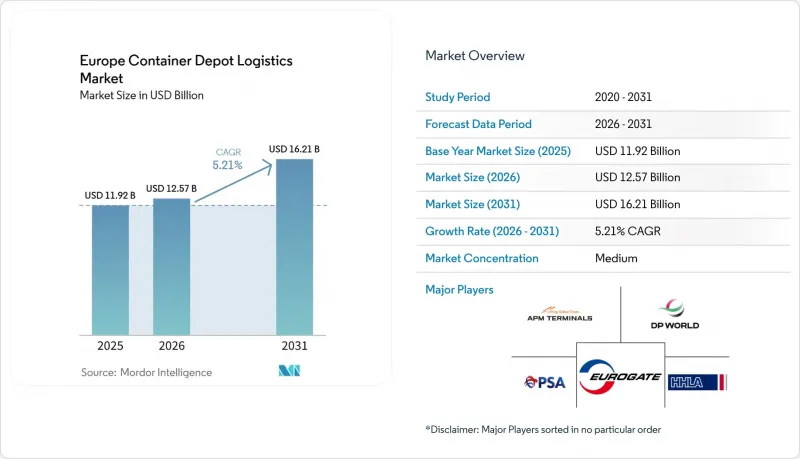
Mordor Intelligence에 의하면, 유럽 컨테이너 디포 물류 시장 규모는 2025년에 119억 2,000만 달러로 평가되었고, 2026년에는 125억 7,000만 달러로 추정되며, 2031년까지 162억 1,000만 달러에 이를 것으로 예측됩니다.
2026-2031년 연평균 성장률(CAGR)은 5.21%로 전망됩니다.
유럽 컨테이너 디포 물류 시장이 확대되고 있는 이유는 해당 지역 최대의 관문에서 만성적인 혼잡이 지속되고 있어 내륙 및 항구 외곽에서의 버퍼링이 일시적인 회피책이 아닌 핵심적인 운영상 필요성이 되었기 때문입니다. 본 보고서는 디포 유형별(내륙 컨테이너 디포, 빈 컨테이너 디포, 기타), 서비스 유형별(컨테이너 보관 서비스, 컨테이너 취급 서비스, 기타), 컨테이너 유형별(건조 컨테이너, 냉장 컨테이너), 무역 지향별(국제/환적, 국내), 국가별(영국, 독일, 스페인,이탈리아, 벨기에, 네덜란드, 북유럽 국가, 기타)로 분류되어 있습니다. 시장 전망은 금액(달러) 기준으로 제시되어 있습니다.
유럽의 컨테이너 디포 물류 시장 동향 및 인사이트
내륙 및 항만 외 버퍼링 수요 증가 : 항만 포화, 수출, 수용 능력 수요, 내륙
북서유럽 전역에 걸친 항만의 혼잡은 일상화된 운영 상황이 되어, 이로 인해 내륙 및 항만 외 디포의 가동 기간이 장기화되고 있습니다. 터미널의 용량 초과로 인해 컨테이너가 부두 인근 시설에서 보관, 통관 절차 및 후속 운송을 처리할 수 있는 버퍼 거점으로 이동될 때, 유럽의 컨테이너 디포 물류 시장은 혜택을 받게 됩니다. 안트베르펜-브뤼헤에서는 2025년 상반기에 TEU 처리량이 3.7% 증가한 반면, 혼잡은 여전히 문제로 남아 있어 처리량 증가와 물류 혼란이 동시에 발생하고 있음을 시사합니다. 허치슨 포츠의 유럽 부문도 컨테이너가 시스템 내에 장기간 체류함에 따라 2025년에 보관 수익 증가를 보고하고 있으며, 이는 디포에 대한 의존이라는 유사한 추세를 뒷받침하고 있습니다. 29억 유로(31억 달러) 규모의 ‘안트베르펜 컨테이너 추가 용량 확대 프로젝트’를 통해 향후 처리 능력이 점진적으로 증강될 것입니다. 그러나 건설에 수년이 소요되는 일정인 만큼, 예측 기간의 대부분 동안 내륙 디포의 중요성은 계속해서 유지될 전망입니다.
냉장 대응 디포의 이용률 상승 : 콜드체인 강화가 디포 구성을 재편
온도 관리형 컨테이너는 표준 드라이 컨테이너보다 세밀한 모니터링, 더 짧은 점검 주기, 더 많은 전력 공급이 필요하기 때문에 냉장 대응 디포의 역할이 확대되고 있습니다. 유럽의 컨테이너 디포 물류 시장에서는 보관 기능에 더해, 출하 전 점검, 플러그 모니터링, 콜드체인 장비의 기술적 수리를 결합한 시설에 대한 수요가 증가하고 있습니다. 국제냉동협회(IIR)는 전 세계 냉장 컨테이너 취급량이 2023년 400만 TEU에서 2030년까지 710만 TEU로 증가할 것으로 예측하고 있으며, 이는 냉장 관련 인프라의 필요성을 폭넓게 뒷받침하는 것입니다. 마스크(Maersk)사가 스타 디포(Star Depot)에 인접한 마스프락테 II(Maersk Frachte II)에 신설한 3만 5,000m² 규모의 냉장 창고 역시, 사업자가 동일한 물류 회랑 내에서 콜드체인 기능과 디포 기능을 얼마나 긴밀하게 통합하고 있는지를 보여줍니다. 이것이 유럽의 컨테이너 디포 물류 시장에서 기본적인 보관 업무보다 유지보수 및 수리 업무의 성장 속도가 더 빠른 이유 중 하나입니다.
주요 항만 회랑 주변의 부지 부족 : 인프라 수요가 이용 가능한 부지를 초과
주요 항만 회랑 인근의 확장에 있어, 이용 가능한 토지의 부족은 가장 큰 제약 요인 중 하나입니다. 유럽의 컨테이너 디포 물류 시장에는 견조한 수요가 있지만, 디포가 운영상의 중요성을 유지하기 위해서는 주요 관문과 충분히 가까운 입지가 여전히 필요합니다. 네덜란드나 벨기에 등 시장에서는 용도 지역 규제나 환경 승인 절차의 장벽으로 인해 새로운 물류 프로젝트의 진전이 더뎌지고 있으며, 사업자들은 기존 방식의 그린필드 개발보다는 기존 야드의 밀도를 높이는 방향으로 몰리고 있습니다. 이것이 바로 유럽의 컨테이너 디포 물류 시장에서 수직 적재, 고밀도 레이아웃, 다목적 내륙 거점이 일반화되고 있는 이유입니다.
부문 분석
2025년, 내륙 컨테이너 디포(ICD)는 유럽 컨테이너 디포 물류 시장 점유율의 39.81%를 차지했으며, 디포 유형 중 1위를 유지했습니다. ICD의 역할은 단순한 보관에 그치지 않고, 내륙 지역에서의 통관 절차, 화물 검사, 컨테이너 하역, 복합 운송 환승, 화물 집하 및 혼적을 지원하고 있습니다. 이러한 업무 구성으로 인해 ICD는 유럽 컨테이너 디포 물류 시장에서 안정적인 입지를 확립하고 있으며, 특히 항만 혼잡으로 인해 화물이 부두 측 터미널에서 멀리 떨어진 곳으로 이동해야 하는 상황에서는 그 우위가 두드러집니다.
빈 컨테이너 디포는 2026-2031년 연평균 성장률(CAGR) 8.07%를 나타낼 것으로 예측되며, 유럽 컨테이너 디포 물류 시장에서 가장 빠르게 성장하는 디포 유형이 될 전망입니다. 이러한 성장은 재배치의 복잡화, 장비 불균형의 장기화, 수출입 회랑 간을 이동하는 빈 컨테이너의 보다 신속한 턴어라운드 필요성을 반영한 것입니다. Sogese의 보고서에 따르면, 2026년 초에는 컨테이너가 아시아 방면으로 재배치되면서 디포의 혼잡이 심화되고 체류 시간이 길어졌습니다. 이는 빈 컨테이너용 디포가 자산 회전 거점으로서 중요성을 더하고 있는 이유를 보여줍니다.
2025년 유럽 컨테이너 디포 물류 시장 규모에서 컨테이너 보관 서비스는 34.02%의 점유율을 차지했으며, 보관 서비스가 가장 큰 서비스 카테고리가 되었습니다. 이 결과는 유럽 컨테이너 디포 물류 시장의 운영 실태와 일치합니다. 이는 오버플로, 스테이징, 체류와 관련된 수요를 처리하는 대부분의 디포에서 보관이 여전히 주요 수익원 역할을 하고 있기 때문입니다. 세척·세탁 및 기타 부가가치 서비스의 점유율은 낮았으나, 각 컨테이너 처리 시 여러 서비스를 조합함으로써 사업자는 수익의 질을 향상시킬 수 있었습니다.
컨테이너 유지보수·수리 서비스는 2026-2031년 연평균 성장률(CAGR) 9.22%를 나타낼 것으로 예측되며, 이는 가장 빠르게 성장하는 서비스 부문이 될 것입니다. 그 주된 이유는 선단의 가동률 향상으로 인해 점검이나 수리를 미루기 어려워졌으며, 이러한 작업이 항만 터미널에 머무르지 않고 디포로 이전되는 비율이 증가하고 있기 때문입니다. DR Depots는 이미 로테르담에서 140곳 이상, 앤트워프에서 60곳의 냉장 컨테이너용 플러그 포인트를 운영하고 있으며, 이는 ARA 지역 내 내륙 지역에서 냉장 컨테이너 유지보수 수요가 얼마나 집중되어 있는지를 보여줍니다.
기타 혜택
- 엑셀 형식 시장 예측(ME) 시트
- 3개월간의 애널리스트 지원
자주 묻는 질문
목차
제1장 서론
제2장 조사 방법
제3장 주요 요약
제4장 시장 구도
제5장 시장 규모 및 성장 예측(금액, 2026-2031년)
제6장 경쟁 구도
제7장 시장 기회 및 향후 전망
AJY 26.09.03According to Mordor Intelligence, the Europe container depot logistics market size was USD 11.92 billion in 2025 and is projected to reach USD 12.57 billion in 2026 and USD 16.21 billion by 2031 at a CAGR of 5.21% from 2026 to 2031.
The Europe container depot logistics market is expanding because persistent congestion at the region's largest gateways has made inland and off-port buffering a core operating need rather than a temporary workaround. This report is Segmented by Depot Type, (inland Container Depots, Empty Container Depots, and More), by Service Type (Storage, Handling, and More), by Container Type (Dry and Reefer), by Trade Orientation (International and Domestic), and by Geography (United Kingdom, Germany, Spain, Italy, Belgium, Netherlands, Nordics, and More). The Market Forecasts are Provided in Terms of Value (USD).
Europe Container Depot Logistics Market Trends and Insights
Growth in Inland and Off-Port Buffering Demand: Port Saturation, Exports, Capacity Demand, Inland
Port pressure across Northwest Europe has become a recurring operating condition, keeping inland and off-port depots active for longer periods. The Europe container depot logistics market benefits when terminal overflow shifts boxes away from quay-side sites and into buffer locations that can handle storage, customs activity, and onward movement. Antwerp-Bruges reported a 3.7% rise in TEU volumes in the first half of 2025, while congestion remained an issue, suggesting that volume growth and flow disruption are occurring simultaneously. Hutchison Ports' European segment also reported higher storage revenue in 2025, as containers stayed longer in the system, supporting the same pattern of depot dependence. The EUR 2.9 billion (USD 3.1 billion) Extra Container Capacity Antwerp project will add capacity over time. Still, its multi-year build schedule means inland depots will remain important through much of the forecast period.
Rising Reefer-Ready Depot Utilization: Cold Chain Intensity Reshapes the Depot Mix
Reefer-capable depots are taking a larger role because temperature-controlled containers require closer monitoring, shorter inspection cycles, and more electrical support than standard dry boxes. The Europe container depot logistics market is seeing stronger demand for sites that can combine storage with pre-trip inspection, plug monitoring, and technical repair for cold chain equipment. The International Institute of Refrigeration expects global refrigerated container volumes to rise from 4 million TEUs in 2023 to 7.1 million TEUs by 2030, which supports the broader case for reefer-linked infrastructure. Maersk's new 35,000 m2 cold store at Maasvlakte II, located next to its Star Depot, also shows how operators are integrating cold chain and depot functions more closely within the same logistics corridor. This is one reason maintenance and repair are growing faster than basic storage in the container depot logistics market in Europe.
Land Scarcity Near Core Port Corridors: Infrastructure Demand Outpaces Available Ground
Land availability is one of the most significant constraints on expansion near major port corridors. The Europe container depot logistics market may have healthy demand, but depots still need sites close enough to key gateways to remain operationally relevant. In markets such as the Netherlands and Belgium, zoning restrictions and environmental approval hurdles have slowed new logistics projects and pushed operators toward denser use of existing yards rather than conventional greenfield growth. This is why vertical stacking, tighter layouts, and multi-use inland sites are becoming more common in the Europe container depot logistics market.
Other drivers and restraints analyzed in the detailed report include:
- Rail-Linked Hinterland Consolidation: Intermodal Networks Become the Depot's Distribution Spine
- Depot Digitization and Yard Visibility Requirements: Cloud Platforms Alter the Unit Economics of Depot Operations
- High Labor and Utility Cost Structure: Wage Inflation Undermines Standard Depot Margins
For complete list of drivers and restraints, kindly check the Table Of Contents.
Segment Analysis
Inland container depots held 39.81% of the Europe container depot logistics market share in 2025, keeping them in the lead among depot types. Their role extends beyond storage because they support customs clearance, cargo inspection, de-stuffing, intermodal interchange, and cargo consolidation in inland locations. That operating mix gives ICDs a stable position in the Europe container depot logistics market, especially where port congestion pushes cargo away from quay-side terminals.
Empty container depots are projected to grow at a 8.07% CAGR from 2026 to 2031, making them the fastest-growing depot type in the Europe container depot logistics market. That growth reflects rising repositioning complexity, longer equipment imbalances, and the need for quicker turnaround of empties moving between export and import corridors. Sogese reported elevated depot congestion and longer dwell times in early 2026 because equipment was being repositioned toward Asia, which shows why empty depots are becoming more important as asset rotation nodes.
Container storage services accounted for 34.02% share of the Europe container depot logistics market size in 2025, making storage the largest service category. That result aligns with the operating reality of the Europe container depot logistics industry, as storage remains the primary revenue stream for most depots handling overflow, staging, and dwell-related demand. Cleaning, washing, and other value-added services accounted for a smaller share, but they helped operators improve revenue quality by bundling more services into each container visit.
Container maintenance and repair services are expected to grow at a 9.22% CAGR from 2026 to 2031, which makes this the fastest-growing service segment. The main reason is that higher fleet utilization leaves less room for deferred inspection and repair, so more of that work shifts to depots rather than staying at seaport terminals. DR Depots already operates more than 140 reefer plug points in Rotterdam and 60 in Antwerp, which shows how concentrated reefer maintenance demand has become in ARA-range hinterland locations.
Complete Report Scope:
- By Depot Type
- Inland Container Depots (ICDs)
- Container Freight Stations (CFS)
- Empty Container Depots (ECDs)
- Port-Based Container Depots
- By Service Type
- Container Storage Services
- Container Handling Services
- Container Maintenance and Repair (M&R) Services
- Container Cleaning & Washing Services
- Other Value-Added Logistics Services
- By Container Type
- Dry Containers
- Reefer Containers
- By Trade Orientation
- International/Transshipment Container Handling
- Domestic Container Movement
- By Country
- United Kingdom
- Germany
- France
- Spain
- Italy
- Belgium
- Netherlands
- NORDICS (Denmark, Finland, Iceland, Norway, and Sweden)
- Rest of Europe
List of Companies Covered in this Report:
- APM Terminals
- DP World
- PSA International
- Hamburger Hafen und Logistik AG (HHLA)
- Eurogate GmbH & Co. KGaA, KG
- Contargo GmbH & Co. KG
- CMA CGM Group (CEVA Logistics)
- MSC Mediterranean Shipping Company SA (MEDLOG/TIL)
- Hutchison Ports
- Samskip
- Contship Italia Group
- Duisburger Hafen AG (duisport)
- BLG Logistics Group AG & Co. KG
- Rhenus Group
- Bertschi AG
- Van Moer Logistics
- H. Essers
- Den Hartogh Logistics
- Depot Connect International (Europe)
- Interporto Bologna S.p.A.
- Katoen Natie NV
- DR Depots
Additional Benefits:
- The market estimate (ME) sheet in Excel format
- 3 months of analyst support
TABLE OF CONTENTS
1 Introduction
- 1.1 Study Assumptions and Market Definition
- 1.2 Scope of the Study
2 Research Methodology
3 Executive Summary
4 Market Landscape
- 4.1 Market Overview and Importance of Container Depot Logistics
- 4.2 Market Drivers
- 4.2.1 Growth in Inland and Off-Port Buffering Demand
- 4.2.2 Rising Reefer-Ready Depot Utilization
- 4.2.3 Rail-Linked Hinterland Consolidation
- 4.2.4 Depot Digitization and Yard Visibility Requirements
- 4.2.5 EU Supply Chain Emissions Reporting Pressures
- 4.2.6 Container Pooling and Leasing Asset Rotation Complexity
- 4.3 Market Restraints
- 4.3.1 Land Scarcity Near Core Port Corridors
- 4.3.2 High Labor and Utility Cost Structure
- 4.3.3 Fragmented Permitting Across European Countries
- 4.3.4 Low Margin Sensitivity in Standard Dry Container Services
- 4.4 Regulatory Framework
- 4.5 Value Chain and Distribution Channel Architecture Analysis
- 4.6 Technology Innovations Outlook
- 4.7 Porter's Five Forces Analysis
- 4.7.1 Threat of New Entrants
- 4.7.2 Bargaining Power of Suppliers
- 4.7.3 Bargaining Power of Buyers
- 4.7.4 Threat of Substitutes
- 4.7.5 Rivalry Among Competitors
- 4.8 Container Throughput Trends
- 4.9 Import-Export Trade Analysis
- 4.10 Port and Terminal Infrastructure Analysis
- 4.11 Sustainability and ESG Analysis
- 4.12 Evolution of Container Depot Logistics Market
- 4.13 Impact of Geo-Political Events on Supply Chain Shifts
5 Market Size and Growth Forecasts (Value, 2026-2031)
- 5.1 By Depot Type
- 5.1.1 Inland Container Depots (ICDs)
- 5.1.2 Container Freight Stations (CFS)
- 5.1.3 Empty Container Depots (ECDs)
- 5.1.4 Port-Based Container Depots
- 5.2 By Service Type
- 5.2.1 Container Storage Services
- 5.2.2 Container Handling Services
- 5.2.3 Container Maintenance and Repair (M&R) Services
- 5.2.4 Container Cleaning & Washing Services
- 5.2.5 Other Value-Added Logistics Services
- 5.3 By Container Type
- 5.3.1 Dry Containers
- 5.3.2 Reefer Containers
- 5.4 By Trade Orientation
- 5.4.1 International/Transshipment Container Handling
- 5.4.2 Domestic Container Movement
- 5.5 By Country
- 5.5.1 United Kingdom
- 5.5.2 Germany
- 5.5.3 France
- 5.5.4 Spain
- 5.5.5 Italy
- 5.5.6 Belgium
- 5.5.7 Netherlands
- 5.5.8 NORDICS (Denmark, Finland, Iceland, Norway, and Sweden)
- 5.5.9 Rest of Europe
6 Competitive Landscape
- 6.1 Market Concentration
- 6.2 Key Strategic Moves
- 6.3 Market Share Analysis
- 6.4 Company Profiles (includes Global level Overview, Market level overview, Core Segments, Financials as available, Strategic Information, Market Rank/Share for key companies, Products & Services, and Recent Developments)
- 6.4.1 APM Terminals
- 6.4.2 DP World
- 6.4.3 PSA International
- 6.4.4 Hamburger Hafen und Logistik AG (HHLA)
- 6.4.5 Eurogate GmbH & Co. KGaA, KG
- 6.4.6 Contargo GmbH & Co. KG
- 6.4.7 CMA CGM Group (CEVA Logistics)
- 6.4.8 MSC Mediterranean Shipping Company SA (MEDLOG/TIL)
- 6.4.9 Hutchison Ports
- 6.4.10 Samskip
- 6.4.11 Contship Italia Group
- 6.4.12 Duisburger Hafen AG (duisport)
- 6.4.13 BLG Logistics Group AG & Co. KG
- 6.4.14 Rhenus Group
- 6.4.15 Bertschi AG
- 6.4.16 Van Moer Logistics
- 6.4.17 H. Essers
- 6.4.18 Den Hartogh Logistics
- 6.4.19 Depot Connect International (Europe)
- 6.4.20 Interporto Bologna S.p.A.
- 6.4.21 Katoen Natie NV
- 6.4.22 DR Depots
7 Market Opportunities and Future Outlook
- 7.1 White-space and Unmet-Need Assessment


